
RFF delivers FY26 results in line with forecasts
In its FY26 results presentation dated 21 August 2026, Rural Funds Group (ASX: RFF) reported financial results for the year ended 30 June 2026 that came in line with forecasts, delivering adjusted funds from operations (AFFO) of 11.7 cpu and distributions of 11.73 cpu, underpinned by a programme of earnings-accretive asset sales.
Management highlighted a standout balance sheet outcome, with adjusted net asset value (NAV) per unit rising 4.5% to $3.22 (from $3.08 at 30 June 2025). Headline metrics were presented pro forma for $255.3m of contracted asset sales, with pro forma gearing of 31.8% and total earnings of $124.1m.
When big ASX news breaks, our subscribers know first
FY26 results snapshot
The agricultural REIT recorded net property income growth of 5.7% to $100.5m, driven by rentalised capital expenditure on macadamia developments and lease indexation. AFFO of $45.4m (11.7 cpu) was broadly flat against the prior year’s $44.7m (11.5 cpu).
The most striking movement was in total comprehensive income, which reached $124.1m compared to $20.3m in FY25. This uplift was driven primarily by realised gains on asset sales, revaluations of assets to contracted sale values, and interest rate swap movements, rather than underlying operating growth.
| Metric | FY26 | FY25 | Change | Investor takeaway |
|---|---|---|---|---|
| AFFO | $45.4m | $44.7m | +1.6% | Core operating cash flow broadly stable |
| AFFO per unit | 11.7c | 11.5c | +0.2c | Distribution coverage maintained |
| Earnings | $124.1m | $20.3m | +$103.8m | Driven by sale gains and revaluations, not operations |
| DPU | 11.73c | 11.73c | Flat | Distribution held steady |
| Adjusted NAV/unit | $3.22 | $3.08 | +4.5% | Asset value growth per unit |
| Payout ratio | 100.6% | 102.2% | -1.6pp | Distributions near fully covered by AFFO |
The asset sale strategy driving value
At the centre of the FY26 result was a programme of earnings-accretive divestments. The company contracted $314.9m of asset sales across six properties and water entitlements, achieving an average 17.9% premium to prior book values. Cattle property sales stood out, delivering a 102% average premium to purchase price on a pro forma FY26 basis.
Management outlined that proceeds are being applied to fund capital expenditure, reduce gearing into the target range, and build balance sheet flexibility for potential future accretive acquisitions. Over the past two years, RFM has contracted to divest $373m of assets.
The RFF asset sales announced in July 2026 were contracted at a 22.7% premium to December 2025 book values, with four of the five transactions unconditional immediately and proceeds earmarked to reduce the core debt facility.
Case study — Rewan
The Rewan divestment served as a tangible proof point of the strategy of developing and leasing agricultural assets. Acquired in FY16, the cattle property was later aggregated with Wyseby and sold to a single purchaser.
- Acquired in FY16 for $31.2m as one of RFF’s first cattle properties.
- Leased to Australian Agricultural Company (ASX: AAC) in October 2019 for a ten-year term at a value of $43.1m, a 38% uplift on the purchase price.
- Wyseby was acquired in June 2023 to form an aggregation with Rewan, with both properties later sold to the same purchaser.
- Outcome: net sale proceeds 46% above book value and an internal rate of return of 22%.
Capital management: gearing back within target
A key distinction in the presentation was between statutory and pro forma gearing. Statutory gearing at 30 June 2026 stood at 39.8%, while pro forma gearing (after contracted asset sales) was 31.8%, placing the fund within its 30–35% target range.
The weighted average cost of debt was 4.69%, with the proportion of debt hedged or fixed increasing to a pro forma 82.3% (from 69.2% at 30 June 2025), at a weighted average hedge maturity of 3.3 years. Covenant headroom remained strong, with pro forma loan to value ratio (LVR) of 43.7% against a 60.0% covenant, and interest cover ratio (ICR) of 3.26x versus a 1.50x covenant.
The J&F Australia Guarantee facility increased from $123m (FY25e) to $160m, and unitholders approved a further increase up to $200m. Committed capital expenditure for FY27f is forecast to fall to $46.7m (from $114.7m in FY26) as major developments complete, fully funded from bank facilities.
| Metric | 30 Jun 2026 pro forma | 30 Jun 2026 | 30 Jun 2025 | Covenant |
|---|---|---|---|---|
| Gearing | 31.8% | 39.8% | 39.3% | 30–35% target |
| Cost of debt | – | 4.69% | 4.79% | – |
| Debt hedged/fixed | 82.3% | 57.5% | 69.2% | – |
| LVR | 43.7% | 50.1% | 46.2% | 60.0% |
| ICR | – | 3.26x | 2.21x | 1.50x |
Understanding RFF: how an agricultural REIT creates value
For investors newer to the sector, RFF operates a distinctive model. The fund acquires agricultural land, invests capital to improve productivity or convert it to a “higher and better use”, then leases the assets on long-dated leases to high-quality corporate and institutional tenants.
Most leases are structured as triple net, meaning the lessee covers property outgoings such as rates, insurance, and maintenance. A key measure of income durability is the weighted average lease expiry (WALE), which represents the average remaining term across the leased portfolio. RFF’s pro forma WALE of 14.8 years provides long-dated income visibility.
The four pillars underpinning the model are:
- Long WALE of 14.8 years (pro forma) for income visibility.
- Triple net leases that shift outgoings to lessees.
- Quality lessees, with 89% of FY27f revenue from corporate and institutional tenants.
- Structural rental growth via lease indexation and market rent reviews.
AFFO is the REIT cash-flow measure that supports distributions. For investors, the appeal lies in defensive food-production exposure with inflation-hedge characteristics, given that 56% of FY27f revenue is CPI-linked.
Portfolio quality and diversification
On a pro forma basis, the portfolio comprised an adjusted total property value of $1.8b across 57 properties, spanning five sectors and multiple climatic zones. By asset value, 80% of the portfolio was leased (pro forma), with 89% of FY27f revenue derived from corporate and institutional lessees.
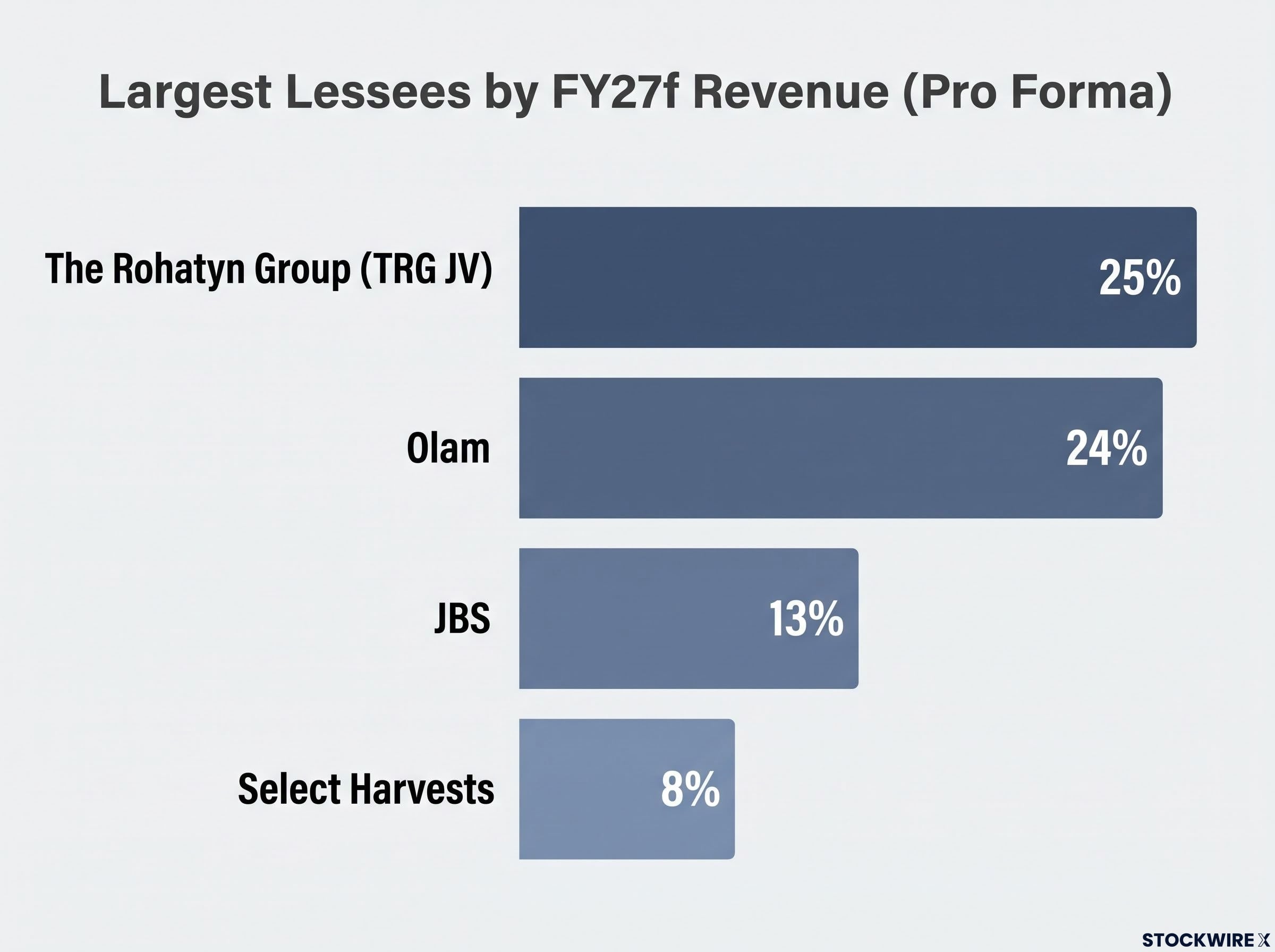
The largest lessees by FY27f revenue (pro forma) were The Rohatyn Group (TRG JV) at 25%, Olam at 24%, JBS at 13%, and Select Harvests at 8%. Independent valuations covered 60% ($1,169m) of the portfolio and were largely in line with book values.
The development pipeline includes staged macadamia developments at Rookwood Farms, with 401 ha forecast to be planted CY26. The Kaiuroo Aggregation “grow-on” cotton cropping developments are expected to contribute to AFFO in FY27 (Stage 2) and aim for AFFO generation in FY28 (Stage 3).
FY27 outlook and next steps
For FY27, RFF disclosed forecast AFFO of 11.7 cpu (unchanged) and distributions of 11.73 cpu, representing a 100% payout ratio and a forecast distribution yield of 5.4% (based on the $2.18 unit close price on 14 August 2026).
AFFO is forecast to hold flat despite several headwinds, including a lower macadamia price (revised from $4.25/kg to $3.80/kg), lower dryland wheat and chickpea yields, and additional tax (which will attract franking credits) arising from the AWF tax group.
FY27 strategic focus
Additional asset sales are planned during FY27 to provide additional balance sheet capacity for potential earnings-accretive acquisitions.
The presentation also pointed to the model’s longer-term track record, noting a NAV compound annual growth rate (CAGR) of 10.1% over FY14–FY26 and total distributions of $1.37 per unit since FY14. The FY26 result marked a return to stronger earnings following a softer FY25, when earnings per unit stood at 5.2c.
Don’t Miss the Next ASX REIT Announcement
Get FREE breaking ASX news delivered to your inbox within minutes of release, complete with in-depth analysis already done for you. Join 20,000+ active subscribers who stay ahead of the market the moment announcements drop. Click the “Free Alerts” button at Big News Blast to start receiving real-time coverage across ASX’s top sectors today.