
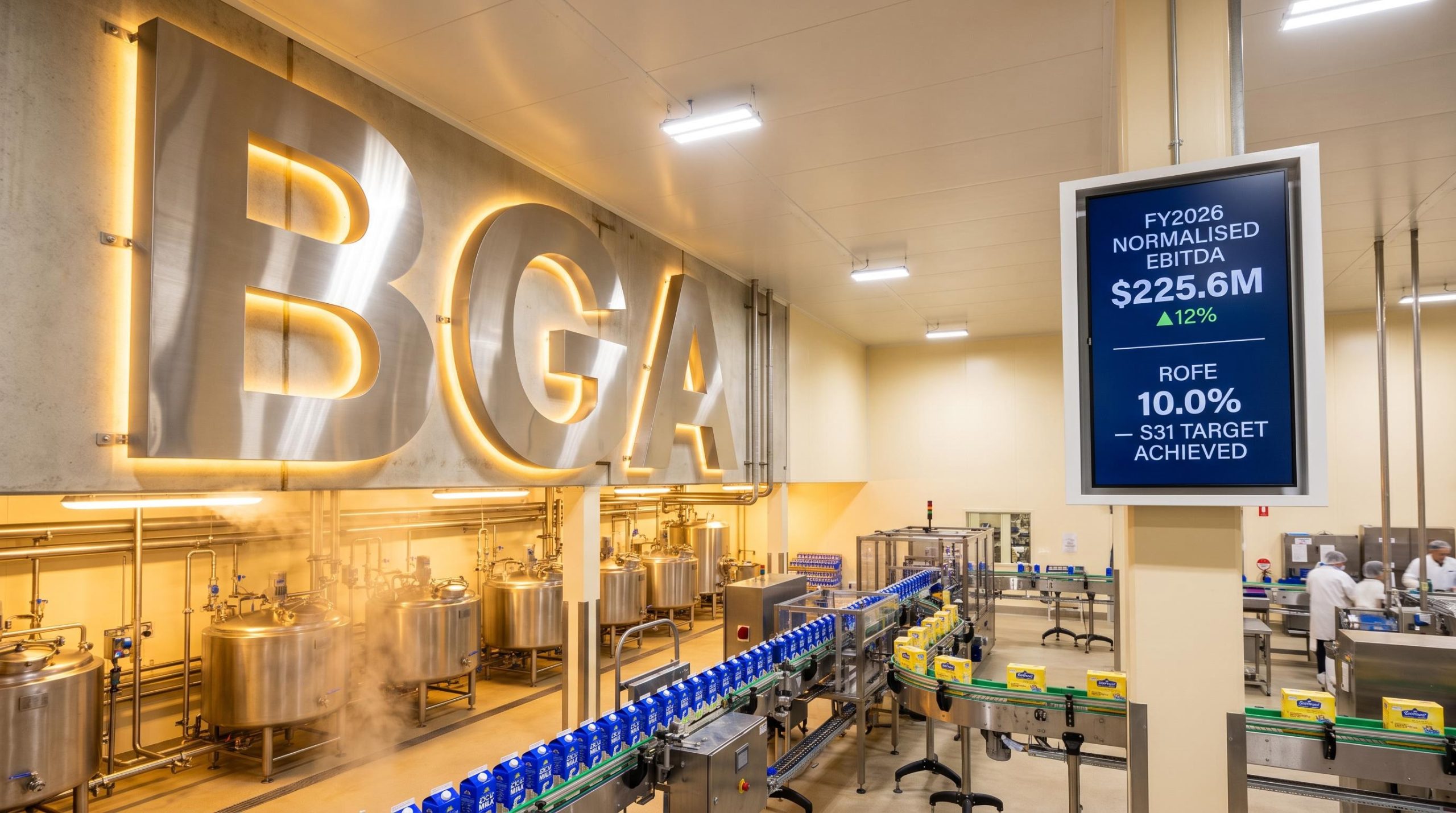
Bega delivers 12% EBITDA growth and hits ROFE target two years early in FY2026
In its FY2026 full-year results presentation delivered on 20 August 2026, Bega Group (ASX:BGA) reported normalised EBITDA of $225.6m, up 12%, while achieving its return on funds employed (ROFE) target of double digits two years ahead of schedule.
The result marks one of the strongest recent periods of progress for the 127-year-old branded food company, delivered against its refreshed S31 Strategic Plan.
Management reported net revenue of $3.8bn, up 6.7%, alongside normalised profit after tax (PAT) of $69.0m, a 36% increase. ROFE reached 10.0%, up 1.6 ppts, while the total dividend rose 21% to 14.5cps fully franked. Together, the figures point to disciplined execution, margin expansion and building shareholder-return momentum.
When big ASX news breaks, our subscribers know first
FY2026 results at a glance
Both normalised and statutory results improved strongly across the reporting period, with the scorecard below summarising the headline movements.
| Metric | FY2026 (Normalised) | FY2025 (Normalised) | Change |
|---|---|---|---|
| Net revenue | $3,774.6m | $3,539.0m | +6.7% |
| EBITDA | $225.6m | $202.0m | +12% |
| PAT | $69.0m | $50.8m | +36% |
| EPS | 22.6c | 16.6c | +36% |
| ROFE | 10.0% | 8.4% | +1.6 ppts |
| Dividend | 14.5cps | 12.0cps | +21% |
| Leverage | 0.8x | 0.8x | flat |
On a statutory basis, the company recorded PAT of $54.8m, a turnaround from the prior-year $(8.5)m loss. This represents a genuine return to statutory profit after the previous period’s result.
Pete Findlay, Chief Executive Officer
FY2026 was a strong year, with the Group on track to achieve its refreshed S31 Strategic Plan and ahead of the previous S28 Strategic Plan.
What drove the result: Branded and Bulk both firing
Both operating segments contributed to the improvement in group profitability, with Branded and Bulk each lifting their normalised EBITDA contribution.
Branded segment
The Branded segment recorded external revenue of $3,222.6m, up 5.7%, lifting its normalised EBITDA contribution by $15.5m. Key drivers included:
-
Double-digit International Branded revenue growth, particularly across Southeast Asia and the Middle East
-
Marketing investment up $9m behind power brands and innovation
-
Above-market foodservice growth with continued investment
-
A focus on high-protein and “better for you” innovation
Bulk segment
The Bulk segment reported external revenue of $552.0m, up 12.5%, adding $14.5m to its normalised EBITDA contribution. Bega grew its milk intake by 7%, increasing its share of the Australian milk pool.
Global “better for you” food trends continued to create robust demand for high-value nutritionals and bio-nutrients, including milk protein concentrate (MPC) and lactoferrin. Separately, integration of bulk ingredients into the Branded product range also increased during the period.
Understanding the numbers: what ROFE and normalised EBITDA tell investors
Two measures feature heavily in management’s messaging, and understanding them helps explain why the FY2026 result is significant.
Return on funds employed (ROFE) measures how efficiently a company generates earnings from the capital it has deployed. It is calculated as EBIT as a percentage of average funds employed. Reaching double-digit ROFE two years early signals improving capital discipline, as Bega is producing more profit from the assets it holds.
The difference between normalised and statutory results reflects one-off items. Normalised figures strip out costs that do not reflect underlying performance, in this case manufacturing footprint rationalisation and acquisition-related activities. The gap between statutory EBITDA of $202.3m and normalised EBITDA of $225.6m reflects adjustments of $21.3m for manufacturing footprint rationalisation and $2.0m for acquisition-related activities.
The leverage ratio of 0.8x represents net debt divided by normalised EBITDA. Holding this flat, despite high transformation cash costs during the period, indicates the balance sheet absorbed significant restructuring spend without additional strain.
Transformation and footprint simplification paying off
Management outlined a series of operational programs that reshaped the manufacturing and distribution network during the period:
-
The Strathmerton cheese site was consolidated into Ridge Street in the Bega Valley, completed in June 2026
-
The Kingaroy and Tolga peanut processing sites were sold in December 2025, with savings recognised earlier than expected
-
Laverton warehouse automation, the Group’s largest distribution centre, was commissioned in 2H FY2026
-
The Frenchs Forest property was sold and chilled distribution optimised
-
AI revenue management software and robotic process automation were rolled out
These programs carried a near-term cash cost. Operating cash flow was $129.3m, down $35.7m, reflecting $37.1m in cash redundancy payments to deliver the programs. Capital and intangible expenditure rose to $109.8m from $94.4m. Management framed this spend as investment expected to benefit FY2027 and beyond.
Portfolio strength: market-leading positions in growth categories
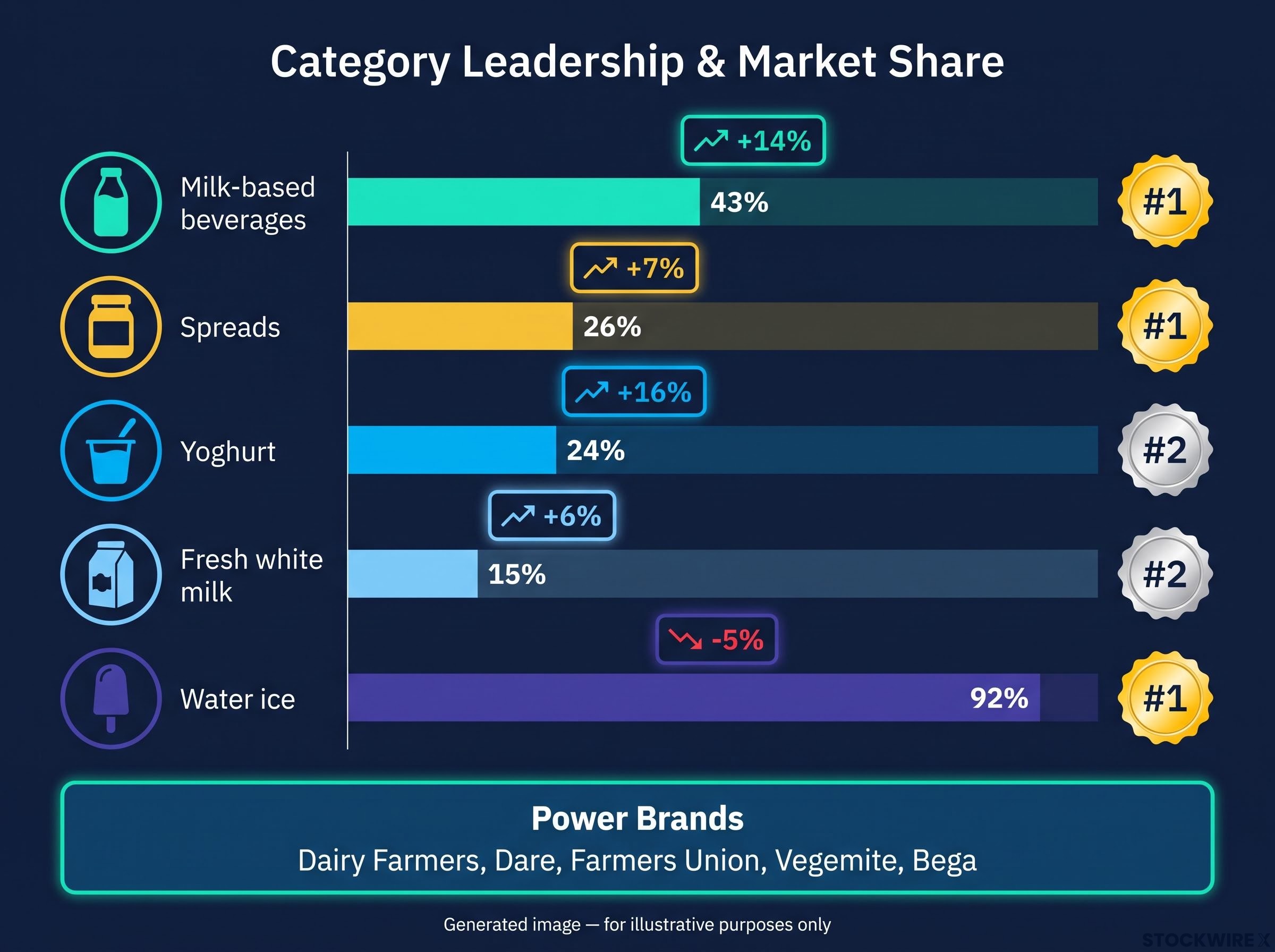
The presentation detailed Bega’s category leadership across several growth segments of the Australian grocery market.
| Category | Category growth | Bega’s share | Market position |
|---|---|---|---|
| Milk-based beverages | +14% | 43% | #1 |
| Spreads | +7% | 26% | #1 |
| Yoghurt | +16% | 24% | #2 |
| Fresh white milk | +6% | 15% | #2 |
| Water ice | −5% | 92% | #1 |
The portfolio is anchored by five power brands, Dairy Farmers, Dare, Farmers Union, Vegemite and Bega. Management highlighted an accelerating innovation pipeline focused on protein and functional nutrition, including protein yoghurt launches and expanded functional milk beverages.
FY2027 outlook and the S31 growth roadmap
Looking ahead, management provided guidance for the coming year and reaffirmed its medium-term targets under the S31 Strategic Plan.
For FY2027, the company guided to normalised EBITDA of $240–245m, with capital expenditure of approximately $110m focused on low-cost manufacturing and core category growth. Management noted expected benefits from the Strathmerton closure, Laverton automation (delivering from 1Q FY2027) and the earlier-than-expected peanut site savings. This guidance is subject to normal trading conditions.
The medium-term S31 targets, to be delivered by FY2031, were reaffirmed as follows:
-
Normalised EBITDA: $310m+
-
Revenue: $4.3–$4.7bn
-
EPS: 37–39 cps
-
ROFE: double digits
-
CO2 reduction: 40% by 2030
Taken together, the FY2027 guidance and S31 framework provide investors with a clear earnings trajectory and a multi-year set of targets against which to track the company’s progress.
Don’t Miss the Next Consumer Sector Winner
Big News Blast delivers FREE breaking ASX news straight to your inbox within minutes of release, complete with in-depth analysis. Join 20,000+ subscribers already staying ahead of the market on consumer sector stocks. Click the “Free Alerts” button at Big News Blast to get the next market-moving announcement the moment it drops.