Brent crude sits above $91 a barrel. The Strait of Hormuz, the passage through which roughly one fifth of globally traded crude normally flows, is running at about a third of its pre-crisis daily crossings on some days. And the Federal Reserve’s own July minutes, released on 19 August 2026, describe the Middle East conflict as having “materially complicated” the inflation outlook.
That convergence matters because this is not the kind of inflation pressure the Fed can cool with rate hikes. A contested chokepoint is a supply shock, and monetary policy has no direct tool to reopen a strait or neutralise a naval blockade. The mechanism sits outside the Fed’s reach, which makes the policy response slower, messier, and more uncertain than anything demand-side.
Here is the framework for judging whether the Hormuz standoff is background noise or a central variable in the rate path, and where it leaves your duration risk and rate expectations heading into the autumn.
Why the Strait of Hormuz is not just a geopolitical story
One fifth of globally traded crude and petroleum liquids normally transits the Strait of Hormuz. That single statistic makes it the most consequential energy chokepoint on the planet. What has happened there since early 2026 is no longer a theoretical risk.
The disruption has built in stages:
- Early 2026: The United States reimposed a naval blockade targeting vessels entering or exiting Iranian ports, deploying a large naval presence to enforce it.
- April 2026: Iran responded by fully closing the strait to traffic and firing on ships attempting to pass, explicitly threatening any vessel approaching the waterway.
- August 2026: Traffic has not stopped entirely, but daily crossings on some days fell to single digits, a drop of roughly one third from pre-crisis baseline flows.
War-risk insurance premiums for ships transiting the area have risen to several percent of hull value, up from fractions of a percent before the conflict.
The Hormuz shipping crisis illustrates a pattern that official declarations consistently obscure: commercial transit volumes, war-risk insurance rates, and maritime union classifications are tracking actual disruption severity more accurately than any diplomatic statement, and each of those physical market signals remains deeply distressed as of mid-August 2026.
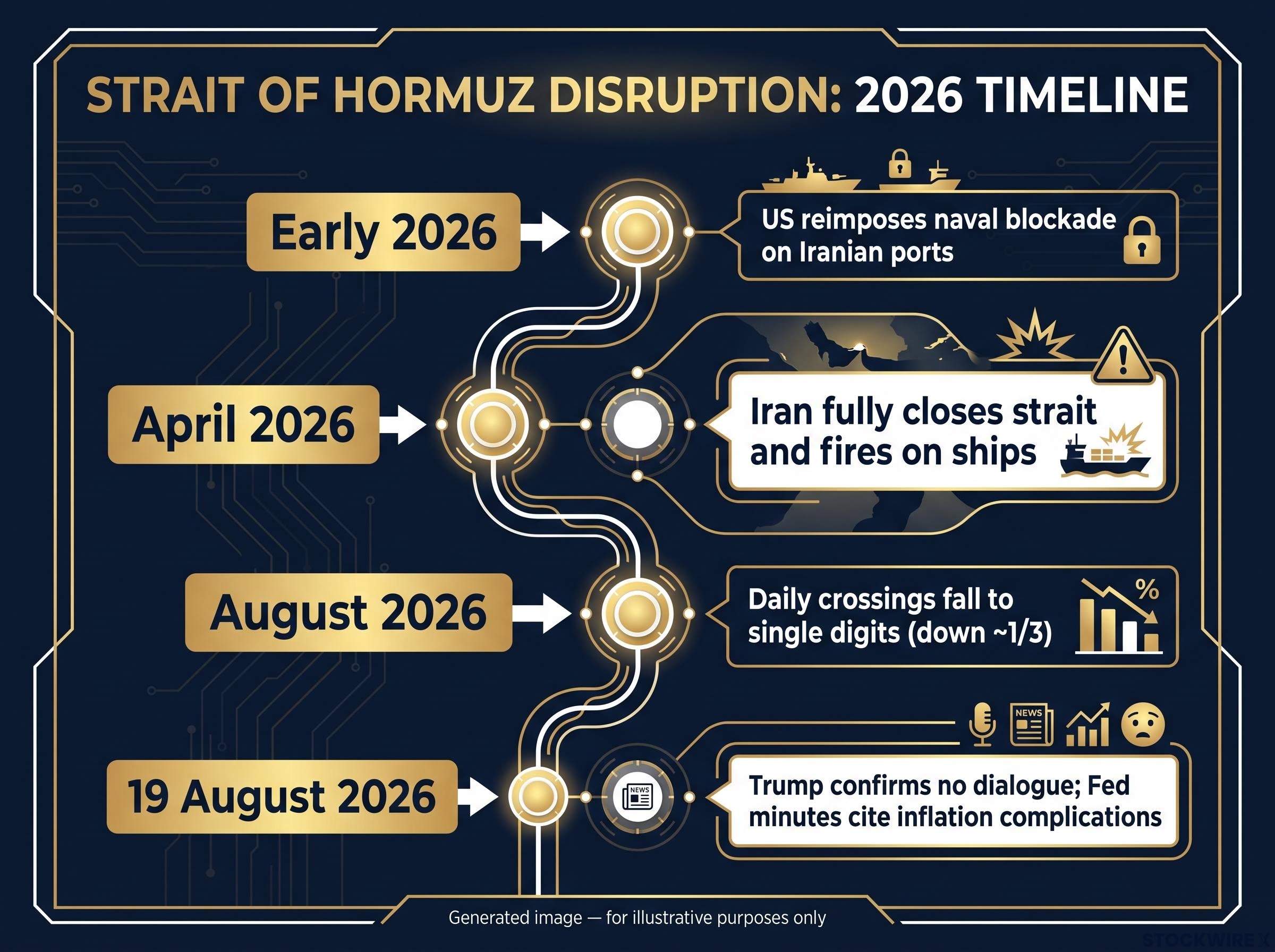
As of 19 August 2026, no negotiations are underway. On that date, Trump confirmed publicly that the United States was not engaged in any dialogue with Iran and had no plans to do so, a position Tehran corroborated through its own statements. Iran has outlined formal preconditions for any resumption of strait access, requiring the United States to end military operations across all active fronts and release assets frozen under sanctions. In a parallel development, Iran has been coordinating with Oman on an alternative governance arrangement for the waterway, prompting Trump to issue a warning that Oman could face military consequences if it moved to undermine American objectives in the region.
That combination, no diplomatic off-ramp, unmet preconditions, and the elimination of a traditional back-channel through Oman, means the assumption that this resolves itself soon carries real risk of being wrong. Persistence is a plausible base case, not a tail scenario.
When big ASX news breaks, our subscribers know first
How oil supply shocks behave differently inside a central bank’s framework
The distinction that shapes everything in the sections ahead is this: the Hormuz disruption is a supply shock, not a demand shock. That difference is not academic. It determines what the Fed can and cannot do.
| Characteristic | Supply shock | Demand shock |
|---|---|---|
| Fed tool effectiveness | Low: rate hikes cannot reopen a chokepoint | High: rate hikes cool spending directly |
| Transmission timeline | Headline CPI first, then core measures with a multi-month lag | Broad-based, relatively synchronous |
| Persistence risk | Depends on geopolitical resolution, outside Fed control | Fed can influence duration through policy |
A supply shock hits headline CPI (the Consumer Price Index, the broadest measure of price changes across the economy) immediately through direct energy costs. But the damage does not stop there.
The lag problem: why the Fed is already behind the data
Higher fuel costs feed into freight rates, manufacturing inputs, and ultimately the prices of goods and services that make up core inflation measures. That transmission typically takes months. By the time the Fed sees core data confirming the pass-through, the shock has already been running for a quarter or more.
This is why the Fed’s explicit data-dependency framing, tracking core inflation trajectory rather than headline alone, creates a structural timing problem. The current standoff’s mechanics (no negotiations, formal preconditions, intermittent closures since April) increase the probability that this is a persistent rather than transient shock. A brief spike can be looked through. A sustained elevation in the effective energy cost floor cannot.
What this tells you is that the Fed is not watching the oil price as a headline number. It is watching whether those prices are already moving freight, goods, and services costs, the channel that makes a supply shock genuinely dangerous for rate policy.
What the July minutes actually said, and what the three dissents mean
The Federal Reserve held the federal funds rate unchanged at its July 2026 meeting. That was the headline. The operationally significant signal was underneath it.
The June 2026 dot plot revision, which moved the Fed’s own year-end rate projection from 3.4% to 3.8%, was the earliest public signal that the committee’s internal posture had shifted from a completed cycle toward a conditional tightening bias, a shift the July minutes have since made explicit through dissent count and upside-risk language.
At the July meeting, the hold position was opposed by three regional Federal Reserve bank presidents, each of whom registered a formal dissent. Three dissents is not routine. It tells you the internal consensus for holding is fragile, and the bar for resuming hikes is lower than current market pricing may reflect.
The July minutes explicitly stated that renewed escalation of Middle East conflict had “materially complicated” the inflation outlook.
The minutes, released on 19 August 2026, revealed more than the dissent count:
- The majority of participants judged that inflation risks were tilted to the upside rather than balanced.
- Several participants cautioned that a lengthy continuation of the conflict risked deepening supply chain stress and keeping further upward pressure on prices.
- Committee members generally agreed that incoming information over the period between meetings would be valuable in reducing uncertainty around the inflation path.
The Fed’s current stance is better characterised as a pause at a restrictive level than a completed hiking cycle. Additional hikes remain explicitly on the table under the right data conditions. Three specific conditions would push the committee toward further action:
- Sustained high oil prices holding Brent at or above the low-90s for several months
- Visible spillovers into PPI (Producer Price Index, which measures wholesale price changes) and CPI beyond direct energy components
- A stall in core disinflation over multiple consecutive prints
The July minutes are the clearest public signal of how the Fed is internalising Hormuz risk. For investors, understanding the internal dissent structure and the specific language around Middle East risk is more actionable than watching the rate decision headline alone.
Three conditions that would push the Fed back toward hiking
The Fed’s July posture leaves three observable tripwire conditions. Each is something you can track without needing to interpret Fed guidance.
- Sustained Brent above the low-90s. Brent crude currently sits at approximately $91 per barrel, near the top of recent ranges. WTI trades at approximately $84 per barrel, with a weekly gain of roughly 3%. The current prices are driven by supply-side fear rather than demand, which matters because supply-driven elevation has a higher probability of passing through into broader costs. With no negotiations underway as of 19 August 2026, the probability that Brent remains elevated rather than correcting on diplomatic resolution is higher than markets may be pricing.
The geopolitical oil risk premium embedded in current Brent prices is not purely a function of supply volumes: the near-total withdrawal of commercial war-risk insurance has effectively closed the strait to standard commercial traffic even during periods when physical passage was technically possible, and the IEA projects a two-year supply chain recovery timeline under a best-case resolution.
- Energy costs bleeding into core data. The signal here is specific: shipping costs, input prices, and supply chain disruptions linked to the Middle East showing up in CPI and PPI beyond the direct energy components. This is the pass-through the Fed is watching most closely, and it is the lagging variable. If it appears in two or three consecutive prints, the argument for patience weakens considerably.
- Core disinflation stalling. If core inflation measures flatten or tick higher over several readings, the Fed’s earlier warnings about upside risks become operational rather than rhetorical. The July minutes already reflect this concern as active policy language, not hypothetical.
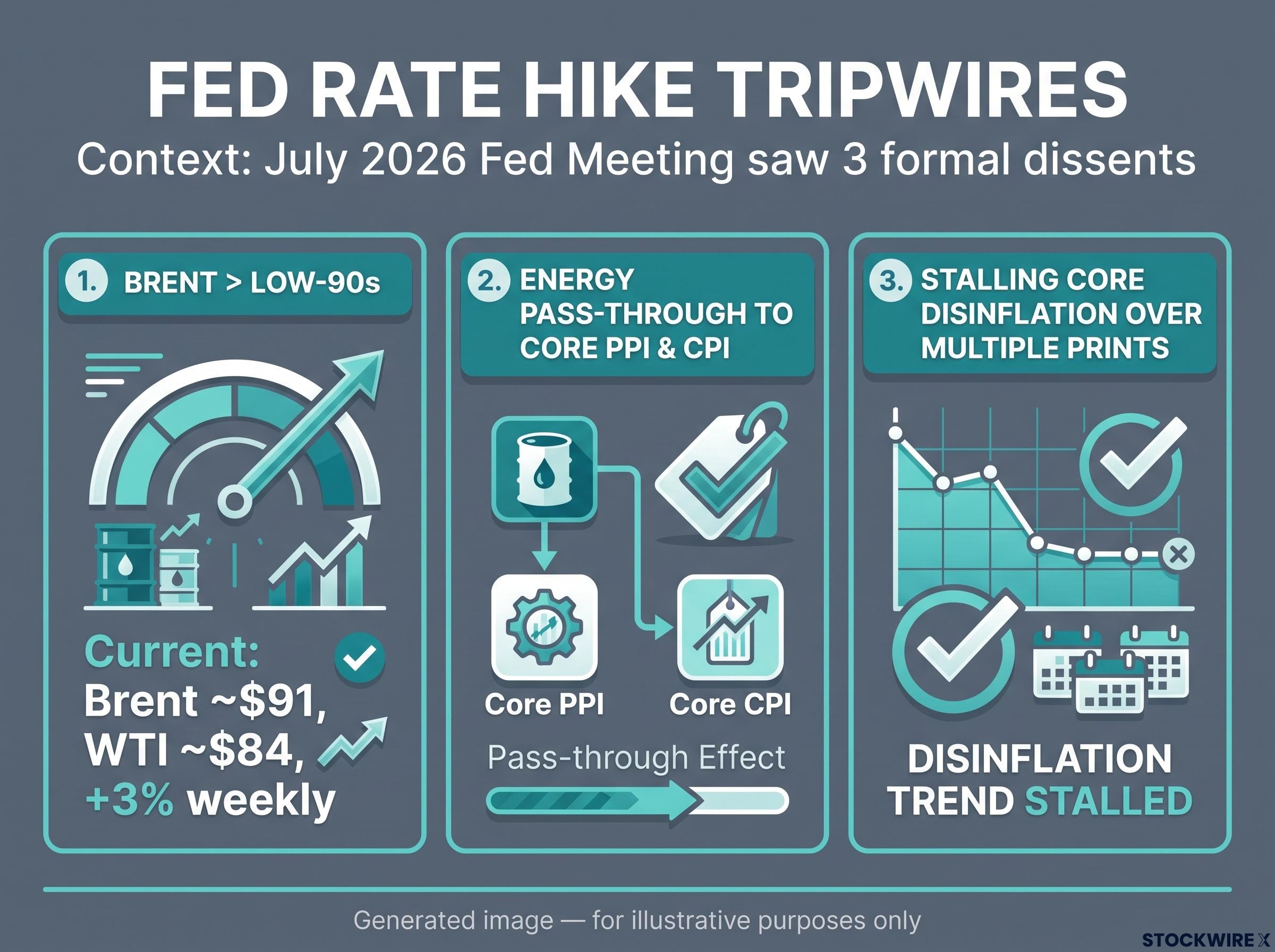
Two of these three conditions are already partially present. Brent is elevated, and the Fed’s July language explicitly flags upside inflation risk. The third, a visible inflection in core data, is the lagging variable that would complete the picture and make additional hikes or a significantly longer hold the default response.
How to position a portfolio when oil is the biggest rate variable
The base case for eventual de-escalation remains. But the risk case, a sustained Hormuz disruption forcing the Fed’s hand, now carries enough probability mass to be actionable. The July minutes confirm it is already part of the active policy conversation.
That asymmetry shapes three asset class considerations.
Energy exposure as a partial hedge. Integrated oil and gas producers, midstream companies, and commodity-linked assets tend to benefit from sustained supply-constraint-driven price elevation. This does not justify chasing oil indiscriminately, but it supports treating energy as a hedge against the specific risk of prolonged Hormuz disruptions.
Duration management in fixed income. Long-duration bonds are most vulnerable if the market has priced in cuts that do not materialise, or if an oil shock forces additional hikes. Three FOMC dissents at the July meeting signals real internal pressure toward further tightening. That is not a benign backdrop for long-duration exposure. Shorter-maturity instruments, T-bills, and laddered structures provide flexibility.
Rate-sensitive growth equities under scrutiny. High-multiple growth stocks and unprofitable tech names are particularly sensitive to discount rate assumptions (the rate used to calculate the present value of future earnings). A repricing of rate expectations, even without a formal hike, can compress valuations. The dissents and the upside inflation language make this repricing risk concrete rather than theoretical.
Four metrics are worth monitoring in the weeks ahead:
- Brent and WTI levels and term structure: direction and persistence matter more than any single day’s reading
- Freight and war-risk insurance premiums for Middle East routes: these move before oil price and CPI data confirm the supply impact
- Core CPI and PCE (Personal Consumption Expenditures, the Fed’s preferred inflation gauge) trends, with particular attention to energy-intensive components
- FOMC communications and dissent patterns: the July minutes already reflect material concern about Middle East escalation
These will tell you more about the Fed’s likely path than day-to-day political statements.
What the Hormuz standoff changes about the rate outlook, and what it does not
The Hormuz crisis has concretely shifted the rate calculus in three ways. It is now explicitly embedded in the Fed’s internal inflation deliberations, as confirmed by the July minutes. Brent is at the upper end of recent ranges, driven by supply fear rather than demand. And three dissents signal a fragile hold rather than a settled pause.
What has not changed: the base case for eventual de-escalation remains. Rate hikes are conditional on data, not automatic. The Fed’s next formal policy action depends on the core disinflation trajectory over the coming months.
| What has changed | What remains uncertain |
|---|---|
| Hormuz risk embedded in Fed’s active deliberations (July minutes) | Whether core data will confirm energy pass-through |
| Three FOMC dissents narrow the consensus for holding | Whether de-escalation or accommodation resolves the standoff |
| Brent elevated at ~$91, supply-fear-driven | Whether persistence lasts long enough to shift the Fed from pause to hike |
| Oman back-channel complicated by Trump’s military warning | How additional geopolitical actors affect the resolution pathway |
The Hormuz standoff has not made additional rate hikes inevitable. But it has made the conditions for avoiding them narrower. The next few core CPI and PCE prints, combined with Hormuz traffic and insurance cost data, are the variables that will determine whether the July minutes’ warnings become operational policy or remain precautionary language.
Geoeconomic fragmentation risk extends the Hormuz disruption beyond a single chokepoint: the broader pattern of regional bloc formation, industrial policy divergence, and supply chain restructuring means investors monitoring only Brent and FOMC minutes may be underweighting the structural repricing that persists even after individual conflicts de-escalate.
For your portfolio, that means monitoring the right variables matters more now than at any point in this cycle. Oil-driven inflation is no longer a peripheral risk. It is the central input the Fed itself says has materially complicated where rates go from here.
This article is for informational purposes only and should not be considered financial advice. Investors should conduct their own research and consult with financial professionals before making investment decisions. Past performance does not guarantee future results. Financial projections are subject to market conditions and various risk factors.