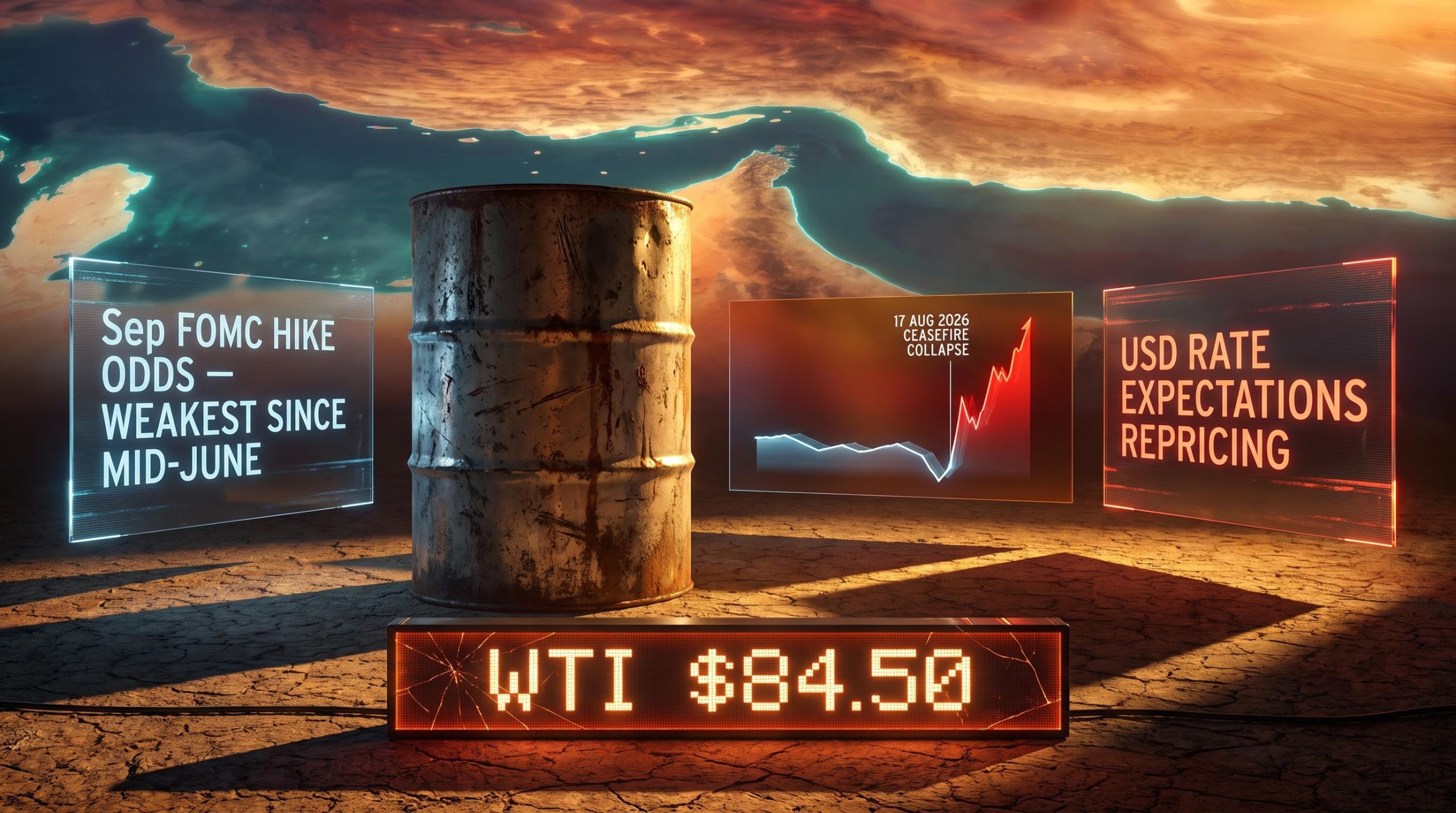
Pricing for a September Fed rate hike had retreated to its weakest position in roughly two months. The soft-data narrative was solidifying: a mild CPI print, a softer labour market report, and a September pause that looked increasingly comfortable. Then the ceasefire collapsed, WTI crossed $84.50, and the market’s clean dovish story stopped being clean.
The breakdown of the US-Iran ceasefire on 17 August 2026 has injected a supply-side oil shock into a monetary policy environment that had been drifting toward an uneventful September. The collision of a geopolitical risk premium with already-fragile inflation dynamics creates a direct tension inside the Fed’s dual mandate, and that tension is now the central variable for anyone positioning in USD or rates through year-end.
Here is how the oil shock transmits into inflation expectations, what the July FOMC minutes (due 19 August) reveal given this new backdrop, and which scenario variables will determine whether USD rate expectations reprice toward hawkishness or hold their dovish ground.
What just broke down, and why Hormuz is back in the Fed’s frame
The 60-day ceasefire under the Islamabad memorandum, agreed 17 June 2026, effectively expired on 17 August without progress on the issues that mattered. Three unresolved points sit at the centre of the breakdown:
- Control of the Strait of Hormuz and the naval posture around it
- Iran’s nuclear programme and verification conditions
- A definitional dispute over whether an extendable ceasefire ever existed at all
Tehran argues the memorandum concerned ending the war, not establishing a temporary truce, and that Washington violated it quickly. The ceasefire has not simply failed to be renewed; its very legitimacy is now contested by both sides.
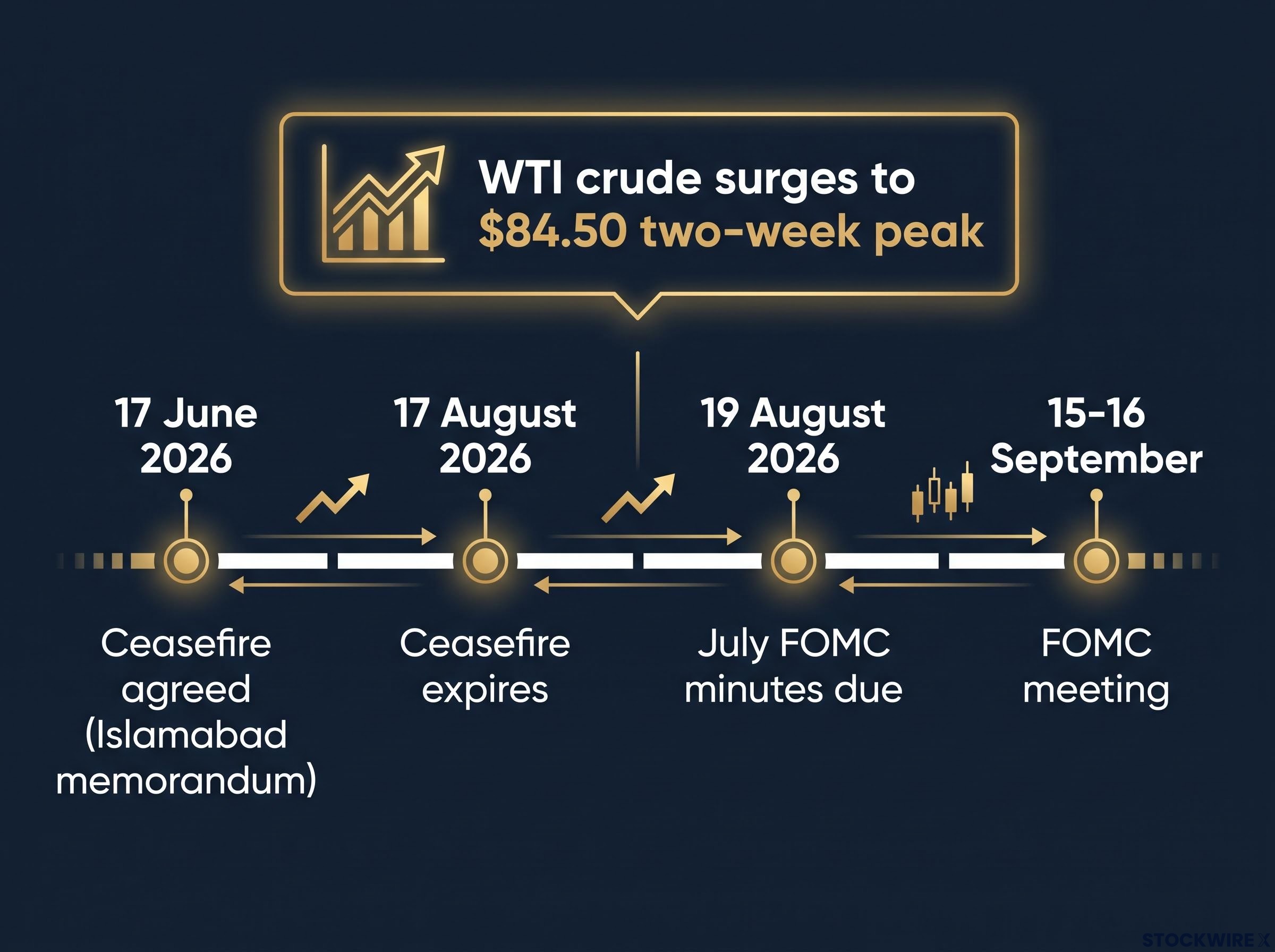
WTI crude surged to a new two-week peak at around $84.50 per barrel following the announcement, with price strength explicitly tied to heightened supply-disruption risk across Gulf shipping lanes and the Strait of Hormuz, a chokepoint that handles a significant share of global crude flows.
That contested legitimacy matters more than the event itself. When markets cannot model a resolution timeline, they price the risk premium as structural rather than transitory. For the Fed, a transitory supply shock can be looked through. A structural one cannot be ignored if it begins feeding into the variables the committee actually watches.
The Hormuz shipping data makes the contested legitimacy tangible: just 14 commercial vessels completed the crossing in a single 24-hour window this week against a pre-war baseline of 120-140, and war-risk insurance premiums are running at approximately 30 times normal rates, conditions that physical markets are treating as structural rather than transitory.
When big ASX news breaks, our subscribers know first
Three channels through which an oil shock in the $80s reaches core inflation
Not all inflation data carries the same weight in this environment. The oil shock reaches consumer prices through three distinct channels, and knowing which one the Fed is actually watching is the difference between reacting to noise and reading the signal.
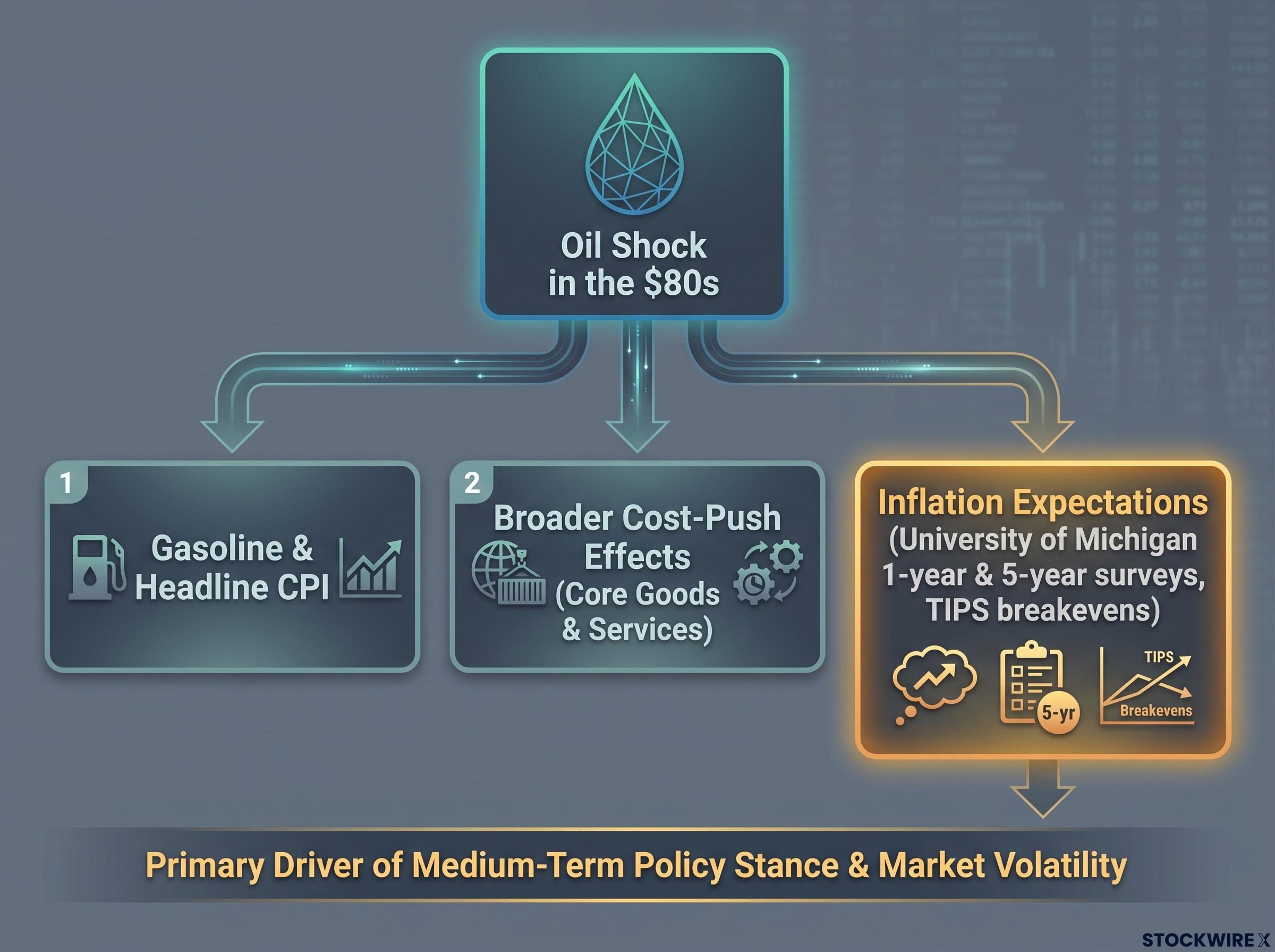
- Gasoline and headline CPI. Retail petrol prices respond to crude moves within weeks. A sustained mid-$80s oil price would push year-on-year headline inflation higher in upcoming prints, complicating a disinflation narrative built on recent mild CPI readings. The effect is fast, visible, and politically salient, but it is also the channel the Fed is most willing to look through.
- Broader cost-push effects. Higher fuel and freight costs bleed into goods and food prices over a longer lag, appearing in core goods and some services categories. The pass-through from oil to core inflation is historically muted, but it is not zero, particularly when firms retain pricing power carried over from prior inflation cycles.
Kansas City Fed research on oil shocks and expectations finds that since 2010, inflation expectations have reliably drifted upward following sustained oil price moves and returned to target only after monetary policy tightened in response, a historical pattern that frames precisely why the Fed cannot treat the Hormuz premium as automatically transitory.
- Inflation expectations. This is where the Fed’s attention sharpens.
Why expectations are the force multiplier
Oil itself can be looked through. Unanchored expectations cannot. If households and markets interpret the oil move as the beginning of another inflation cycle rather than temporary noise, survey-based measures, including the University of Michigan 1-year and 5-year inflation expectations surveys, and market-based TIPS breakevens (the gap between nominal Treasury yields and inflation-protected yields, which reflects what bond markets expect inflation to average) can move higher even before realised inflation confirms the move.
The Fed has emphasised repeatedly that persistent upward drifts in expectations, not one-off headline shocks, are what force a more hawkish policy stance. For investors positioning in USD and duration, the gasoline channel is noise. The expectations channel is signal. Whether UM surveys or breakevens begin to drift higher in the coming weeks is the variable that actually determines Fed behaviour.
The inflation expectations surveys the Fed watches most closely are already under pressure: the August 2026 Michigan Consumer Sentiment release arrived against a backdrop of WTI running more than 15% above early-July levels and CPI at 3.4% year-over-year, with consensus flagging re-acceleration of 1-year expectations above 4.5% as the single most market-sensitive data point in the release.
How the soft-data dovish consensus collides with a supply-side shock
Before the ceasefire collapsed, the September picture looked settled. Odds of a rate increase at the 15-16 September FOMC meeting had retreated to levels not seen since the middle of June, driven by a weaker-than-expected labour market report and a mild CPI reading. Traders had been scaling back hike bets for weeks.
According to HSBC Asset Management, if August inflation and jobs data continue to reflect subdued trends, the Fed is likely to keep rates unchanged at the September meeting.
Into that dovish backdrop, the oil shock introduces a stagflationary tension that the prevailing consensus had not priced. The Fed now faces two genuinely incompatible signals:
- Growth softness: Slower economic indicators and softer labour data argue for patience and a prolonged pause
- Supply-driven inflation risk: A geopolitical oil shock that monetary policy cannot fix directly, but which can trigger second-round effects in wages, expectations, and broader price-setting behaviour that the Fed would be compelled to address
The Fed cannot solve a supply shock with interest rates. But it can be forced to respond if that shock triggers the second-round effects that do fall within its remit. The September decision is no longer about data reads alone. It is about the committee’s judgment call on whether the expectations channel is activating, and that makes it a live event in a way it was not two weeks ago.
What the July FOMC minutes will (and will not) tell you on 19 August
The July FOMC minutes, due 19 August 2026, predate the oil shock entirely. They will reveal how divided officials were on tightening before the geopolitical variable entered, not how they would respond to it.
That makes the minutes a conditional blueprint rather than a fresh information set. Their meaning depends entirely on the oil context at the moment of reading. Historically, the Fed’s framework for determining whether to look through or react to an oil spike rests on three conditions:
- Price duration: Does the spike fade within two to three weeks, or does it persist?
- Headline re-acceleration: Do successive CPI prints begin trending higher?
- Expectations drift: Do survey and market-based measures of inflation expectations move upward in a way that looks persistent?
Two ways markets will read the same text
If the minutes show the committee coalescing around an extended pause, with policymakers stressing data-dependence and the transitory nature of supply shocks, the dovish base case survives even with higher oil. Markets can treat the ceasefire breakdown as background noise.
If the minutes contain hawkish minorities or detailed discussion of the circumstances under which further hikes would be warranted, those passages function as a conditional hawkish blueprint. Elevated oil prices can be seen as pushing reality toward the very thresholds policymakers named in July.
The FOMC vote split provides an advance indicator of internal committee alignment before the minutes arrive: the July 2026 nine-to-three hawkish split, with Cleveland, Minneapolis, and Dallas Fed presidents all preferring an immediate 25-basis-point hike, means the July minutes due 19 August are arriving into a pre-existing hawkish minority whose conditional thresholds an oil shock at $84.50 may now be testing.
The point is not to predict which reading prevails. The scenario divergence itself is the primary risk. The USD reaction to the minutes could be sharp in either direction, because the same text will be interpreted very differently against an $84.50 WTI backdrop versus the pre-shock context in which it was written. Read the minutes not for what they conclude, but for what conditions they name. Those conditions are now being tested by live data in real time.
USD scenario mapping for the weeks ahead
The near-term outlook for USD is not a single forecast. It is a widening of outcome distributions.
| Scenario | Key Trigger | USD Direction | Positioning Approach |
|---|---|---|---|
| Bullish USD | WTI sustained above mid-$80s; rising breakevens and UM expectations surveys | Stronger, particularly versus EUR and JPY (energy importers) | Long USD versus energy-importer currencies; duration underweight |
| Bearish USD | Fed communication emphasises patience and transitory framing; soft-data narrative regains dominance | Initial strength fades; lower-for-longer terminal rate narrative reasserts | Fade USD strength on dovish Fed signals; favour risk-asset and EM FX exposure |
| Base case (wider distributions) | No decisive resolution; data and Fed tone oscillate between dovish and hawkish reads | Elevated two-way volatility around data and Fed dates | Options-based hedging; relative-value over outright directional bets |
The base case is not a directional call. Scenario expansion, not a guaranteed hawkish or dovish regime shift, is the primary near-term risk. Options market implied volatility around key data releases and Fed dates is the instrument that prices this widening directly.
For investors, the actionable read is not which scenario is most likely. All three are live simultaneously. That means outright directional USD bets carry more tail risk than they did a week ago. Options-based or relative-value positioning, particularly via energy-referenced FX crosses, is more structurally appropriate for this environment. The OIS and fed funds futures curve, which had been pricing a short pause followed by cuts, is the measurable signal to watch for any shift toward an extended plateau.
Three variables that will determine whether the risk premium stays structural
These are not abstract watchlist items. They are the specific data triggers that will either force a material repricing of USD rate expectations or allow the soft-data consensus to reassert itself.
- WTI price persistence
- A spike that fades within two to three weeks falls into lookthrough territory for the Fed
- Sustained mid-$80s or higher feeds into successive headline CPI prints and changes the committee’s calculus
- Watch the $84-$86 range as the threshold between transitory and persistent
- Inflation expectations data
- University of Michigan 1-year and 5-year expectation surveys are the fastest-moving barometers
- TIPS breakevens provide the market-based complement to survey data
- An upward drift in the 5-year measure would be the single most hawkish signal for the Fed, because it indicates expectations are becoming unanchored, not just reacting to a headline
- Subsequent Fed communication
- Speeches and language following the 19 August minutes release will shape market interpretation of both the minutes and the incoming data
- Policymakers have the ability to reinforce the transitory framing or signal that conditions have shifted enough to warrant re-evaluation
- Tone is as important as substance; a shift from “patient” to “vigilant” language would be the clearest early warning
Investors who monitor these three variables have an early warning system for USD repricing rather than reacting to a fait accompli when the Fed’s tone shifts. The data will telegraph the policy pivot before it arrives.
What the Hormuz risk premium changes for the rest of 2026
The ceasefire’s collapse, and the fact that its very existence is now contested by both sides, means the Hormuz risk premium has graduated from an event risk with a near-term resolution path to a persistent backdrop variable. That is a structural shift in how investors should build USD and rates exposure through year-end.
The Hormuz risk premium has a documented tendency to outlast diplomatic signals: VLCC daily hire rates tracked approximately $110,000 per day during the May 2026 acute phase, a physical market signal that moved faster than crude futures and persisted well after early de-escalation rhetoric, and the IEA projects a two-year supply chain recovery timeline even under a best-case resolution.
The primary analytical frame is the geopolitical shock’s impact on inflation expectations and the Fed’s reaction function, not its direct growth effects alone. The oil move and Iran tension meaningfully complicate what had been a clean dovish story, but they do not yet force a hawkish pivot. That outcome depends on the persistence of elevated prices and the behaviour of expectations data over the coming weeks.
Three positioning principles flow from this structural analysis:
- Avoid overly one-sided USD or duration trades; this is a regime where scenario-hedging through options or balanced relative-value positions is more appropriate than outright directional bets
- Focus on relative FX trades that explicitly reference energy exposure, particularly USD versus EUR and JPY, while monitoring how the Fed narrative evolves across the minutes release and upcoming data
- Treat the oil-driven Iran risk premium as a structural input to USD rate expectations for the foreseeable future, not as a tail event that resolves quickly
The analytical work here does not expire after the September FOMC meeting. The Hormuz variable and its interaction with expectations data will remain the primary geopolitical input to USD rate expectations through year-end 2026. Position for the regime, not the event.
This article is for informational purposes only and should not be considered financial advice. Investors should conduct their own research and consult with financial professionals before making investment decisions. These statements are speculative and subject to change based on market developments and company performance.