
Japan has spent well over $215 billion since 2022 defending the yen. The interventions have been enormous, coordinated, and, by any historical standard, aggressive. And traders have treated every single one of them as a chance to sell the yen at a better price.
The latest round of coordinated U.S.-Japan action, which began on 30 July 2026, is not a localised Japanese policy story. It is a global fault line. The tension between a political mandate to defend a currency and the gravitational pull of wide interest rate differentials is playing out in real time, and the differentials are winning.
What this analysis gives you is a framework for understanding why sovereign currency defence fails when it is not backed by a genuine shift in underlying policy. Once you can distinguish a temporary intervention bounce from a structural recovery signal, you stop mistaking volatility smoothing for a trend reversal.
The data trail of a fading defence strategy
The 30 July intervention was substantial. Single-day actions have been estimated at $34 billion or more, part of a broader campaign that has now consumed well over $215 billion across operations in 2022, 2024, and 2026. The yen rallied on the day. Then it gave the gains back. The USD/JPY pair subsequently climbed back above the 159.00 level, surrendering all of the ground gained through official action.
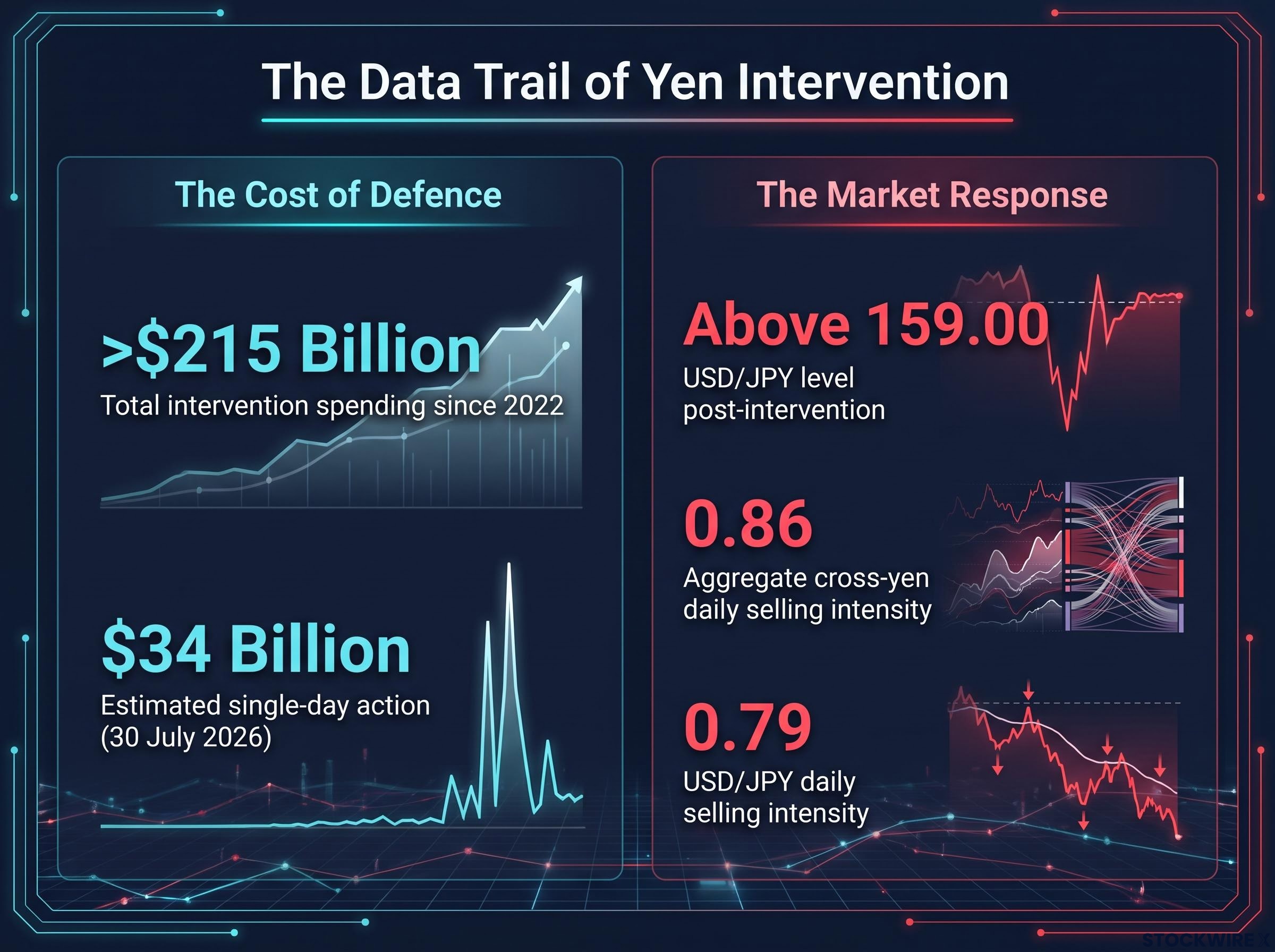
The flow data tell you exactly what happened next. BNY’s Geoff Yu, citing the firm’s proprietary iFlow data, showed that in the period beginning 30 July, the average daily magnitude of yen selling across all currency pairs came in at 0.86, while the figure for USD/JPY alone stood at 0.79. That gap matters. It means the selling was not limited to the dollar-yen pair; traders were dumping the yen against a broad basket of currencies, treating the intervention-driven bounce as a wholesale exit opportunity.
| Metric | Post-intervention value | Historical context | Market signal |
|---|---|---|---|
| Total intervention spending since 2022 | >$215 billion | Includes 2022, 2024, and 2026 operations | Diminishing impact per dollar spent |
| Aggregate cross-yen daily selling intensity | 0.86 | Broad-basket selling, not USD/JPY specific | Traders selling yen across all pairs on intervention rallies |
| USD/JPY daily selling intensity | 0.79 | Lower than aggregate cross-yen | Dollar-yen selling intense but not the sole driver |
| JPY positioning status | Underheld | First time since late 2024; highly volatile | Mechanical seller exhaustion, not bullish demand |
The positioning shift is where the nuance sits. According to iFlow data, institutional yen allocations have dropped below benchmark levels for the first time since the end of 2024, though current holdings remain highly volatile. That sounds like the selling might be done. It is not that simple.
When holders are already below benchmark, the most motivated sellers have largely acted. What remains is not renewed demand for the yen; it is a mechanical slowdown in the pace of outflows. The shift to underheld positioning tells you the easiest selling is behind the market, which means you should prepare for a slow, grinding depreciation or a fragile floor rather than a rapid collapse. That is a very different signal from a genuine recovery.
When big ASX news breaks, our subscribers know first
How sovereign currency defence actually breaks down
Foreign exchange intervention, where a central bank sells its dollar reserves to buy its own currency, is a tool for managing volatility, not for reversing trends. The distinction matters because confusing the two leads to costly misreadings of policy signals.
Unilateral intervention, where Japan acts alone, has a poor track record of sustaining currency strength when the underlying interest rate differential favours the other side. The current coordinated U.S.-Japan actions represent the most significant joint effort since 1998, which adds weight. But even coordinated action has limits.
The core problem is the yen carry trade. Investors borrow cheaply in yen, buy higher-yielding assets abroad, and pocket the rate differential. As long as Japanese rates remain substantially lower than U.S. rates, that trade remains attractive, and capital flows out of the yen regardless of how many billions the Ministry of Finance throws at the problem. Intervention scares markets momentarily but cannot suspend the mechanics of yield-seeking capital.
The yen carry trade has proven structurally resistant even to the BoJ’s most aggressive tightening in three decades, because a roughly 2.5-2.75 percentage point spread over U.S. rates still makes yen-funded positions cheap enough to sustain capital outflows at scale.
The BIS carry trade transmission research shows that leveraged carry positions amplify exchange rate moves in both directions, meaning intervention-driven bounces can accelerate the subsequent reversal as capital rushes back into the yield-favoured currency once the immediate shock subsides.
Sovereign currency intervention buys time and smooths volatility. It does not, and cannot, substitute for credible monetary tightening when rate differentials are wide and structural factors favour the higher-yielding currency.
You need to view these multi-billion-dollar coordinated actions as volatility smoothers meant to buy time, not as trend reversals that justify rotating back into yen-denominated assets.
The GDP trap constraining monetary normalisation
If intervention alone cannot fix the yen, the obvious question is why the Bank of Japan (BoJ) does not simply raise interest rates to close the differential. The answer is that the domestic economy cannot currently absorb it.
Japan’s real GDP grew at approximately 1.1% annualised in Q2 2026, down from a revised 1.9% in Q1 2026. That is a decelerating economy, not one that invites aggressive tightening. The BoJ is caught in a political trap where the currency needs higher rates but the economy does not.
This is the credibility gap the market is pricing. Even when BoJ officials signal that rate increases remain “on the table,” markets assign a low probability to sustained tightening because the growth data contradicts the rhetoric. BNY’s Geoff Yu has noted that market participants remain broadly sceptical that Japanese authorities can successfully defend the yen, and the GDP trajectory is a primary reason.
The 31 July BoJ rate decision added a diplomatic layer to Japan’s policy calculus: the U.S. Treasury had already conducted a formal rate check on the yen, and Secretary Bessent publicly labelled it substantially undervalued, meaning the BoJ board was navigating both domestic growth constraints and bilateral political pressure simultaneously.
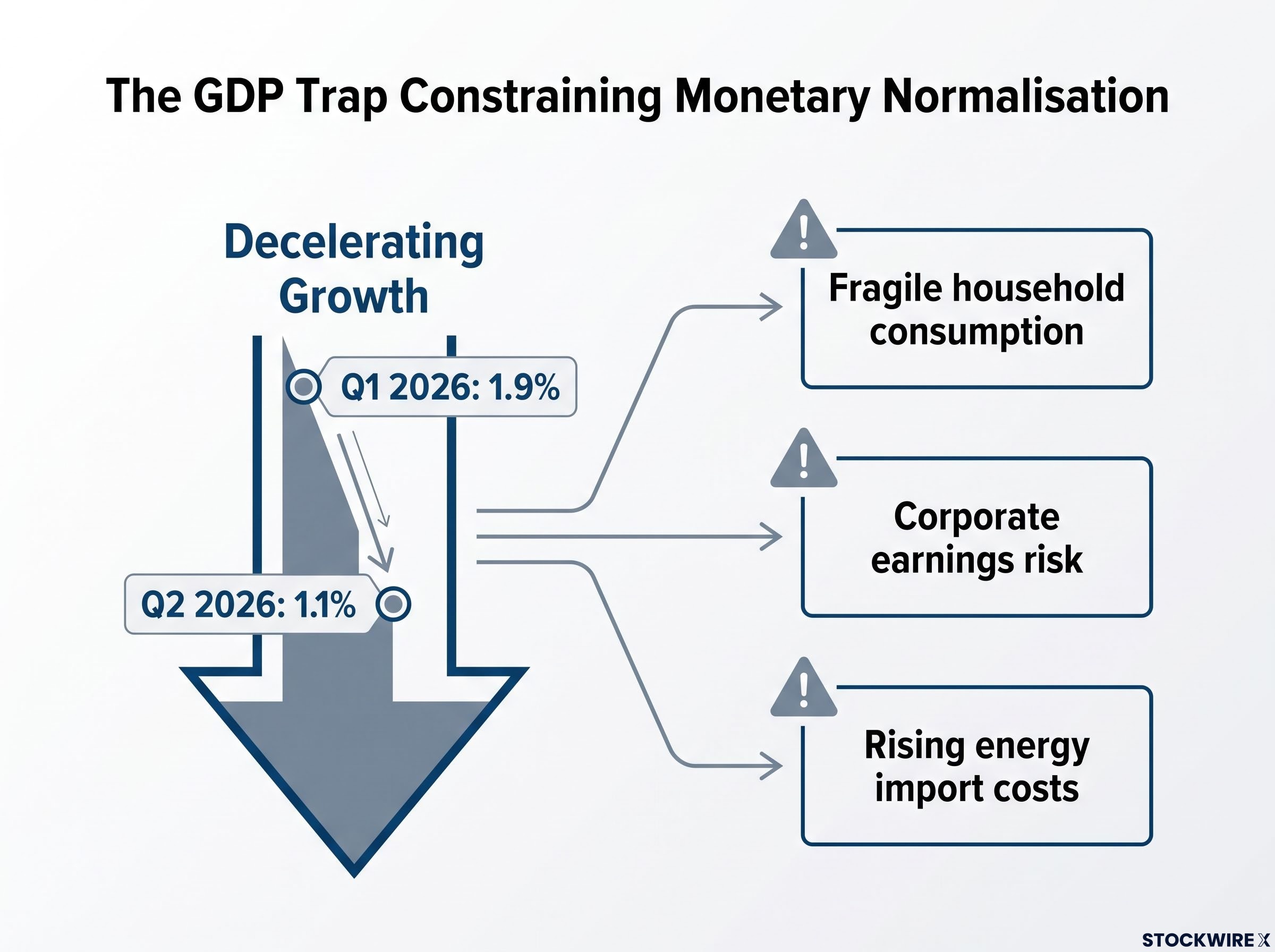
The specific trade-offs preventing meaningful rate hikes include:
- Fragile household consumption that would contract further under tighter monetary conditions
- Corporate earnings risk from a stronger yen reducing the value of overseas revenue when repatriated
- Rising energy import costs that already squeeze real incomes, a burden that higher borrowing costs would compound
This fragile domestic growth data reveals that the BoJ cannot currently afford to bail out the currency with aggressive rate hikes. That leaves your yen exposures highly vulnerable to broader global rate shifts, particularly anything that widens the U.S.-Japan differential further.
The bond market alarm and the policy doom loop
The currency story is concerning. The bond market story is where the systemic risk lives.
The spread between 10-year and 2-year Japanese Government Bond (JGB) yields, a measure of how much more investors demand for lending to the government over a longer period, has widened to approximately 143 basis points. That is the widest since 2004. A spread this wide signals that long-term investors are pricing in rising inflation expectations and growing doubt about the sustainability of Japan’s fiscal path.
JGB yield dynamics carry consequences well beyond Japan’s domestic fiscal position: as the narrowing U.S.-Japan rate differential erodes carry trade profitability, Japanese institutional investors including the near-2 trillion dollar GPIF face a credible domestic alternative, removing a historically stable long-duration buyer from U.S., European, and Australian sovereign bond markets.
This is the “policy doom loop” that Reuters and other observers have identified. Japan carries an enormous public debt load. Loose fiscal policy and cautious monetary normalisation have made JGBs particularly vulnerable to repricing. If long-term yields rise too sharply, debt-servicing costs escalate, which worsens the fiscal position, which further undermines confidence in the currency. The loop feeds itself.
Navigating the purchase taper
The BoJ currently purchases approximately ¥2.3-2.5 trillion of JGBs per month, tapering toward a target of roughly ¥2 trillion. Those purchases are what keeps long-term yields from blowing out entirely. BoJ meeting minutes show a split board, with some members warning that continuing to reduce bond purchases at the current pace could have “unforeseen” consequences for market stability.
That split tells you how sensitive the system has become. If the BoJ allows yields to rise meaningfully to support the yen, it risks destabilising the bond market and driving up debt-servicing costs. If it leans back into capping yields through continued purchases, it signals ongoing accommodation and undercuts the one channel that could credibly support the currency.
The widening yield spread is a direct distress signal. You should monitor this metric closely because systemic bond market stress will always force policymakers to abandon currency defence in favour of debt stability. The yen comes second when sovereign solvency is at stake.
Recognising the triggers for a genuine regime shift
Temporary interventions will continue to fail until the underlying structural conditions change. The pattern of intervention, brief rally, and renewed selling is not a cycle that will break on its own.
Carry trade unwind risk extends into global equity markets through a mechanical cascade: Bank of America’s CTA trigger mapping estimates that a roughly 3% S&P 500 decline could unleash approximately $100 billion in programmatic selling by trend-following funds, a transmission channel that connects yen volatility to cross-asset positioning far beyond Japan.
For the yen to move from fragile stabilisation to genuine recovery, markets need to see at least one of the following conditions materialise:
- Credible tightening evidence: Clear signals that the BoJ can and will raise rates despite soft growth, sustained enough that markets do not immediately discount them
- Macro backdrop improvement: Stronger domestic growth that gives the BoJ political and economic cover to tighten without triggering a consumption or corporate earnings shock
- JGB market stability: Reduced fiscal concerns and lower bond-market volatility that would allow monetary normalisation without destabilising debt-servicing costs
- Narrowing rate differentials: Either through U.S. rate cuts, Japanese rate hikes, or both, closing the gap that sustains the carry trade
Until at least one of those conditions is met, the structural bias against the yen remains intact. The intervention programme functions as a holding action. It smooths the descent; it does not reverse it.
This article is for informational purposes only and should not be considered financial advice. Investors should conduct their own research and consult with financial professionals before making investment decisions. Forward-looking statements regarding monetary policy, interest rate paths, and currency trajectories are speculative and subject to change based on market developments and policy decisions.