UK inflation is about to jump to 2.9%, and an energy bill increase is doing most of the heavy lifting. The Office for National Statistics (ONS) publishes its July Consumer Price Index (CPI) data on 19 August 2026, and the headline number will look uncomfortable.
Here is the paradox. The same data release that shows headline CPI accelerating from 2.6% to 2.9% is also expected to show core and services inflation continuing to fall. That split matters, because the Bank of England (BoE) watches the underlying measures, not the headline figure, when deciding whether to raise interest rates.
So the question every mortgage holder, saver, and household budget planner is already asking: does this inflation number push the BoE to hike rates again, and what does that mean for your finances? Here is what the data actually tells you, what it does not, and how to read the week ahead.
Why your energy bill is driving the inflation headline this July
In July 2026, the UK household energy price cap was lifted by 13%, a single administered price change that feeds directly into the ONS CPI basket, producing a mechanical upward shift in the headline number. The jump from 2.6% in June to a forecast of 2.9% (some consensus estimates reach 3.0%) is largely this energy effect working through the statistics.
The distinction matters. A regulated price cap adjustment is a government decision, not a market signal that demand is overheating. The BoE made this explicit in its own forward guidance.
The MPC monetary policy summary and minutes from the July 2026 meeting record the Committee’s explicit assessment that the anticipated energy-driven pickup in headline inflation does not represent a deterioration in the medium-term inflation outlook, providing the formal basis for the hold decision.
The Bank of England has acknowledged that inflation is likely to pick up again later in 2026 as higher energy prices pass through into the headline index, meaning the anticipated rise is not a surprise to the MPC.
Because this spike originates from a regulated price decision rather than consumer demand, it does not automatically signal that the economy is running hot or that rate rises are coming.
- June 2026 CPI: 2.6% (confirmed ONS figure)
- July 2026 CPI forecast: 2.9% (some estimates at 3.0%)
- Energy price cap increase: 13%, effective July 2026
- ONS CPI release date: 19 August 2026
You already received your higher energy bill in July. This section explains why that experience is now showing up in the official statistics, and what it does and does not tell you about broader price pressures.
When big ASX news breaks, our subscribers know first
The number beneath the headline: core and services inflation are falling
Strip out energy, food, alcohol, and tobacco, and the picture reverses. Core CPI is forecast to fall to 2.5% in July from 2.6% in June. Services inflation, the measure the BoE watches most closely as its preferred gauge of domestically generated price pressure, is expected to ease a further 0.2 percentage points to approximately 3.4%.
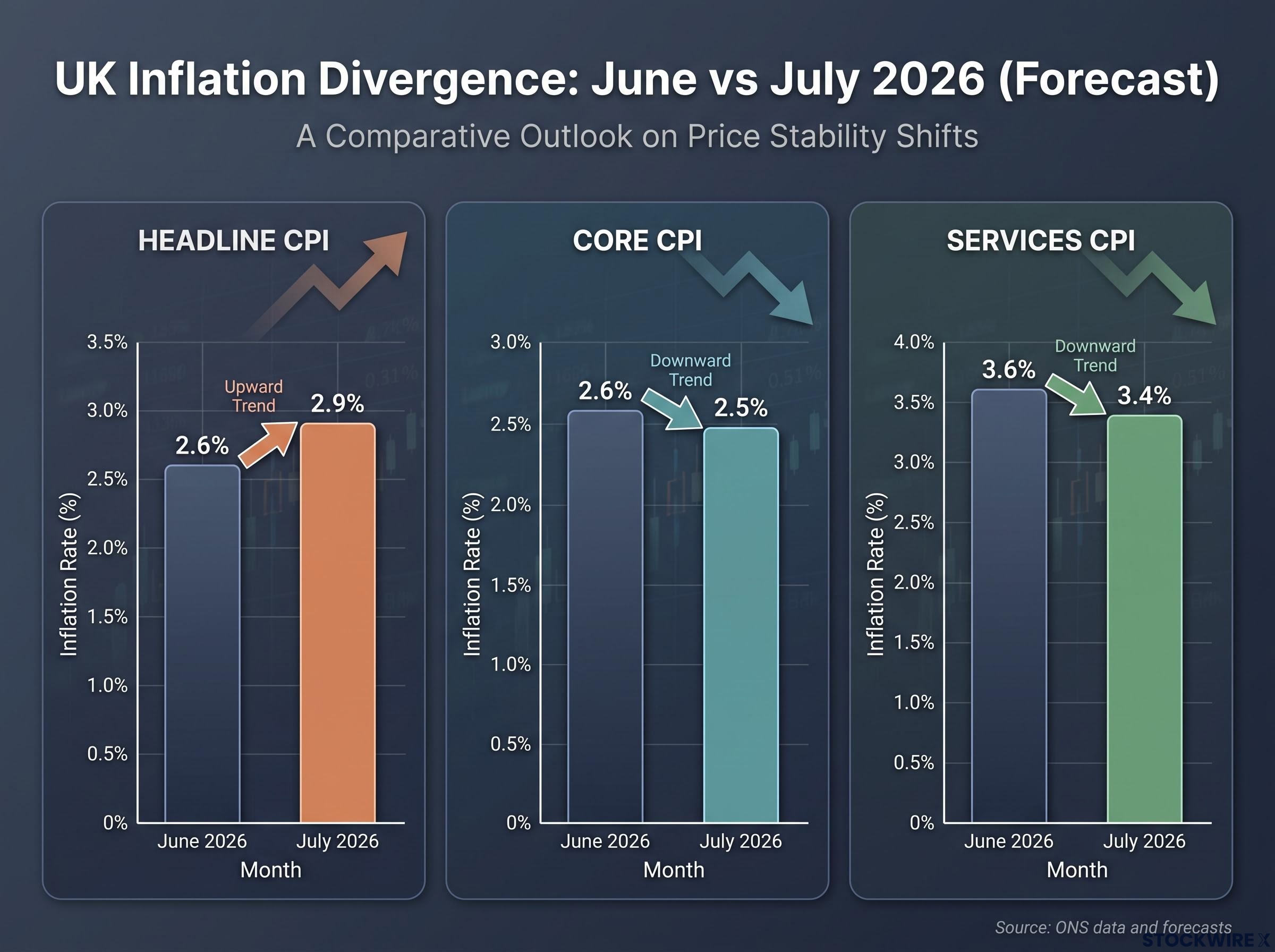
Headline CPI rising while core and services CPI fall in the same month is an unusual and analytically important combination. It tells you the price pressures that actually influence whether rates rise or fall are heading in the right direction, even as the number on the front page moves uncomfortably upward.
The same core-versus-headline split visible in UK data has appeared in the US, where the US core inflation trajectory showed annual core CPI falling to 2.6% in June 2026, reinforcing that domestically generated price pressure is easing across developed economies even as energy-driven headline figures move in the opposite direction.
| Measure | June 2026 (actual) | July 2026 (forecast) |
|---|---|---|
| Headline CPI | 2.6% | 2.9% |
| Core CPI | 2.6% | 2.5% |
| Services CPI | 3.6% | 3.4% |
If you hold a mortgage, savings account, or investments sensitive to rate decisions, this is the table that matters more than the headline. The BoE has consistently signalled that it monitors underlying inflation measures more closely than volatile headline figures when making rate decisions.
What the jobs market tells us about where inflation goes next
The labour market data lands on 18 August 2026, one day before the CPI release, and the sequence is deliberate. Wages are the channel through which energy shocks become embedded in broader inflation. If pay growth is accelerating, the BoE worries. If it is cooling, the energy spike is more likely to pass through without triggering a self-reinforcing cycle.
Wages are moderating
Earnings growth is forecast to ease to 4.0% from 4.3%, and ex-bonus earnings growth to 2.8% from 2.9%. That is the wage channel cooling, not re-igniting.
- Earnings growth forecast (July data): 4.0%, down from 4.3%
- Ex-bonus earnings growth forecast: 2.8%, down from 2.9%
- Unemployment rate forecast: 4.7%, down from a 2026 high of 5.2%
- Job vacancies: sit beneath pre-pandemic levels, pointing to continuing slack in the market
- Data release date: 18 August 2026
It should be noted that the official UK unemployment figures have been subject to known methodological and sampling difficulties, which means the headline rate should be interpreted with some caution. But the direction across multiple indicators, moderating pay, lower vacancies, residual slack, points the same way.
For workers and households, the earnings forecast is directly relevant to your real income outlook. For anyone watching the rate path, labour market softness reduces the urgency for further hikes. The wage-price spiral that would genuinely alarm the Monetary Policy Committee (MPC) and force its hand on rates is not materialising in the current data.
Where the Bank of England stands, and why it is unlikely to move yet
The BoE’s most probable response to this data is to hold. At its late-July 2026 meeting, the MPC voted 6-3 to keep Bank Rate at 3.75%, with a minority of three members favouring an increase to 4.0%.
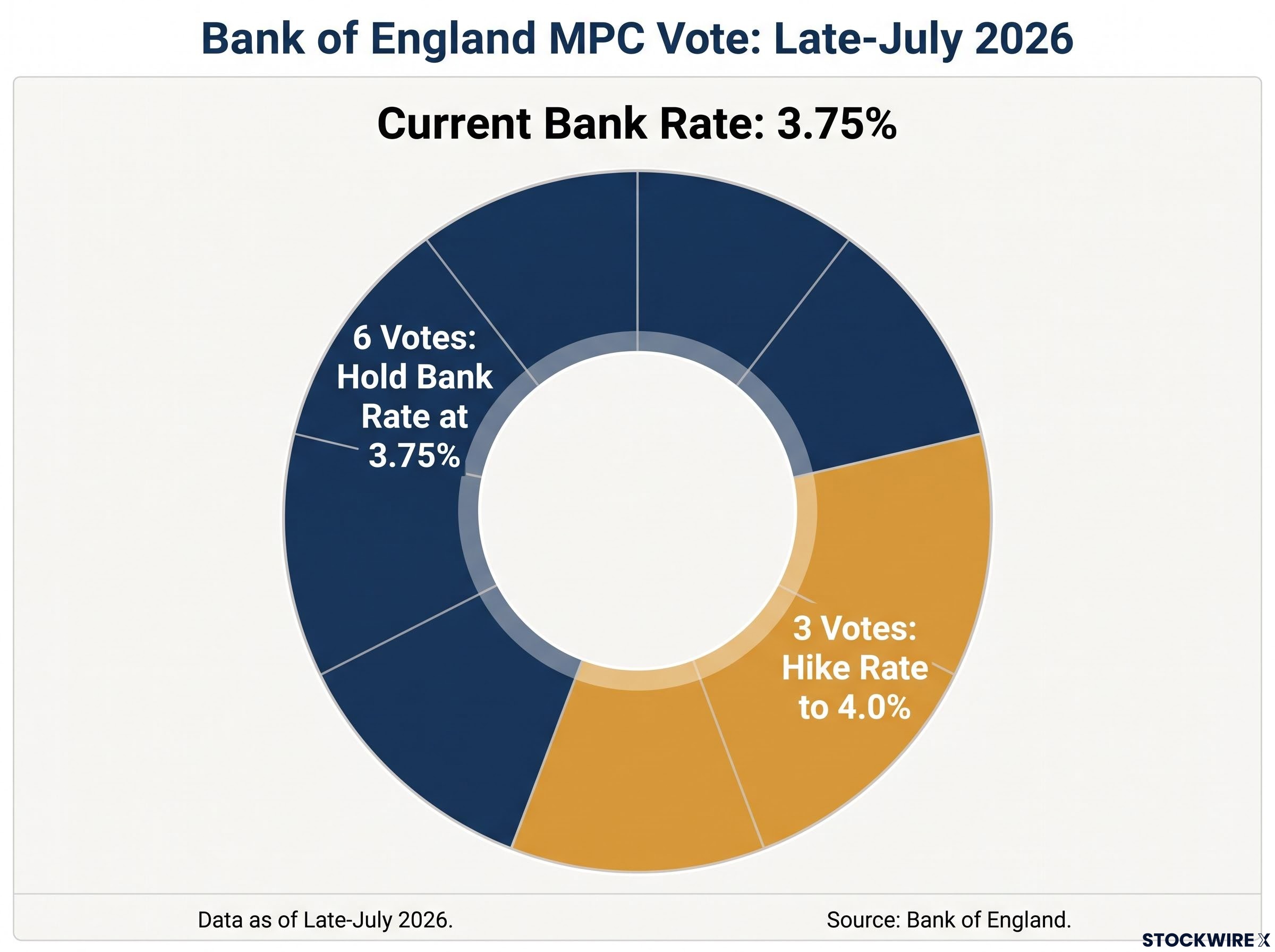
- Bank Rate: 3.75% (held at late-July 2026 meeting)
- MPC vote: 6-3 to hold (three members favoured a hike to 4.0%)
- Broader inflation so far shows little indication of second-round effects taking hold from elevated energy costs
The majority’s logic runs through the BoE’s own framework. The Committee distinguishes between energy-driven headline spikes and domestically generated inflation. An energy-driven move to approximately 2.9% headline CPI, accompanied by easing core and services readings, is precisely the pattern in which holding is the appropriate response.
The three dissenters are worth noting. Their vote signals the Committee is not complacent, and the “hold and watch” position is not unanimous.
The MPC has stated it will act if medium-term inflation risks increase materially, framing its current stance as conditional rather than fixed.
For you, the 6-3 split means the debate is live but the baseline is clear: rates stay on hold unless the underlying data deteriorates. If you are on a variable or tracker mortgage rate, or facing a rate-sensitive financial decision in the second half of 2026, the conditions that would need to change before the MPC moves again are specific and identifiable.
The risk that changes the calculus: Middle East tensions and energy prices
The settled baseline above rests on one condition: the energy shock remains contained. The specific external trigger most likely to unravel it is a sustained surge in global energy prices driven by escalating Middle East geopolitical tensions.
The BoE has explicitly flagged this scenario as the primary upside risk to both UK inflation and the interest rate outlook. The UK is a net energy importer. A renewed and sustained price surge would hit both households and businesses, raising the risk of second-round wage and price effects that the current data does not yet show.
The Hormuz oil risk premium is a structural rather than transient feature of current energy markets, with analysts at multiple institutions describing a two-year supply chain recovery timeline even under a best-case resolution, which is precisely the scenario the MPC’s ‘hold with upside risk’ framing is designed to accommodate.
What would shift the MPC from “hold” to “hike”
- A sustained surge in global energy prices driven by Middle East escalation
- Evidence of second-round wage and price effects feeding through into domestic pricing behaviour
- A material deterioration in medium-term inflation expectations
The risk distribution is asymmetric. Rates are unlikely to fall materially from 3.75% in the near term, but the upside risk of further hikes remains alive and geopolitically contingent. August Purchasing Managers’ Index (PMI) readings, due the week of 18-21 August, will be watched closely for any indication that businesses are beginning to push higher input costs through to their customers.
For anyone making longer-term financial decisions, whether fixing a mortgage rate or assessing UK equity exposure, the “hold” baseline is not a guarantee. It is a conditional forecast, and the condition is worth monitoring actively.
What the data this week will actually confirm or challenge
The week of 17-21 August 2026 delivers a concentrated sequence of releases, and the order matters. Labour market data on 18 August sets the wage context before the CPI release on 19 August. Retail sales and PMIs later in the week provide demand-side confirmation.
The concentrated release sequence this week mirrors a pattern seen in May 2026, when data sequencing across central bank decisions demonstrated how a single week of coordinated prints, CPI, wages, PMIs, and FOMC minutes releasing within days of each other, can compress months of rate expectation repricing into a few trading sessions.
| Date | Release | Forecast | What to watch for |
|---|---|---|---|
| 18 August | UK Labour Market Statistics | Earnings 4.0%; unemployment 4.7% | Earnings above forecast would add hawkish pressure before CPI |
| 19 August | ONS CPI (July 2026) | Headline 2.9%; core 2.5%; services 3.4% | Core or services failing to ease would be the hawkish surprise |
| 21 August | UK Retail Sales | -0.5% month-on-month | Heatwave may weigh on figures; World Cup conclusion a partial offset |
| 18-21 August | August PMI readings | n/a | Whether firms are raising prices to their customers to cover higher input costs |
A “reassuring” set of readings looks like this: earnings moderating as forecast, core and services CPI easing, retail sales soft but not collapsing, PMIs showing limited pass-through. A “hawkish surprise” looks like this: earnings coming in above forecast, core or services CPI failing to ease, and PMIs showing aggressive cost pass-through to consumers. You do not need to follow every release, but you should know which outcome from each would matter and why.
What the inflation print means for your finances, and what it does not
Headline CPI at 2.9% is uncomfortable but expected, driven by an energy mechanism the BoE has already discounted in its policy framework. The readings that actually matter for rates, core and services inflation and wage growth, are all easing.
If you are on a variable or tracker mortgage rate, the baseline scenario does not point to an imminent rate hike. If you are on a fixed rate approaching renewal, factor in that rates are likely to stay around current levels unless the geopolitical situation deteriorates materially.
The “hold” baseline is the most probable path, but it is conditional. It depends on the energy shock remaining contained and not generating the second-round effects the MPC is watching for. This week’s full data set will either reinforce or complicate that picture.
For readers wanting to act on the conditional hold baseline and position their portfolios for the range of possible MPC outcomes in the second half of 2026, our dedicated guide to investing during rate hikes covers portfolio rebalancing strategies, sector rotation, and how to assess pricing power across equity holdings in a capital-constrained environment.
This article is for informational purposes only and should not be considered financial advice. Investors should conduct their own research and consult with financial professionals before making investment decisions.
These statements are speculative and subject to change based on market developments and company performance. Past performance does not guarantee future results.