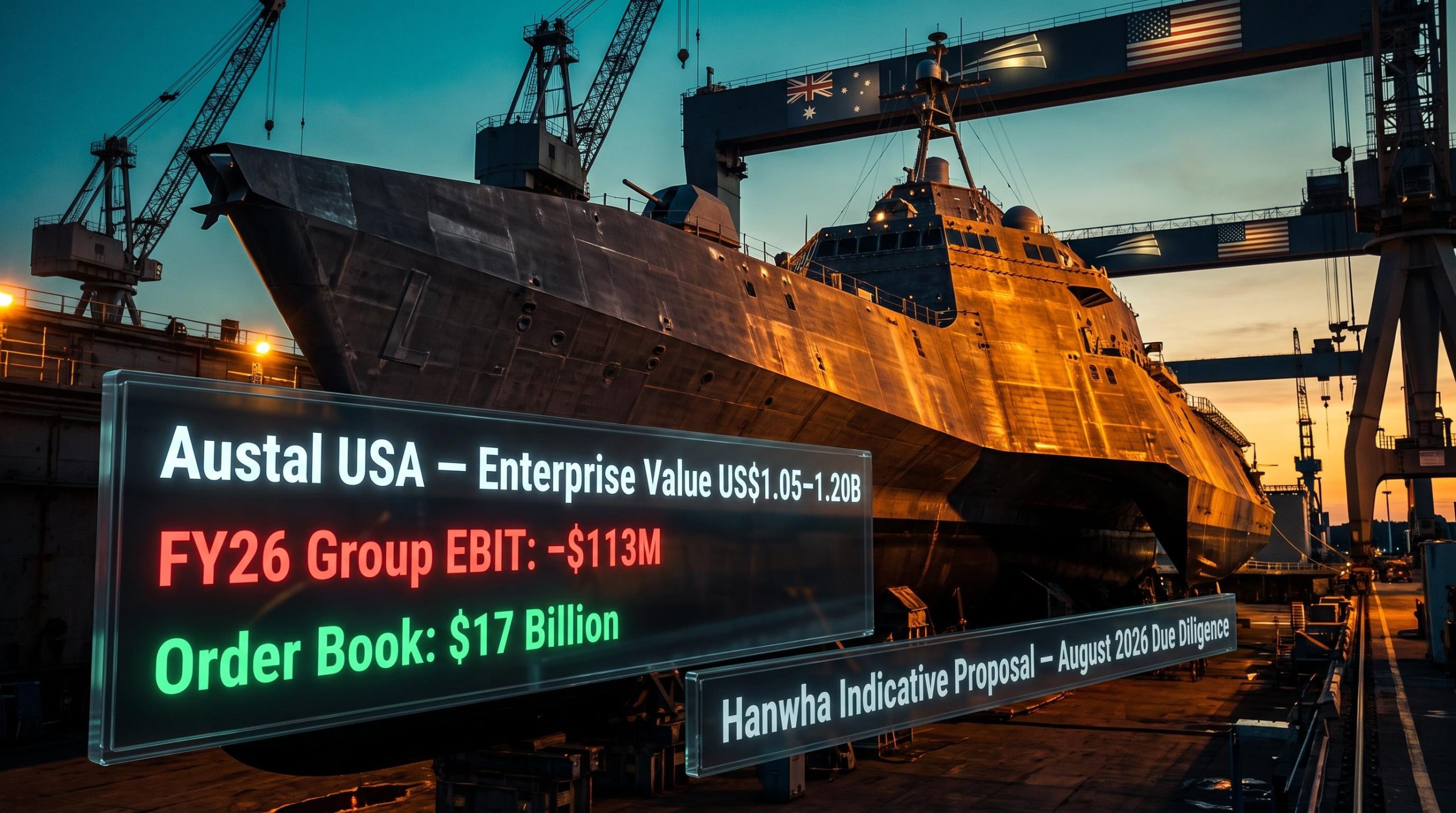
Austal has disclosed that South Korean defence conglomerate Hanwha has put forward a non-binding indicative proposal to purchase Austal USA, with an enterprise value in the range of US$1.05-1.20 billion, at the same time as the company updated the market on a dramatic shift in FY26 group EBIT, from prior guidance of positive $110 million to an expected $113 million loss. Two headlines landed on the same day, and they look like they belong to different companies.
They don’t. The EBIT loss is driven entirely by non-cash provisions on three legacy US programmes. The acquisition offer is the structural successor to a full-company bid that Hanwha Ocean launched in April 2024 and that Austal’s board rejected partly because regulators were never going to approve it. These are not contradictory signals; they are two sides of a single story about a defence shipbuilder clearing out legacy pain while a strategic buyer tries to acquire the asset it has been circling for more than two years.
Here is what actually matters for shareholders trying to separate a headline loss from the real financial picture, and why the structure of the offer tells you as much as the price tag.
What Hanwha is actually offering, and why it is structured this way
The key terms are straightforward:
- Enterprise value pitched at US$1.05-1.20 billion, on a cash-and-debt-free basis, with the Australasia operations and listed entity shares sitting outside the scope
- A four-week due diligence period kicking off in August 2026 before any firmer proposal can be tabled
- The perimeter of the offer is Austal USA only; the listed group and its Australasia business are explicitly excluded
- Completion of a transaction remains uncertain at this point
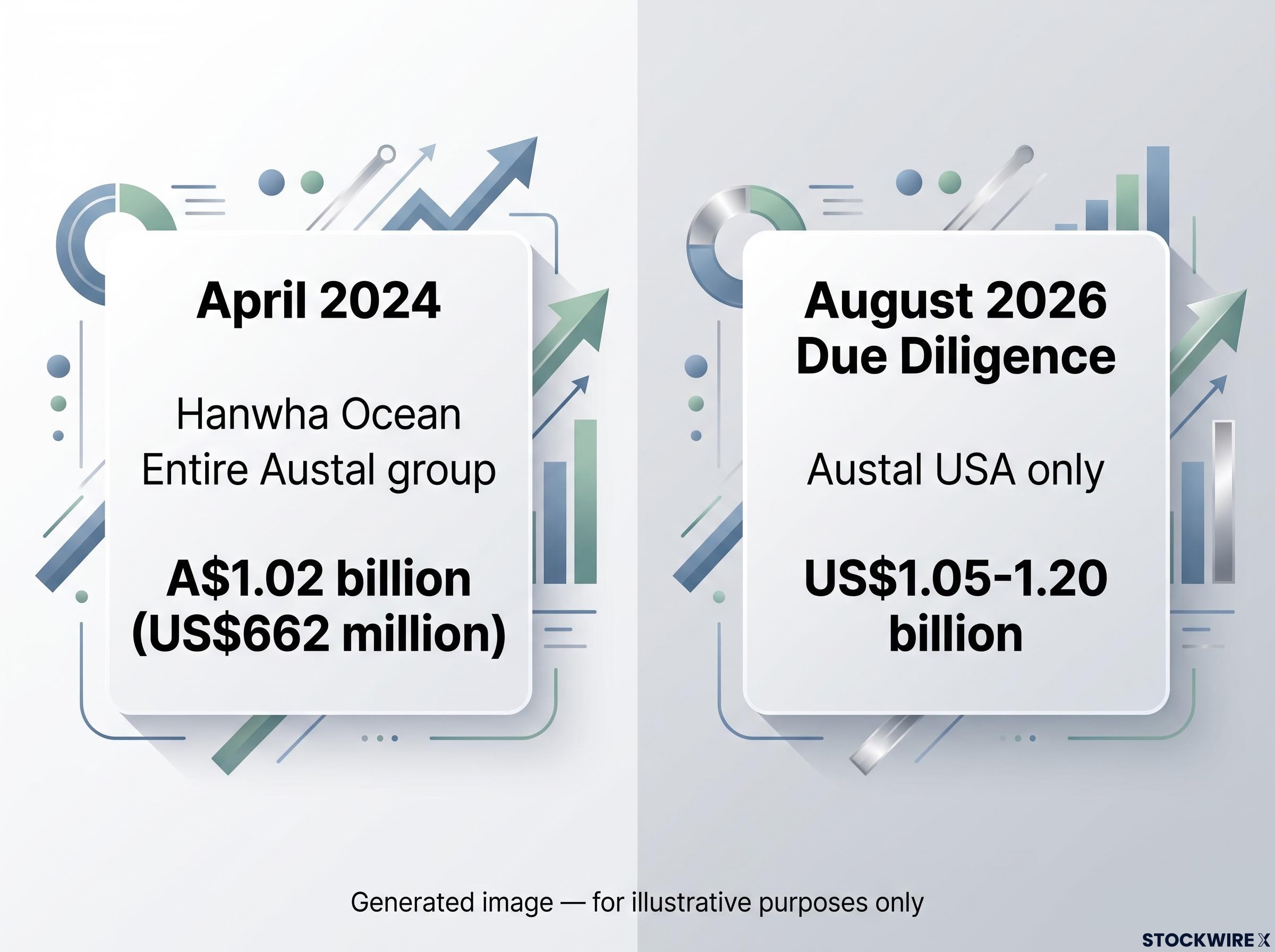
The valuation range deserves context. In April 2024, Hanwha Ocean offered approximately A$1.02 billion (roughly US$662 million) for the entire Austal group, US and Australasia combined. The board rejected it. The current offer values Austal USA alone at US$1.05-1.20 billion. The market, in short, had been underpricing the US business relative to what a strategic buyer is now willing to pay.
From full-company bid to US-only offer: the 2024 precedent
The US-only structure is not arbitrary. The 2024 bid collapsed partly because the Foreign Investment Review Board (FIRB), Australia’s foreign investment regulator, was unlikely to approve a full foreign takeover of a sovereign defence asset. Hanwha subsequently repositioned as a strategic shareholder, investing approximately A$183 million to secure a 9.9% economic stake with exposure to 19.9%, approved by the Australian Treasurer with strict conditions including an explicit 19.9% ownership cap. The Committee on Foreign Investment in the United States (CFIUS), the US body that reviews foreign investment in sensitive sectors, cleared the equity stake increase.
The US-only structure tells you this deal was designed around the regulatory outcome of 2024, not in spite of it. For shareholders, that means the political path for this version of the transaction is at least partially pre-cleared in a way the full-company bid never was.
When big ASX news breaks, our subscribers know first
Why the EBIT loss is not what it looks like
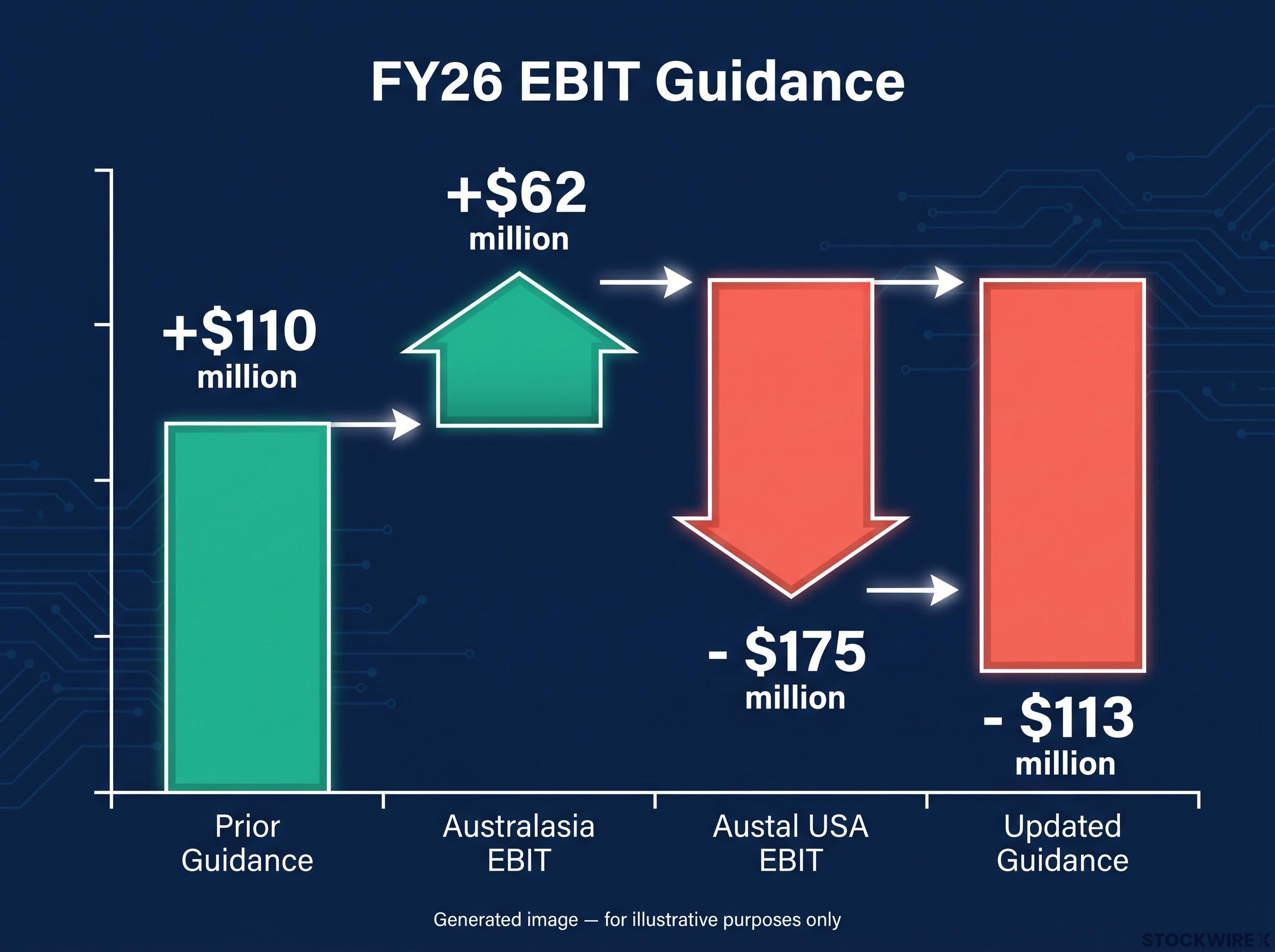
The headline figure demands unpacking. Austal’s FY26 group EBIT guidance has shifted from roughly +$110 million to roughly -$113 million, a $223 million swing in a single update. Every dollar of that deterioration traces back to non-cash accounting provisions booked at Austal USA, where the division is set to post an EBIT loss of around -$175 million. The culprits are three specific programmes: T-ATS, AFDM, and LCU, on which Austal USA has pulled forward all projected losses through to contract completion into one reporting year rather than letting them bleed across future periods.
The FY26 provision follows an earlier T-ATS accounting correction disclosed in February 2026, when Austal reduced guidance to A$110 million after identifying a US$17.1 million overstatement of incentive revenue on the same programme, establishing a pattern of legacy US contract complexity flowing through successive reporting periods.
| Metric | Value |
|---|---|
| Prior guidance (group EBIT) | ~+$110 million |
| Updated guidance (group EBIT) | ~-$113 million |
| Australasia EBIT | ~+$62 million |
| Austal USA EBIT | ~-$175 million |
The Australasia business, expected to deliver approximately +$62 million in EBIT for FY26, remains profitable. The underlying operational story outside the US legacy programmes is intact.
The $175 million loss is non-cash in the year of recognition. It is an accounting timing event, not an operational collapse. Future years’ earnings are relieved of these legacy drags, which can paradoxically make the forward earnings picture cleaner and more readable.
A one-year provision clean-up on legacy fixed-price contracts means next year’s guidance, when it arrives, should be structurally easier to interpret. That matters directly to how you read the FY27 numbers.
What “onerous contract provisioning” actually means
When a company determines it will lose money on a contract it has already signed, accounting standards require it to recognise the full expected loss immediately, even if most of the cash has not yet been spent. This is called onerous contract provisioning.
The mechanics work like this:
- The company estimates the total remaining cost to complete the contract
- If that cost exceeds the remaining revenue, the entire shortfall must be booked as a provision now
- The loss appears on the income statement in the current year, pulling forward pain that would otherwise drip through across multiple future reporting periods
- Future years are then relieved of the drag, because the loss has already been recognised
Using Austal USA’s situation as the live example: the $175 million provision covers projected losses on the T-ATS, AFDM, and LCU programmes through to their completion. Once you understand this mechanism, that figure stops being a signal about Austal’s current operational health and starts being a signal about how much legacy pain the company has decided to clear in a single year.
The balance sheet and order book as the real story
The income statement tells one story. The balance sheet tells a different one.
- Cash at bank: $366 million held as at 31 July 2026
- Net cash position: $240 million
- Undrawn credit facilities: $435 million available
- Order book: $17 billion, a record high
The EBIT loss is not a liquidity event. Holding $240 million in net cash alongside $435 million in undrawn facilities means Austal carries sufficient financial headroom to keep executing on its contracted book of work without coming under funding pressure. Non-cash provisions do not drain the bank account in the year they are recognised.
Austal’s order book stands at a record $17 billion, the clearest single indicator of forward revenue visibility and the primary reason a strategic buyer is willing to pay US$1.05-1.20 billion for the US division alone.
A buyer paying that price is not acquiring a distressed shipyard. It is acquiring significant contracted pipeline and US Navy relationships. For a shareholder asking whether Austal can continue operating through a difficult reporting year, the net cash and undrawn facilities answer that question directly and should anchor your interpretation of the EBIT figure.
What the regulatory hurdles actually look like from here
The four-week due diligence window is the starting line, not the finish. A transaction transferring Austal USA to Hanwha would need to clear multiple regulatory layers:
- CFIUS review: Foreign control over a sensitive US defence asset with active US Navy contracts requires formal CFIUS submission and approval, a categorically different question from the minority equity stake clearance Hanwha obtained in 2024
- US Navy and Department of Defence reviews: Continuity and security of supply on active programmes, plus broader industrial base considerations
- Australian regulatory consideration: Spillover effects on sovereign capability, technology flows, and the independence of the residual ASX-listed entity
The 2024 precedent is instructive. FIRB scrutiny effectively killed the full-company bid. A full asset transfer of Austal USA, with its active US Navy contracts, is a materially more sensitive question than approving a minority equity stake with a 19.9% cap.
Australia’s foreign investment policy explicitly classifies military-related industries as national security businesses, requiring Treasurer approval regardless of deal size — the regulatory foundation that shaped the conditions placed on Hanwha’s existing equity stake and that a full asset transfer of Austal USA would need to navigate afresh.
The regulatory risk here is not speculative. These bodies have already drawn a clear line on full foreign ownership of Austal, and shareholders should treat the indicative valuation as conditional until those reviews conclude.
What the residual Austal looks like if the sale proceeds
If the transaction completes, shareholders in the ASX-listed entity would hold equity in a smaller, Australasia-focused Austal that retains cash proceeds (net of transaction costs and applicable taxes), the Australasia component of the record order book, and its sovereign shipbuilding mandate.
The Australasia order book has been building steadily through 2026, most recently with a $136 million Border Force patrol boat contract extension that pushed the record total past $17.7 billion, underpinning the $62 million EBIT contribution that would become the standalone earnings base if the US division sale proceeds.
| Scenario | Key Variable |
|---|---|
| No deal | Austal remains intact; market re-prices on standalone FY26 loss and forward earnings |
| Deal at low end (US$1.05b) | Modest value uplift; depends on cost structure and tax leakage |
| Deal at mid-point (US$1.125b) | Meaningful uplift if proceeds are returned efficiently |
| Deal at high end (US$1.20b) | Significant value crystallisation for shareholders |
| Deal blocked on regulatory grounds | Returns to no-deal scenario; reputational and strategic uncertainty lingers |
The use-of-proceeds question shareholders should be asking now
A strong sale price only creates shareholder value if the proceeds reach shareholders efficiently. Three potential uses of proceeds are worth tracking:
- Capital return: Special dividend or on-market buyback
- Reinvestment: Expansion of Australasia capacity, R&D, or bolt-on acquisitions
- Obligations: Recapitalisation of pension liabilities or other long-term commitments that absorb proceeds before shareholders see them
The standalone Australasia business has a $62 million EBIT base. Whether that can be sustained or grown without US-scale operations is an open question. And whether the sale agreement leaves Austal carrying warranties or indemnities on the three problem US contracts (T-ATS, AFDM, LCU) could generate future cash outflows that erode the headline sale benefit. Shareholders should hold the valuation range loosely until binding terms clarify how proceeds flow and what liabilities remain with the listed entity.
The landmark LCH contract, a $4 billion Commonwealth agreement announced in February 2026 for eight Landing Craft Heavy vessels extending to 2038, is a central pillar of the Australasia earnings base that would remain with the listed entity under a US-only sale structure.
What comes next and what to watch before forming a view
Three specific milestones will determine whether the indicative valuation translates into real shareholder value:
- Due diligence outcome: The four-week window is the immediate near-term milestone. Whether Hanwha tables a binding offer at the conclusion, and at what price, is the first confirmation event.
- Regulatory lodgements: CFIUS submission, Department of Defence review initiation, and any formal Australian regulatory comment will de-risk or kill the transaction. Track the ASX announcements feed and regulatory registries directly.
- FY26 full-year result: When published, this is the moment shareholders get confirmation that the provision clean-up is genuinely contained to the three named programmes and that no further legacy issues are emerging.
Until a binding offer is tabled and regulatory submissions are lodged, the indicative valuation range tells you what Hanwha thinks Austal USA is worth, not what shareholders will receive. The gap between those two numbers is where the real story plays out over the coming months.
This article is for informational purposes only and should not be considered financial advice. Investors should conduct their own research and consult with financial professionals before making investment decisions. Forward-looking statements regarding the potential transaction, regulatory outcomes, and future earnings are speculative and subject to change based on market developments and company performance.