Three Mainfreight Group subsidiaries have collectively paid $594,000 in ASIC infringement notices after allegedly failing to lodge their annual financial reports by the statutory deadline of 31 July 2025. The three entities, Mainfreight Distribution Pty Limited, Owens Group Australia Pty Limited, and Mainfreight Holdings Pty Ltd, were each issued a notice of $198,000, which all three subsequently paid.
The action lands inside a broader ASIC enforcement campaign that has now issued 27 infringement notices exceeding $5 million across sectors from retail to logistics. This is not an isolated regulatory event; it is part of a pattern.
Here is what the notices mean, what they do not mean, and what investors tracking the group’s Australian operations should watch next.
Which entities were penalised and what triggered the notices
All three subsidiaries are large proprietary companies incorporated in Australia. Their financial year ended 31 March 2025, which set a statutory lodgement deadline of 31 July 2025 under the Corporations Act 2001. All three missed it.
ASIC’s lodgement of financial reports guidance confirms that large proprietary companies must submit annual financial reports within four months of their financial year end, making 31 July 2025 the binding statutory deadline for entities with a 31 March year end.
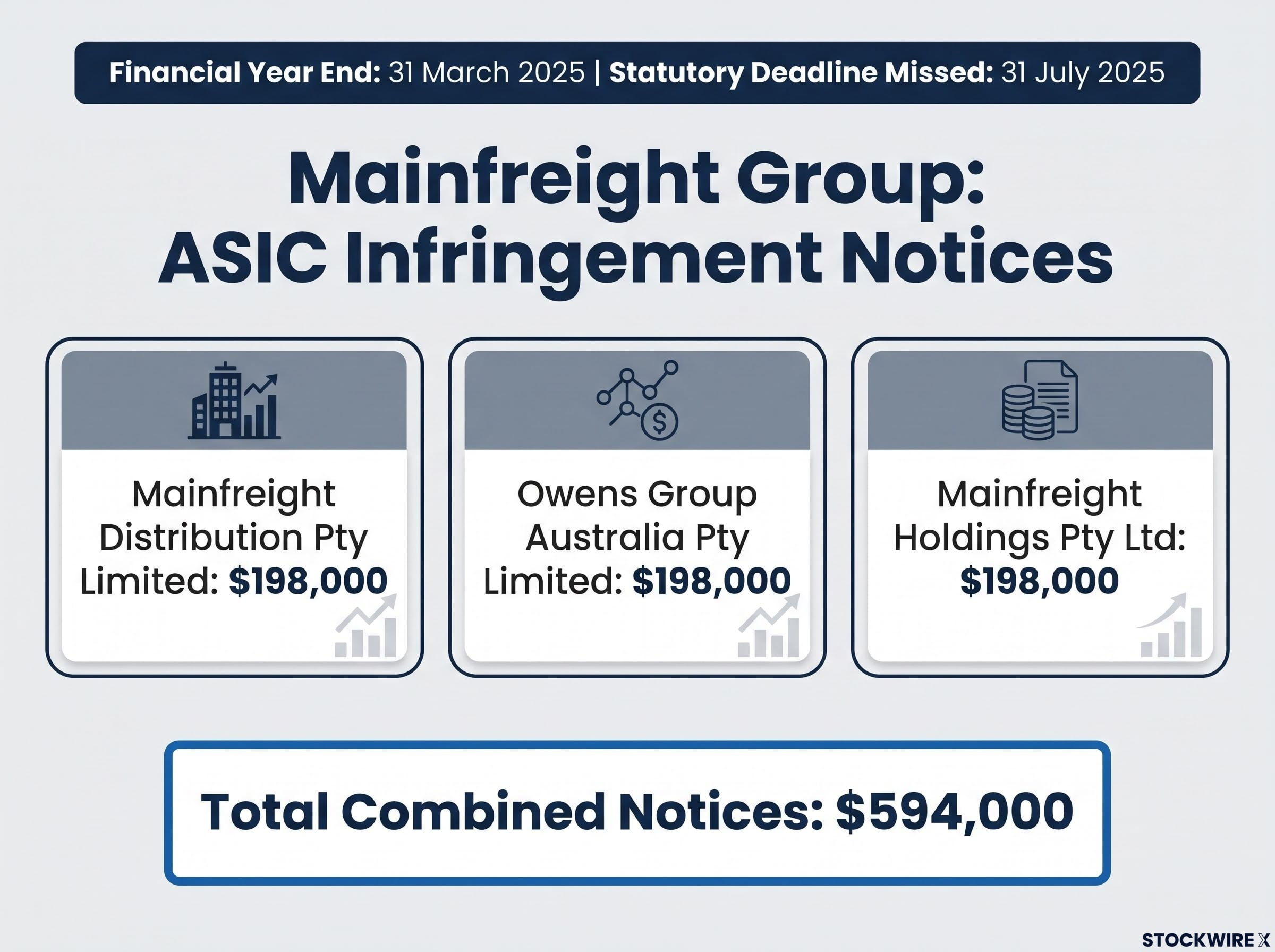
ASIC issued the infringement notices under Section 1317DAM of the Corporations Act 2001, as detailed in media release 26-188MR. Each entity paid $198,000.
| Entity | Notice amount | Financial year end | Lodgement deadline |
|---|---|---|---|
| Mainfreight Distribution Pty Limited | $198,000 | 31 March 2025 | 31 July 2025 |
| Owens Group Australia Pty Limited | $198,000 | 31 March 2025 | 31 July 2025 |
| Mainfreight Holdings Pty Ltd | $198,000 | 31 March 2025 | 31 July 2025 |
The fact that all three subsidiaries missed the same deadline points to a group-wide execution failure, not an isolated entity-level anomaly. That distinction matters for anyone assessing the governance of Mainfreight’s Australian operations. These entities are subject to Corporations Act obligations regardless of the parent group’s listing on the New Zealand Exchange (NZX).
When big ASX news breaks, our subscribers know first
What paying an infringement notice actually means under Australian law
A common misreading of these actions is that “paying a fine” equals an admission of guilt or a court finding. It does not.
Under Australia’s infringement notice regime, the mechanism operates as an “on-the-spot” fine under federal legislation. Payment resolves the matter without court proceedings and does not constitute an admission of guilt, liability, or a criminal conviction.
Under the infringement notice regime, paying a notice carries no admission of guilt or liability, and the company is not treated as having been convicted of any offence. The matter concludes without court proceedings.
That said, ASIC only issues a notice where it considers there is a reasonable basis to allege a contravention. So payment is not entirely without significance. The notice and payment are recorded permanently on ASIC’s public Infringement Notices Register, accessible to anyone conducting due diligence.
For investors, the legal distinction between “paid a fine” and “convicted of an offence” is material to how this event should be weighted in a governance assessment. But the public register entry still forms part of the compliance record, and it will remain there indefinitely.
Where this fits inside ASIC’s financial reporting crackdown
This is not about Mainfreight specifically. It is about a regulatory environment that has shifted.
ASIC launched a broad surveillance programme focused on late and non-lodgement of financial reports, which has been operational since August 2025. The regulator has designated financial reporting misconduct as a named enforcement priority for 2026, and the numbers tell you the regulator is backing the priority with action.
To date, the campaign has produced 27 infringement notices totalling more than $5 million. In addition, three public companies faced court-ordered penalties totalling over $1.1 million in a single sitting at the Downing Centre Local Court.
The court-ordered penalties issued at Downing Centre Local Court represent a parallel and escalating enforcement track: where infringement notices resolve matters administratively, court proceedings produce convictions and larger financial consequences, and ASIC has been running both mechanisms simultaneously since naming financial reporting misconduct as a 2026 priority.
Comparable enforcement actions include:
The Canva Group penalties, totalling $792,000 across four subsidiaries for a delay of nearly 11 months, sit at the more severe end of the enforcement spectrum and illustrate how late lodgement exposure scales when a group-wide compliance failure is compounded by the length of the delay.
- Mecca companies: $594,000
- Canva Group: $792,000
- Zara, H&M, and Sephora (Australian entities): $596,000
ASIC Commissioner Kate O’Rourke has indicated the regulator intends to press ahead with its data-driven sweep, continuing to identify and pursue companies that submit reports late or not at all.
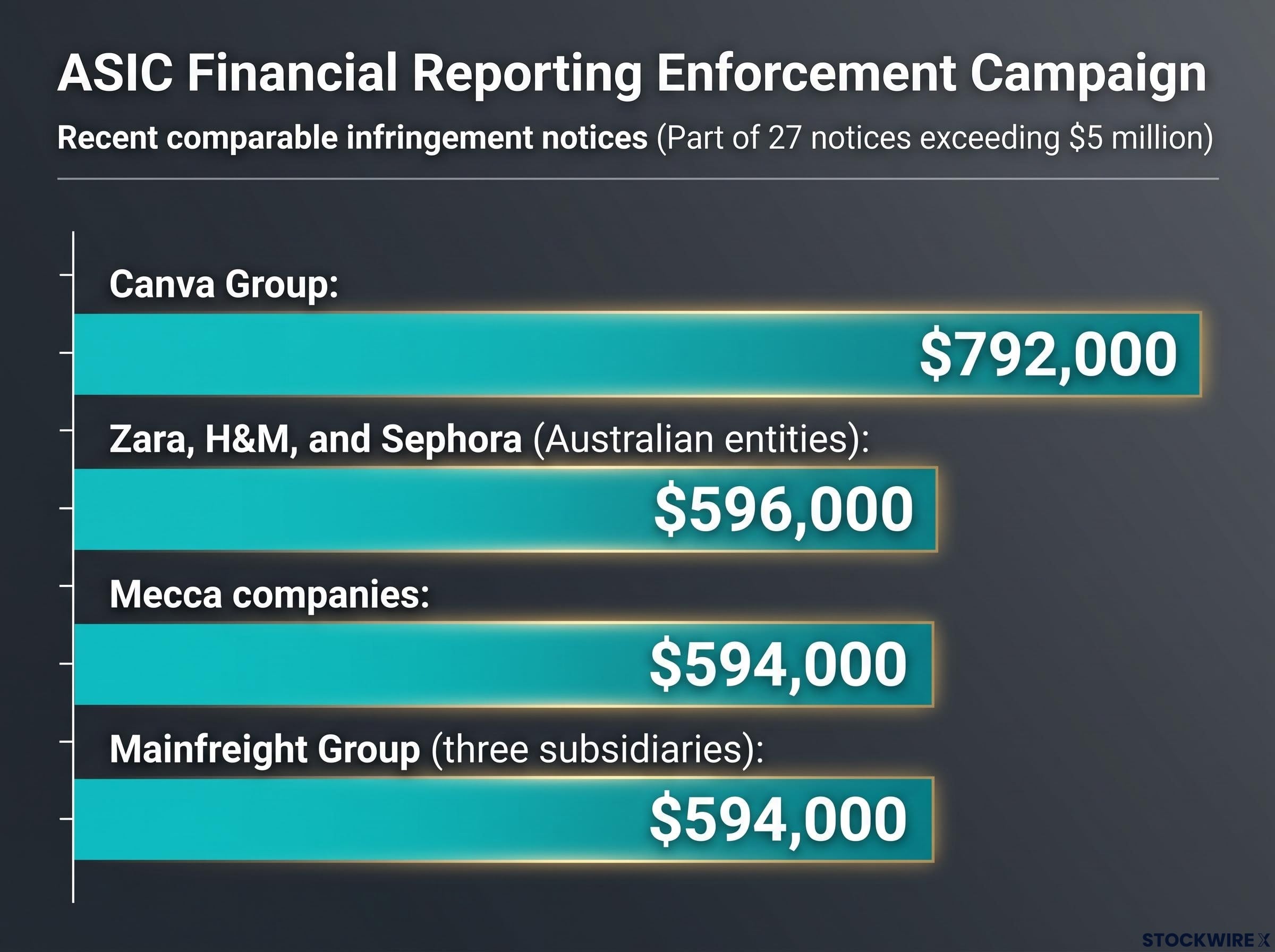
The pattern tells you ASIC is running a systematic, cross-sector sweep. Any large proprietary company missing reporting deadlines is now a potential enforcement target, not just those in logistics or any single industry. The era of administrative tolerance for late lodgements appears to be over.
What this signals about governance and what investors should watch
The $594,000 payment is financially modest for a large multinational logistics group. That is not where the signal sits.
The signal sits in the fact that three subsidiaries, all operating under the same parent group, all missed the same deadline. That pattern suggests a systemic issue in how the group manages its Australian reporting obligations, whether that is a staffing gap, a process gap, or an oversight gap at the board level.
ASIC enforces at the Australian entity level regardless of where the parent is listed. Mainfreight Group’s NZX listing does not shield its Australian subsidiaries from Corporations Act requirements.
Financial reporting scrutiny from ASIC in FY2026-27 extends beyond lodgement timing into the substantive accounting judgements inside the reports themselves, with revenue recognition, asset impairment, and financial instrument measurement designated as the three core areas most exposed to management bias.
For investors and analysts, the forward-looking questions worth putting to management are specific:
- What caused the delay in lodging the FY25 financial reports for the three Australian entities?
- What remedial steps have been taken, whether systems upgrades, staffing changes, revised audit timetables, or enhanced board oversight?
- Has the group reviewed lodgement obligations across all other Australian entities in the group structure?
- What governance changes, if any, have been implemented to ensure the FY26 reports are lodged on time?
The key variable going forward is not the $594,000 already paid. It is whether the FY26 financial reports for these entities land on time. A repeat event would be a materially stronger governance signal than a first offence.
Whether the reporting culture has shifted or the compliance clock is still running
This is a compliance event, not a criminal matter. But it sits inside a regulatory environment where ASIC is actively pursuing late lodgers across sectors, and the Mainfreight Group’s Australian operations are now on record.
The ASIC Infringement Notices Register is permanent and publicly searchable. This event will remain part of the group’s due diligence footprint indefinitely, visible to investors, creditors, and counterparties.
The most informative signal will come when the FY26 annual reports for these three entities fall due. A clean lodgement resets the narrative to a one-off slip. A second miss turns it into a pattern.
This article is for informational purposes only and should not be considered financial advice. Investors should conduct their own research and consult with financial professionals before making investment decisions.