
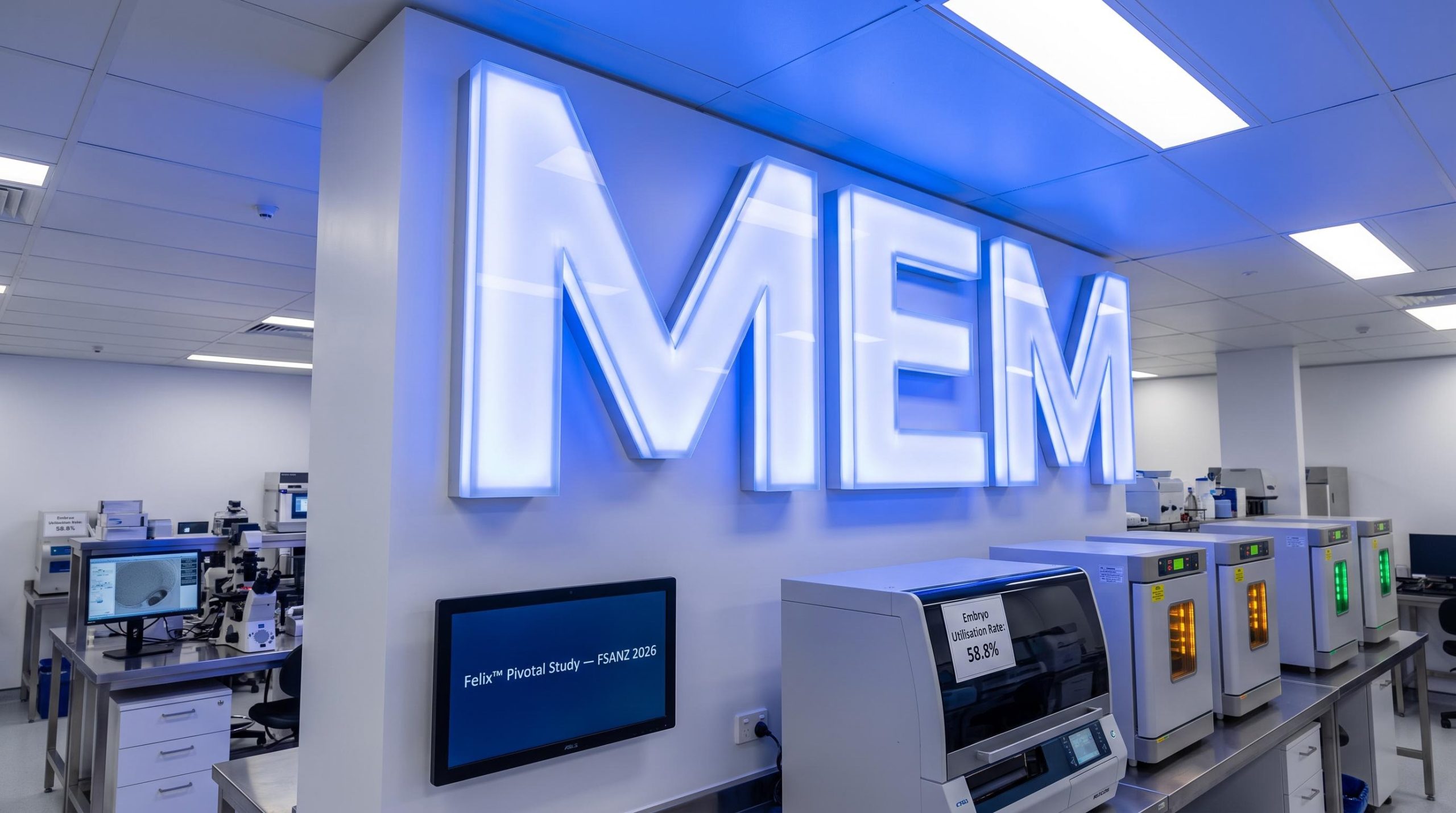
Felix™ pivotal study results reach scientific stage for the first time at FSANZ 2026
Results from the pivotal Felix™ clinical study were presented to a scientific audience for the first time at the Fertility Society of Australia and New Zealand 2026 Annual Conference (FSANZ 2026) in Canberra on 9 August 2026. The presentation was delivered by A/Prof Hassan Bakos, Memphasys Director, Clinical Partnerships & Growth, at the National Convention Centre.
The study results were previously announced to the ASX on 24 March 2025. Their appearance at FSANZ 2026 marks the first formal presentation of the findings to a major scientific and clinical audience, rather than the release of new data.
For investors, the significance lies in fresh clinical validation being placed directly in front of fertility clinicians and laboratory decision-makers, giving commercial partners additional evidence to drive clinic engagement and adoption.
When big ASX news breaks, our subscribers know first
What the pivotal study found
The registered, multi-centre, blinded, randomised sibling oocyte study compared sperm selected using the Felix™ System against two commonly used preparation methods: density gradient centrifugation (DGC) and swim-up (SU).
Key features of the study design included:
-
Registered, multi-centre, blinded, randomised sibling oocyte trial
-
103 couples undergoing intracytoplasmic sperm injection (ICSI)
-
Conducted across 10 Monash IVF Group centres
-
Primary outcome: Embryo Utilisation Rate (EUR), the proportion of embryos available for transfer or cryopreservation
The headline result was a statistically significant improvement in EUR over DGC, alongside non-inferiority versus swim-up.
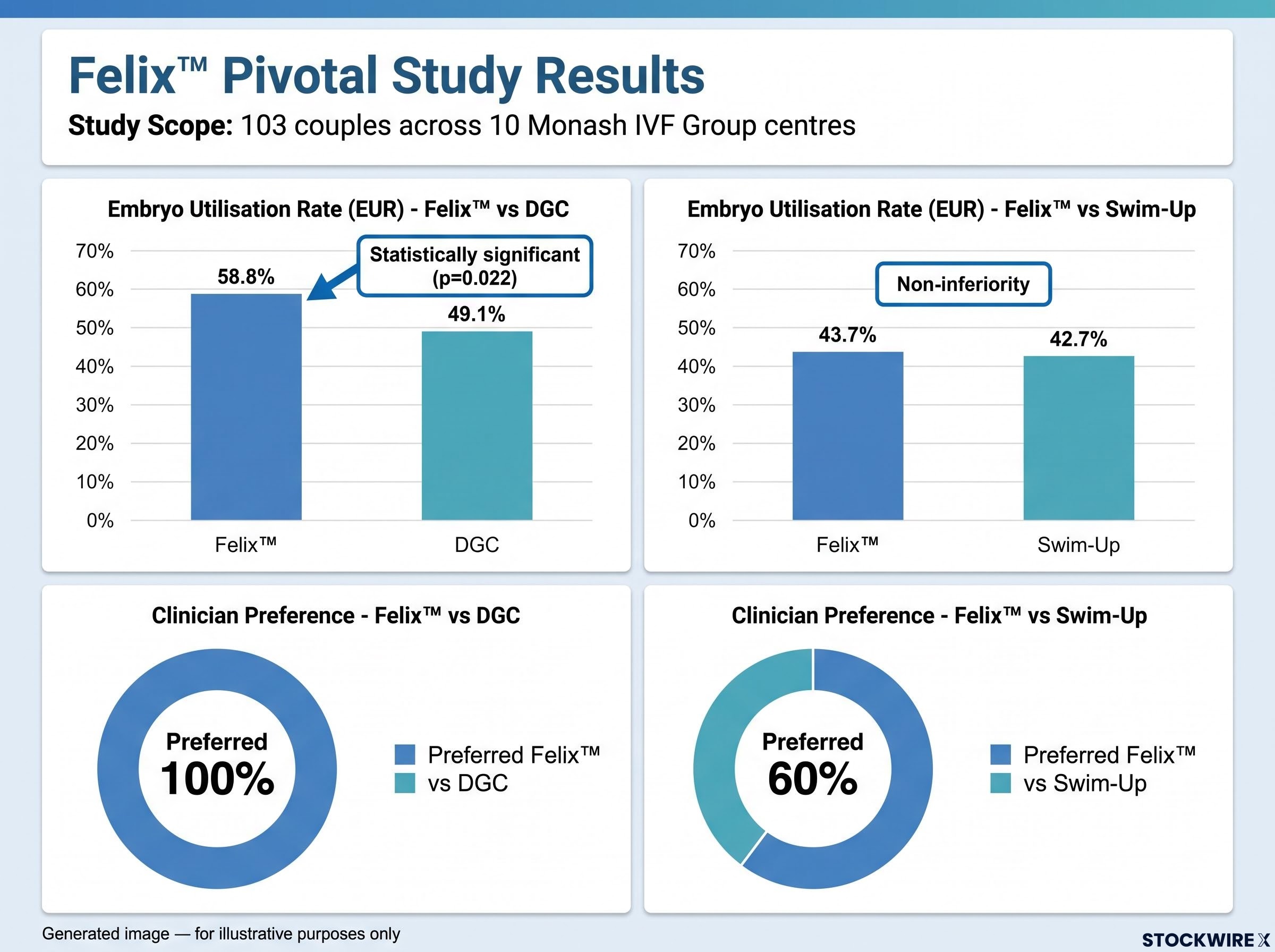
| Metric | Felix™ | Comparator | Result |
|---|---|---|---|
| Combined EUR vs DGC | 58.8% | 49.1% (DGC) | Statistically significant (p=0.022), superiority |
| Combined EUR vs Swim-Up | 43.7% | 42.7% (SU) | Non-inferiority |
| Clinician preference vs DGC | 100% preferred Felix™ | Strong adoption signal | |
| Clinician preference vs Swim-Up | 60% preferred Felix™ | Majority preference | |
Clinician preference stands out
One of the most notable findings was that 100% of clinicians preferred the Felix™ process over DGC, with 60% preferring Felix™ over swim-up.
Clinician preference is often viewed as a leading indicator of laboratory switching behaviour. A unanimous preference against the incumbent centrifugation method may support the case for clinics adopting the technology as existing agreements progress.

Understanding sperm selection and why Embryo Utilisation Rate matters
The Felix™ System is a patented bio separation technology that isolates the most viable sperm cells for human assisted reproduction. It combines electrophoresis and size-exclusion membranes, producing a fast and standardised sperm selection process.
According to Memphasys, the system replaces traditional centrifugation (DGC), which can cause cellular stress and DNA damage. The company describes Felix™ as offering clinicians a superior, repeatable alternative.
Embryo Utilisation Rate refers to the proportion of embryos that end up available for transfer or cryopreservation. A higher rate means more usable embryos are generated from a given cycle, an outcome with clear clinical relevance for patients undergoing assisted reproduction.
For investors, repeatable results of this kind underpin the case for clinics switching preparation methods. Because Felix™ operates on a cartridge-based process, wider adoption is positioned to drive recurring cartridge revenue over time.
The cartridge revenue model targets gross margins exceeding 60% at scale, with each clinic capable of generating A$100,000 to A$300,000 in annual revenue once console deployment is established, a profile that underpins the financial logic of pursuing multi-site network agreements like the one with Monash IVF.
From clinical evidence to regulatory access and revenue
The study formed part of the clinical evidence supporting Felix™ achieving CE Mark certification under the European Union Medical Device Regulation in December 2025.
Felix™ currently holds the following regulatory positions:
-
CE Mark certified under EU Medical Device Regulation, providing commercial access across the European Economic Area
-
Included on the Australian Register of Therapeutic Goods (TGA approved)
-
Registered with the UK Medicines and Healthcare products Regulatory Agency (MHRA)
On the commercial side, Memphasys secured more than A$3 million in contracted minimum revenue over multiple years during FY2026, exceeding its stated A$2 million corporate objective. The company also recently announced an exclusive commercialisation agreement in Poland, with a minimum contracted value of approximately A$350,000 over two years.
Memphasys reports that it now has commercial agreements, sales or active evaluations across Australia, Europe, the United Kingdom, the Middle East and North Africa, India, Japan and Southeast Asia.
The presentation provides the company and its commercial partners with additional clinical evidence to support engagement with fertility clinics, embryologists and laboratory decision-makers as existing agreements progress towards product adoption and recurring cartridge orders.
Monash IVF — from trial partner to largest commercial agreement
The study was conducted as part of a scientific and clinical collaboration between Memphasys and Monash IVF Group spanning more than a decade.
In June 2026, this relationship progressed from clinical collaboration to commercial deployment when Memphasys entered into a 12-month exclusive national supply agreement with Monash IVF Group for Felix™ in Australia.
The Monash IVF national supply agreement, signed in June 2026, covers a 22-clinic network that performed 12,085 stimulated IVF cycles in FY2025, representing approximately 21% of the Australian market and converting a decade-long clinical collaboration into contracted recurring revenue.
The agreement is currently in its initial three-month rollout phase across two Monash IVF sites. Successful completion of this phase will trigger the full 12-month supply term and provide a pathway for deployment across Monash IVF Group’s Australian network of 22 clinics.
Memphasys describes this arrangement as its largest Felix™ commercial agreement and a model it is seeking to replicate internationally.
What management said
David Tasker, Non-Executive Chairman
“This first scientific presentation of the pivotal study results represents another important milestone in the commercial development of Felix™. The study generated important clinical evidence that supported Felix™ achieving CE Mark certification and demonstrated a significantly higher Embryo Utilisation Rate than density gradient centrifugation.
“Memphasys has since secured regulatory access across Europe, Australia and the United Kingdom, more than A$3 million in contracted minimum revenue during FY2026, and a further A$350,000 agreement in Poland. The presentation gives our commercial partners additional evidence to support clinic engagement as we work to convert regulatory access and contracted agreements into adoption and recurring cartridge revenue.
“Our relationship with Monash IVF Group has progressed from a decade-long scientific collaboration and pivotal clinical trial to our largest Felix™ commercial agreement, providing a model we are seeking to replicate internationally.”
A/Prof Hassan Bakos added that presenting the findings at FSANZ enabled the company to share the clinical evidence supporting Felix™ directly with leading fertility clinicians, embryologists and researchers.
“The results demonstrated that Felix™ achieved a significantly higher Embryo Utilisation Rate than density gradient centrifugation and a comparable rate to swim-up,” said Bakos.
A/Prof Bakos will also chair the FSANZ 2026 session “Evolving Standards and Innovations in Male Fertility Care” on Tuesday, 11 August 2026.
What comes next for Memphasys
The near-term focus, based on disclosed information, centres on converting regulatory access and contracted agreements into product adoption and recurring cartridge orders.
Completing the three-month Monash IVF rollout would unlock the full 12-month supply term and open a pathway towards deployment across the group’s 22-clinic Australian network. Alongside this, Memphasys has stated it is seeking to replicate the Monash model internationally, drawing on its regulatory access across multiple regions and its expanding commercial footprint.
For investors, the FSANZ 2026 presentation adds to the evidence base the company can use to pursue that adoption, though the pace of conversion into recurring revenue remains dependent on how existing agreements progress.
Don’t Miss the Next Healthcare Breakthrough on ASX
Big News Blast delivers FREE breaking ASX healthcare news directly to your inbox within minutes of release, complete with in-depth analysis already done for you. Join 20,000+ subscribers who stay ahead of the market on every major announcement. Click the “Free Alerts” button to start receiving real-time alerts the moment market-moving healthcare news breaks.