The Federal Reserve may hold fewer policy meetings each year than at any point in the past 45 years. The change being floated is not a scheduling convenience but a deliberate signal about how much the central bank intends to shape financial markets going forward.
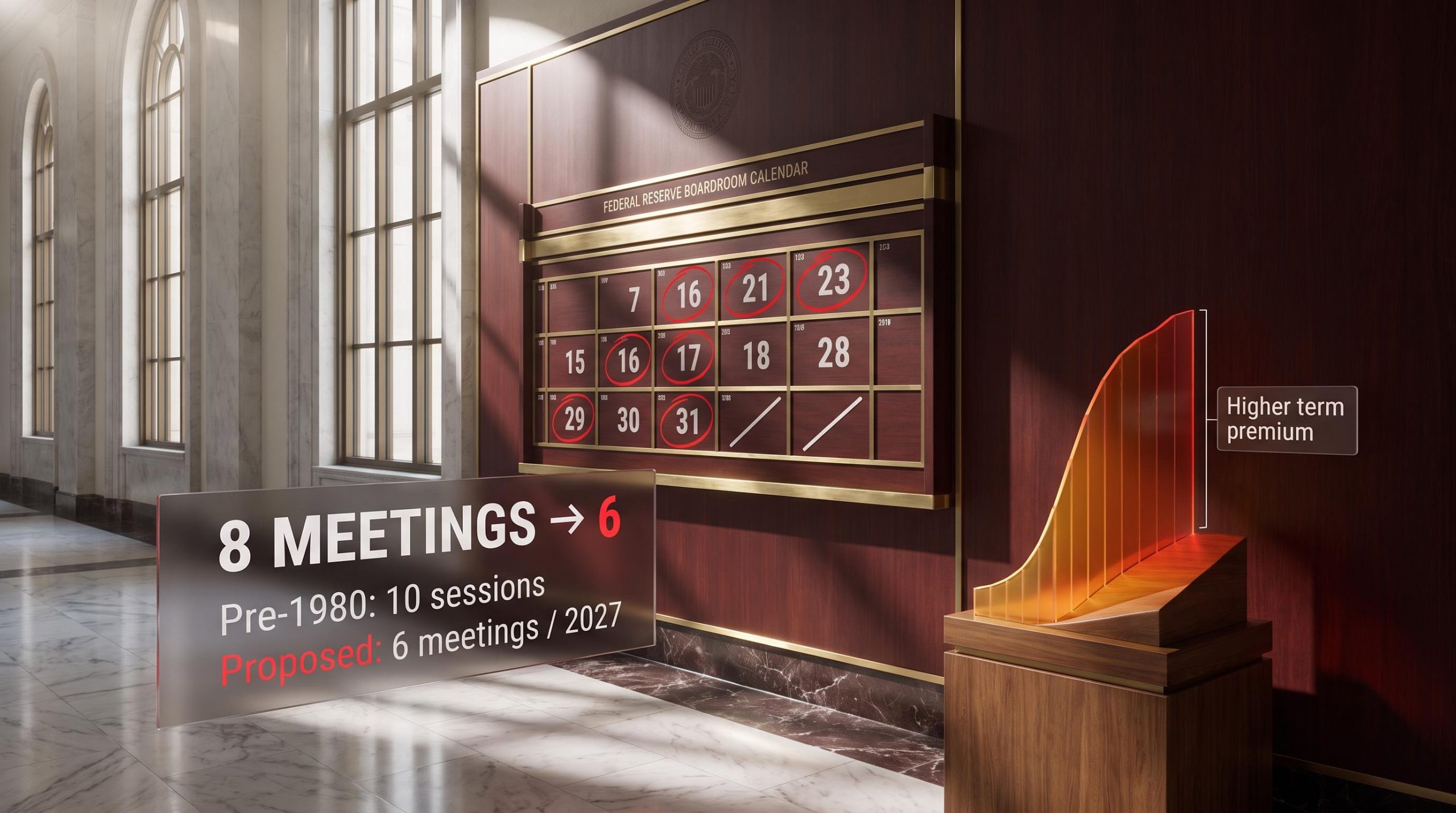
Fed Chair Kevin Warsh has raised the possibility of cutting the eight annual FOMC meetings to roughly six, with Barclays analysts describing six sessions as a plausible middle ground between the legal minimum of four and the current total. No formal proposal has been made, and any change is not anticipated before 2027, but the implications for rate decisions, bond markets, and how investors read incoming data are already drawing serious attention.
Here is what the data and the analyst debate actually tell you about whether this change would shrink the Fed’s footprint or simply concentrate its market power into fewer, higher-stakes moments.
What Warsh is reportedly considering, and how far it would go
At the most recent FOMC meeting, Warsh raised the possibility of reducing the number of regular policy meetings, according to multiple reports based on people familiar with the discussion. Officials briefly debated whether six meetings per year could work. The idea was framed as a topic for discussion, not a formal proposal.
Bloomberg reported a specific hybrid model: six meetings focused on rate and policy decisions, plus two additional meetings devoted to broader economic discussions without immediate policy moves attached. That model has not been formally proposed, but it represents the most detailed version of the concept to surface publicly.
Barclays analysts Michael McLean and Jonathan Millar described a six-meeting schedule as a potential “Goldilocks” figure, landing between the statutory floor and the current total. Any formal change is not anticipated before 2027, pending the results of a communications task force review.
What Warsh has said publicly
At his April Senate confirmation hearing, Warsh stated that the law requires at least four meetings per year but added that “four is not enough.” He did not commit to a number.
The gap between that public framing and the specific six-meeting model being discussed internally tells you this is more than idle speculation. It reflects a coherent institutional direction, even if the timeline remains open.
| Attribute | Current (8 meetings) | Proposed (6 meetings) | Hybrid (6 + 2) |
|---|---|---|---|
| Total meetings per year | 8 | 6 | 8 (6 policy + 2 discussion) |
| Policy decisions | 8 | 6 | 6 |
| Press conferences | 8 | 6 | 6 |
| Economic projections | 4 (quarterly) | TBD | TBD |
When big ASX news breaks, our subscribers know first
The 1980 blueprint and why the current schedule is not as old as it seems
The eight-meeting norm feels permanent. It is not. Under Paul Volcker, the FOMC shifted from ten annual sessions to eight in 1980, restructuring its calendar to fit a revised operating approach that prioritised bank reserve targets over direct management of the federal funds rate.
The reserve-targeting approach that prompted the change was itself discarded within three years of introduction.
Before 1980, the Federal Open Market Committee (FOMC), the Fed body that sets interest rates, met nearly monthly at ten sessions per year. The three-era timeline puts the current debate in context:
- Pre-1980: Nearly monthly, ten sessions per year
- 1980 to present: Eight sessions per year (Volcker reform)
- Proposed future: Six sessions, or a six-plus-two hybrid model
The operating framework that gave rise to the eight-meeting calendar lasted fewer than three years, yet the meeting structure it produced has endured for four and a half decades.
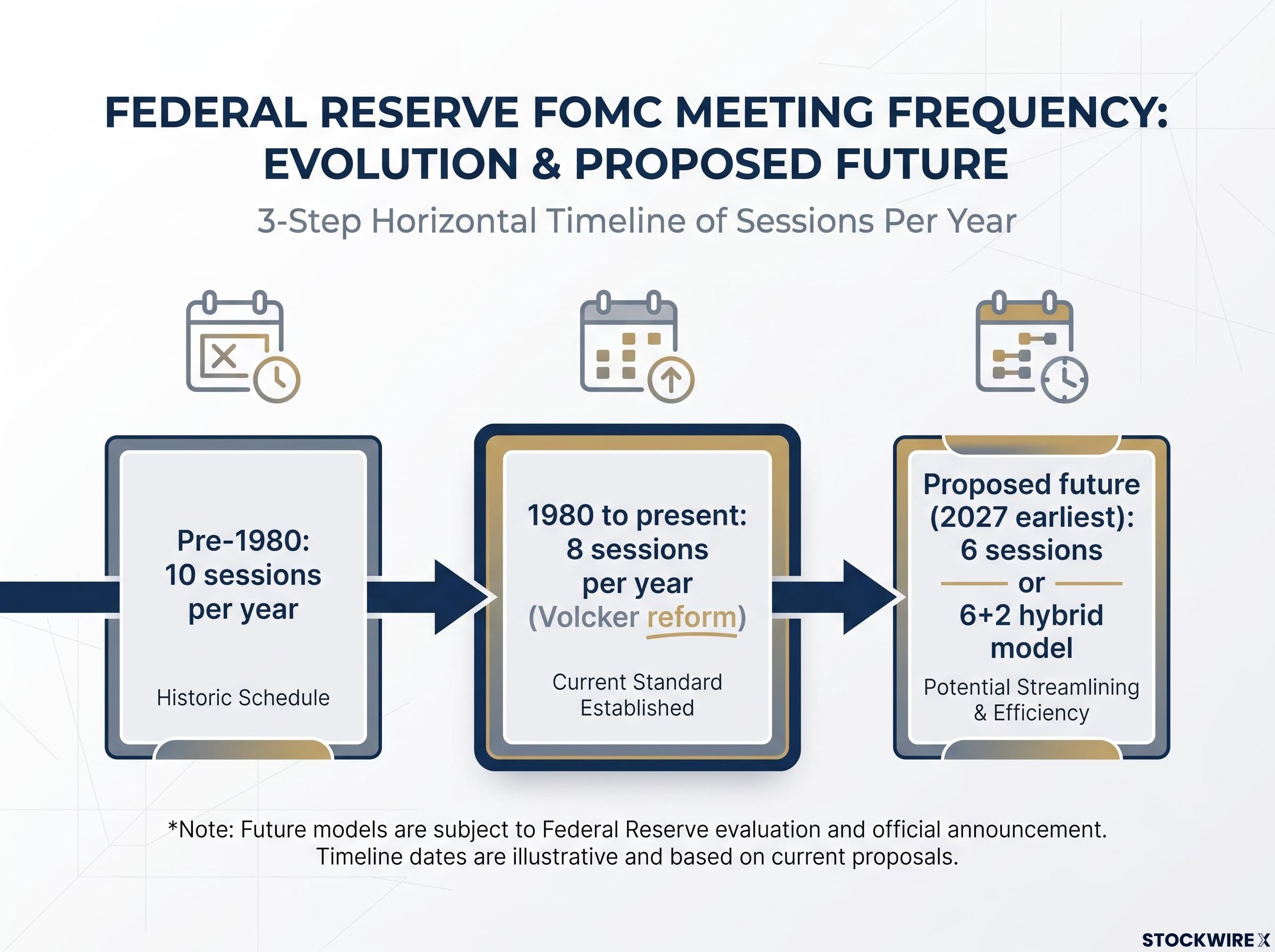
The accidental durability of this structure tells you the current norm was never a principled design choice. The argument for preserving it on tradition alone is weaker than it might appear, and the Fed has adjusted its procedural architecture before when its operating philosophy changed.
Why fewer meetings fits Warsh’s broader vision for the central bank
The meeting-frequency discussion does not exist in isolation. It is part of Warsh’s broader institutional vision: fewer meetings, fewer statements, fewer press conferences, and reduced Fed influence over daily asset pricing.
Warsh’s stated intent to reduce the Fed’s market footprint was already visible at his first FOMC meeting, where a 130-word policy statement replaced the 341-word April version and all forward guidance was eliminated, leaving markets without the interpretive buffer that prior chairs had built up over two decades.
The mechanism is straightforward. With more weeks between policy events, incoming economic data rather than Fed signals would carry more weight in shaping market expectations. The Fed would still set rates. It would just do so less often, and with fewer opportunities for incremental language shifts to move markets between decisions.
Several regional Fed presidents, including Neel Kashkari, have indicated openness to discussing a change, without treating any specific number as fixed. According to Barclays, the meeting-frequency question sits within a wider institutional conversation covering Fed communications strategy, balance-sheet policy, and how actively the central bank should influence asset prices and market expectations.
Supporters highlight four stated benefits:
- Reduced communication noise, with fewer official statements and press conferences for markets to parse
- A longer-horizon policy focus, encouraging medium-term thinking rather than data-print-by-data-print reaction
- Reduced administrative burden from less frequent forecasting cycles
- Clearer emergency-meeting signal value, since off-cycle sessions would stand out more distinctly
Why emergency meetings would carry more weight under a reduced schedule
With fewer routine meetings, any off-cycle session would be a much clearer signal of genuine financial stress rather than routine policy adjustment. The Fed retains the ability to call emergency meetings at the Chair’s discretion or at the request of any three FOMC members, regardless of the scheduled cadence.
If the Fed successfully reduces the market’s habit of anchoring to every FOMC date, investors who currently treat Fed weeks as distinct calendar events would need to redistribute their positioning discipline across longer inter-meeting stretches.
Fewer meetings, higher stakes: the risks analysts are flagging
Fewer meetings could increase, not decrease, volatility around each remaining session. That is the paradox at the centre of this debate.
Markets would know that the next opportunity for a rate adjustment is further away. That awareness would concentrate positioning, hedging, and risk repricing into fewer annual windows, potentially amplifying the market impact of each decision rather than reducing it.
Barclays explicitly cautioned that concentrating policy decisions into fewer annual events could amplify market attention on each individual meeting.
CNBC reporting notes that some experts see a real possibility that less frequent meetings could paradoxically increase market volatility, despite the stated goal of reducing the Fed’s footprint. The risks fall into three categories:
The committee fracture already visible in the July 9-3 hawkish dissent, where Hammack, Kashkari, and Logan all voted for an immediate 25 basis point hike and the 30-year Treasury yield surged to 5.21%, illustrates precisely how concentrated policy uncertainty amplifies market reactions even before any calendar restructuring takes effect.
- Higher event risk per meeting: Traders would reposition more aggressively before each session and react more sharply to surprises
- Diminished scope for timely policy adjustments: Fewer scheduled chances to adjust rates or guidance incrementally
- Prolonged information vacuums: Longer stretches where markets must infer the Fed’s reaction function from speeches and data alone, which can produce greater uncertainty when data prints conflict
For investors currently managing rate exposure, the key implication is not just that FOMC meeting dates would matter more. It is that the stretches between them become structurally more ambiguous, with direct consequences for duration positioning and options hedging strategies.
What a six-meeting calendar would mean for how investors track the Fed
The shift from eight meetings to six would change the information architecture investors use to build rate expectations, not just the calendar itself. Three practical adjustments would follow:
- Repositioning around fewer but higher-stakes FOMC dates. Rate changes and major guidance updates would cluster into fewer windows, encouraging markets to build positions and hedges more heavily around those events. Options markets could see more pronounced event-risk pricing around each of the six annual meetings.
- Greater macro-data focus between meetings. With fewer opportunities for the Fed to reinterpret data in real time, key releases, including CPI, PCE, payrolls, and ISM, would carry additional interpretive weight as the primary signals between sessions.
- Higher term-premium expectations for long-duration bonds. Less frequent incremental guidance may lead markets to demand a higher term premium on longer-dated Treasuries, reflecting greater uncertainty about the policy path between decisions.
Barclays frames the broader shift as a signal of a Fed stepping back from constant guidance and placing greater weight on underlying economic fundamentals.
Bond markets and the term-premium question
With less frequent Fed guidance, longer-dated bond holders face greater uncertainty about the policy path, which typically translates into a higher term premium demanded to hold duration. The term premium is the extra yield investors require for holding a bond to maturity rather than rolling shorter-term debt.
This could be an unintended consequence if the Fed’s intent is to reduce market distortion rather than shift it from short-duration pricing to long-duration pricing. For bond and rate traders specifically, the shift would demand a recalibration of how much analytical bandwidth goes toward parsing Fed statements versus tracking the macro data path between meetings.
What would actually need to happen for this to become policy
No congressional approval is required. Under the Federal Reserve Act, the FOMC must convene at least four times annually; a reduction to six sits comfortably within the FOMC’s own authority. Although Warsh likely holds the authority to restructure the calendar on his own initiative, analysts expect him to pursue committee buy-in rather than move without it.
Building committee buy-in has been complicated from the outset: the April 2026 FOMC meeting produced four dissenting votes, the most at any single Federal Reserve meeting since 1992, exposing the fractured internal landscape Warsh must navigate before any structural calendar change can be formalised.
The FOMC Rules of Procedure specify that the committee must meet in Washington at least four times each year, with additional sessions held as deemed necessary, establishing the statutory floor within which any schedule restructuring must remain.
The communications task force review is the vehicle through which any schedule restructuring would most plausibly be formalised, with the earliest realistic window for implementation sitting at 2027. FOMC calendars are published years in advance and marked “tentative,” which provides operational scope to adjust if the committee agrees.
Four specific signals would tell a watching investor that this is moving from discussion to decision:
- A formal schedule proposal at an FOMC meeting
- Public statements from governors and regional presidents signalling support or conditions
- Communications task force findings and recommendations
- Adjustments to published FOMC calendars for upcoming years
At his April Senate confirmation hearing, Warsh said “four is not enough,” anchoring the directional intent without committing to a specific number.
The 2027 timeline and the task-force process tell you this is not an imminent market event. It is a directional institutional signal worth monitoring now, particularly through any changes in how FOMC members talk about communication strategy at upcoming meetings.
A procedural debate with structural consequences
The intent of the change and its likely market reality may point in opposite directions. A smaller Fed footprint is the goal. Higher stakes per meeting, greater data sensitivity between meetings, and a potential shift in where term premium sits across the yield curve are the plausible consequences.
Whatever number the FOMC settles on, the fact that this discussion is happening at all is a clear signal about the direction Warsh wants to take the central bank. According to Barclays, the central question is not really how many meetings per year is optimal, but whether the broader FOMC membership is prepared to embrace Warsh’s vision of an institution that communicates less frequently and exerts less influence over financial markets.
Whether investors treat this as a near-term trading signal or a longer-horizon institutional shift depends entirely on how quickly Warsh can build committee consensus. That makes the next round of Fed member public commentary the most important indicator to watch.
For investors evaluating how much a reduced meeting schedule would actually matter for real economic outcomes, our dedicated guide to Fed economic control limits examines how Milton Friedman’s long and variable lags mean policy effects take over a year to reach the real economy, challenging the premise that meeting frequency drives economic results.
This article is for informational purposes only and should not be considered financial advice. Investors should conduct their own research and consult with financial professionals before making investment decisions. These statements are speculative and subject to change based on market developments and Fed decision-making.