If you believe you can apply value investing to AI stocks with enough research, the problem is not that the research is too hard. The problem is that the inputs your methodology requires do not exist yet for most of these companies. No amount of diligence fixes a missing variable.
The timing makes this distinction urgent. AI IPOs are moving from private to public markets across 2026, investor enthusiasm is at historically elevated levels, and retail investors are being asked to make real capital allocation decisions without a reliable valuation framework. Howard Marks, co-founder of Oaktree Capital Management, has addressed this directly across multiple memos in late 2025 and early 2026, making his framework the most articulate available lens for the problem.
Here is the specific diagnostic: after this, you will know exactly where your valuation process breaks down on an AI stock, why that breakdown makes your position speculative rather than analytical, and what a disciplined investor does with that distinction.
The three steps value investing requires, and why they each demand certainty
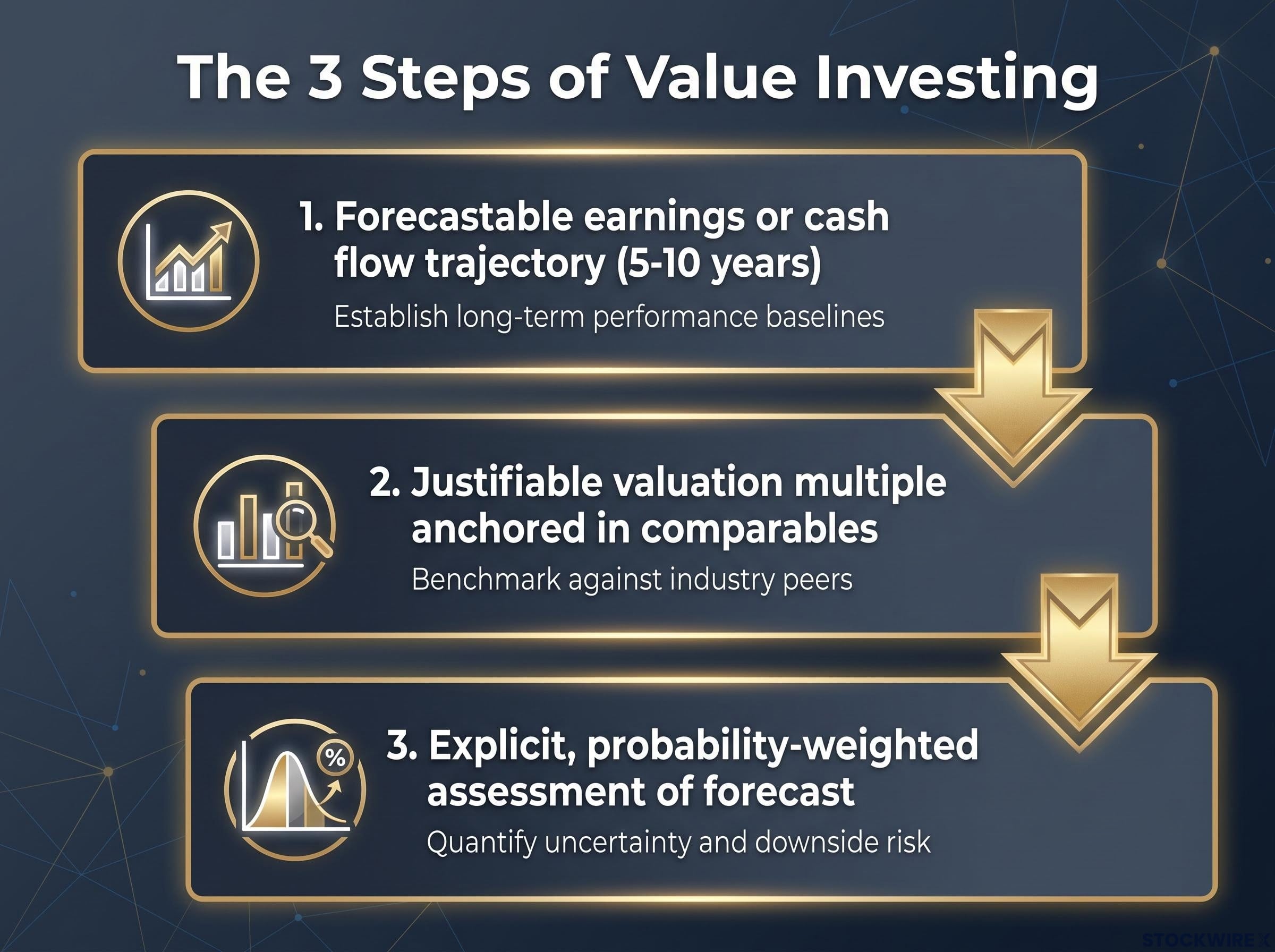
Value investing is not a philosophy about buying cheap assets. It is a three-step process, and skipping any step means you are no longer doing value investing in the disciplined sense, even if you think you are. Marks defines analytical investing as buying assets at a demonstrable discount to a well-reasoned intrinsic value estimate, grounded in cash flows you can model and probabilities you can defend.
A margin of safety calibrated to business quality, 30% for high-moat predictable businesses and 40-50% for cyclical or leveraged firms, requires a modellable intrinsic value estimate as its foundation, which is precisely the input the article has established is unavailable for most pure-play AI companies.
The three requirements, in order:
- A forecastable earnings or cash flow trajectory over five to ten years. You need a view on revenues, margins, capital intensity, and competitive dynamics, modelled with enough specificity to produce a number you would defend.
- A justifiable valuation multiple anchored in comparables. Different business models support different price-to-earnings or enterprise-value-to-EBITDA ranges, but those ranges must be tethered to economics, not enthusiasm.
- An explicit, probability-weighted assessment of how likely your forecast is to be correct. This is the step most investors skip, even with conventional stocks. It is also the step that separates analysis from guessing.
If you run your own process against those three requirements and find that any one of them is missing, what you are doing is not value investing. That is the honest starting point for everything that follows.
When big ASX news breaks, our subscribers know first
Where the process collapses when you try to apply it to an AI company
What the model requires
Each of those three steps depends on stable, knowable inputs. For a mature business, those inputs exist in financial statements, comparable company data, and observable competitive dynamics. You can argue about the assumptions, but you are arguing within a range that history and evidence constrain.
Where each requirement fails for AI companies
For a frontier AI company like Anthropic or OpenAI, none of the required inputs are available with the precision the methodology demands. The dominant use cases have not settled. Pricing models are still experimental. The regulatory environment is unresolved. Competitive structure shifts quarterly. Long-run compute costs remain a moving target.
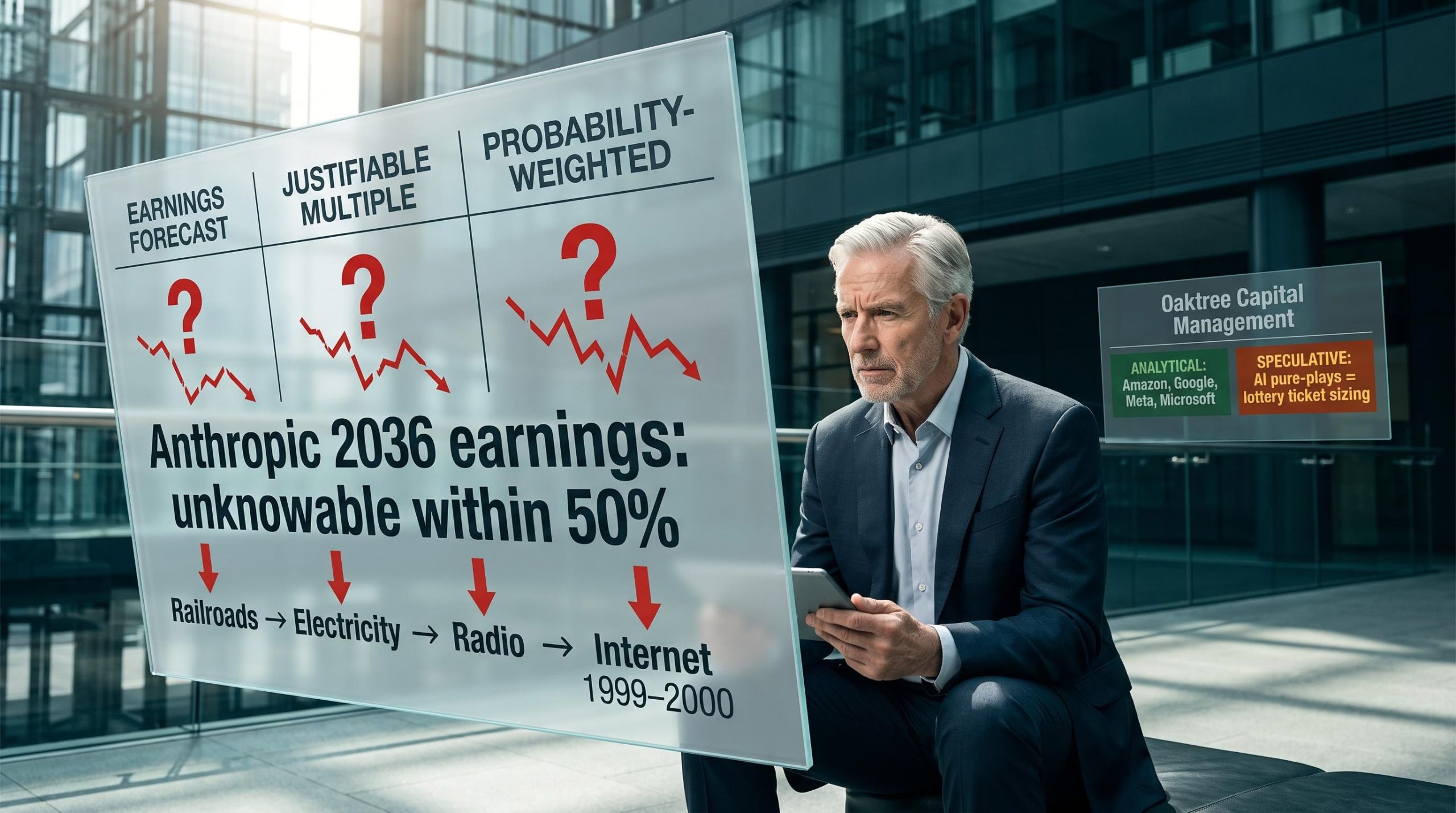
Marks has argued that any analyst who claims to know Anthropic’s net earnings for 2036 within a 50% margin of error is not working from evidence, but from assumption, because the underlying inputs that would make such a projection defensible simply do not exist yet.
The concrete numbers behind AI IPO valuations illustrate the methodological problem precisely: Anthropic’s implied forward price-to-sales multiple of approximately 22x is derived from third-party projections rather than any company-disclosed financial data, making the denominator of the multiple itself an assumption rather than a measurement.
That illustration, drawn from his podcast commentary and reinforced across his “Is It a Bubble?” memo (December 2025) and “AI Hurtles Ahead” (February 26 2026), makes the conclusion unavoidable: if you cannot generate a defensible, probability-weighted intrinsic value estimate, you are not investing in the analytical sense when you buy these names. The collapse of the process is not a reflection of failure on your part. It is a structural feature of what it means to try to value a company whose economics have no historical precedent and whose key inputs are genuinely unknowable today.
How disciplined investors classify a position they cannot analytically value
Marks uses the word “speculation” as a precise analytical category with a specific technical meaning, not as a dismissal or moral judgement. Understanding the distinction changes how you size your risk.
Marks describes a spectrum:
- At one end: analytical investing in prosaic, understandable companies with stable, modellable cash flows.
- At the other: speculative investing in futuristic companies that cannot be described at all.
- Most pure-play AI names currently sit much closer to the speculative end.
Speculation, in his operational definition, means forecasting without honestly accounting for the probability that your forecast is wrong, or, in the case of most AI companies, without having a coherent earnings forecast at all. In his view, investing without that rigour is closer to placing a bet than conducting analysis.
Marks does not say speculation should be avoided entirely. He says it must be named honestly, and position sizing must reflect the actual risk profile, not a false sense of analytical rigour. For you, re-labelling a position from “value investment” to “speculation” is not a defeat. It is a risk management instruction: the position must be sized as a lottery ticket, not a core holding, and losing most of your capital in it is a real, acceptable outcome you need to have already priced into your decision.
FINRA guidance on speculative investment risk reinforces this sizing principle: positions whose underlying economics cannot be verified carry a realistic probability of total capital loss, and position sizing must be calibrated to that outcome rather than to an optimistic base case.
The technology being real does not make the stock fairly priced
Here is the logic that costs retail investors the most money: “AI is genuinely transformative, therefore AI stocks are good investments.” Both halves of that sentence can be true independently, and conflating them is the error that causes overpaying.
Marks frames this directly: AI technology being real and AI stocks being fairly priced are two different things.
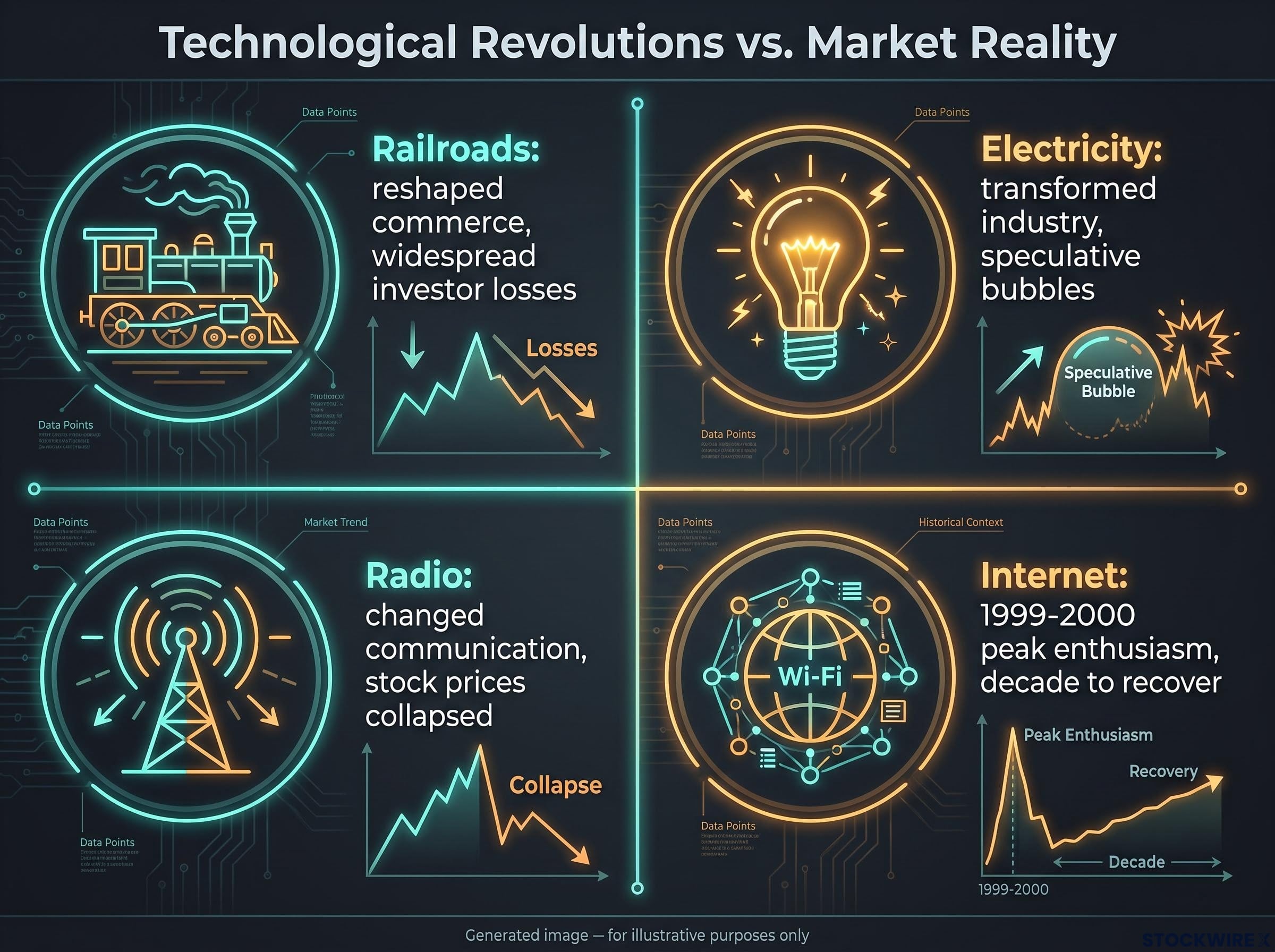
History reinforces the point. Marks cites the same pattern across multiple genuine technological revolutions:
- Railroads reshaped commerce and produced widespread investor losses.
- Electricity transformed industry and generated speculative bubbles.
- Radio changed communication and saw stock prices collapse after initial euphoria.
- The internet created trillions in economic value, but many investors who bought at peak enthusiasm in 1999-2000 waited more than a decade to recover.
Marks has explicitly noted that whether the current AI enthusiasm constitutes a bubble is not yet determinable, and that recognition is itself a significant analytical statement. The uncertainty is genuine, which is another reason the valuation method breaks down.
Multiple AI bubble frameworks, including the Shiller CAPE ratio at 40-41 and Minsky’s financing stage analysis, converge on the same structural reading that Marks identifies from a value investing lens: the uncertainty is genuine, and the tools for resolving it have not yet produced a clear verdict.
What this gives you is permission to hold two things simultaneously: confidence that AI is a genuinely transformative technology, and scepticism about whether the stocks currently available to buy reflect fair value or extreme optimism already embedded in the price. Those are not contradictory positions. They are the intellectually honest ones.
What a disciplined investor actually does when they cannot reliably value an asset
Marks’ core guidance is neither all-in nor all-out. As he has stated in Oaktree commentary, committing everything to AI without honestly confronting the possibility of severe losses is reckless, but standing aside entirely and forfeiting exposure to a potentially generational shift in technology is its own form of error. The middle path is not timidity. It is the only analytically honest position.
That middle path has two sides. Marks distinguishes between AI exposure through established, cash-generating companies, specifically Amazon, Google, Meta, and Microsoft, whose AI investments sit on top of analysable earnings streams, and speculative pure-play startups that should be sized like lottery tickets. The hyperscalers can fund AI build-outs without betting the company. Their existing economics are modellable. Most AI startups’ economics are not.
Before you buy or hold any AI position, Marks’ framework implies four diagnostic questions:
- Can you model the earnings path? Can you articulate a plausible earnings trajectory and competitive position five to ten years out, and assign a realistic probability to being roughly right?
- Does the price reflect genuine value? Does today’s price represent a clear discount to your probability-weighted intrinsic value, or is it simply a bet that enthusiasm will continue?
- Are you getting exposure the right way? Is your AI exposure coming through profitable, diversified tech giants with analysable economics, rather than concentrated bets on speculative, loss-making startups?
- Is your position size honest about uncertainty? Is your sizing consistent with the level of uncertainty, small for speculative names, larger only where cash flows are genuinely modellable?
| Analytically accessible AI exposure | Speculative AI exposure | |
|---|---|---|
| Earnings visibility | Existing cash flows from established businesses; AI layered on top of modellable revenue streams | No proven earnings model; revenue projections are narrative-based, not evidence-based |
| Position sizing guidance | Can be sized as a core holding, supported by analysable economics | Should be sized as a lottery ticket; total loss of capital is a realistic outcome |
| What you are actually betting on | Continued cash generation from an established business, with AI as an upside catalyst | A future that may or may not materialise, at a price that already embeds extreme optimism |
The practical implication: you likely need to reclassify, rather than exit, your AI positions. Move concentrated speculative names into small, explicitly labelled speculative sizing. If you want genuine AI exposure, shift weight toward cash-generating companies whose economics you can actually analyse. Marks himself often allocates capital to cheaper, more cyclical areas, including shipping, energy, resources, and emerging markets, while waiting for AI economics to clarify.
What changes when AI economics become clearer, and how to recognise when that moment arrives
Waiting for AI cash flows to appear in financial statements is not the same as sitting out. It means watching specific signals and being ready to move when the analysis becomes genuinely possible.
Marks points to three signals worth monitoring:
Frontier AI economics remain far from self-sustaining: OpenAI spent $2.22 for every $1.00 of revenue generated in Q1 2026, a cost structure that makes the earnings visibility required for disciplined valuation genuinely unavailable rather than merely uncertain.
- Real end-user demand appearing in revenues, not demos, headlines, or partnership announcements, but sustained purchasing behaviour that shows up in quarterly results.
- Sustained earnings allowing five-year modelling, the moment when analysts can construct defensible forward models based on actual financial performance rather than narrative approximations.
- Valuation multiples that can be anchored in comparable cash-flow businesses, meaning the company’s economics resemble something analysts have successfully valued before.
Until those signals emerge, Marks advocates holding cheaper non-AI assets, including shipping, energy, resources, and emerging markets, rather than forcing capital into frothy names simply to be involved.
There is an honest trade-off here. Waiting may mean paying higher prices later when the economics clarify. Marks views that as the correct exchange: a higher price for a business you can analyse is preferable to a lower price for a business you cannot. The discipline is not in getting the lowest entry point. It is in knowing what you own and why.
Knowing what you are doing with your money, even when the answer is uncomfortable
The honest classification of a position as speculative rather than analytical is itself a risk management act, not a reason to avoid AI entirely. Most retail investors holding AI positions today have never answered those four diagnostic questions honestly. Doing so will produce one of three outcomes: a genuine investment case, a right-sized speculative bet, or an exit. All three are more defensible than the current default of enthusiastic uncertainty.
Marks’ own posture is the model. He is not a technophobe who avoids AI. He is not a fear-of-missing-out buyer. He is an investor who is explicit about what he knows, what he does not know, and how to size his capital accordingly.
“No one should go all-in without acknowledging that they face the risk of ruin if things go badly. By the same token, no one should stay all-out and risk missing out on one of the great technological steps forward.”
That is not a hedge. It is the only honest position available when the inputs your process requires do not yet exist.
This article is for informational purposes only and should not be considered financial advice. Investors should conduct their own research and consult with financial professionals before making investment decisions. These statements are speculative and subject to change based on market developments and company performance.