A bank that spent A$1.2 billion on technology in a single half-year is making one of the largest operational bets in Australian banking history. The tension at the centre of that bet is not the spending itself. It is whether the efficiency gains it was designed to produce are large enough to protect the profitability that justifies Commonwealth Bank of Australia’s premium valuation.
That question stops being theoretical in five days. CBA’s FY26 full-year results land on 12 August 2026, and the numbers will either confirm that artificial intelligence is translating into financial performance or expose a widening gap between operational claims and bottom-line outcomes. Analysts, competitors, and every investor holding CBA at roughly 25 times earnings are about to see the same data simultaneously.
Here is the framework for reading those results with precision: which metrics carry the most weight, what the bank’s AI deployments have actually achieved so far, and why the external pressures bearing down on CBA’s lending book mean the efficiency thesis is facing a harder test than the bank’s own communications have fully acknowledged.
A$1.2 billion in one half-year: what CBA is actually spending on
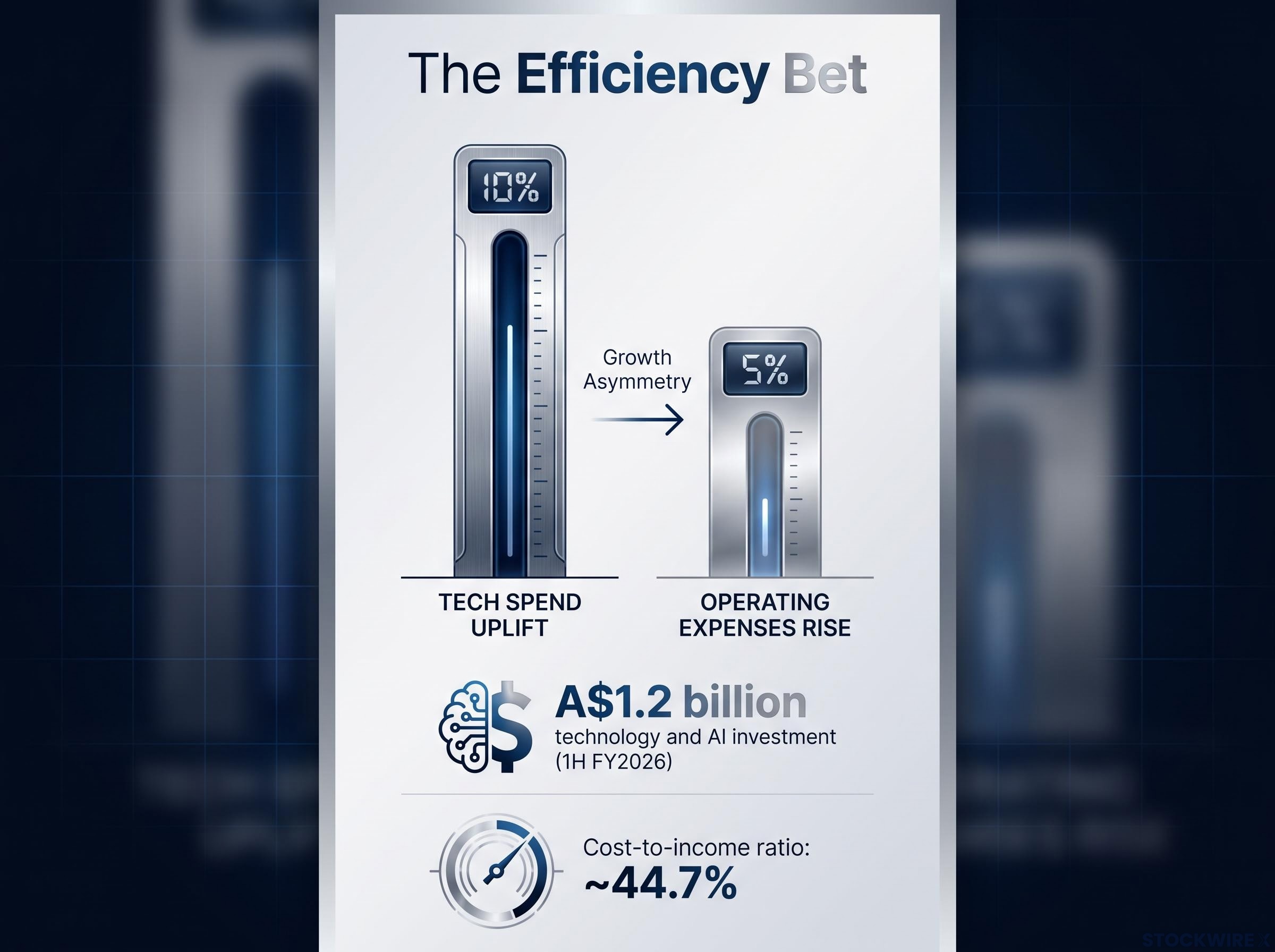
During the first half of FY2026 (the six months ended December 2025), CBA directed A$1.2 billion into technology and AI investment, a figure that represents a 10% uplift compared with the same period a year earlier. Total operating expenses rose 5% over the same period. Technology spending is growing at twice the rate of the overall cost base.
That asymmetry is not accidental. It is the financial signature of a bank deliberately front-loading costs on the bet that automation will flatten or reduce cost growth later. Whether that bet is already paying off, or is still being made, is the question the 12 August results need to answer.
The AI cost thesis for Australian banks rests on operating leverage mathematics: Macquarie estimates every 1% reduction in labour costs translates to approximately 2.7% profit improvement across the sector, a multiplier that explains why the market has already begun pricing the efficiency narrative into valuations well before it appears in reported financials.
CBA invested A$2.3 billion across FY2025 in modernising systems, migrating data, and building engineering and AI capabilities, making the current run-rate a continuation of a multi-year programme rather than a one-off spike.
The bank’s total annual investment spend sits at approximately A$2.3-2.4 billion, with the vast majority allocated to technology. The key areas absorbing that capital include:
- Infrastructure modernisation and core systems overhaul
- Generative AI deployment across operations
- Economic crime capabilities (more than A$1 billion in a single year directed here)
- Data migration and engineering capability build-out
This is not a budget cycle anomaly. It is a structural commitment with a long payoff horizon, and every dollar of it needs to earn its way back through the cost-to-income ratio.
When big ASX news breaks, our subscribers know first
From labs to ledger: the AI capabilities CBA has actually deployed
Leadership hires as a strategic signal
The people CBA is recruiting tell you as much as the money it is spending. Victoria Ledda, who came to CBA from Goldman Sachs, has taken on the Group Chief Information Officer position. Rodrigo Castillo, whose background includes senior roles at HSBC, has been named Group Chief Technology Officer. Both appointments are effective 1 July 2026, drawing from global institutions that treat technology as a competitive weapon rather than a back-office function.
The bank has also created and filled the position of Chief AI Scientist, which it describes as the first such role within an Australian bank. The appointment is intended to bring rigorous scientific oversight to AI deployment, moving beyond reliance on external vendor implementations. In a further demonstration of its AI ambitions, CBA arranged an internal summit at which OpenAI CEO Sam Altman appeared, underscoring the depth of the bank’s executive-level engagement with OpenAI alongside the formal multi-year partnership the two organisations have established.
Where the AI is operating today
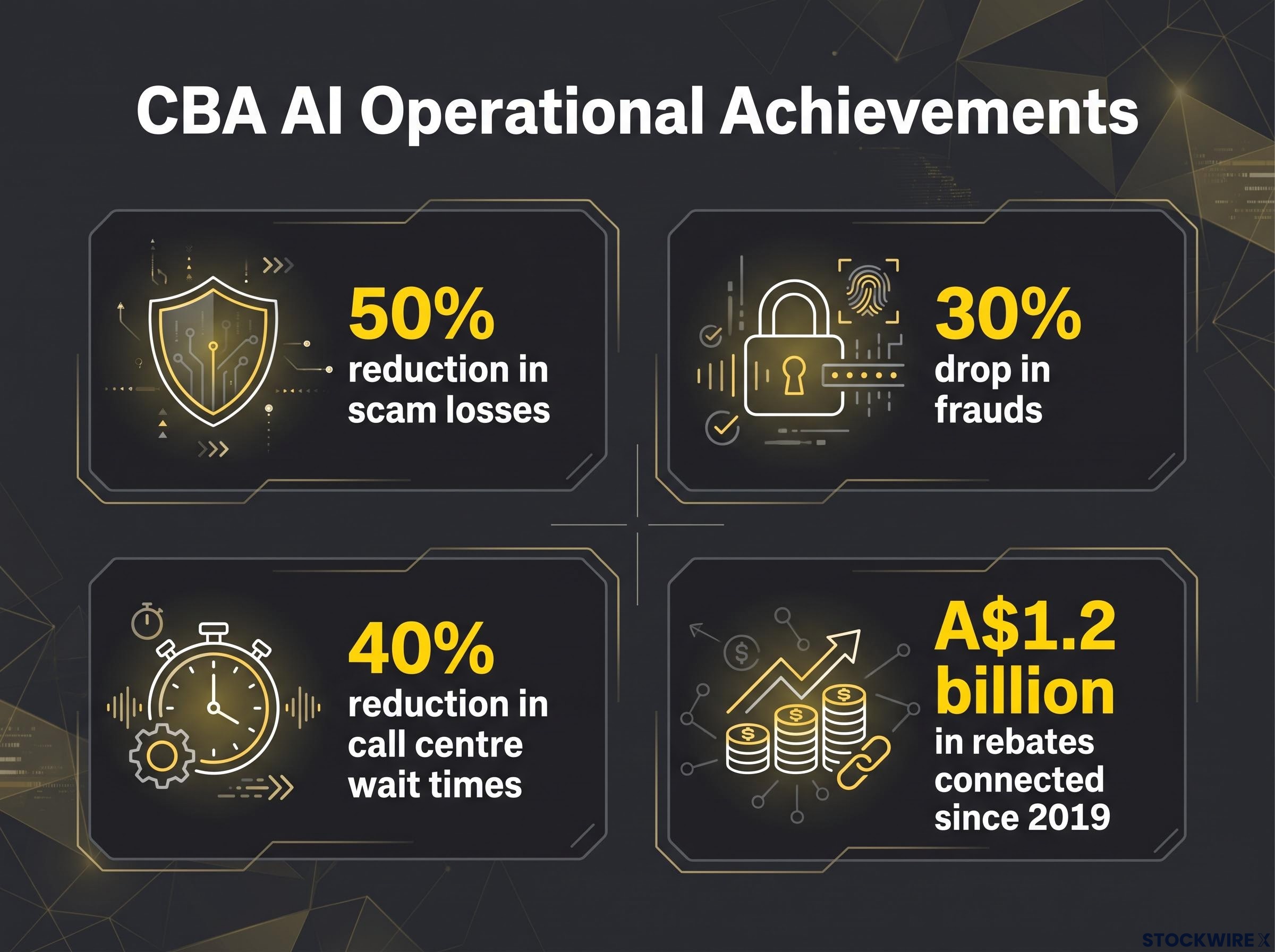
The operational metrics CBA has publicly confirmed are not pilot-scale results. They are changes at production scale:
- 50% reduction in customer scam losses, powered by NameCheck, CallerCheck, and CustomerCheck features
- 30% drop in customer-reported frauds, supported by generative-AI-powered suspicious transaction alerts
- 40% reduction in call centre wait times over the last financial year, driven by AI-powered in-app messaging
- A$1.2 billion in government rebates connected to customers via the Benefits Finder AI tool since 2019
| AI deployment area | Confirmed metric | Maturity level |
|---|---|---|
| Scam and fraud detection | 50% scam loss reduction; 30% fraud drop | Mature, at scale |
| Customer service | 40% call centre wait time reduction | Mature, at scale |
| Benefits identification | A$1.2B in rebates connected since 2019 | Mature, at scale |
| Credit underwriting automation | Not yet publicly quantified | Emerging |
These are the inputs to the efficiency equation CBA is trying to close. A 50% reduction in scam losses and a 40% reduction in call centre wait times are not experimental outcomes; they represent real operational cost reductions. The question for investors is whether those reductions are now showing up in the financial statements, or whether they remain operational achievements that have not yet moved the needle on the cost-to-income ratio.
Why the cost-to-income ratio is the number that matters most
The cost-to-income ratio measures operating costs as a share of revenue. It is the single most direct way to assess whether a bank’s spending is productive. CBA’s current ratio sits at approximately 44.7%.
Rigorous ASX bank stock analysis centres on four metrics that conventional equity frameworks routinely underweight: net interest margin, return on equity, CET1 capital adequacy, and the cost-to-income ratio, the last of which carries the most diagnostic weight for a bank like CBA whose premium is built on cost efficiency rather than margin expansion.
Here is the financial logic that makes this number the fulcrum of the entire AI thesis:
- AI automation reduces unit costs (fewer fraud losses, lower call centre load, faster credit decisions)
- Lower unit costs improve the cost-to-income ratio, even if revenue growth is modest
- An improved ratio defends net interest margin (NIM) and return on equity (ROE), which are the foundations of CBA’s valuation premium
According to CEO Matt Comyn, the principal way CBA plans to defend both its net interest margin and its valuation premium is through the operational efficiency that AI delivers. With limited scope to expand market share in core areas like mortgages, the primary lever is cost efficiency.
That framing is important because it tells you what management is optimising for. CBA is not promising AI will generate new revenue streams. It is promising AI will make the existing business cheaper to run, preserving profitability in an environment where top-line growth is constrained.
The cost-to-income ratio is not just an accounting line. It is the market’s primary test of whether CBA’s AI spending is productive or merely expensive. If you are evaluating the 12 August results, this is the number that either holds the premium valuation together or begins to crack it.
The headwinds AI cannot optimise away
The efficiency thesis does not exist in isolation. Three categories of external pressure are bearing down on CBA, and none of them can be solved by better algorithms.
- NIM compression from competitive mortgage pricing and rate-sensitive deposits
- Credit cycle normalisation as the unusually benign environment potentially shifts
- Policy risk to investor lending from expected federal Budget measures
Sector-wide pressures on margin and credit
Competitive mortgage pricing across the major Australian banks continues to compress net interest margins. AI can soften the impact through lower unit costs, but it cannot change the pricing environment itself. The margin pressure is structural, not cyclical.
On credit quality, peer signals suggest the benign conditions may be ending. NAB’s recent results pointed to weakening mortgage demand alongside a rising volume of loans moved onto watch lists. The same results included data indicating a 15% contraction in home loan applications, though this specific number has not been independently verified and should be treated as indicative rather than confirmed. CBA’s own risk disclosures emphasise close monitoring of arrears and watchlist migration, outcomes driven by the macro cycle rather than controllable by AI alone.
The policy risk unique to CBA’s lending book
CBA holds the largest share of investor home loans among Australian lenders, a position that creates specific exposure to policy changes. Proposed federal Budget measures are anticipated to tighten the negative gearing concession and trim the capital gains tax discount available on property investments.
These are structural demand risks. If tax incentives for property investment are reduced, investor mortgage volumes could contract regardless of how efficiently CBA processes applications. AI can optimise the cost base and sharpen risk management, but it cannot prevent a policy-driven slowdown in the segment where CBA holds its largest competitive advantage.
The transmission channel from negative gearing reform to bank earnings runs through credit volume rather than credit quality: lower investor demand for established properties reduces new mortgage origination in the segment where CBA earns its strongest lending economics, creating a structural revenue headwind that sits outside the cost-efficiency gains AI can deliver.
Each of these headwinds arrives from outside the bank’s efficiency equation. They are not reasons to dismiss the AI strategy, but they are the specific conditions under which that strategy will be stress-tested in the August results and beyond.
Interpreting CBA’s results: the five data points for 12 August
The cost-to-income ratio is the single most important number in the 12 August results. Everything else supports or complicates the story it tells.
These five metrics form the analytical frame through which you can assess whether the AI thesis is advancing or stalling. If the cost-to-income ratio falls and management explicitly connects operational AI metrics to financial KPIs, the investment case strengthens. If technology spend rises without a corresponding efficiency signal, the premium valuation faces a harder question.
| Metric to watch | What to look for | What it would confirm |
|---|---|---|
| Cost-to-income ratio | Falling or holding from ~44.7% despite 10%+ tech spend growth | AI efficiency gains are reaching financial statements |
| NIM and margin guidance | Quantified AI-driven cost offsets to margin pressure, not just qualitative narrative | Efficiency is a concrete margin defence, not a talking point |
| Credit quality (arrears, watchlists, impairments) | Whether AI early-warning analytics are managing loss content at the margin | AI risk tools function under real credit stress, not just benign conditions |
| Forward tech spend guidance | Continuation of A$1.2B half-year run-rate, harvest phase signal, or explicit productivity targets | Management confidence in when the investment cycle delivers returns |
| Scaling of operational AI metrics | Scam, fraud, and call centre metrics explicitly linked to financial KPIs, not presented standalone | Operational achievements are translating into investor-relevant outcomes |
The distinction between qualitative and quantitative framing matters. If management presents AI as a strategic narrative with operational anecdotes, the market will discount it. If management presents specific cost reductions tied to specific AI deployments and maps them to the cost-to-income trajectory, the premium has fresh evidence supporting it.
What the August result will settle, and what it will not
A strong 12 August result can credibly validate several things: that AI-driven efficiency gains are beginning to appear in financial metrics, that the cost-to-income trajectory is moving in the right direction, and that the operational claims management has made over the past two years translate into outcomes investors can independently verify.
What a strong result cannot settle is whether the efficiency gains will be large enough to offset a full credit cycle downturn, whether policy-driven changes to investor mortgage demand will reshape the lending book over the medium term, or whether a 25 times earnings premium is structurally sustainable across a full macro cycle rather than one that has been largely benign.
The broker consensus on CBA valuation has been uniformly bearish since May 2026, with every major analyst house carrying a sell or underperform rating and price targets implying 18-43% downside from levels the stock has since partially recovered from, a backdrop that frames the August result as a credibility test as much as an earnings event.
| What 12 August can settle | What it cannot settle |
|---|---|
| Direction of cost-to-income trajectory | Whether gains offset a full credit downturn |
| Whether operational AI metrics reach financial KPIs | Medium-term impact of negative gearing policy changes |
| Management credibility on technology claims | Structural sustainability of 25x premium across a macro cycle |
The A$2.3 billion invested in FY2025 and A$1.2 billion in 1H26 alone confirm this is a multi-year programme. A single result is a waypoint, not a verdict. It can confirm the direction of travel, but the premium will ultimately be justified or challenged by conditions CBA cannot control and AI cannot fully offset: the credit cycle, competitive pricing dynamics, and government policy on property investment.
The forward-looking question the August result will open, rather than close, is whether CBA’s AI strategy is durable enough to defend the premium in a tougher environment, or whether the bank has so far been stress-tested only in favourable conditions.
This article is for informational purposes only and should not be considered financial advice. Investors should conduct their own research and consult with financial professionals before making investment decisions. Past performance does not guarantee future results. Financial projections are subject to market conditions and various risk factors.