In this reporting season, the headline profit number is almost beside the point. What moves stocks is what management says about next year, not what happened last year.
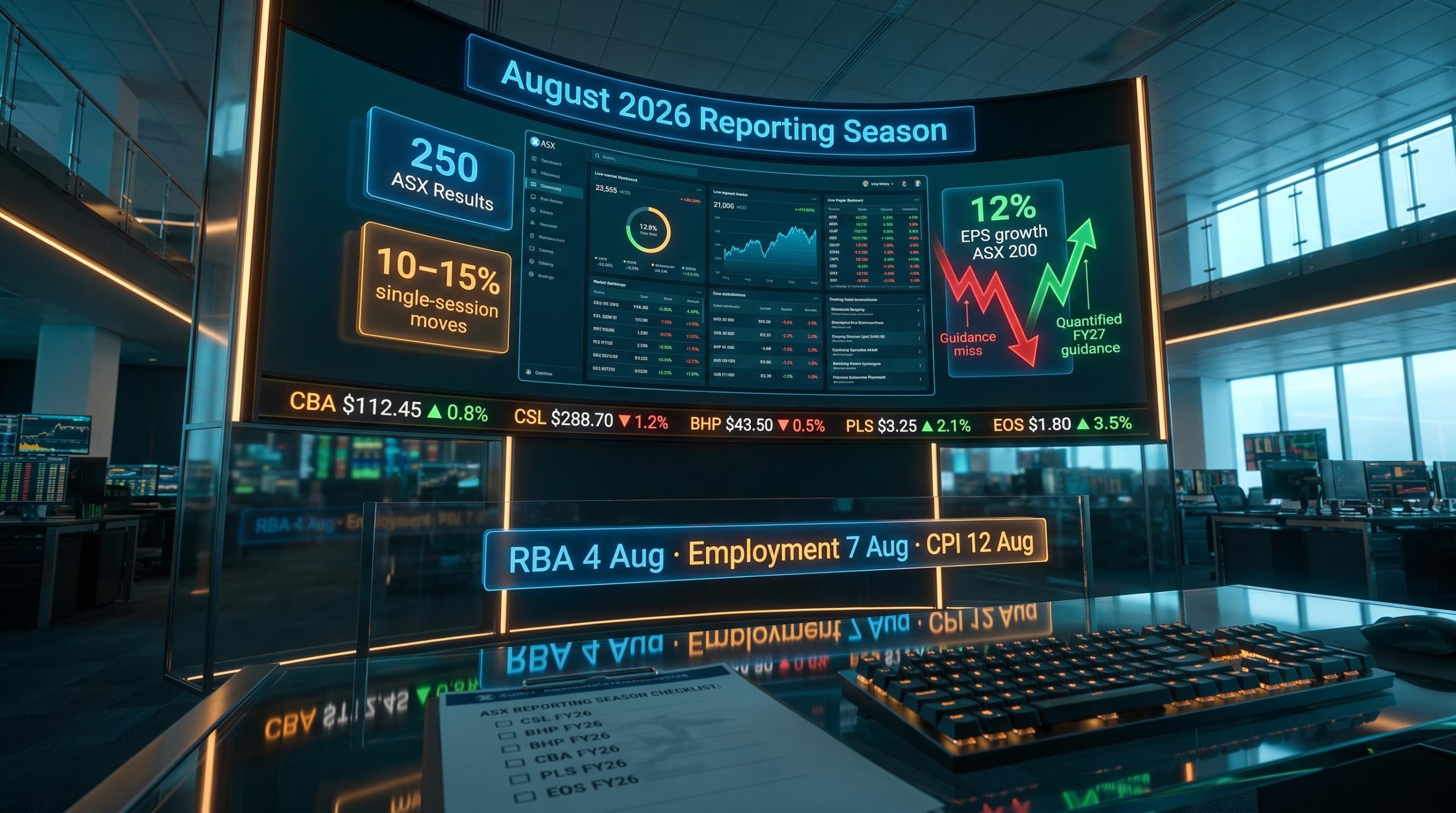
More than 250 ASX results are due across August 2026, and the earnings calendar is running in parallel with a macro calendar that can reshape how investors read every announcement. The RBA delivered its cash rate decision on 4 August, employment data lands on 7 August, and the CPI print arrives on 12 August. Each of those releases will colour the sentiment backdrop as results arrive in waves. The Australian market heads into this season from a lower valuation base than US equities, which makes positive surprises achievable, but also means guidance missteps will be punished sharply.
Here are the three lenses the market is using to judge every result, the six stocks most likely to set the season’s tone, and a practical check you can run on each announcement as it lands.
Why the FY26 number is the last thing to read
A company can post record profits and still fall 10% on the day. It happens every August, and the mechanism is straightforward: algorithmic and institutional flows react aggressively to guidance surprises, producing single-session moves of 10-15% in high-beta sectors including tech, resources, and small-cap growth. The reported number is already priced in. What is not priced in is what management says about next year.
Henry Jennings of Marcus Today has described this as a “participant-driven” market, where hedge funds and trading entities actively seek and exploit vulnerabilities in stocks that merely meet forecasts but deliver cautious outlook commentary. Results must be real, not aspirational.
“This is a participant-driven market. Results must be real, not aspirational.” — Henry Jennings, Marcus Today
Starting from a lower valuation base than US markets, where elevated expectations are already baked into prices, the ASX has a genuine advantage when it comes to beating subdued forecasts. The flipside is that this same dynamic makes the market particularly unforgiving when guidance falls short, given that investors are already positioned for a divergent earnings environment where resources and energy shoulder much of the growth while consumer-facing businesses face pressure.
That 10-15% single-session move range is not random volatility. It is the market’s mechanism for enforcing accountability on management, and it creates both risk and opportunity depending on how you position ahead of key dates. The distinction comes down to what each company says about the future:
ASX reporting season volatility is structurally embedded rather than exceptional: JPMorgan data from February 2026 found more than one third of ASX 200 companies recorded price moves exceeding three standard deviations on their reporting days, the highest rate in the dataset since 2015.
- What the market rewards: clear, quantified guidance with specific revenue and margin drivers; numerical FY27-FY28 ranges tied to macro realities
- What the market punishes: vague references to “ongoing uncertainty” without numbers; withdrawal or repeated deferrals of outlook commentary; qualitative-only language where numbers are expected
When big ASX news breaks, our subscribers know first
Key criteria for assessing company performance
Three criteria now filter every result this season. Each one gives you a specific signal to look for in the numbers, and together they form a framework you can apply within minutes of any ASX announcement dropping, before broker notes arrive and before the market opens.
Capex strategy and allocation
Investors will reward capital expenditure clearly linked to near-term revenue or cost savings, and penalise speculative expansion, particularly in cyclical sectors. For resources names, the scrutiny centres on whether management is spending to grow into favourable prices or spending defensively and presenting it as growth.
- Positive signals: capex aligned to clearly describable revenue outcomes; hurdle rates disclosed; spending matched to balance sheet strength
- Negative signals: expansion projects assuming optimistic commodity price decks; growth capex outpacing free cash flow (FCF, the cash left after operating costs and existing capital spending) without clear justification
Shareholder returns: payouts and repurchases
August is a major dividend announcement window, and Australian investors are highly income-oriented. Franking credits (tax credits attached to dividends paid from already-taxed corporate profits) make fully franked payouts particularly tax-effective for local investors, raising the stakes for any payout decision.
For income-oriented investors, the grossed-up dividend yield is the correct metric to evaluate rather than the face cash yield, because a fully franked payout from a major ASX bank carries an embedded franking credit that can represent an additional 40-plus percent of value for eligible investors including SMSFs in pension phase.
- Positive signals: dividends maintained or increased with strong FCF coverage; buyback extensions alongside solid capital ratios
- Negative signals: dividends held or lifted while operating cash flow deteriorates, often indicating perception management rather than genuine confidence; buybacks paused when the balance sheet appears healthy, which can signal management sees tougher earnings ahead
Management outlook and guidance statements
Guidance is the primary price driver this season. Read the guidance section first, before net profit after tax (NPAT) or earnings per share (EPS) headlines. Note whether management provides numerical ranges or only qualitative language, and compare FY27-FY28 commentary with broker consensus estimates.
- Positive signals: quantified guidance ranges with specific volume, pricing, or cost programme drivers
- Negative signals: repeated qualitative uncertainty language without numbers; refusal to give even directional guidance
| Lens | Positive signal | Red flag |
|---|---|---|
| Capex discipline | Spending linked to near-term revenue; hurdle rates disclosed | Expansion assuming optimistic commodity prices; leverage rising to fund growth |
| Shareholder returns | Dividends and buybacks backed by strong FCF | Payout maintained while operating cash flow deteriorates or debt rises |
| Forward guidance | Quantified FY27-FY28 ranges with named drivers | Vague uncertainty language; guidance withdrawn or deferred |
The stocks likely to set the season’s tone
Six stocks collectively cover banks, healthcare, resources, defence technology, and small-cap med-tech. How each result lands will signal the health of those sectors for the rest of FY27. A sharp post-result move in any of these names is often the first indicator of whether a sector thesis is intact or under revision.
| Stock | Reporting window (approx.) | Primary focus | Key risk |
|---|---|---|---|
| CBA | ~12 August* | NIM trajectory, credit quality, final dividend | Crack in credit story triggers broad bank de-rating |
| CSL | ~18 August* | Plasma margins, FX impact, FY27 growth guidance | Good result that is not good enough for the valuation |
| COH | Late August* | Implant volume growth, reimbursement trends | Slower structural demand or competitive pressure |
| PLS | Mid-late August* | Realised lithium prices, unit costs, capex credibility | Aggressive capex funded by rising leverage at trough prices |
| EOS | Mid-season* | Revenue conversion from backlog, operating leverage | Revenue slippage in a sector trading on enthusiasm |
| 4DX | Late season* | Recurring revenue, US scanner installations | Momentum narrative unsupported by hard commercial numbers |
*All reporting dates are approximate and unverified.
Commonwealth Bank (CBA)
CBA is the season’s most consequential single result. It trades on a premium price-to-earnings (P/E) and price-to-book (P/B) ratio relative to major bank peers, justified by higher return on equity (ROE) and stronger technology capability. The net interest margin (NIM, the difference between what a bank earns on loans and pays on deposits) trajectory, home loan arrears data, and final dividend will either support or crack the bank sector premium that underpins a large share of retail and superannuation portfolios.
CSL Limited
CSL is a top-10 ASX stock with a history of mid-teens earnings growth, but this is a name where the danger is a good result that is not good enough. Currency exposure is material: CSL earns heavily in US dollars but reports in Australian dollars, so FX swings can materially affect reported growth. Plasma cost normalisation, R&D capex discipline, and quantified FY27 guidance are the price drivers.
Cochlear (COH)
Cochlear trades on a multi-year growth premium with high expectations already embedded. Implant volume growth across the US, Europe, and China, particularly as elective procedure volumes normalise, is the primary variable. Any hint of reimbursement pressure from insurers or government payers, or more aggressive competitive dynamics, could prompt sharp multiple compression.
Pilbara Minerals (PLS)
Pilbara Minerals is the retail sentiment proxy for Australian lithium. Prices remain well below peak levels, so investors will examine margin resilience and unit cost discipline carefully. Whether management’s capex plan credibly balances future upside against the price trough, without funding expansion through rising leverage, is the pass-or-fail test.
Electro Optic Systems (EOS)
EOS operates in the defence technology space and has built a reputation for translating contract wins into recognised revenue more effectively than a number of its ASX peers. Revenue recognition versus backlog is the key distinction: how much contracted work is turning into booked revenue, and whether any recognitions are being pushed out. Any slippage in recognition timing will be punished in a sector trading on enthusiasm rather than demonstrated earnings.
4DX
4DX is the small-cap momentum test. The market needs hard numbers on recurring revenue growth and US scanner installations to sustain current valuations. A rising share of recurring revenues (software, service, and usage fees) from installed systems would support a higher-quality earnings profile. Qualitative commercialisation optimism without those numbers is unlikely to be enough.
The broader picture: what banks, miners, and consumer names are signalling
The wider reporting calendar creates a running sector-by-sector temperature check throughout August. Each major result can be read as part of a pattern rather than in isolation.
Brokers describe a “multi-speed” economy this season: resources and energy carry more of the earnings burden, while consumer-facing names face a more challenging downgrade cycle.
The bank cluster arrives first. Westpac’s Q3 update (approximately 10 August), CBA (approximately 12 August), ANZ (approximately 13 August), and NAB (approximately 17 August) will collectively determine whether the sector’s NIM and credit quality story holds or deteriorates. The major miners follow: BHP (approximately 18 August), Fortescue (approximately 24 August), and Woodside (approximately 25 August) test whether capex discipline and commodity price assumptions hold up. Prior quarterly production releases mean miners have already put volumes, unit costs, and commodity price realisations on the public record, giving investors a solid foundation for estimating full-year outcomes before the formal results arrive.
The consumer and defensive names arrive later: Telstra (approximately 13 August), Goodman Group (approximately 20 August), Woolworths (approximately 26 August), and Wesfarmers (approximately 27 August). These results are the read-through on consumer spending durability and cost-of-living pressures. The macro data calendar, with the RBA on 4 August, employment on 7 August, and CPI on 12 August, sits inside this earnings sequence and will colour how investors interpret each wave.
Consumer spending durability is one of the most contested macro questions entering the late-August results wave, with Australian dwelling prices down 0.4% in June 2026 and consumer sentiment at 80.6, well below the neutral threshold of 100, creating a deteriorating confidence backdrop that the Woolworths and Wesfarmers results will need to navigate.
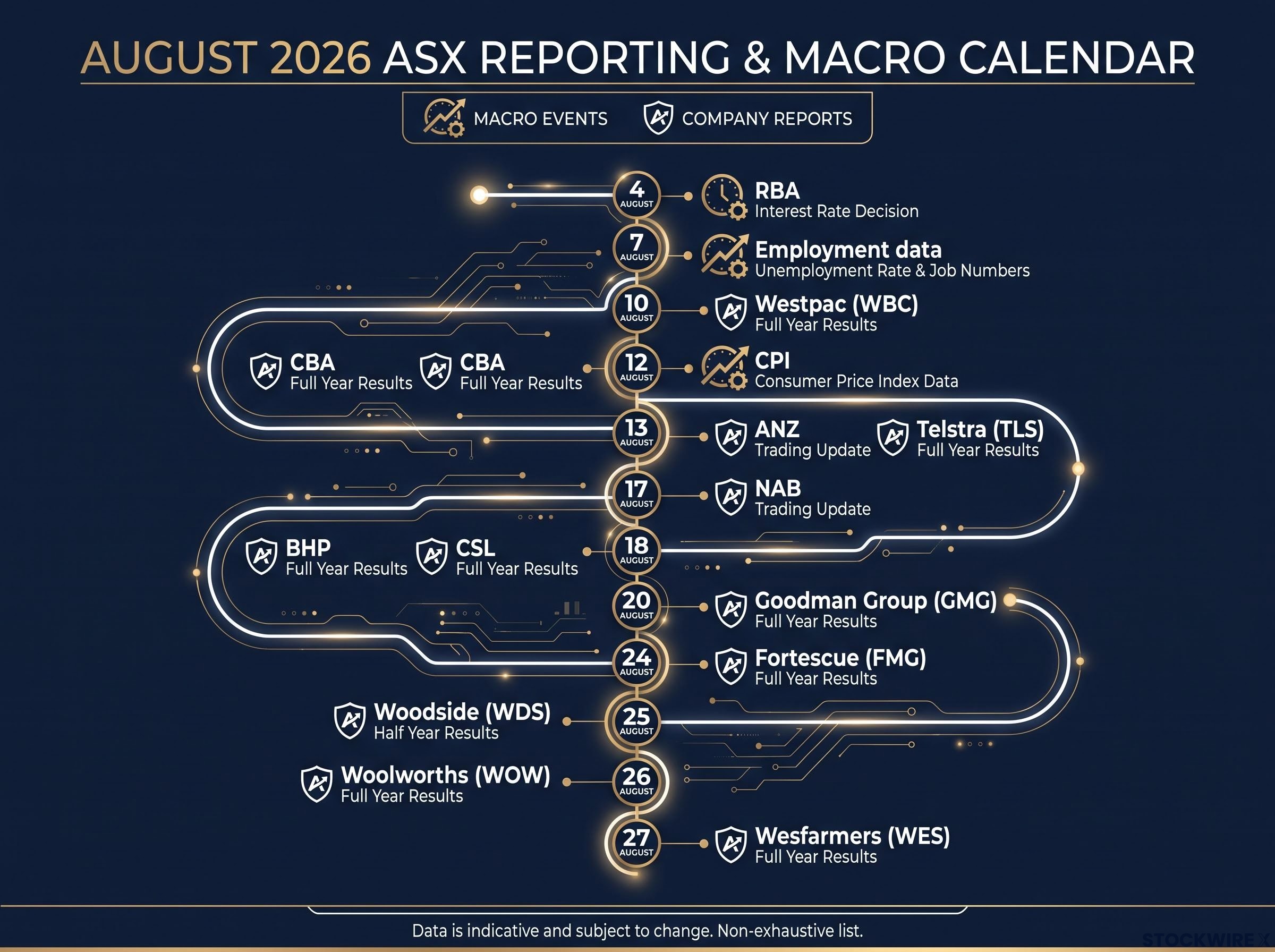
| Approximate date | Company | What to watch |
|---|---|---|
| ~10 August* | Westpac (WBC) | Q3 NIM trends, credit quality signals |
| ~12 August* | CBA | FY26 result, final dividend, credit quality |
| ~13 August* | ANZ | Q3 update, institutional bank margin pressure |
| ~13 August* | Telstra (TLS) | FY26 result, mobile ARPU, NBN margin |
| ~17 August* | NAB | Q3 update, business lending growth, provisions |
| ~18 August* | BHP | FY26 result, iron ore realised prices, capex discipline |
| ~20 August* | Goodman Group (GMG) | FY26 result, data centre pipeline, development margins |
| ~24 August* | Fortescue (FMG) | FY26 result, cost per tonne, dividend and capital return |
| ~25 August* | Woodside (WDS) | HY26 result, LNG pricing, project capex |
| ~26 August* | Woolworths (WOW) | FY26 result, food inflation pass-through, cost pressures |
| ~27 August* | Wesfarmers (WES) | FY26 result, Bunnings margin, lithium division update |
*All reporting dates are approximate and unverified.
Tracking results by sector wave rather than by individual stock date gives you a way to build a running picture. A deteriorating consumer picture in the late-August names, after a bank sector that has already flagged credit stress, would represent a compounding signal worth acting on.
The August seasonal return pattern across 45 years of ASX 200 data shows a 0.71% average price gain with a 61% positive-close frequency, but concentrated earnings-day swings from heavyweight banks and miners, which represent roughly 45% of the ASX 300, have repeatedly overridden that seasonal tailwind in a single session.
A practical checklist for every result that lands
The single most important habit change this season: read the guidance section first, before the NPAT headline. That one discipline shift would have prevented the most common post-results mistake of the prior two seasons: selling a stock that beat earnings but initially fell on cautious guidance, before re-reading the guidance and realising it was in line with expectations.
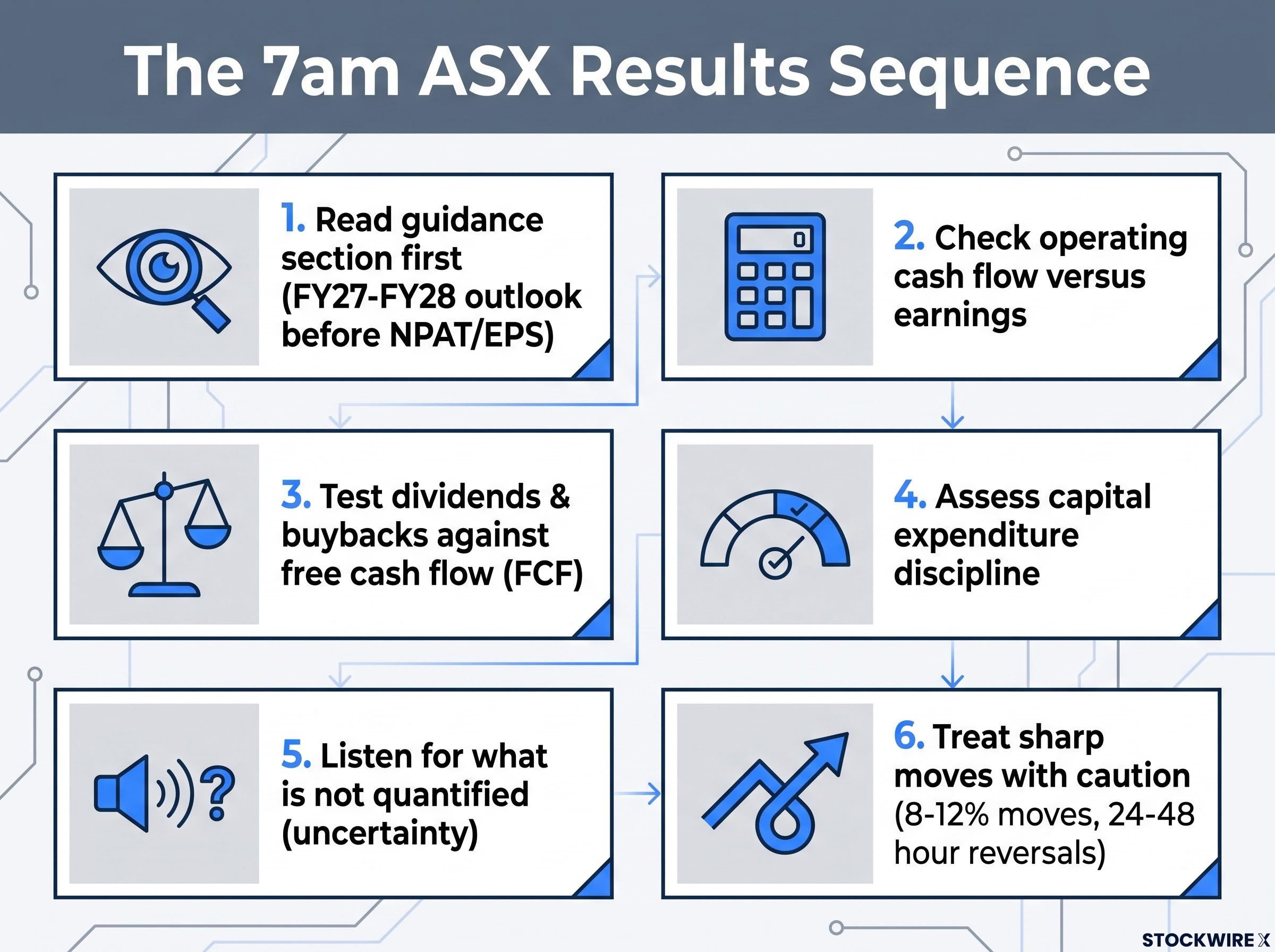
Here is a six-step sequence you can run in order at 7am when an ASX announcement drops:
- Read the guidance section first. Locate management’s FY27-FY28 outlook before reacting to NPAT or EPS. Note any numerical guidance ranges and compare with consensus where available.
- Check operating cash flow versus earnings. Strong NPAT paired with weak operating cash flow warrants investigation. Look for explanations involving working capital movements, one-off items, or accounting adjustments.
- Test dividends and buybacks against free cash flow. A stable or growing dividend funded by strong FCF is a confidence signal. A payout maintained via higher debt or asset sales is a warning, not generosity.
- Assess capital expenditure discipline. Is capex aligned to clearly describable revenue or cost outcomes? Does it match management’s own commentary on cycle conditions and balance sheet strength?
- Listen for what is not quantified. Repeated references to “uncertainty” without numbers, or refusal to give even directional guidance, often signal internal management caution, not just prudent communication.
- Treat sharp moves with caution, not instant conviction. An 8-12% move on result day is common in a participant-driven market where hedge funds and algorithms trade guidance surprises. Before buying the dip or chasing the pop, re-read guidance and cross-check with broader sector and macro context. These initial algorithmic reactions often reverse within 24-48 hours once analysts have published their guidance assessments.
What a strong season looks like from here, and what would change the story
Analysts forecast approximately 12% EPS growth for the ASX 200 in FY26, though this figure is unverified. Investor expectations are described as subdued heading into the season, which makes positive surprises achievable but raises the cost of guidance disappointments.
A constructive season would look like this: CBA and the bank cluster deliver stable NIM and reassuring credit quality; CSL and Cochlear provide mid-term growth confidence; resources names show capex discipline and credible guidance; EOS and 4DX convert their thematic narratives into hard commercial numbers. That combination would give the market a credible earnings base to build on for the second half of FY27.
A deteriorating season would look different: bank credit quality cracks, consumer-facing names deliver downgrades, guidance across multiple sectors is withdrawn or heavily qualified, and the lower-valuation-base advantage is eroded by a wave of earnings revisions. The CPI print on 12 August and the employment data on 7 August are the macro catalysts most likely to tip the aggregate reading in one direction or the other mid-season.
The indicators to track in real time as results accumulate:
- Bank NIM commentary trend across the four major bank updates
- The proportion of reporting companies withdrawing or heavily qualifying guidance
- Aggregate earnings revision direction (upgrades versus downgrades) as broker notes are published
- Commodity price deck assumptions embedded in resources capex plans
- Consumer-facing names’ commentary on spending patterns and cost-of-living pass-through
The divergence between these two scenarios is not just a sector story. It is the difference between a second half of FY27 where the market builds on a credible earnings base and one where it spends the following months recalibrating to a lower consensus. Having both scenarios mapped in advance allows you to make deliberate, pattern-based decisions as results accumulate, rather than reactive ones driven by individual result-day noise.
This article is for informational purposes only and should not be considered financial advice. Investors should conduct their own research and consult with financial professionals before making investment decisions. Past performance does not guarantee future results. Financial projections referenced are subject to market conditions and various risk factors. All reporting dates cited are approximate and have not been independently verified.
—