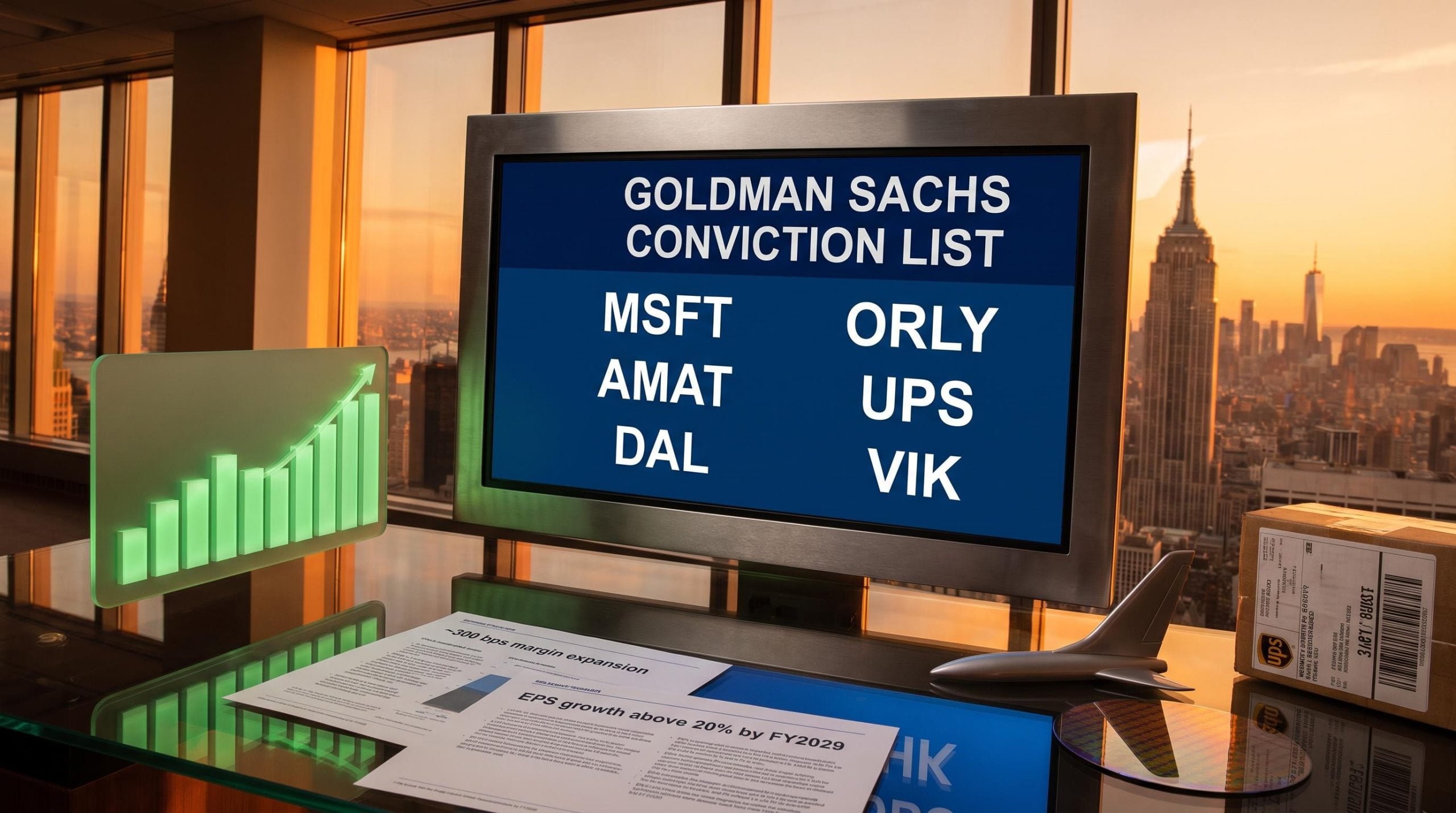
Goldman Sachs just refreshed its U.S. Conviction List, adding six stocks the firm believes are best positioned as markets broaden beyond the concentrated leadership of the past two years. This is not a routine ratings update. The Conviction List is where Goldman’s analysts place their highest-confidence, most differentiated ideas, and the August 2026 revision spans six sectors in a single move.
The six additions, Microsoft, Applied Materials, Delta Air Lines, O’Reilly Automotive, UPS, and Viking Holdings, are not united by a single macro bet. They share a different quality: each carries a company-specific catalyst that Goldman’s analysts believe the market has not fully priced. The firm simultaneously removed four names, including Broadcom and ServiceNow, signalling an active rotation rather than a passive expansion of the list.
Here is the investment thesis behind each addition, including the specific projections Goldman’s analysts have attached to several of these names, so you can assess whether any of these ideas belong in your own thinking.
What it means to land on Goldman’s Conviction List
The Conviction List is not just another buy rating. Goldman Sachs covers hundreds of stocks with a Buy recommendation at any given time. The Conviction List is a curated subset of those names, reserved for ideas where analysts have the strongest confidence in near-term outperformance, each backed by an identifiable catalyst.
One distinction worth noting: addition to or removal from the Conviction List does not automatically constitute a formal upgrade or downgrade of the underlying stock rating. A stock can leave the list while retaining its Buy rating if the original catalyst has played out. When Goldman puts a stock on this list, it is telling institutional clients this is where the firm sees its sharpest edge. For retail investors tracking institutional sentiment, that signal carries different weight than a standard rating.
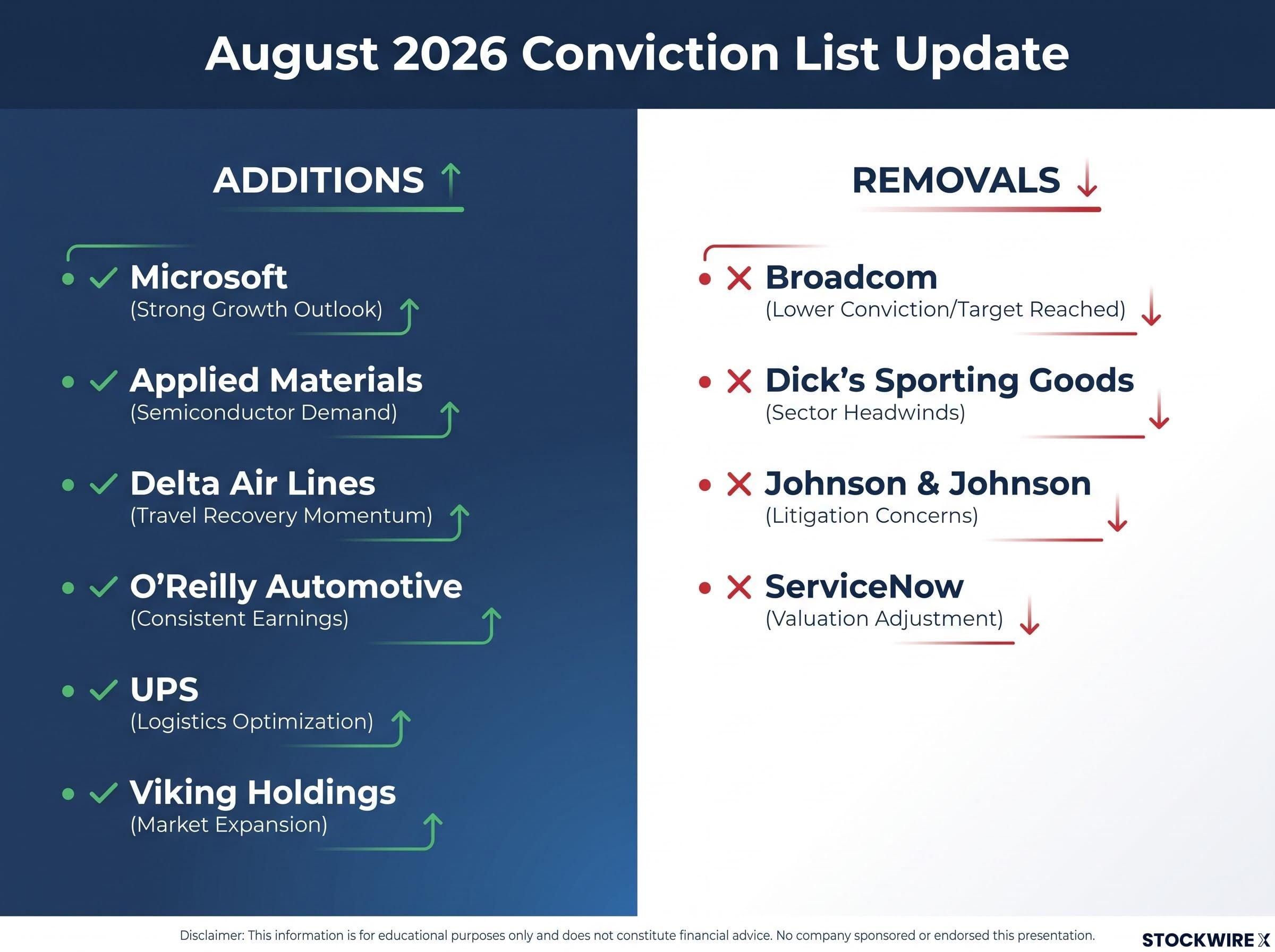
The August 2026 update added six names and removed four:
- Additions: Microsoft, Applied Materials, Delta Air Lines, O’Reilly Automotive, UPS, Viking Holdings
- Removals: Broadcom, Dick’s Sporting Goods, Johnson & Johnson, ServiceNow
The six additions span enterprise software, semiconductor equipment, airlines, auto parts, logistics, and luxury travel, a deliberate diversification signal rather than a concentrated thematic bet.
The same August 2026 revision cycle extended to Goldman’s European coverage, where the firm’s European Conviction List saw Sika and ASML added alongside luxury beauty name Puig, with analyst EPS forecasts running as much as 18% above Street consensus on certain names.
When big ASX news breaks, our subscribers know first
The AI inflection play: Microsoft and Applied Materials
Both of these additions are AI-adjacent, but the earnings mechanisms are structurally different. Microsoft is a software monetisation play. Applied Materials is a capital equipment cycle play. Goldman is making two distinct bets on the same macro trend playing out differently at each company.
Microsoft: the enterprise AI monetisation thesis
Goldman analyst Gabriela Borges placed Microsoft on the Conviction List, anchoring her view on how the AI cycle is evolving as the focus moves away from building foundational infrastructure and towards making AI function practically within large organisations.
Her identified catalysts include progress in Azure growth, gains in AI unit economics, and advancing Copilot adoption across enterprise customers.
Borges pointed to the June quarter results as the moment that validated her thesis, noting that the numbers represented a clear turn from a run of underperformance, with stronger unit economics on AI products among the key drivers.
The enterprise AI monetisation thesis Goldman attaches to Microsoft rests on a dynamic that runs counter to the displacement narrative: AI agents executing multi-step enterprise tasks depend on existing systems of record for authoritative data, making incumbent platforms infrastructure for AI deployment rather than targets for replacement.
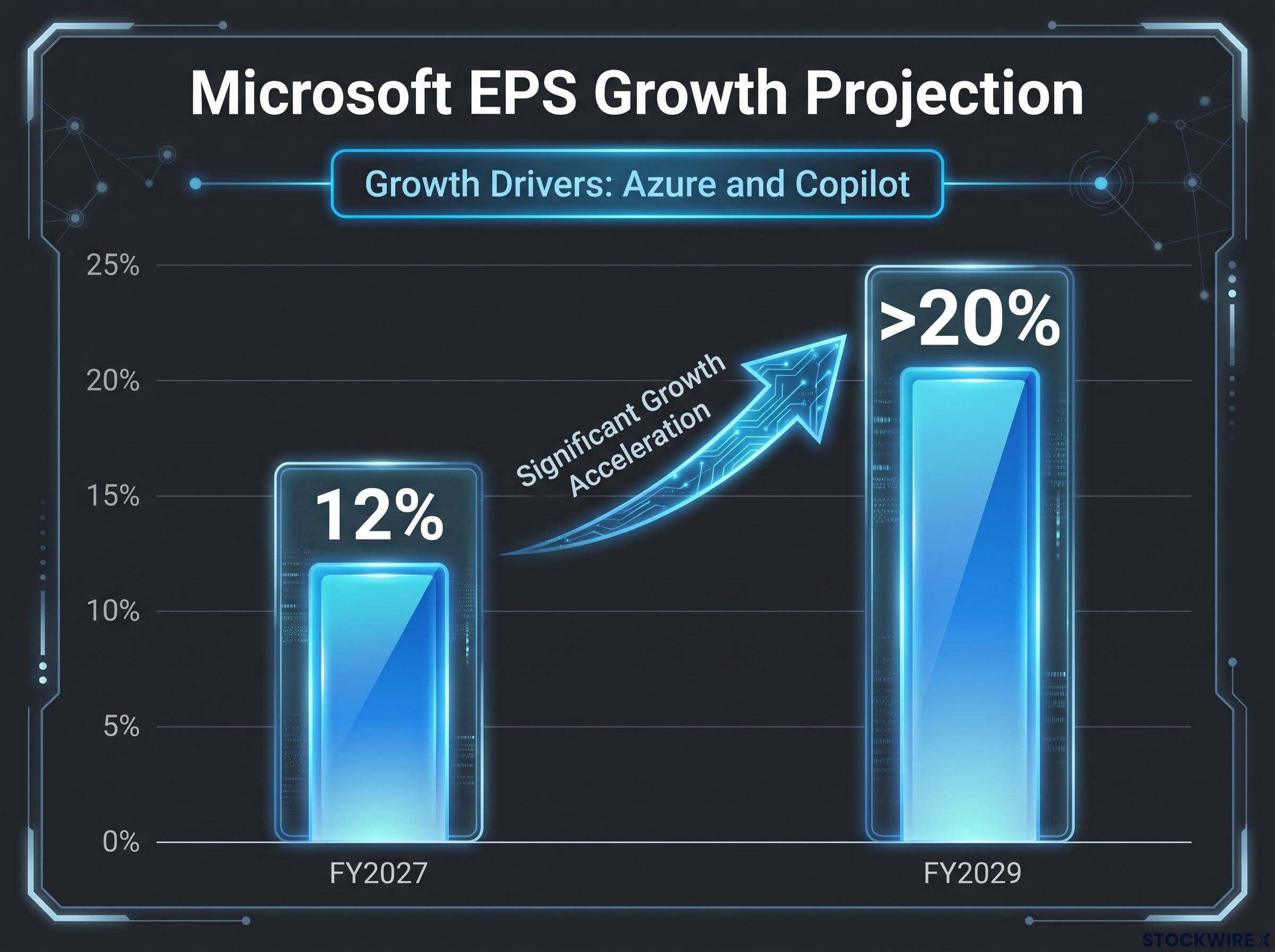
Key projection: Borges forecasts that Microsoft EPS growth will pick up from 12% in fiscal year 2027, reaching above 20% by fiscal year 2029.
For investors already holding broad AI exposure through index funds or megacap tech, this thesis suggests the next leg of AI returns may come from enterprise software monetisation rather than the infrastructure buildout names that led the first wave.
Applied Materials: betting on the equipment cycle
Applied Materials is not an AI company in the way most investors think about the term. Its core business is supplying the deposition and etch tools that chipmakers depend on to build up and precisely shape the layers of circuitry within semiconductors. Capital spending cycles at leading memory producers and major foundries translate directly into demand for this equipment.
Goldman’s thesis here is straightforward: as chipmakers invest in the next generation of memory and logic capacity, Applied Materials is positioned to capture incremental market share among those leading customers. The risk profile differs from Microsoft: this is cyclical upside tied to capital spending at chipmakers, not recurring software revenue.
Pricing power, ageing fleets, and the recovery plays: Delta, O’Reilly, and UPS
The previous section covered where Goldman sees AI-driven opportunity. These three names reveal something different: the firm is also betting on durable, real-economy advantages in industries that rarely generate headlines.
Delta Air Lines: the pricing power premium
Goldman’s analysis placed Delta at the top of the airline sector, viewing it as the carrier best able to take advantage of the stronger fare-setting environment that has taken hold across the industry. The analysis centred on premium cabin economics and the financial contribution of the American Express co-branded card partnership, a durable, non-ticket revenue stream that supports margin expansion independent of fare levels.
Key projection: Goldman projects approximately 300 basis points of margin expansion for Delta over a two-year period.
That margin expansion thesis, built on pricing leverage and AmEx card economics rather than volume growth, is what separates this from a generic airline recovery call.
O’Reilly and UPS: different paths to the same thesis
O’Reilly Automotive is positioned around growth in the professional end of the auto parts market, where workshops and service centres purchase components on behalf of their customers rather than those customers buying parts themselves. The structural tailwind: the average age of the U.S. vehicle fleet continues to climb, meaning more cars need more parts serviced by professionals rather than replaced by new vehicles.
S&P Global Mobility data shows the average age of U.S. light vehicles reached 12.8 years in 2025, a figure that has risen for two consecutive years, reinforcing the structural tailwind Goldman cited when adding O’Reilly to its Conviction List.
UPS is presented as a recovery story following roughly three years of earnings erosion. The post-pandemic volume normalisation period, compounded by labour-related disruption, is largely behind the company. Goldman believes UPS is approaching a revenue and profit turnaround.
| Stock | Sector | Core thesis | Key metric |
|---|---|---|---|
| Delta Air Lines | Airlines | Pricing power and premium cabin economics | ~300 bps margin expansion over two years |
| O’Reilly Automotive | Auto parts | DIFM share gains, ageing fleet tailwind | Not specified |
| UPS | Logistics | Revenue and profit inflection after ~3-year decline | Approaching turnaround |
These three picks signal that Goldman sees the next phase of market broadening rewarding companies with structural competitive advantages in unglamorous industries. For investors concerned about overexposure to high-multiple technology names, these additions offer Goldman-backed exposure to sectors with more modest valuations and earnings catalysts less correlated to the AI trade.
Viking Holdings: the affluent-traveller hedge inside the Conviction List
Goldman analyst Lizzie Dove assessed Viking Holdings as a relative defensive play within a turbulent broader cruise market, and the reasoning centres on who Viking’s customers are, not just what the company sells.
Viking’s key differentiating characteristics:
- Geographic diversification across river and ocean itineraries, reducing exposure to any single travel corridor
- Higher-income customer base with demonstrated spending resilience in prior slowdowns
- Premium positioning within the cruise sector, distinct from mass-market operators competing on price
No specific numeric projection is attached to Viking in the research note, but the inclusion itself carries a signal. Goldman is not purely chasing cyclical recovery across this Conviction List revision; the firm is also adding a name that should hold up if the consumer environment deteriorates faster than expected. For investors who want leisure travel exposure but are cautious about the mass-market consumer outlook, Viking offers a thesis built on demographic insulation rather than volume growth.
How Goldman read the market to build this list
Step back from the individual names and a coherent macro view emerges. Goldman framed the August 2026 revision around a “broadening market environment,” a rotation toward stocks with broader-based earnings drivers rather than concentrated exposure to a single theme.
The removals sharpen that picture:
- Broadcom: removed as the AI infrastructure trade matured past the point where Goldman saw differentiated upside at the conviction level
- ServiceNow: added in February 2026, removed just six months later, illustrating how quickly the catalyst-to-resolution cycle can close on high-conviction ideas
- Dick’s Sporting Goods: removed from the list
- Johnson & Johnson: removed from the list
The speed of ServiceNow’s rotation is worth noting on its own. A stock can enter the Conviction List with a strong catalyst, see that catalyst play out, and exit within a single half-year. The list is not a buy-and-hold portfolio; it is a snapshot of where Goldman sees its sharpest edge at a specific moment.
The sector spread across the six additions (enterprise software, semiconductor equipment, airlines, auto parts, logistics, luxury travel) tells you Goldman is positioning for a market where leadership rotates across sectors rather than concentrating in one. The removal of Broadcom and ServiceNow alongside the addition of Delta and UPS is the firm signalling that the easy money in AI infrastructure and software has been made, and the next phase of returns requires getting more selective and sector-diverse.
What these six picks actually tell you about where Goldman sees opportunity
The Conviction List revision is a snapshot of Goldman’s highest-confidence ideas at a specific moment, not a buy signal that persists indefinitely. ServiceNow’s rapid rotation from addition to removal in six months makes that point clearly.
The practical implication: these six names are worth monitoring against the specific thesis Goldman has attached to each. If Delta’s margin expansion stalls, or if Applied Materials loses share rather than gains it, the thesis changes regardless of the Conviction List tag. The value is in the reasoning, not the label.
Goldman’s “broadening market” framing suggests the firm expects leadership to rotate in the coming months. That has implications beyond just these six names, and it is worth weighing against your own portfolio positioning.
Goldman’s broadening thesis lands against a backdrop where institutional positioning signals have been flashing late-cycle warnings: the May 2026 BofA Fund Manager Survey recorded the largest single-month equity allocation surge ever measured, with cash levels below the 4.0% sell-signal threshold and long global semiconductors the most crowded trade at 73% conviction.
This article is for informational purposes only and should not be considered financial advice. Investors should conduct their own research and consult with financial professionals before making investment decisions. These statements are based on Goldman Sachs analyst projections, which are subject to change based on market developments and company performance.