Investors who opened their first brokerage account in the last five years may assume that all ETFs do roughly the same thing at different price points. They do not.
The ETF that tracks the ASX 200 and the ETF now using AI signals to select global stocks on a monthly cycle belong to the same product category in name only. ETFs have moved through three distinct structural generations since the early 1990s, and each generation involves meaningfully different trade-offs around cost, turnover, tax efficiency, and the degree of human or algorithmic judgement baked into the portfolio.
As of mid-2026, AI-driven ETFs are actively trading on the ASX. That means you now have access to all three generations simultaneously, and you need a framework for understanding what you are actually choosing between. Here is what each generation offers you, and what it costs you.
What a market-cap ETF actually does (and why that is still remarkable)
The first generation of ETFs, launched in the early 1990s, did something deceptively simple. They gave you the entire market in a single trade. A market-capitalisation-weighted ETF owns each company in proportion to its size, so the portfolio tracks its index without anyone deciding which stocks to favour or avoid. No stock picker. No committee. No judgement call.
That simplicity is the product’s greatest feature. Three characteristics define ETF 1.0:
The Australian ETF market now spans approximately 470 products across $329.7 billion in AUM, so grasping ETF structure and costs before selecting between the three generations is the practical foundation for any allocation decision.
- Passive construction: the fund follows a published index rather than making active decisions
- Cap-weighted holdings: larger companies occupy a larger share of the portfolio, reflecting their market value
- Index-replication objective: the goal is to match the market return, not beat it
On the ASX, broad Australian equity and global developed equity ETFs tracking widely used indices are the local equivalents. These products brought institutional-grade index access to retail investors at a fraction of the cost of managed funds, and the fee compression over three decades has been extraordinary.
The low turnover is not a side effect. It is a deliberate design feature. Holdings change only when the index itself rebalances, which means fewer realised capital gains events inside the fund and a larger share of market return actually landing in your account. For an Australian investor building long-term wealth, the ETF 1.0 structure’s low cost and minimal turnover are not boring defaults. They are the reason the product works as well as it does.
When big ASX news breaks, our subscribers know first
How ETF structures have evolved: comparing what changes at each stage
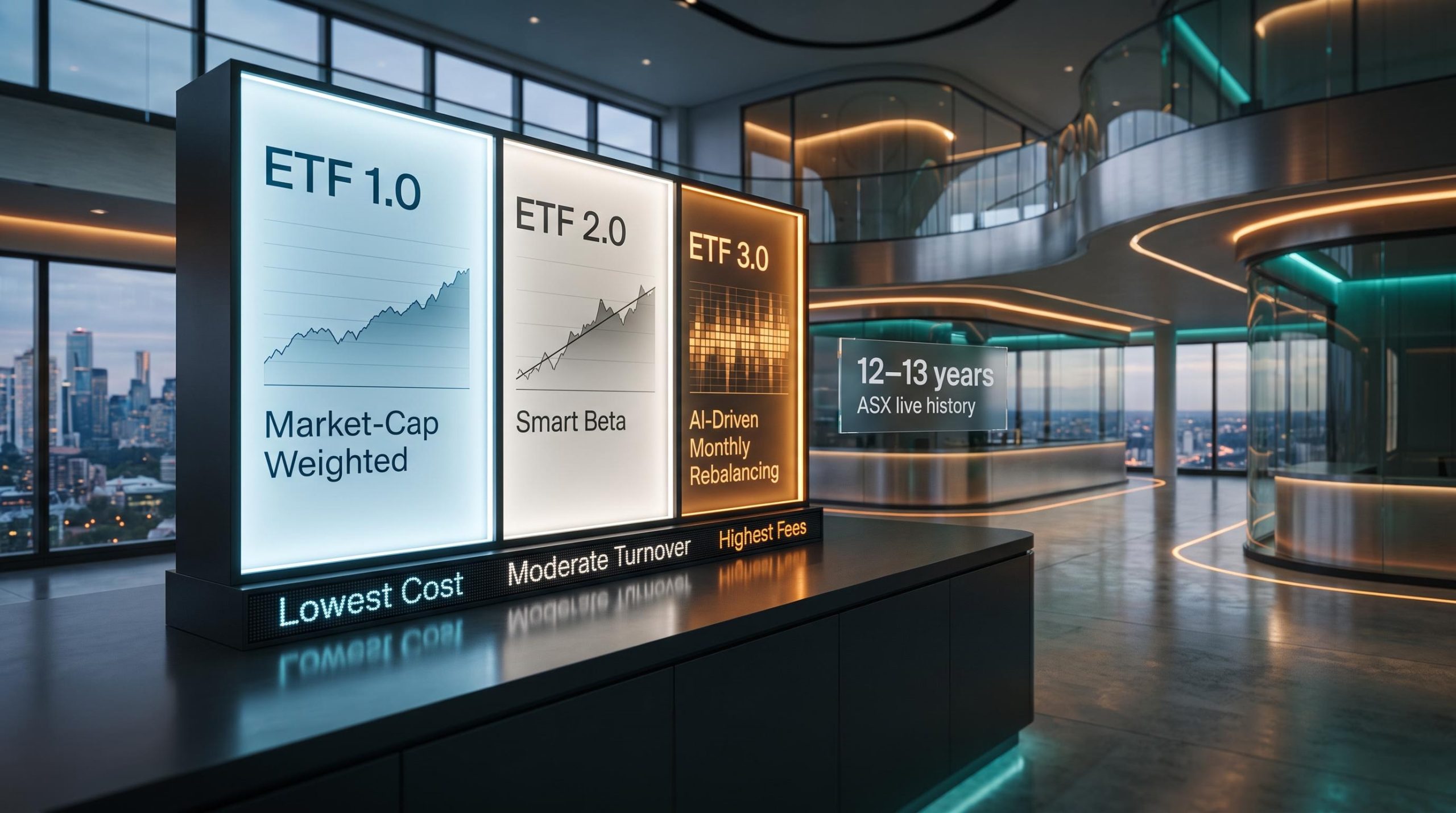
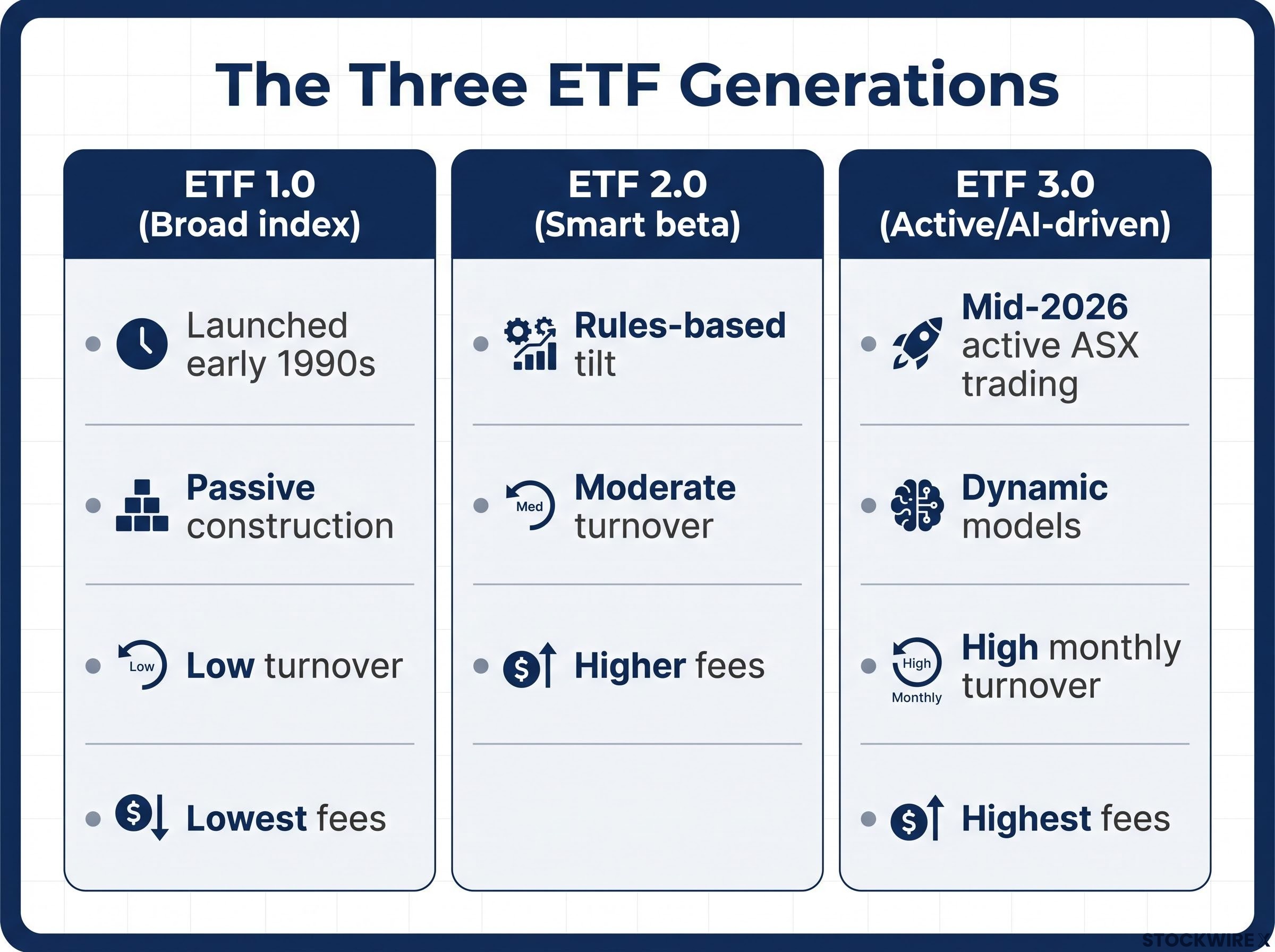
The three generations differ across every dimension that affects your returns. The table below maps the structural progression.
| Dimension | ETF 1.0 (Broad index) | ETF 2.0 (Smart beta) | ETF 3.0 (Active/AI-driven) |
|---|---|---|---|
| Portfolio construction | Market-cap weighted, tracks a standard index | Rules-based tilt to chosen factor(s) | Dynamic, model-driven; rules can adapt |
| Objective | Match market return at low cost | Improve risk-adjusted returns vs benchmark | Seek outperformance through skill or models |
| Active decision-making | Minimal | Moderate (factor choice, screening rules) | High (security selection, timing, model design) |
| Turnover | Low (index rebalance only) | Moderate (periodic factor screen updates) | Often high (monthly or more frequent rebalancing) |
| Typical fees | Lowest | Higher than plain beta | Highest within the ETF universe |
| Transparency | Very high | High (published index rules) | Variable (daily holdings possible, but process may be complex) |
The row most investors skip over is turnover. Higher portfolio turnover inside a fund generates more realised capital gains events, which can be distributed to you as a unitholder and taxed in the year they are distributed, even if you have not sold a single unit. That matters most if you hold outside superannuation.
The fee row gets the attention, but turnover is the dimension with the most direct impact on your after-tax returns. When you compare an ETF 1.0 product that rebalances once or twice a year with an AI-driven ETF 3.0 product rebalancing monthly, the gap in realised gains distributions can be substantial.
Why smart beta was meant to improve on the index (and when it does not)
The intellectual case for ETF 2.0 is genuine. Smart beta ETFs systematically overweight stocks with characteristics that academic research associates with better long-term risk-adjusted returns. A quality factor ETF, for example, tilts toward companies with high return on equity and stable earnings. A value factor ETF tilts toward stocks trading below their intrinsic worth.
Factor investing sits in a third space between index replication and active stock-picking, using rules-driven processes to tilt toward characteristics like size, value, and profitability that decades of academic research link to higher long-run returns, which is precisely the intellectual foundation that ETF 2.0 smart beta products are built on.
The problem is not the theory. It is the timeline.
Factors can underperform the broad market for extended periods, years rather than months. During those stretches, the underperformance feels indistinguishable from the factor having stopped working entirely. This is the factor cycle problem, and it is the single most practically important thing for you to understand before buying a smart beta product.
If you cannot articulate which factor you are tilting toward and why you believe in it over a decade-long horizon, a smart beta ETF is likely to be abandoned at exactly the wrong moment in its cycle.
Several Australian-listed smart beta ETFs now carry genuine live performance histories worth examining. VanEck’s MSCI International Quality ETF (QUAL), positioned as the largest smart beta international ETF in Australia, and the Australian Equal Weight ETF (MVW), which has been trading on the ASX for roughly 12-13 years, provide investors with actual return data to assess rather than relying on backtests alone. That is a genuine advantage over most ETF 3.0 products.
ETF 2.0 is likely to add value when three conditions hold:
- You understand the specific factor and the academic evidence behind it
- Your time horizon is at least 10 years, long enough to ride through a full factor cycle
- You can tolerate extended underperformance relative to the market index without selling
If all three apply, a targeted factor tilt can serve a useful portfolio role. If any one of them does not, you are better served by ETF 1.0 as your core.
AI-driven ETFs: what is genuinely new and what is marketing
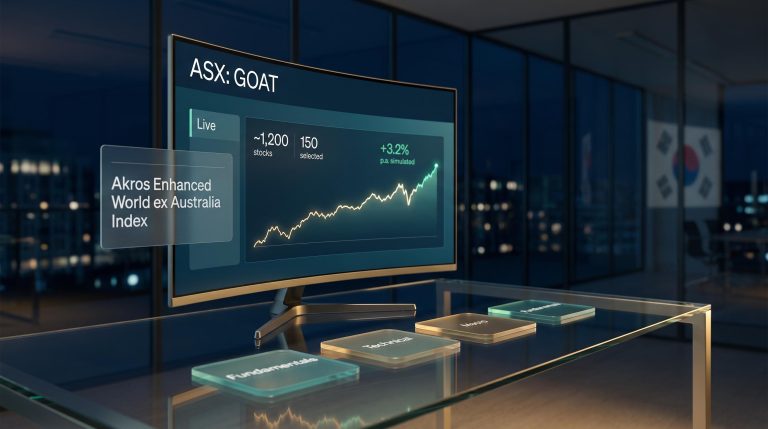
What genuinely distinguishes ETF 3.0 is not the AI label. It is the shift from static to dynamic portfolio construction. In an ETF 1.0, the rules are fixed: own each company in proportion to its market cap. In an ETF 2.0, the rules are fixed but tilted: overweight quality, underweight everything else, rebalance on a set schedule. In an ETF 3.0 product like VanEck’s GOAT ETF, the model itself decides which signals matter and updates holdings accordingly, rebalancing monthly based on signal currency rather than a fixed calendar.
That is a meaningful structural departure. The GOAT ETF follows a rules-based index that is publicly available and publishes its full holdings each day on VanEck’s website. Its AI signal processing scans global equities to rank which stocks score most highly on return signals at each monthly rebalance point.
VanEck positions the GOAT ETF as bringing the kind of signal-driven, data-intensive analysis previously available only to institutional quantitative managers, such as Renaissance Technologies, within reach of individual investors.
The transparency that does exist is real: daily holdings disclosure and a rules-based index you can examine. But the complexity that remains is also real. The AI process generating the signals is inherently difficult for you to audit independently. Daily holdings tell you what the fund owns. They do not tell you why, and for an AI-driven strategy, the “why” is the part that determines whether the edge is durable or temporary.
Three questions to ask before you invest in an AI-driven ETF
These are evaluative prompts, not disqualifying hurdles. The point is readiness, not discouragement.
- What is the rebalancing frequency and what drives it? Monthly rebalancing driven by signal updates is structurally different from annual rebalancing on a fixed date. Understand what triggers changes in the portfolio.
- What is the live track record versus the backtest period? Most ETF 3.0 products have shorter live histories than their ETF 1.0 and 2.0 equivalents. Heavy reliance on backtests carries model risk, the possibility that past patterns the model identified do not persist in live markets.
- How comfortable are you with the methodology if the model underperforms for 18 months? If you cannot explain, at least in broad terms, how the strategy works and why you trust it to recover, you are likely to sell at the worst possible time.
Tax, superannuation, and the turnover problem for Australian investors
The structural differences between the three generations become most tangible when you look at what happens inside your tax return.
Higher portfolio turnover inside a fund generates more realised capital gains events. Those gains can be distributed to you as a unitholder and are taxable in the year they are distributed, regardless of whether you have sold any units yourself. For a low-turnover ETF 1.0 product, these distributions tend to be small and infrequent. For an AI-driven ETF 3.0 product rebalancing monthly, the distributions can be larger and less predictable.
Three structural factors drive the tax efficiency gap across the three generations:
ETF tax obligations extend well beyond reporting distributions: mandatory annual cost base adjustments, foreign income gross-up requirements, and the 50% CGT discount rules each interact differently depending on whether you hold inside or outside superannuation, and the compounding effect of handling these incorrectly can silently inflate your tax bill for years.
- Turnover rate: low for ETF 1.0, moderate for ETF 2.0, often high for ETF 3.0
- Realised gains distribution frequency: less frequent distributions in lower-turnover products
- Holding wrapper type: the account structure in which you hold the ETF materially affects the after-tax outcome
That last point matters most for Australian investors. Superannuation’s concessional tax environment significantly reduces the drag from frequent capital gains realisation. If you are considering a higher-turnover strategy like an AI-driven ETF, the super wrapper is the structurally natural home for it.
As a general principle of Australian fund tax planning, holding higher-turnover strategies inside superannuation and lower-turnover strategies in taxable accounts tends to maximise your after-tax return across the total portfolio.
An investor holding an AI-driven ETF in a taxable brokerage account may be paying a higher effective cost than the stated management fee alone suggests, once capital gains distributions are factored in. This is a general principle rather than a specific recommendation; your tax position and structure should guide the decision.
This article is for informational purposes only and should not be considered financial advice. Investors should conduct their own research and consult with financial professionals before making investment decisions.
Building a portfolio with all three generations: core, tilt, and satellite
The three generations are a toolkit, not a ladder. You are not expected to graduate from ETF 1.0 to ETF 3.0 as your portfolio matures. The question is what job each type is doing and whether it is the right instrument for that job.
The practical hierarchy works like this:
- ETF 1.0 as core. Lowest cost, highest tax efficiency, longest track record. This is the allocation that captures the market return and lets compounding do the work.
- ETF 2.0 as a deliberate long-term tilt. Only if you understand the specific factor, believe in it over a full cycle, and can tolerate years of underperformance relative to the index. If those conditions are met, a quality or value tilt can complement your core.
- ETF 3.0 as a satellite exposure. Only if you have absorbed the cost, turnover, track record, and methodology considerations above. VanEck positions GOAT as a potential replacement for, or complement to, traditional active international equity exposure, not as a replacement for a core index allocation. That framing is consistent with how you should think about it: a satellite, not a foundation.
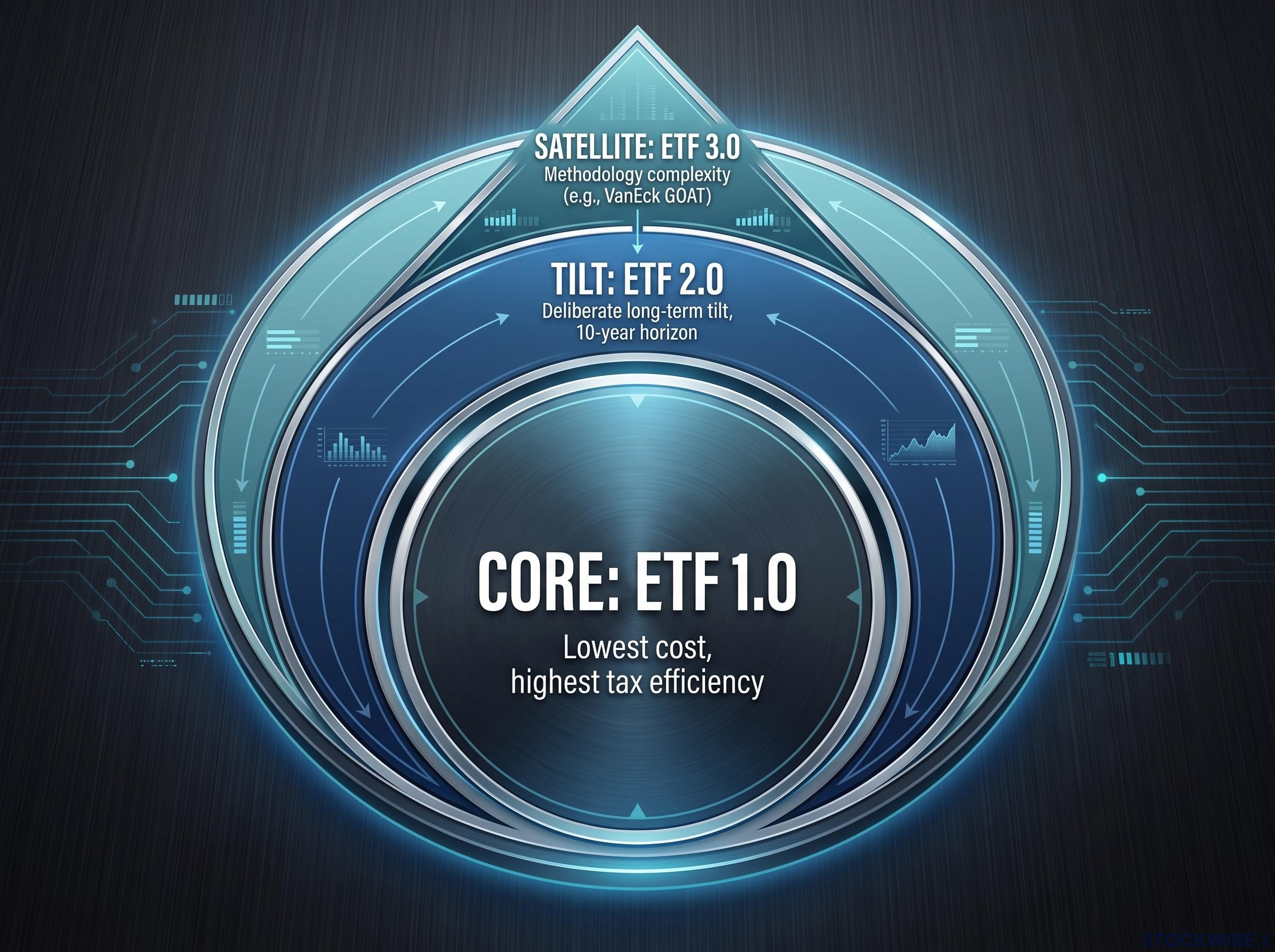
The question is not which generation is best. It is which type of instrument is right for each role in your specific portfolio. The answer depends on your time horizon, your tax structure, and your comfort with methodology complexity.
For investors ready to put the three-generation framework into practice, our dedicated guide to structuring an ETF portfolio for Australian investors covers asset allocation splits, the role of equal-weighted products, and the fee compounding calculations that determine how much each generation costs over a long horizon.
The ETF landscape in 2026 rewards investors who understand the difference
The three ETF generations are not versions of the same product at different price points. They are structurally different instruments with different objectives, cost structures, and suitability profiles.
With AI-driven ETFs now actively trading on the ASX as of mid-2026, you are making these generational distinctions in live markets. VanEck’s three-generation framework (ETF 1.0, 2.0, 3.0) serves as a practical lens for evaluating any ETF you encounter, regardless of who issues it.
ASX ETF market growth in 2026 has pushed industry funds under management past $372 billion, with AI-driven technology exposures among the strongest performers so far this year, reflecting how quickly the third-generation product category has moved from a niche offering to a mainstream allocation choice for Australian investors.
If you can place any ETF into the right generational category, you are equipped to ask the right questions about cost, turnover, tax efficiency, and suitability before you allocate. That is the practical payoff of the framework: not knowing which generation is best, but knowing what each one is actually asking you to accept.
Past performance does not guarantee future results. Financial projections are subject to market conditions and various risk factors.