U.S. equity markets sold off hard on 29 July 2026. The Dow fell more than 2%, the Nasdaq dropped nearly 1.75%, and Microsoft closed the regular session down 0.71% at $390.54. Then the bell rang, the fiscal Q4 numbers landed, and the stock reversed.
Microsoft reported quarterly revenue of $90.0 billion and adjusted earnings per share of approximately $4.81, clearing Wall Street’s consensus on both measures by a margin wide enough to send shares up 2.84% in after-hours trading. For a company whose quarterly revenue now approaches $90 billion, the result functions as more than a single-stock event; it is a real-time reading on cloud infrastructure demand, enterprise AI adoption, and the durability of technology sector earnings growth.
Here is what the numbers actually show, where the growth came from at the segment level, and what the after-hours reversal tells you about how investors are pricing Microsoft‘s trajectory heading into fiscal 2027.
Microsoft clears Wall Street’s bar on earnings per share and revenue
The headline beat was not close. Microsoft reported adjusted diluted earnings per share of approximately $4.81 for fiscal Q4 2026, against an LSEG analyst consensus of approximately $4.24. That is a beat of more than 10%, a gap that signals execution well above what professional analysts had modelled into their estimates.
Adjusted EPS: approximately $4.81 versus $4.24 consensus, a beat of over 10%.
Total revenue came in at $90.0 billion, topping the consensus estimate of approximately $87.6 billion by roughly $2.4 billion, or about 2.7%. A revenue beat of that magnitude on a base this large is not a rounding error; it tells you the underlying demand environment is running ahead of where the Street had positioned.
One data note worth flagging: early Investing.com coverage cited an EPS figure of $4.74, but Microsoft‘s own release and major outlet reporting align on the approximately $4.81 figure, which is the number used throughout this article.
The Microsoft fiscal Q4 2026 earnings press release confirms revenue of $90.0 billion and diluted EPS of $4.81 on a GAAP basis, providing the primary source figures underlying the headline beat reported across major financial outlets.
| Metric | Reported | Consensus |
|---|---|---|
| Adjusted EPS | ~$4.81 | ~$4.24 |
| Total revenue | $90.0B | ~$87.6B |
| Revenue beat | ~$2.4B (~2.7% above consensus) | |
A beat of this size on both lines is not a narrow pass. It tells you Microsoft is executing well ahead of what the professional forecasting community expected, and that has direct implications for how investors and competitors should read the company’s current run rate.
When big ASX news breaks, our subscribers know first
Cloud and AI infrastructure powered the revenue engine
The top-line beat did not come from one lucky quarter in a legacy division. It came from cloud and AI infrastructure, the part of Microsoft‘s business that investors care about most.
Microsoft Cloud revenue hit $59.3 billion, up 27% year over year. That is the aggregated cloud figure Microsoft reports across its segments, and it is the single best measure of how the company’s cloud and AI businesses are scaling.
The segment-level numbers sharpen the picture:
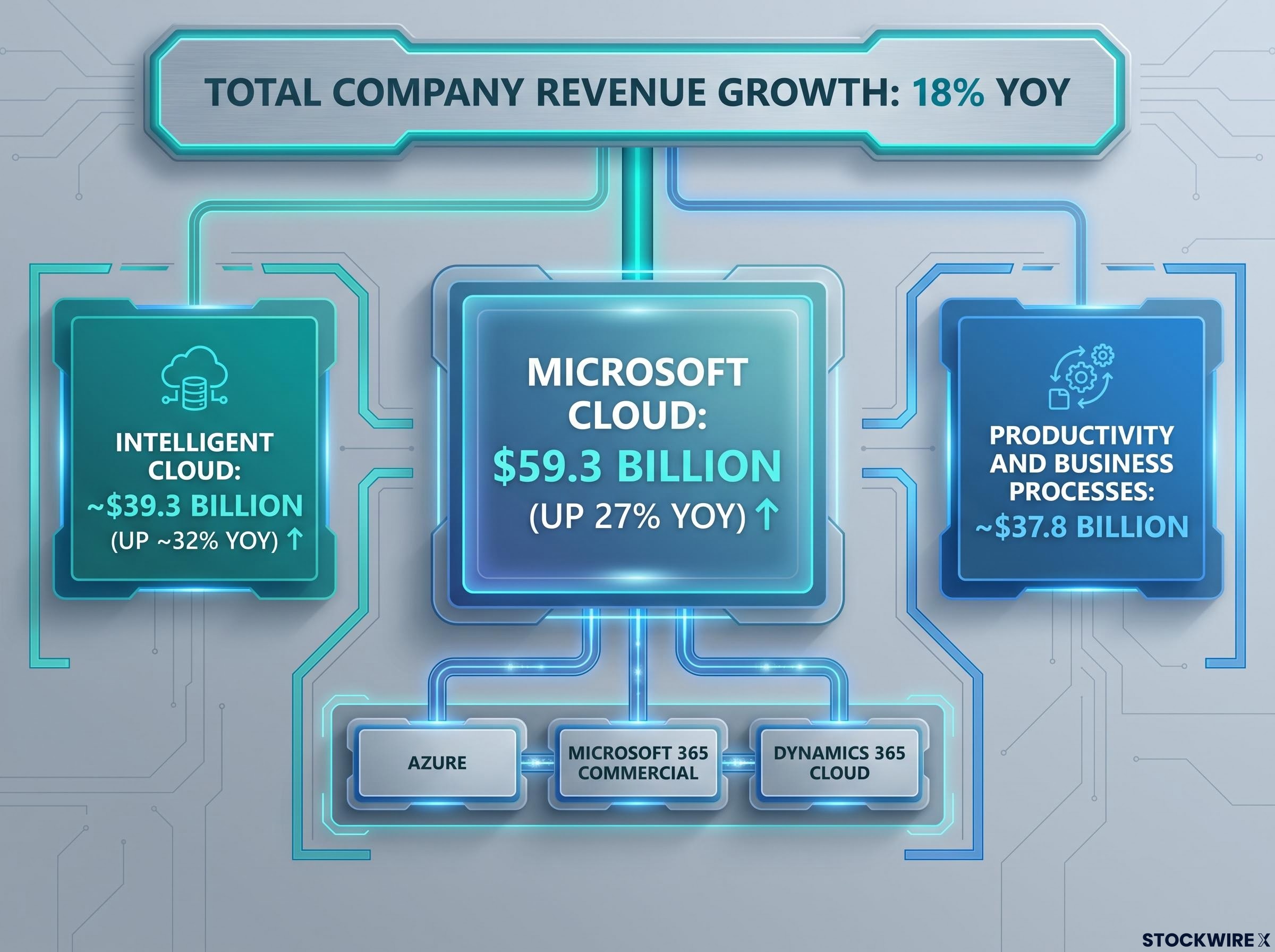
- Intelligent Cloud: approximately $39.3 billion, up approximately 32% year over year
- Productivity and Business Processes: approximately $37.8 billion
- Total company revenue growth: 18% year over year
The Intelligent Cloud segment’s 32% growth rate is the number that deserves the most attention. It tells you that enterprise demand for cloud and AI infrastructure is not slowing, and that Microsoft is the primary beneficiary of that demand at scale. Total company revenue grew 18%, which is strong for a business of this size, but the cloud segments are growing nearly twice as fast as the whole, which means the mix is shifting toward higher-growth, higher-margin revenue.
The AI capex vs monetisation gap is the structural question Microsoft’s Q4 result speaks to most directly: with FY26 total capex expected near $190 billion and the Intelligent Cloud segment growing at 32%, the company is providing real-time evidence that infrastructure spending is converting into measurable revenue at a pace that justifies the investment scale.
What is Microsoft Cloud, and why does it anchor the company’s growth story
Microsoft Cloud is not a single product. It is Microsoft‘s own aggregated revenue measure covering the cloud services that span multiple business segments. The components include:
- Azure: the company’s cloud computing platform, which also houses its AI infrastructure services
- Microsoft 365 commercial: the cloud-based subscription versions of Office, Teams, and related productivity tools
- Dynamics 365 cloud: enterprise resource planning and customer relationship management software delivered as cloud services
The reason analysts watch Microsoft Cloud revenue as closely as total revenue comes down to the economics. Cloud revenue tends to be recurring (subscriptions, not one-off licences), scalable (the infrastructure costs are largely fixed), and higher-margin than legacy software licensing. When Microsoft Cloud grows 27% year over year to $59.3 billion, it tells you the most valuable part of the business is expanding faster than the whole.
The AI connection matters here, too. Azure’s AI infrastructure services are a growing component of what drives cloud revenue growth, which makes the Microsoft Cloud figure a proxy for whether the company’s AI investment thesis is converting into real, measurable revenue. For anyone trying to assess that question from the outside, this is the most direct signal available in a quarterly earnings release.
MSFT stock fell during the session, then reversed sharply after the bell
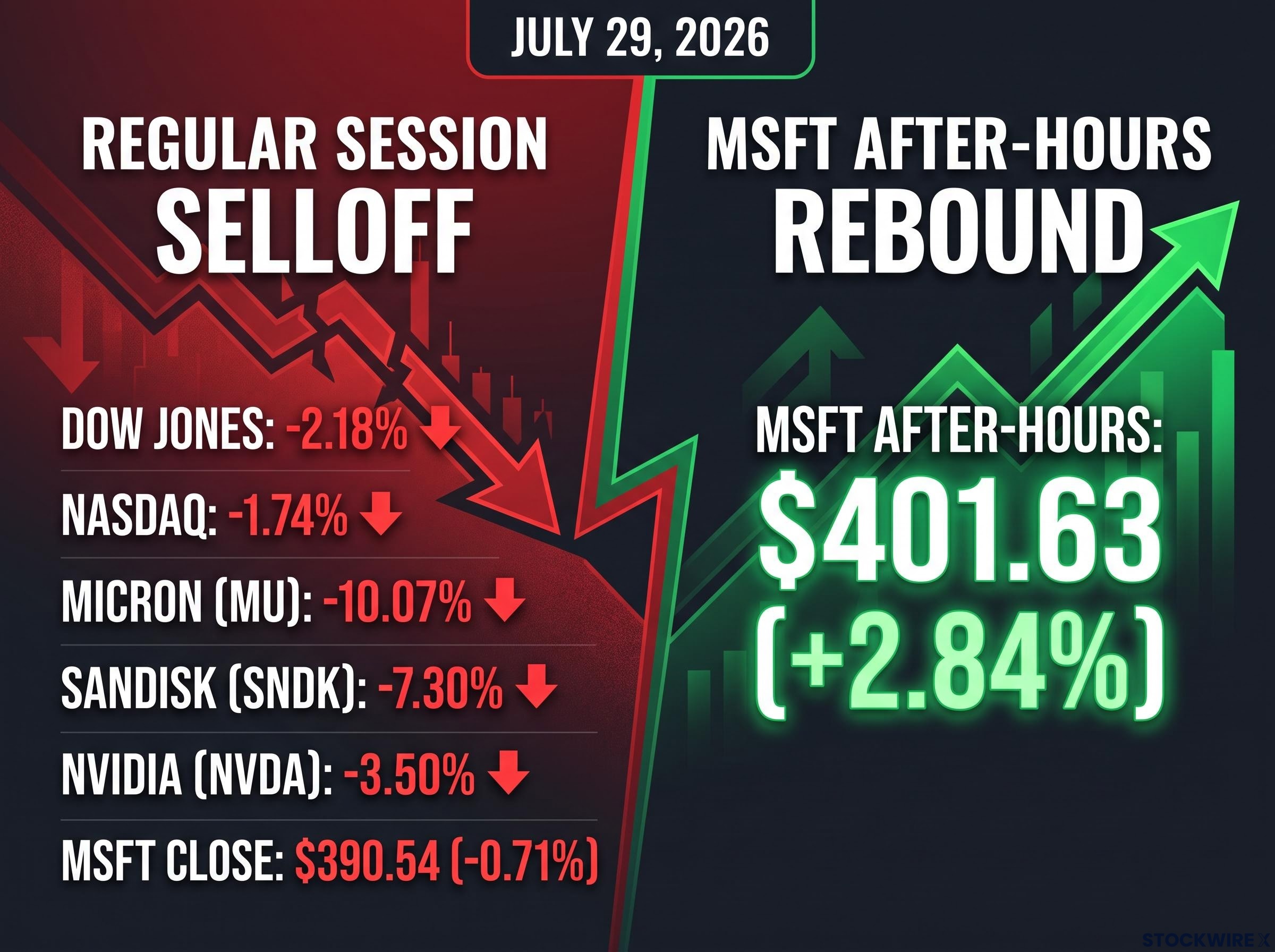
Microsoft shares closed the regular session on 29 July 2026 at $390.54, down $2.81 or 0.71%. The decline landed in a session where almost everything was selling off, and the stock’s pre-earnings drift lower reflected the same caution that hit the broader market.
The MSFT technical levels heading into earnings had defined a well-structured support cluster in the mid-$340s to $370s, with the 200-day moving average at $438.77 representing the key ceiling the stock needed to reclaim for the medium-term trend signal to shift from corrective to neutral.
Then the numbers dropped.
After-hours price: $401.63, up $11.09 (+2.84%)
The after-hours move erased the day’s loss entirely and added meaningful incremental value on top. For anyone holding MSFT through the session’s weakness, the earnings release confirmed that the intraday decline was about broader market pressure, not anything specific to Microsoft‘s business.
| Session | Price | Change |
|---|---|---|
| Regular close | $390.54 | -$2.81 (-0.71%) |
| After-hours | $401.63 | +$11.09 (+2.84%) |
That contrast between intraday weakness and post-earnings strength is the clearest expression of how the market judged the result. The stock data is sourced from Investing.com; readers may wish to verify against a second provider given single-source status.
A volatile session for U.S. markets made the after-hours rebound more notable
Microsoft‘s earnings did not land into a calm market. 29 July 2026 was one of the more aggressive selloff sessions of the quarter, and the after-hours recovery happened against genuine macro headwinds.
Major index moves on the day:
- Dow Jones Industrial Average: fell approximately 2.18%
- Nasdaq Composite: dropped approximately 1.74%
- CBOE Volatility Index (VIX): rose approximately 13.29%
The VIX spike, a measure of expected market volatility often used as a gauge of investor fear, confirmed the session’s risk-off character. Semiconductor and storage names were hit hardest across the tech sector:
- Micron Technology (MU): -10.07%
- Sandisk (SNDK): -7.30%
- NVIDIA (NVDA): -3.50%
With major indices falling sharply and semiconductor names bearing the brunt, Microsoft‘s post-earnings rebound stands out as a company-specific vote of confidence. This was not a rising tide; it was one stock moving against the current because the numbers justified it.
The dynamic between tech earnings and capex played out clearly in Q1 2026, when all five major US tech companies beat estimates yet only two saw immediate stock gains, because investor focus had shifted decisively to whether infrastructure spending commitments of $650-$725 billion would generate commensurate revenue returns.
These broader market figures appeared in Investing.com coverage without named source attribution and should be verified against a named financial data provider for precision.
What the Q4 result positions Microsoft to argue heading into fiscal 2027
The Q4 numbers give Microsoft a strong hand to play heading into the next earnings cycle. An EPS beat of more than 10%, total revenue growth of 18% year over year, and Microsoft Cloud growth of 27% collectively reinforce the company’s positioning as a primary beneficiary of enterprise AI and cloud infrastructure spending.
The after-hours recovery to $401.63, a 2.84% gain against a session where the Nasdaq fell nearly 1.75%, signals that investors are pricing confidence in the trajectory, not just rewarding the quarter.
Microsoft Cloud revenue: $59.3 billion, up 27% year over year.
The forward question is whether those growth rates hold as the comparison base grows harder. A 32% growth rate in Intelligent Cloud is striking, but next quarter’s year-over-year comparison will be measured against an already elevated base. For anyone deciding whether to hold, add, or watch Microsoft, this result provides concrete evidence that the AI infrastructure bet is generating revenue at scale. Whether that rate of conversion accelerates, sustains, or compresses is the question fiscal 2027 will answer.
Microsoft stock risks that mainstream coverage tends to underweight include Azure’s revenue concentration in a single partner and the longer-term structural threat agentic AI poses to the Microsoft 365 bundling logic, both of which remain live questions even after a strong quarterly print.
This article is for informational purposes only and should not be considered financial advice. Investors should conduct their own research and consult with financial professionals before making investment decisions. Past performance does not guarantee future results.