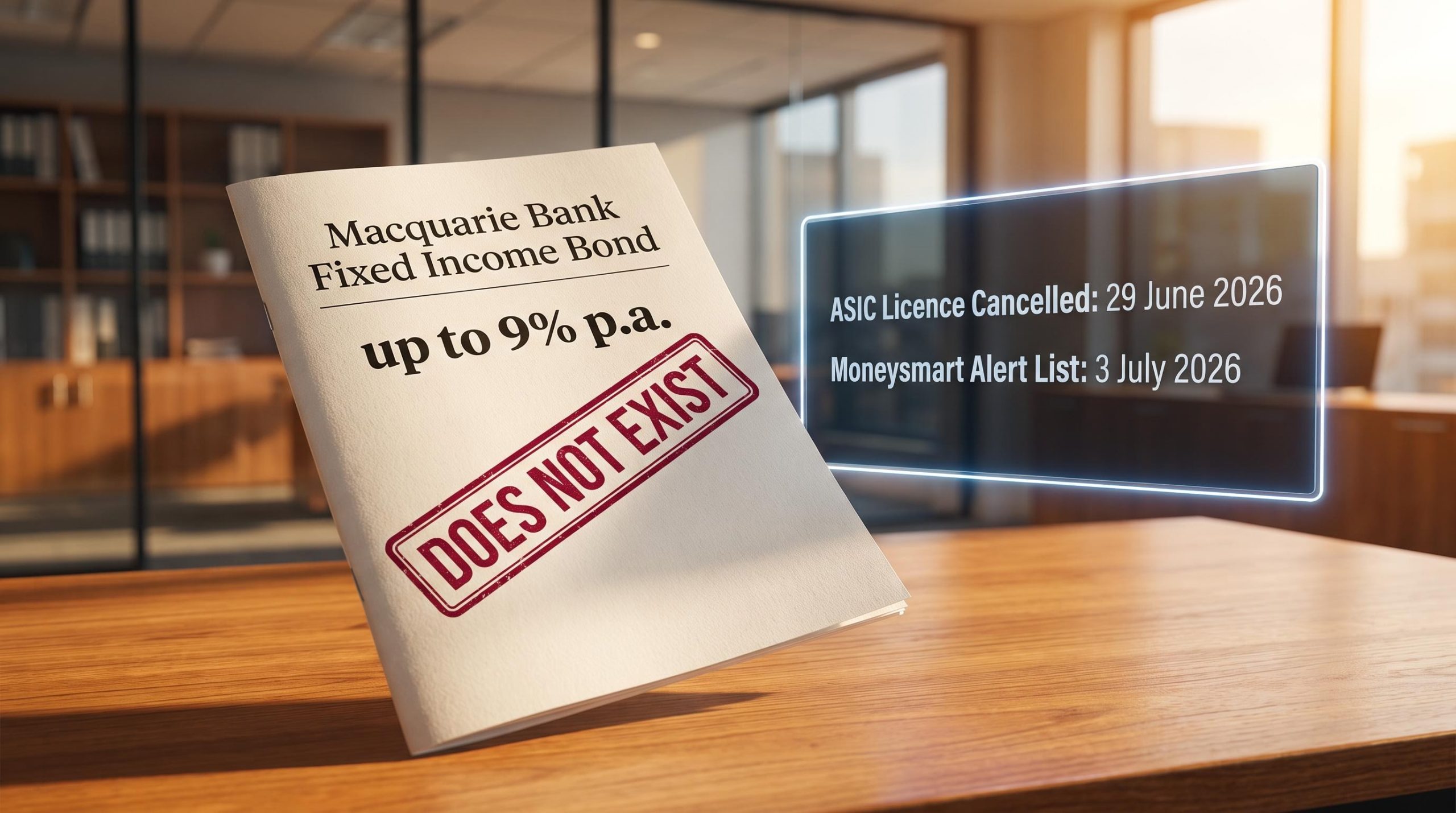
Capital Guard held a genuine, ASIC-issued financial services licence. Its online presence was polished and professional, with active social media channels, paid digital advertising, and coverage in news-style articles, presenting the firm as a regulated provider that marketed itself as “your investment shield” offering conservative, investment-grade bond products. It still raised more than $17 million from approximately 80 Australian investors using a Macquarie Bank bond product that did not exist.
Every signal a retail investor is taught to check, the licence, the institutional name, the professional presentation, was present and appeared legitimate. The fraud passed the usual tests.
The Capital Guard case is not an outlier. It is part of a documented, rising pattern in which sophisticated fraud operates inside the formal regulatory framework, using real licences, recognisable institutional names, and professional-grade digital presences to manufacture credibility. ASIC cancelled Capital Guard’s AFS licence effective 29 June 2026 and added the firm to the Moneysmart Investor Alert List on 3 July 2026, making this a live reference point.
Investment scam losses across Australia reached $837.7 million in 2025 even as ASIC removed nearly 12,000 scam websites that year, a figure that establishes Capital Guard’s $17.4 million as one part of a much larger ongoing pattern rather than an isolated incident.
Here is what you will take from this: the specific tactics that made Capital Guard convincing, the red flags that appeared before ASIC acted, and the verification steps that would have protected you. This is a practical toolkit for your next investment decision, not a retrospective on someone else’s losses.
How Capital Guard constructed a convincing facade of legitimacy
Capital Guard built its deception in layers, and each layer reinforced the one beneath it. The firm held a genuine AFS licence dating from 2017. Current management acquired the company, and its licence, in 2024. That acquisition matters: rather than applying for a new licence and facing fresh ASIC scrutiny, the new operators inherited an established regulatory credential.
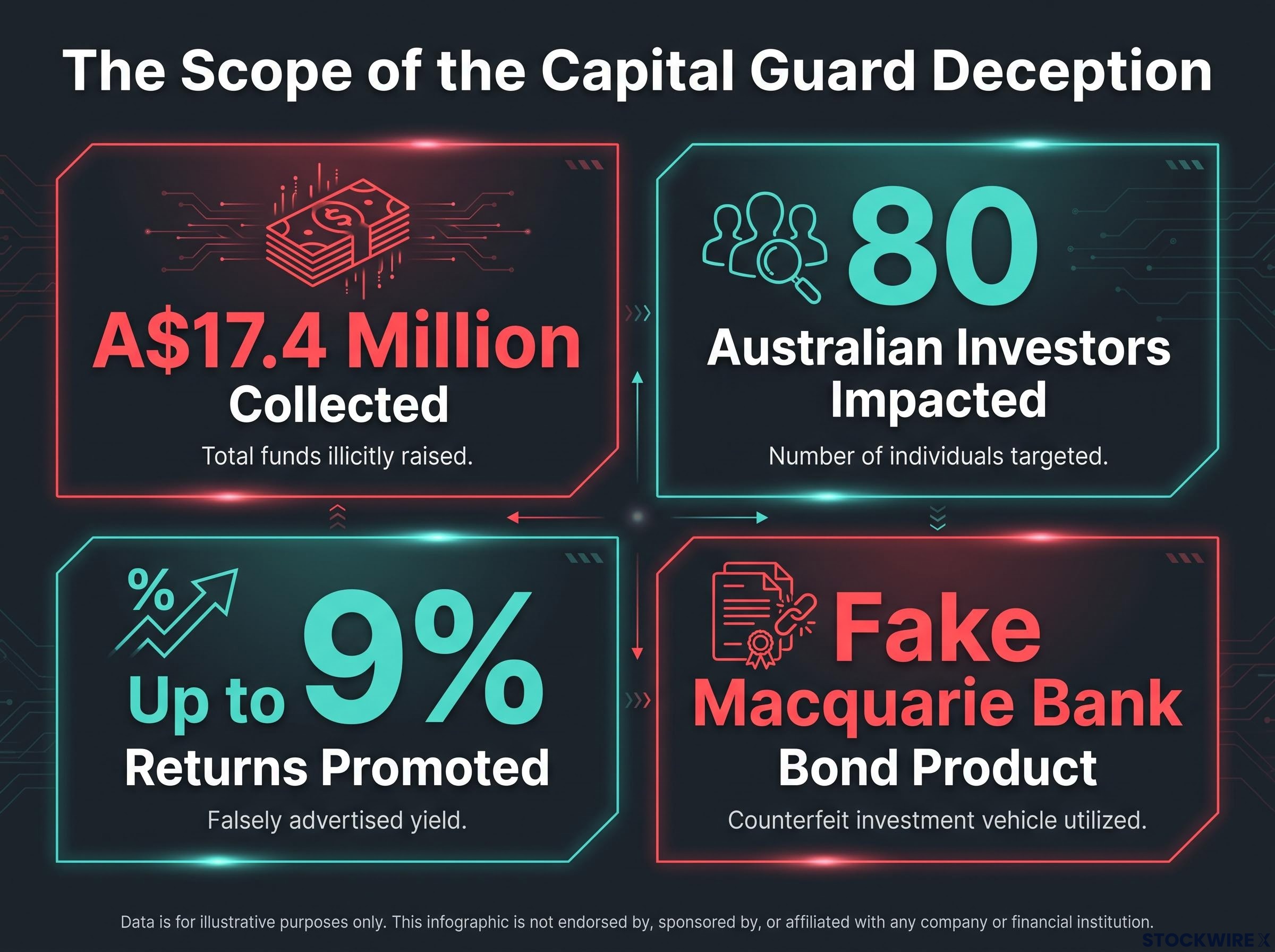
From there, the architecture expanded. Capital Guard created a fake prospectus for a Macquarie Bank bond product that did not exist, solicited investor funds for it, and obtained at least $100,000 for this specific instrument. The firm promoted returns of up to 9 per cent while positioning itself as a conservative, investment-grade provider.
The deception did not stop at the product. Capital Guard also:
- Submitted fabricated records to its external auditor, corrupting the independent oversight process
- Misrepresented its experience on its website
- Altered third-party scam warnings about itself so that investors conducting their own research would not find the original concerns
- Ran a multi-channel promotional operation spanning paid online advertising, social media activity, and placement in news-format online content to project the appearance of a credible firm
According to ASIC’s investigation, the firm collected around A$17.4 million from roughly 80 investors across Australia. When regulators intervened, the overwhelming majority of those funds could not be located in the company’s known accounts.
ASIC found that Capital Guard engaged in misleading or deceptive conduct, dishonest conduct in connection with its financial services business, and serious failures in compliance, supervision and resourcing, according to ASIC media release 26-141MR.
The critical point for you: checking the licence alone would not have protected you. Capital Guard’s deception worked precisely because it mixed genuine regulatory credentials with fabricated product details. Every verification shortcut a retail investor might take was anticipated and exploited.
When big ASX news breaks, our subscribers know first
Why these tactics work: the psychology of manufactured credibility
Understanding what Capital Guard did is one thing. Understanding why it worked shifts you from observer to potential target, and that shift is where the real protection sits.
The AFSL credibility signal
A current Australian Financial Services Licence (AFSL), the authorisation ASIC grants to firms providing financial services, is widely treated by retail investors as a meaningful ongoing guarantee of legitimacy. It is reasonable to treat it that way. But an AFSL confirms that ASIC assessed a firm’s fitness at the point of authorisation. It does not constitute continuous supervision of every product or transaction the firm subsequently offers.
Capital Guard’s licence was genuine and current throughout the period of alleged misconduct. It was cancelled effective 29 June 2026. An investor who checked the licence at any point before that date would have found a valid, active credential.
The institutional name tactic
By attaching Macquarie Bank’s name to its fake bond product, Capital Guard exploited a specific cognitive shortcut. You assume a major, well-regarded institution would not permit its name to be misused. You assume that if a product carries that name, the institution has vetted the promoter. Neither assumption is safe.
Capital Guard promoted bond returns of up to 9 per cent while marketing itself as “your investment shield” offering conservative, investment-grade products. That combination, high returns with low-risk positioning, is itself a contradiction that warranted scrutiny.
The alteration of third-party scam warnings adds a further layer. If you were a cautious investor who searched for warnings about Capital Guard, you may have found modified content that no longer conveyed the original concern. You performed due diligence. You still arrived at a false sense of safety.
Your instinct to check for a licence and look up the institution’s name are reasonable steps. Sophisticated fraud is specifically designed to pass those checks. Recognising why each tactic is persuasive makes it harder to be persuaded by the same mechanics under a different company name.
Seven red flags that appeared before ASIC acted
Each of these warning signs appeared in the Capital Guard case. Individually, any one warrants caution. In combination, they should prompt disengagement. The value of anchoring each flag to a real, ASIC-investigated case is that the pattern transfers: you will recognise the same mechanics when they appear in a different context.
- Inconsistent risk-return profile. Capital Guard promoted returns of up to 9 per cent while positioning itself as a conservative provider of investment-grade bonds. Bond products described as investment-grade typically offer returns closer to prevailing market yields for comparable fixed-income assets. When the return is high but the claimed risk is low, the two claims are contradicting each other. That contradiction is your signal.
- Institutional name misuse. Capital Guard created a fake prospectus carrying Macquarie Bank’s name for a product the bank never issued or authorised. Any investment that references a major institution should be verified directly with that institution through independently sourced contact details.
- High-pressure urgency tactics. Pressure to act quickly, including “limited-time offer” framing or artificial deadlines, is designed to suppress the due diligence that would reveal the fraud. Legitimate investments do not require rushed decisions.
- Vague or circular explanations of how returns are generated. A legitimate provider should be able to clearly describe the underlying assets, the cash-flow mechanism, and the key risks. If explanations shift when follow-up questions are asked, treat that as a strong warning.
- Unsolicited cold outreach. Patterns associated with cases like Capital Guard include contact from supposed advisers who are not listed on ASIC’s Financial Advisers Register. Unsolicited calls, emails, or social media messages inviting investment should trigger heightened scrutiny.
- Unusual payment instructions. Instructions to transfer funds to personal accounts, use cryptocurrency, or send money via overseas wire transfers are inconsistent with how regulated financial services operate in Australia. Licensed firms handle client money through appropriate trust or client accounts.
- Poor or inconsistent documentation. Most retail financial products under Australian law must be accompanied by a Product Disclosure Statement (PDS), a formal document setting out the product’s features, fees, and risks. If a firm cannot provide a PDS, provides documents with obvious errors, or cannot explain how its documentation aligns with its licence authorisations, treat that as a serious warning.
The flag you are most likely to miss is the one partially concealed by the legitimate-looking elements surrounding it. Capital Guard’s licence was real. The website looked professional. That is precisely why the inconsistent return profile or the vague documentation could be rationalised away. Knowing which flag you would dismiss is part of the defence.
How to verify a financial firm before you invest: a practical checklist
The warning signs above tell you when to pause. This section tells you what to do next. These steps take minutes, use free public tools, and represent your most reliable line of defence before committing funds.
Checking ASIC’s professional registers
- Search by name, ABN, or licence number. Look up the firm using ASIC’s professional registers, available on the ASIC website.
- Confirm the entity name matches exactly. The name on the register must match the name used in marketing materials. Be cautious if a promoter references a licence held by a different legal entity than the one you are contracting with.
- Check licence status. Verify that the licence is current. A cancelled, suspended, or revoked licence is an immediate disqualifying signal. Capital Guard’s licence was cancelled effective 29 June 2026; a check after that date would have shown a cancelled licence.
- Review authorisations. An AFSL specifies the types of products and services the holder is authorised to offer. A firm promoting products outside those authorisations is operating unlawfully even if the licence itself remains current.
- Look at recent variations or conditions. New conditions, restrictions, or recent changes can indicate that ASIC has identified compliance concerns.
Checking the Moneysmart Investor Alert List
Capital Guard was added to this list on 3 July 2026. Here is what the list does and does not tell you:
- Search for the company’s legal name, any trading names, and key individuals
- Presence on the list is a major red flag: ASIC is signalling that dealing with the entity may jeopardise your money
- Check the list directly via ASIC’s Moneysmart platform, not through links on the promoter’s own materials
- Re-check periodically during any ongoing investment relationship, as firms can be added after your initial investment
- Absence from the list does not guarantee legitimacy; many schemes operate for some time before appearing on formal alert lists
| Tool | What it checks | What it does not guarantee |
|---|---|---|
| ASIC Professional Registers | Licence status, authorisations held, entity name, recent conditions or variations | That every product the firm promotes is legitimate, or that the firm is operating within its authorisations at the time you invest |
| Moneysmart Investor Alert List | Whether ASIC has flagged the firm as a concern based on known misconduct or complaints | That a firm not on the list is safe; schemes may operate for months or years before being added |
One additional step applies whenever an investment is said to involve a major institution: contact that institution directly, using contact details sourced independently from its official channels, and obtain written confirmation that the specific product exists and that the promoter is authorised to distribute it. This single step would have exposed Capital Guard’s fake Macquarie Bank bond.
Both ASIC tools described here are free, publicly accessible, and would have flagged Capital Guard, but only if you use them before committing funds.
Moneysmart’s check before you invest guidance provides a step-by-step verification process covering AFS licence searches, the Investor Alert List, and how to confirm whether a financial firm and its products are legitimately registered with ASIC.
If you have already invested: what to do right now
If you suspect you have invested in a scheme with characteristics similar to Capital Guard’s, the most urgent action comes first.
Stop all further transfers immediately. Do not send additional funds, even if promised that investing more will help recover earlier losses. Follow-on fraud, where scammers target already-affected investors with recovery schemes, is a documented tactic. Do not engage.
Once you have stopped the outflow, work through the remaining steps in order:
- Stop further transfers. This is your most time-critical action.
- Preserve all evidence. Keep copies of emails, messages, contracts, disclosure documents, screenshots of websites or portals, and bank transfer records. This material is critical for regulatory investigations and any potential civil action.
- Report to ASIC. Lodge a complaint or report of misconduct. Investor reports assist ASIC in building enforcement cases, and your report may protect other investors from the same scheme.
- Contact AFCA. The Australian Financial Complaints Authority (AFCA) handles complaints about financial advice or investments. AFCA may be able to assist with dispute resolution or compensation in some circumstances.
- Seek independent legal advice. A lawyer experienced in financial services and consumer law can advise on civil recovery options and how best to protect your position.
- Contact your bank promptly. For recent transfers, your bank may be able to attempt payment recalls depending on the payment method and timing. The sooner you act, the better the prospect of any recovery.
Affected investors face a firm AFCA complaint deadline of 29 June 2027, after which AFCA’s jurisdiction over Capital Guard expires under the residual licence provisions, making it the only hard time limit in the recovery process.
Reporting to ASIC and AFCA is not merely bureaucratic. It is how enforcement cases are built, how patterns are identified across multiple complaints, and how regulatory action reaches firms that are still operating. Your report has value beyond your own situation.
What the Capital Guard case changes about how you should approach investment offers
The Capital Guard case does not mean ASIC’s licensing system has failed. It means that a genuine licence is a necessary but not sufficient condition of legitimacy. That distinction changes how you should evaluate every investment offer you encounter.
The pattern is documented and growing. Fraudsters increasingly acquire real licences, submit false information to auditors, build multi-channel digital presences that credibly mimic legitimate firms, and attach the names of major institutions to products those institutions never authorised. Capital Guard’s licence dated from 2017; current management acquired the company and its licence in 2024, illustrating the tactic of acquiring an established licence rather than applying for a new one under fresh scrutiny.
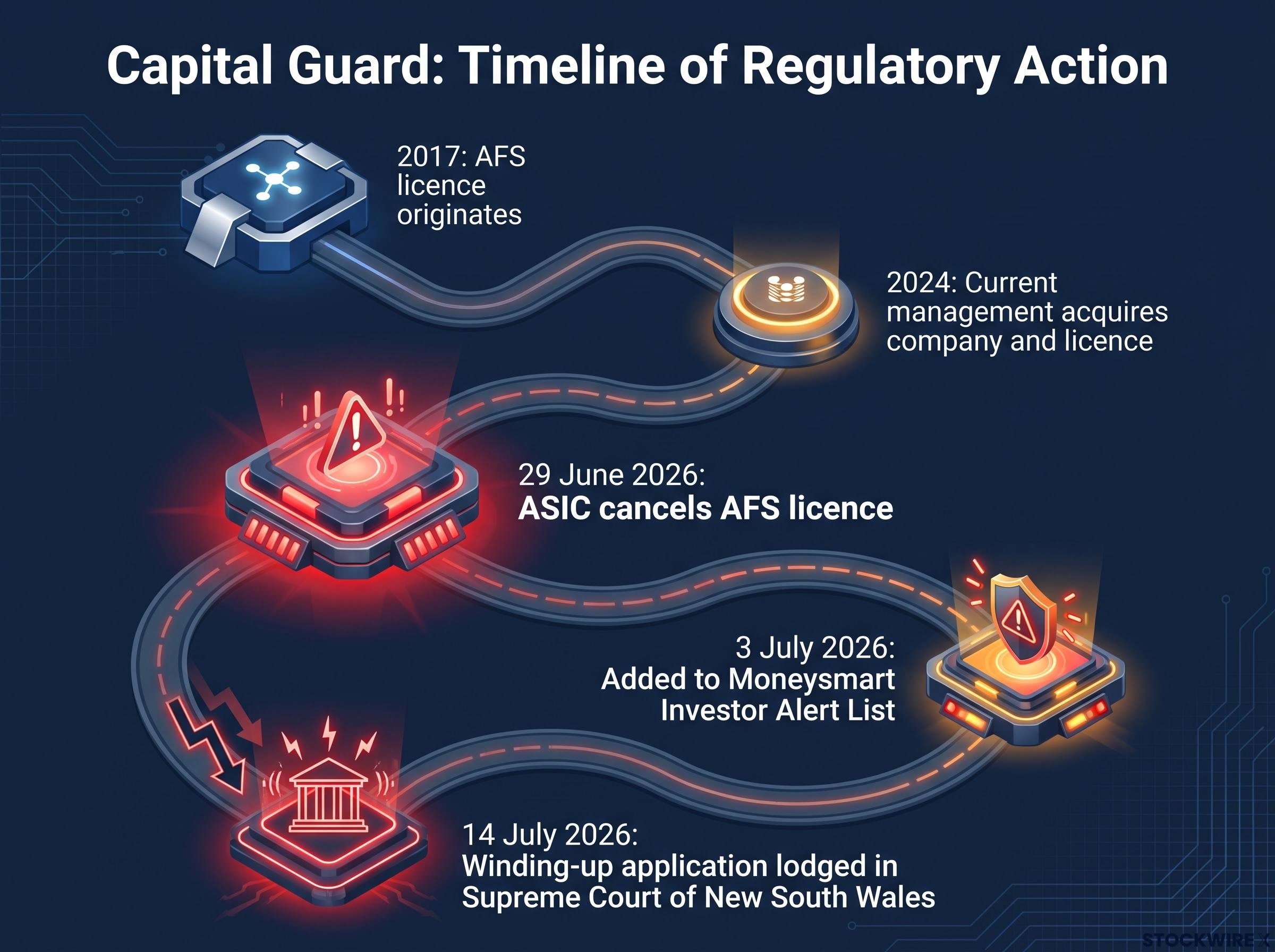
ASIC’s response has been substantive: licence cancellation effective 29 June 2026, Moneysmart Investor Alert List addition on 3 July 2026, and a winding-up application lodged in the Supreme Court of New South Wales on 14 July 2026. The system can and does respond. But that response typically comes after losses have occurred, and approximately 80 investors across Australia are left with most of their funds unrecoverable.
ASIC’s enforcement powers extend well beyond licence cancellation: in cases where misconduct involves deliberate deception rather than competence failures, the regulator has applied permanent lifetime bans covering all financial services activity, as the 2026 action against adviser Yanhua Chen illustrates.
Your primary line of defence sits before the investment decision, not after it. ASIC’s professional registers and the Moneysmart Investor Alert List are available to you now. Direct verification with any named institution takes a phone call. The red flags outlined above cost nothing to check. The cost of not checking is the lesson Capital Guard’s investors are living through today.
This article is for informational purposes only and should not be considered financial advice. Investors should conduct their own research and consult with financial professionals before making investment decisions.