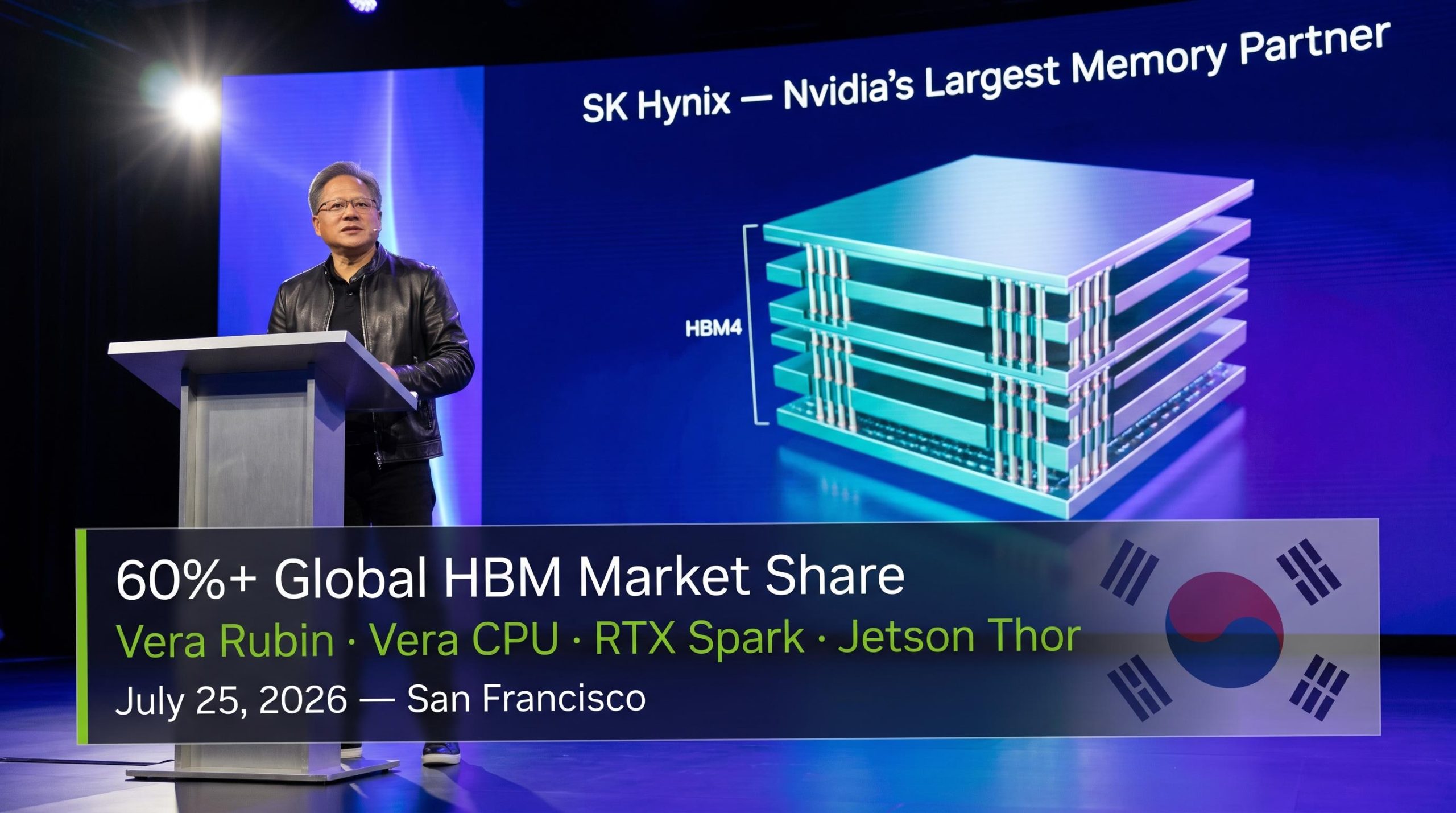
Jensen Huang stood in front of the cameras on Friday 25 July 2026 and said it plainly: SK Hynix has been Nvidia’s largest memory partner, and it will stay that way. The formal multiyear supply and co-development agreement signed today makes that statement contractual.
The deal was timed to coincide with South Korean President Lee Jae Myung’s San Francisco visit, arriving at a moment when high-bandwidth memory (HBM), the specialised chip stacking technology that feeds data to AI processors, has become the single most constrained resource in the global AI compute stack. Companies are no longer competing over GPU allocations alone. They are racing to lock in the memory that makes those GPUs run.
Here is what is officially confirmed, what remains contested, and what the partnership actually means for anyone evaluating SK Hynix’s position in the AI memory supply chain.
What Nvidia and SK Hynix have actually agreed to
The confirmed scope of this partnership is broader than a standard memory procurement deal. Nvidia and SK Hynix have entered into a multiyear agreement spanning technology co-development and supply, with next-generation memory, including HBM, at its core, targeting both AI data centres and what both companies describe as “AI factories.”
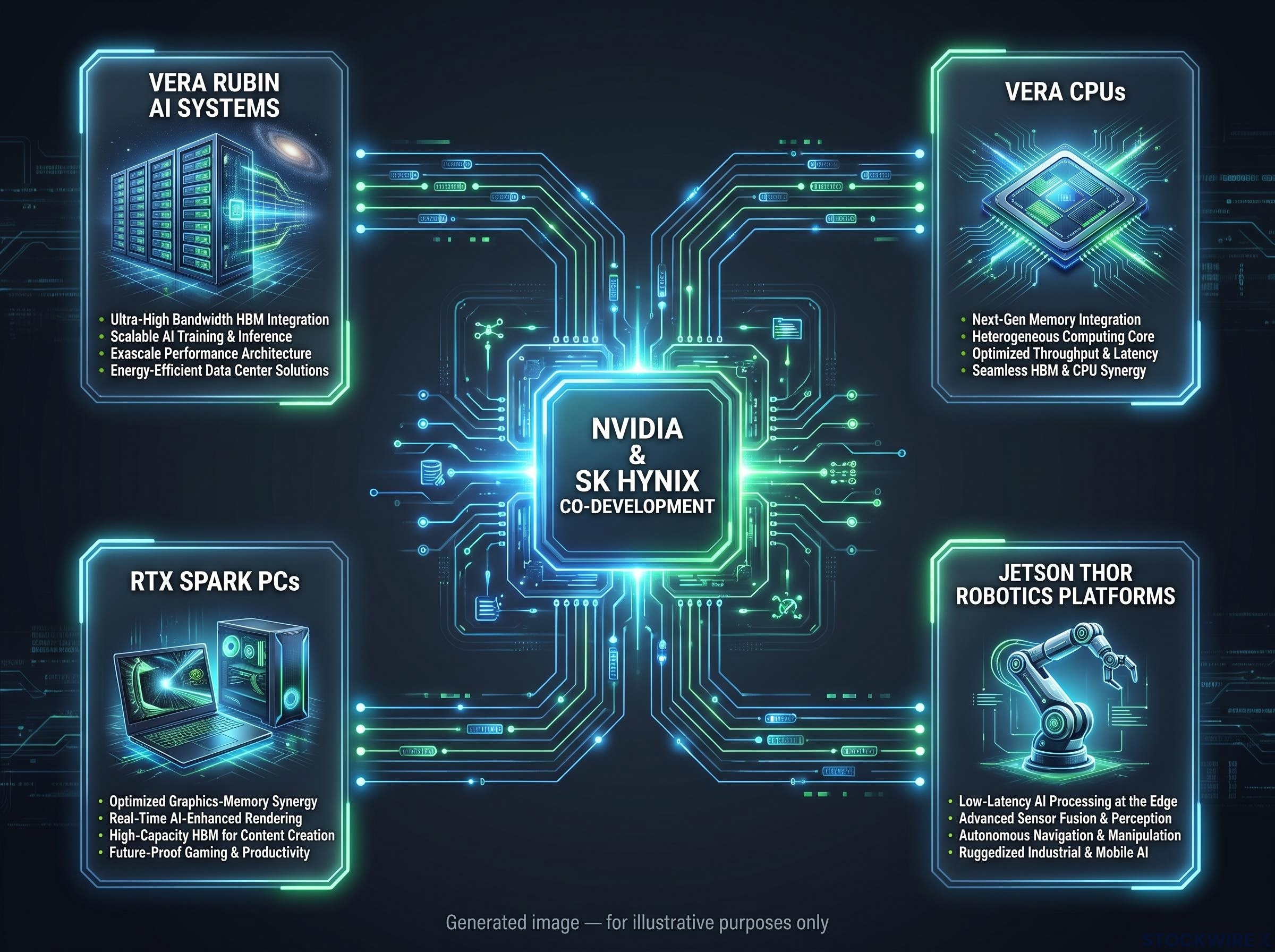
The partnership spans four distinct Nvidia product lines:
- Vera Rubin AI systems: Nvidia’s next-generation data centre platform for large-scale AI training and inference.
- Vera CPUs: The central processors designed to work alongside Nvidia’s GPU accelerators in AI server architectures.
- RTX Spark PCs: Nvidia’s AI-capable personal computing platform.
- Jetson Thor robotics platforms: Nvidia’s computing module for autonomous machines and humanoid robotics.
“SK Hynix has been Nvidia’s largest memory partner. SK Hynix will continue to be Nvidia’s largest memory partner.” — Jensen Huang, Nvidia CEO
Neither company disclosed financial terms. Multiple independent analyses have explicitly noted that no dollar figures appear in official communications from either Nvidia or SK Hynix.
Being co-designed into four distinct product lines, spanning AI data centres, personal compute, and robotics, means SK Hynix is not simply a supplier filling purchase orders. It is embedded in Nvidia’s product roadmap in a way that creates durable, multi-year switching costs. For anyone tracking revenue visibility, the scope of platform integration matters more than any specific dollar figure.
When big ASX news breaks, our subscribers know first
HBM4 and the Vera Rubin architecture: why the technology pairing matters
The partnership centres on co-developing HBM4 memory specifically for Nvidia’s Vera Rubin platform. HBM (high-bandwidth memory) is a chip-stacking technology that places memory layers directly on top of each other, connected by thousands of vertical wires, to deliver the enormous data throughput that AI processors require. Without enough HBM, even the most powerful GPU sits idle waiting for data.
The Vera Rubin platform’s HBM4 supplier qualifications, confirmed by Jensen Huang on 5 June 2026, established SK Hynix, Samsung, and Micron as the three certified memory suppliers for that architecture, with SK Hynix estimated to hold 60-70% of initial volume allocations reflecting its earlier entry into the certification process.
SK Hynix holds approximately 60%+ of the global HBM market, making it the dominant supplier of the single most supply-constrained component in AI infrastructure.
That market share in a product category that cannot be substituted or quickly replicated by competitors gives SK Hynix pricing leverage and strategic indispensability that commodity memory cycles do not replicate. It also explains why Nvidia would enter a multiyear co-development agreement rather than simply diversifying supply. The technology lock-in is structural, not transactional.
SK Telecom’s planned gigawatt-scale AI cloud
The downstream deployment story is already taking shape. SK Telecom has announced plans to develop a gigawatt-scale AI cloud facility in South Korea, with initial operations scheduled to begin in 2027. No official capital expenditure figure has been disclosed for this facility by SK Telecom, SK Hynix, or Nvidia.
The dollar figures: what a South Korean presidential adviser disclosed and what the companies confirmed
The strategic partnership is confirmed. The specific dollar figures circulating in headlines require more scrutiny.
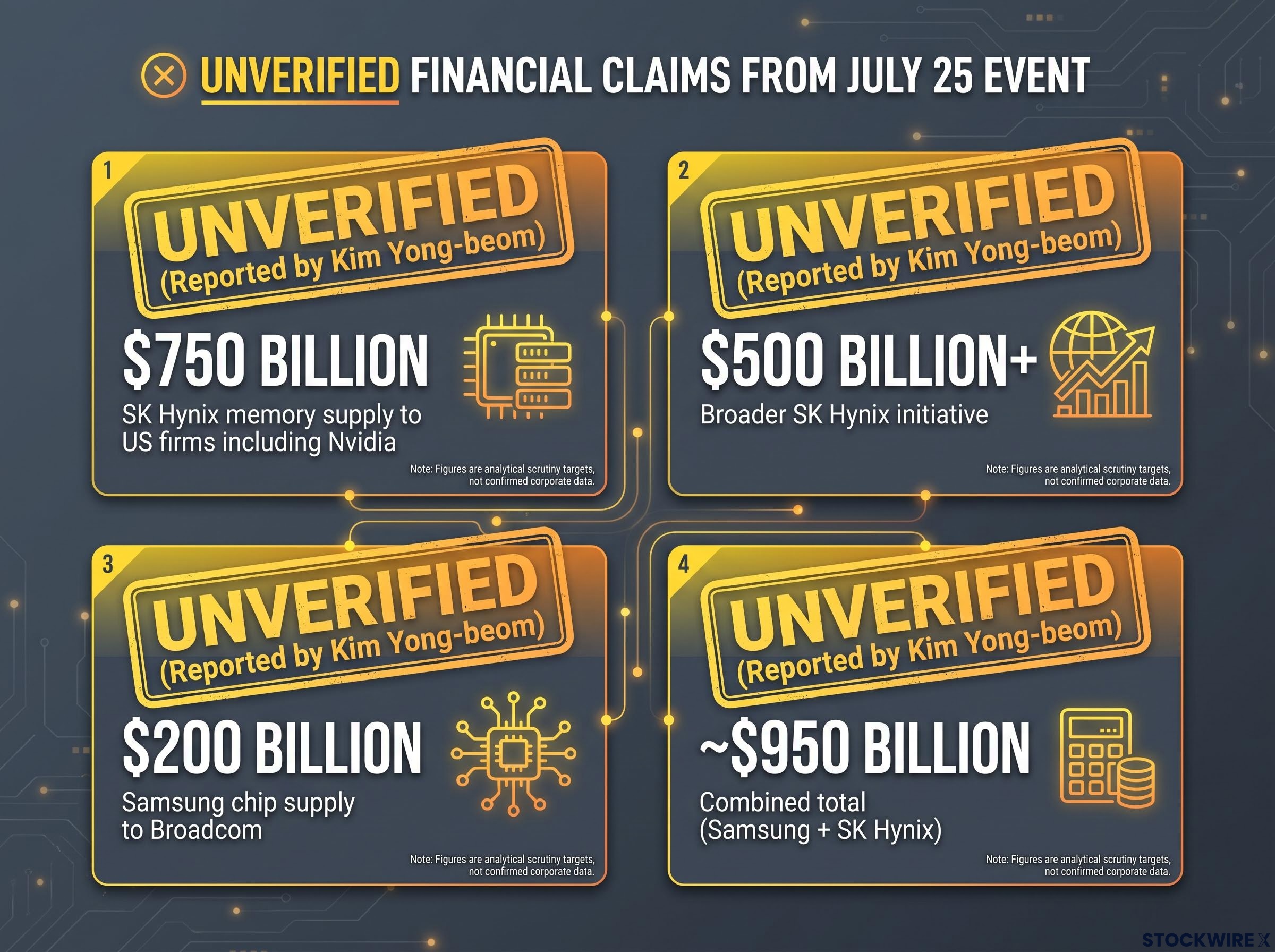
At the 25 July San Francisco event accompanying the presidential visit, South Korean presidential adviser Kim Yong-beom put forward a set of figures that have since circulated widely. These numbers have been widely reported but are not corroborated by either company’s official communications, and detailed deal analyses from major outlets explicitly note that no financial terms were disclosed.
| Figure | Reported Amount | Verification Status |
|---|---|---|
| SK Hynix memory supply to US firms including Nvidia | $750 billion | Reported by Kim Yong-beom; not independently corroborated |
| Broader SK Hynix initiative (memory development + AI data centres) | $500 billion+ | Reported by Kim Yong-beom; CNBC frames entire deal as “could be worth $500B” |
| Samsung chip supply to Broadcom | $200 billion | Reported by Kim Yong-beom; absent from major outlet coverage |
| Combined total (Samsung + SK Hynix) | ~$950 billion | Reported by Kim Yong-beom; not independently corroborated |
| CNBC estimate of overall Nvidia-SK Group agreement | “Could be worth $500 billion” | Framed as potential maximum value, not confirmed contract amount |
Note: “Reported” means sourced to Kim Yong-beom’s briefing during the presidential visit. “Not independently corroborated” means the figure is absent from company statements and major outlet coverage that has explicitly noted no financial terms were disclosed.
Figures that originate from a government briefing and are not corroborated by the counterparties should be treated as indicative of the deal’s ambition, not as confirmed financial commitments. Investors who anchor on headline dollar figures without understanding their provenance risk mispricing the stock move. The strategic story is confirmed and material; the specific numbers require more verification before they belong in any valuation model.
What the deal means for SK Hynix as an investment
Setting aside the unverified dollar figures, the confirmed partnership creates three structural advantages worth pricing in:
- Multi-year revenue visibility. Co-development across Vera Rubin, Vera CPUs, RTX Spark, and Jetson Thor implies demand visibility across multiple Nvidia product cycles, not a single procurement order.
- Capex justification for HBM expansion. The partnership’s explicit framing around extended development cycles and capital investment gives SK Hynix management a stronger case to accelerate HBM capacity expansion despite high upfront costs.
- Competitive moat through co-design. Being designed into Nvidia’s architecture raises switching costs structurally. This is a fundamentally different relationship from commodity DRAM procurement.
HBM pricing dynamics add a further commercial dimension to this partnership: Bernstein projects a 2-2.5x HBM contract price increase for 2027, with cost increases amplifying approximately fourfold at the hyperscaler purchase level once GPU vendors apply margin preservation, a structural repricing that makes multi-year supply agreements more valuable to both sides of the deal.
A co-development agreement embedded across four product lines converts what would otherwise be a cyclical supplier relationship into something closer to a strategic technology partnership. That distinction matters for how the market should price SK Hynix’s forward earnings.
Risks that persist regardless of deal size
- AI capex normalisation. If AI infrastructure spending slows or plateaus, the long-term value realised from any supply commitment shrinks accordingly.
- Cyclical DRAM pricing pressure. Non-HBM memory markets remain cyclical. Standard DRAM pricing could still compress SK Hynix’s overall margins even while HBM demand stays tight.
- Competitive pressure from Samsung and Micron. Both are actively investing in HBM development. SK Hynix’s current 60%+ market share advantage is real, but it is being contested.
South Korea’s chip diplomacy and the US supply chain realignment
The commercial announcements carry a diplomatic signal that extends beyond any single corporate relationship.
Between them, Samsung and SK Hynix account for a commanding portion of worldwide memory output, spanning both DRAM and HBM. That concentration hands South Korea genuine structural influence over the AI supply chain, which is precisely why these announcements were wrapped around a presidential visit rather than communicated through a standard earnings call.
The diplomatic staging signals that governments now view semiconductor supply chains as strategic assets requiring state-level stewardship, not just commercial relationships managed between procurement teams.
The dependency flows in both directions. American AI developers rely on South Korean memory capacity, while South Korean chipmakers depend on the scale of American demand. With supply constraints tightening, technology firms have begun locking in capacity well before they need it, and the resulting upward pressure on memory prices is sharpening that urgency further. For investors, understanding this geopolitical layer helps assess both the durability of these supply arrangements and the risks that would emerge if the US-South Korea relationship were to shift.
Geopolitical risk in semiconductor stocks can materialise rapidly: a single unverified Facebook post from a South Korean presidential aide in May 2026 erased more than $300 billion in market value intraday before three government bodies issued coordinated denials within hours, illustrating precisely the kind of non-legislative risk that investors tracking the US-South Korea relationship need to price in.
What the confirmed deal signals, and what still needs to be verified
The strategic picture is clear: the world’s leading GPU maker and the world’s leading HBM supplier have formalised a multiyear, multi-platform co-development partnership. That is real, confirmed, and strategically significant.
What remains open is the specific financial scale. The dollar figures attributed to Kim Yong-beom have not been confirmed by either company and are not independently corroborated in major outlet coverage.
Investors tracking this story should watch for:
- Official financial disclosures from SK Hynix in upcoming earnings reports or regulatory filings
- Independent reporting on the Samsung-Broadcom arrangement claimed by Kim Yong-beom
- SK Telecom’s data centre progress reports and any disclosed capex figures for the gigawatt-scale AI cloud
- Any formal company response to the specific dollar figures circulating in coverage
Investors who anchor on confirmed fundamentals, the partnership scope, the HBM market position, and the co-design lock-in, rather than unverified headline figures will be better positioned to evaluate SK Hynix’s AI memory thesis as more information becomes available.
This article is for informational purposes only and should not be considered financial advice. Investors should conduct their own research and consult with financial professionals before making investment decisions. These statements are speculative and subject to change based on market developments and company performance.