
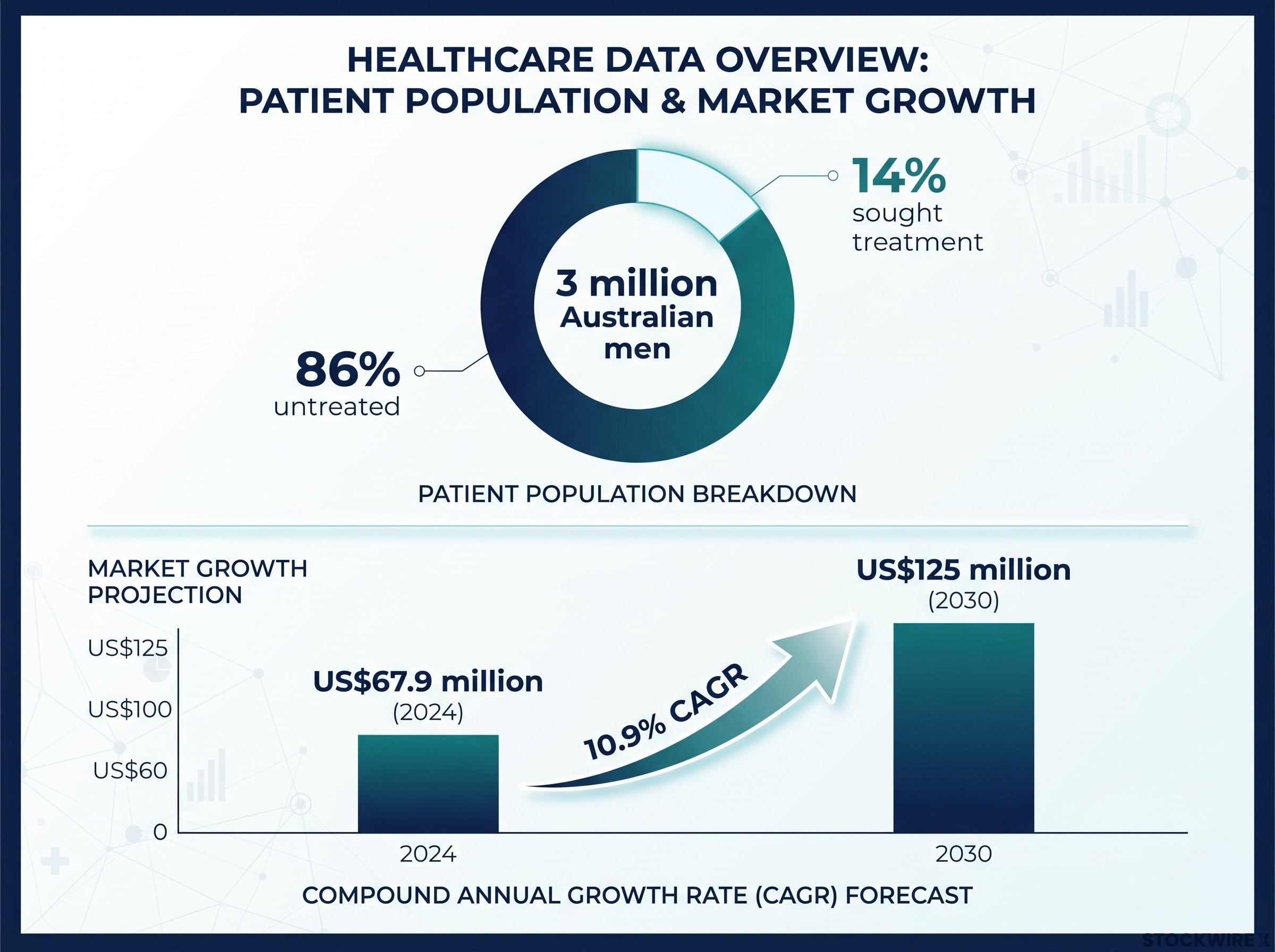
Around 3 million Australian men live with erectile dysfunction. Fewer than 1 in 7 has ever sought treatment.
That gap between prevalence and action is not just a public health problem. It is a structural market condition. When a pharmaceutical category is growing at nearly 11% annually but 86% of the potential patient population has never entered the funnel, you are looking at a demand profile that most consumer markets never produce. The investor question is straightforward: what kind of ASX health stock emerges when a genuinely differentiated product meets that kind of latent demand?
Here is what the numbers, the clinical evidence, and the commercial model tell you. This piece walks through the actual scale of the erectile dysfunction (ED) market in Australia and globally, why the current standard of care is failing the patients it reaches, and what one emerging Australian company, Eve Health Group (ASX: EVE), is attempting to build in response.
A market hiding in plain sight: the scale of ED in Australia and globally
The numbers start large and get larger. Globally, ED affects an estimated 322 million men, and in Australia that figure sits at roughly 3 million, a population in which prevalence climbs steeply with age, with approximately 1 in 5 men over 40 experiencing the condition.
The age-prevalence relationship makes this a growing problem, not a static one:
- Approximately 1 in 5 Australian men past the age of 40 live with the condition
- Among men aged 60-69, roughly 70% report some degree of ED
- From age 45 onward, each additional year of age brings roughly an 11% higher likelihood of ED
As populations age, the patient pool expands every year. But the real number is the one that reframes the entire category.
Just 14% of Australian men with ED have ever pursued treatment for it, leaving the remaining 86% of those affected entirely outside any care pathway.
For you as an investor evaluating health stocks, that 14% figure changes the arithmetic. This is not a mature market where growth requires taking share from competitors. It is a market where most of the demand has never been activated. Any company that can credibly reduce the barriers keeping patients out of the funnel is not fighting for slices of a fixed pie; it is expanding the pie itself.
When big ASX news breaks, our subscribers know first
Why ED is more than a quality-of-life issue
The common framing of ED as a lifestyle concern understates its clinical significance. Clinical literature consistently recognises ED as an early indicator of underlying cardiovascular disease, and that connection reshapes how you should assess both the public health urgency and the commercial opportunity.
The cardiovascular connection
Penile blood vessels are among the smallest in the body, making them particularly sensitive to endothelial dysfunction, which is damage to the lining of blood vessels that impairs blood flow. Problems show up there first. A man experiencing ED may have developing cardiovascular disease that has not yet produced symptoms detectable through standard screening.
Research on ED severity as a cardiovascular risk marker shows that the risks of cardiovascular disease events and mortality increase steadily with the severity of erectile dysfunction, reinforcing why clinicians treating men for ED are increasingly alert to underlying cardiometabolic conditions.
Elevated rates of diabetes, hypertension, and depression are also well documented among men presenting with ED. A man presenting for ED treatment frequently carries co-existing, potentially undiagnosed cardiometabolic risk factors. That means the treatment gap identified above is not just leaving sexual health unaddressed. It is leaving millions of men outside any care pathway that could detect serious chronic disease early.
For you as an investor, the cardiovascular connection reframes the commercial opportunity. Companies building patient access infrastructure around ED are not just selling a single-condition product. They are potentially becoming entry points into a far broader chronic disease management opportunity.
What is wrong with the current standard of care
To understand why disruption is possible, you need to see what the current treatment experience actually looks like for patients.
Oral PDE5 inhibitors, a class of drugs that includes sildenafil, tadalafil, and vardenafil, dominate ED treatment. PDE5 inhibitors work by relaxing blood vessel walls to increase blood flow, which is the mechanism behind medications such as Viagra and Levitra. They are effective for many patients, but the discontinuation data tells a different story about the treatment experience.
Within 12 months of beginning oral PDE5 inhibitor therapy, over 50% of patients have already stopped purchasing their medication.
A multicenter PDE5 inhibitor adherence study found Kaplan-Meier discontinuation estimates ranging from 42% to 67% across tadalafil and sildenafil regimens, providing controlled clinical evidence for the treatment dropout rates that characterise the current standard of care.
The reasons are specific and measurable:
| Limitation | Current tablet therapy | Clinical consequence | Patient impact |
|---|---|---|---|
| Onset time | 45-60 minutes | Requires advance planning | Reduces spontaneity |
| Food interaction | Sildenafil affected by food | Absorption delayed or reduced | Dietary restrictions around dosing |
| Side effects | Up to 35% experience flushing, headaches | Tolerability-driven dropout | Patients stop treatment |
| Non-responder rate | 30-35% report inadequate results | Clinical need unmet | Patients exit funnel entirely |
| 12-month discontinuation | Over 50% | Leaky patient retention | Market churns rather than retains |
Here is the structural point that matters for your assessment. Globally, the ED market is forecast to expand at a CAGR of 7.6% to 2032. Australia’s trajectory is steeper, with the local market projected to reach approximately US$125 million by 2030 from a base of US$67.9 million in 2024, representing a CAGR of 10.9%, among the fastest rates recorded anywhere globally.
That growth is happening despite a 50%-plus dropout rate. The market is not retaining patients effectively. It is growing because new patients keep entering and cycling through a leaky funnel. Any product that genuinely improves the treatment experience has a dual opportunity: converting men who have never sought treatment at all, and recapturing the large cohort who tried, were disappointed, and stopped.
How Libbo works and what makes the delivery format different
Eve Health Group has developed Libbo, a proprietary oral dissolving film (ODF) built around vardenafil, the active compound found in the established medication Levitra, reformulated using Eve’s own delivery technology.
The format is physically simple. A thin strip of film that dissolves on contact with the mucosal lining of the mouth, either beneath the tongue or against the inner cheek. It dissolves without water in seconds. There is no visible tablet and no need to plan around meals.
The speed advantage comes from how the drug enters the bloodstream. Eve’s formulation uses proprietary nano-emulsion technology, a process that encapsulates the drug in extremely small droplets, to enable transmucosal absorption. That means the active ingredient passes through the lining of the mouth directly into the bloodstream, bypassing the gastrointestinal tract where standard tablets are absorbed. By skipping the digestive process, the drug reaches effective levels faster.
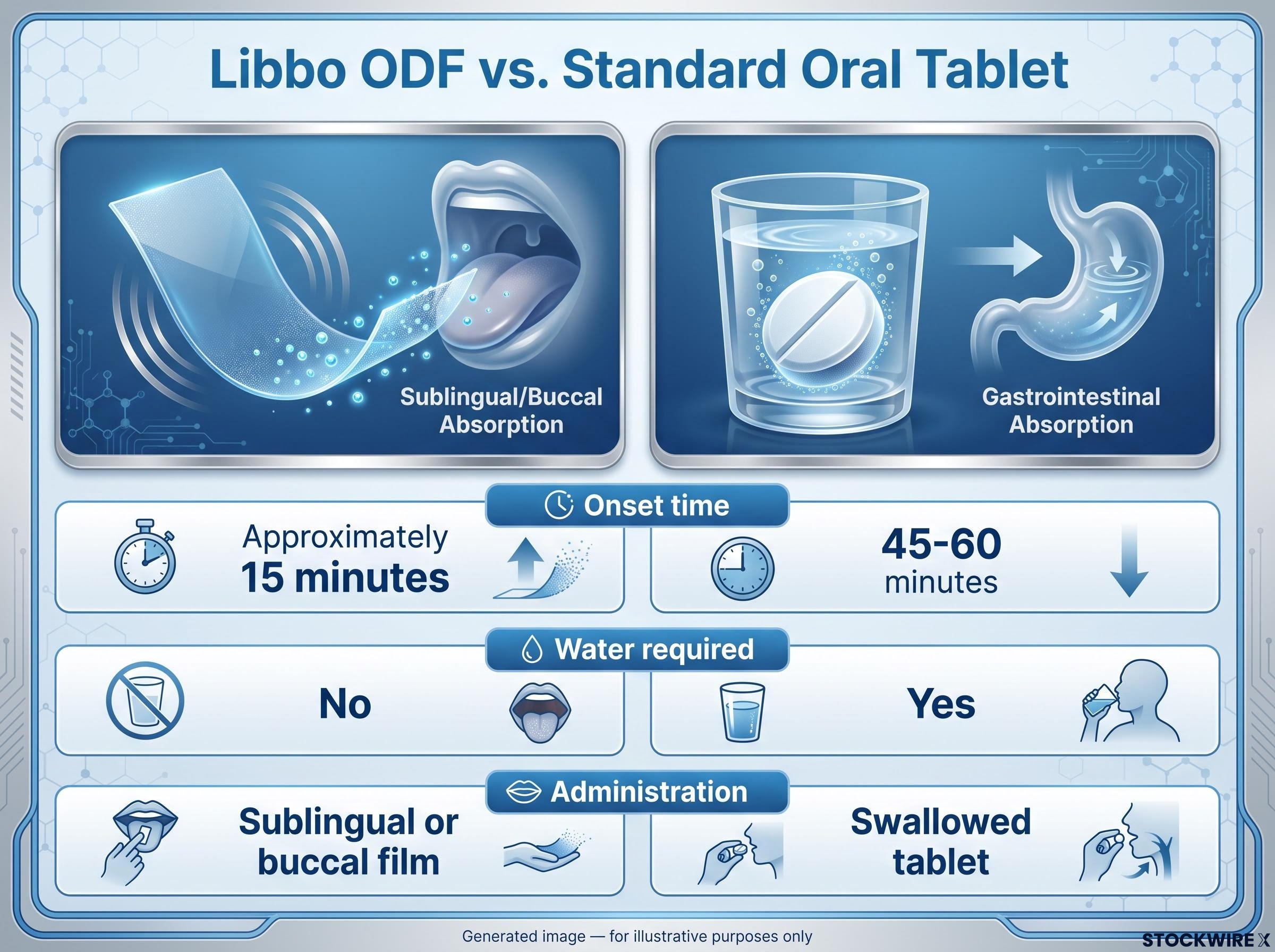
Initial observational data from a cohort of 10 participants showed every individual achieved a clinical response within around 15 minutes, well inside the 45-60 minute window typical of conventional tablets. Because this dataset is small and preliminary, Eve initiated a formal bioequivalence study to validate the findings under rigorous, controlled conditions.
The pilot pharmacokinetic study is underway, with subject recruitment progressing; a successful outcome will inform the design of the larger pivotal bioequivalence trial required before the ARTG submission can proceed.
| Feature | Libbo ODF | Standard oral tablet |
|---|---|---|
| Onset time | Approximately 15 minutes | 45-60 minutes |
| Food interaction | Not required to avoid food | Sildenafil affected by food |
| Water required | No | Yes |
| Administration | Sublingual or buccal dissolving film | Swallowed tablet |
| Australian regulatory status | Available via SAS-B and Authorised Prescriber; ARTG submission planned | Fully registered |
The formulation innovation here is not about discovering a new molecule. The value proposition for investors evaluating this as an ASX health stock is that the same drug, delivered differently, could produce meaningfully better patient outcomes and a differentiated market position, while carrying lower molecule-level development risk because vardenafil’s safety profile is already well established.
Submission for inclusion on the Australian Register of Therapeutic Goods (ARTG), the formal product registration pathway administered by the Therapeutic Goods Administration (TGA), is targeted within the next 12 months.
From prescription to patient: how Eve’s commercial model is built for low-friction access
Libbo is already available in Australia. Prescriptions are currently written under two pre-registration frameworks, the Special Access Scheme (SAS-B) and the Authorised Prescriber pathway, each of which allows clinicians to prescribe the product before it holds full ARTG registration.
The access pathway is designed to directly address the stigma and convenience barriers that keep 86% of affected men from seeking help:
- A patient visits Libx Health (libx.com.au), an education-focused platform that serves as an entry point connecting individuals to prescribers
- A telehealth consultation is completed via hubMed or TeleDocs Clinic, so no face-to-face GP appointment is required
- A prescription is issued if clinically appropriate
- The prescription is filled and dispatched directly to the patient’s door through Chemist2U
The architecture is deliberate. Remote consultation removes the in-person visit. Home delivery adds discretion. Each layer chips away at the specific friction points that have kept this market structurally underserved for decades.
Beyond Libbo: the pipeline case
For you as an investor, the distribution infrastructure matters as much as the product itself. A scalable telehealth and pharmacy fulfilment model that removes stigma friction is an asset that can be redeployed across additional products, compounding the commercial value of each new entry. Eve’s disclosed pipeline extends the thesis:
- Vardenafil oral spray for ED, designed for even faster onset without alcohol-based delivery systems
- Dapoxetine oral spray for premature ejaculation (PE), a condition that frequently co-occurs with ED
- Dual-active combination spray combining vardenafil and dapoxetine, targeting patients experiencing both conditions simultaneously
The combined global market opportunity across ED and premature ejaculation is estimated at more than US$8 billion, according to company commentary.
Eve’s reformulated drug pipeline extends well beyond the ED category, with completed R&D on three oral spray formulations for men’s sexual health and a provisional patent lodged for an apixaban anticoagulant reformulation targeting a US$19 billion market ahead of patent expiry.
What the ED market tells investors about disruption-stage health stocks
The ED market illustrates a pattern that recurs across ASX health stocks in the disruption stage. The demand is real and large. The existing products are structurally flawed. The company attempting to capture the opportunity is early enough in its regulatory journey that the outcome remains genuinely uncertain.
Rapid-onset ED reformulations are attracting clinical and investor attention across the ASX, with LTR Pharma’s SPONTAN nasal spray recording a median onset of 10 minutes across 27 Phase II subjects, illustrating how multiple companies are competing to close the spontaneity gap that standard oral tablets leave open.
That uncertainty is the risk-return profile. Here is how the upside case and the risk picture sit side by side:
| Factor | Upside case | Risk to consider |
|---|---|---|
| Regulatory pathway | Bioequivalence study underway; ARTG submission planned | Regulatory timelines and outcomes are not guaranteed |
| Market demand | 86% untreated population; Australian CAGR of 10.9% | Latent demand may not convert without sustained marketing spend |
| Product differentiation | 15-minute onset via ODF; no food interaction; discreet format | Early observational study (n=10) requires confirmation in formal study |
| Competitive context | No widely approved Australian ODF product with comparable profile | Generic sildenafil and tadalafil are widely available and inexpensive |
| Pipeline depth | Three additional formulations across ED and PE; combined market over US$8 billion | Pipeline products are pre-registration; commercial success depends on execution |
The reformulation strategy uses a known active ingredient with an established safety profile, reducing molecule-level risk. The value creation lever is delivery technology, IP protection, and commercial execution, not novel drug discovery.
The 50%-plus discontinuation rate among current patients and the 86% untreated population represent two distinct demand pools. The first is recapture; the second is conversion. Both require a product that patients actually want to continue using and an access model that removes the reasons they never started.
This article is for informational purposes only and should not be considered financial advice. Investors should conduct their own research and consult with financial professionals before making investment decisions. Past performance does not guarantee future results. Forward-looking statements regarding regulatory timelines, clinical outcomes, and market projections are subject to change based on market developments and company performance.
The ED disruption thesis, assessed
Australia’s ED market sits among the fastest-growing pharmaceutical categories in the country, is demonstrably underserved relative to the scale of patient need, and shows no sign of slowing. Eve Health Group’s pairing of a delivery-differentiated product with a telehealth access model constructed around stigma reduction is a purposeful response to the structural conditions producing that opportunity.
The variables that matter from here are specific: the outcome of the formal bioequivalence study now underway, the timing of the ARTG submission, and whether the telehealth access model generates measurable prescription volume ahead of full registration. Each carries real clinical, regulatory, and commercial risk.
TGA approval timelines vary significantly by product category and regulatory pathway, and Memphasys demonstrated that early approval is possible when regulatory execution is strong, securing its Felix System listing approximately two months ahead of guidance and enabling immediate commercial deployment across Australian IVF clinics.
For the most current regulatory and clinical updates, Eve Health Group’s ASX announcements provide the primary source. For patient-facing product information, libx.com.au offers details on treatment access pathways.
—