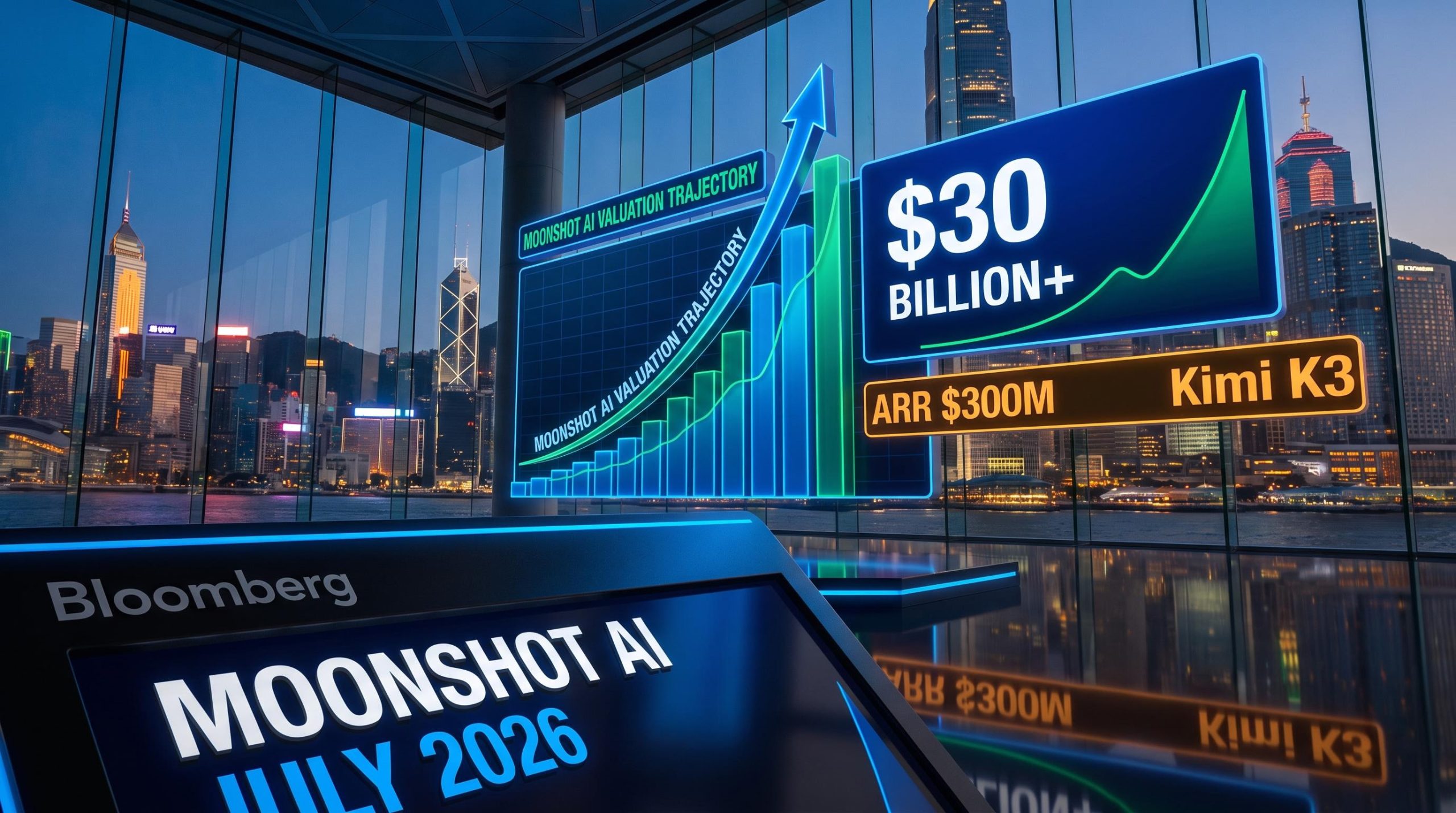
Moonshot AI, a Beijing startup founded just three years ago, is now seeking a public valuation above $30 billion, a number that puts it within striking distance of companies that took decades to build.
The IPO bid arrives on the back of Kimi K3, an open-weight model that third-party benchmarks show competing with Anthropic’s Claude Opus 4.8 in coding and agentic tests. That single performance data point has compressed a fundraising timeline and pushed forward a Hong Kong listing process now expected to wrap up within roughly half a year. This is not simply a story about one company’s ambitions. It is about what the market is now prepared to pay for Chinese AI capability.
Here is the financial trajectory, the competitive context, and the specific variables that will determine whether the $30 billion figure holds when public-market scrutiny arrives. The goal is a grounded basis for evaluating Moonshot as an investment signal, not just a headline.
From $18 billion to $30 billion in a single year
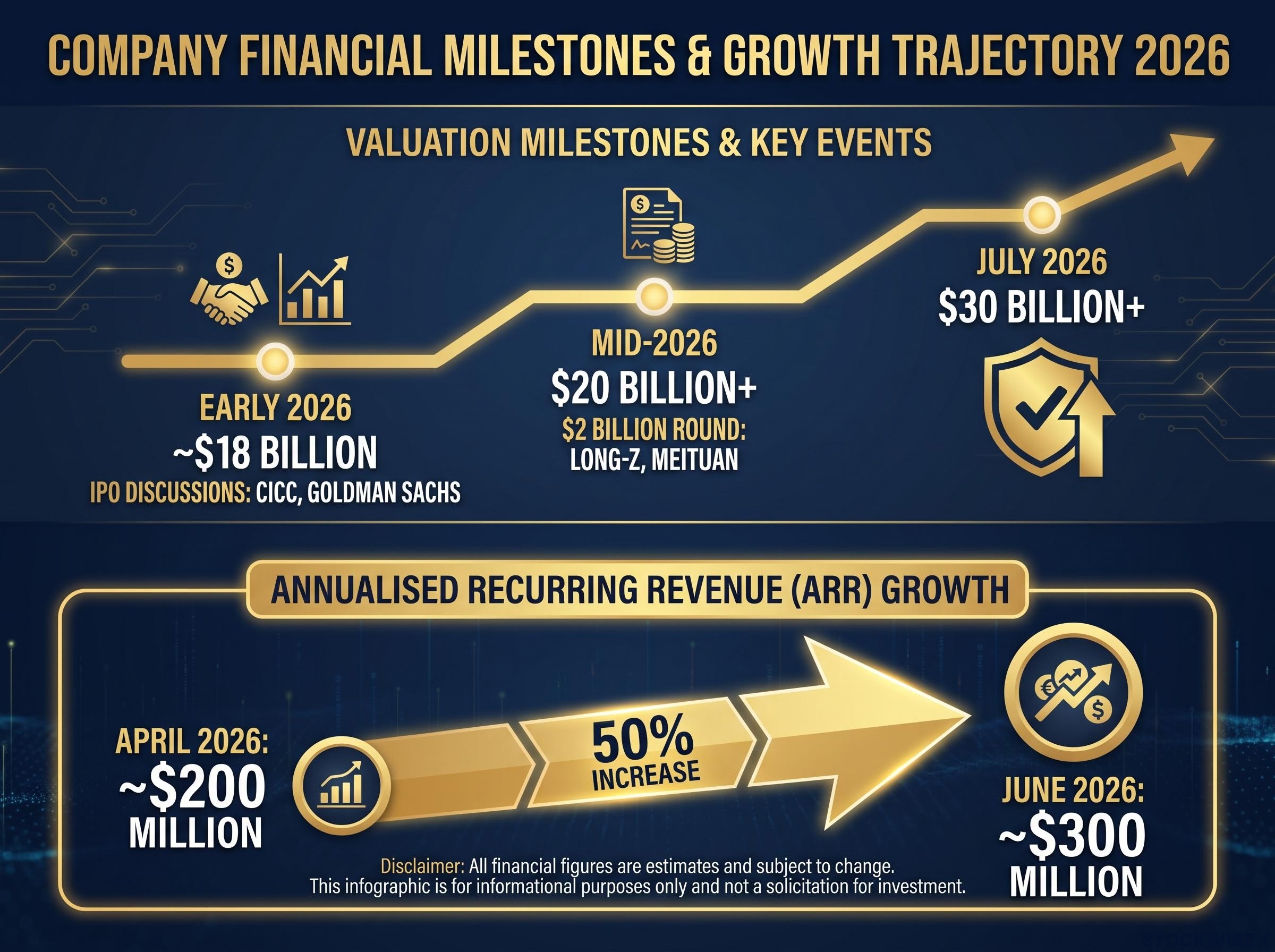
The valuation climb started earlier in 2026, when multiple sources placed Moonshot AI at approximately $18 billion in connection with early IPO discussions. A funding round of approximately $2 billion, led by Long-Z Investments and Meituan’s venture arm, lifted the figure to over $20 billion and brought total capital raised in roughly six months to an estimated $3.9 billion.
Then came the latest mark. Bloomberg reported on 19-20 July 2026 that an ongoing private financing round could push the company’s valuation beyond $30 billion, with the precise terms of that round still to be agreed.
$30 billion+: Bloomberg’s current reported valuation mark for Moonshot AI as of July 2026, up from approximately $18 billion earlier in the year.
CICC and Goldman Sachs are in discussions to advise on the Hong Kong offering, with a potential listing window of late 2026 to early 2027. That timeline is anchored by a shareholder resolution the company distributed to investors seeking approval for the proposed listing, which set out a roughly six-month preparatory window.
| Valuation Mark | Approximate Timing | Key Catalyst |
|---|---|---|
| ~$18 billion | Early 2026 | Initial IPO discussions with CICC and Goldman Sachs |
| $20 billion+ | Mid-2026 | $2 billion round led by Long-Z Investments and Meituan’s venture arm |
| $30 billion+ | July 2026 | Kimi K3 benchmark performance and accelerated listing preparations |
The pace of that step-up tells you something specific: private-market participants are revising their assumptions about Chinese AI capability faster than most public-market frameworks have yet priced in.
When big ASX news breaks, our subscribers know first
What Kimi K3 actually does, and why benchmarks matter to the valuation
Kimi K3 is an open-weight large language model. That means its parameters are publicly released and can be run or customised locally by developers and enterprises, rather than being locked behind a proprietary API. It is a fundamentally different distribution strategy from the closed-model approach taken by OpenAI and Anthropic.
The benchmark results explain the valuation enthusiasm. Third-party evaluations from Artificial Analysis and Arena.ai show Kimi K3:
- Outperforms Anthropic’s Claude Opus 4.8 in coding benchmarks
- Outperforms Claude Opus 4.8 in agentic task benchmarks
- Falls short of the most capable Western frontier systems, including Anthropic’s Claude Fable 5 and OpenAI’s GPT-5.6, on overall capability measures
The company has conceded that a performance gap exists relative to the very latest frontier models. That acknowledgement is investor-relevant context, not a disqualifying weakness.
Kimi K3 is the third successive Chinese AI milestone within roughly eight months, a pattern that analysts have characterised as confirmation of a structural open-weight commoditisation trend rather than an isolated outlier, with direct implications for the premium valuations assigned to closed-model Western incumbents.
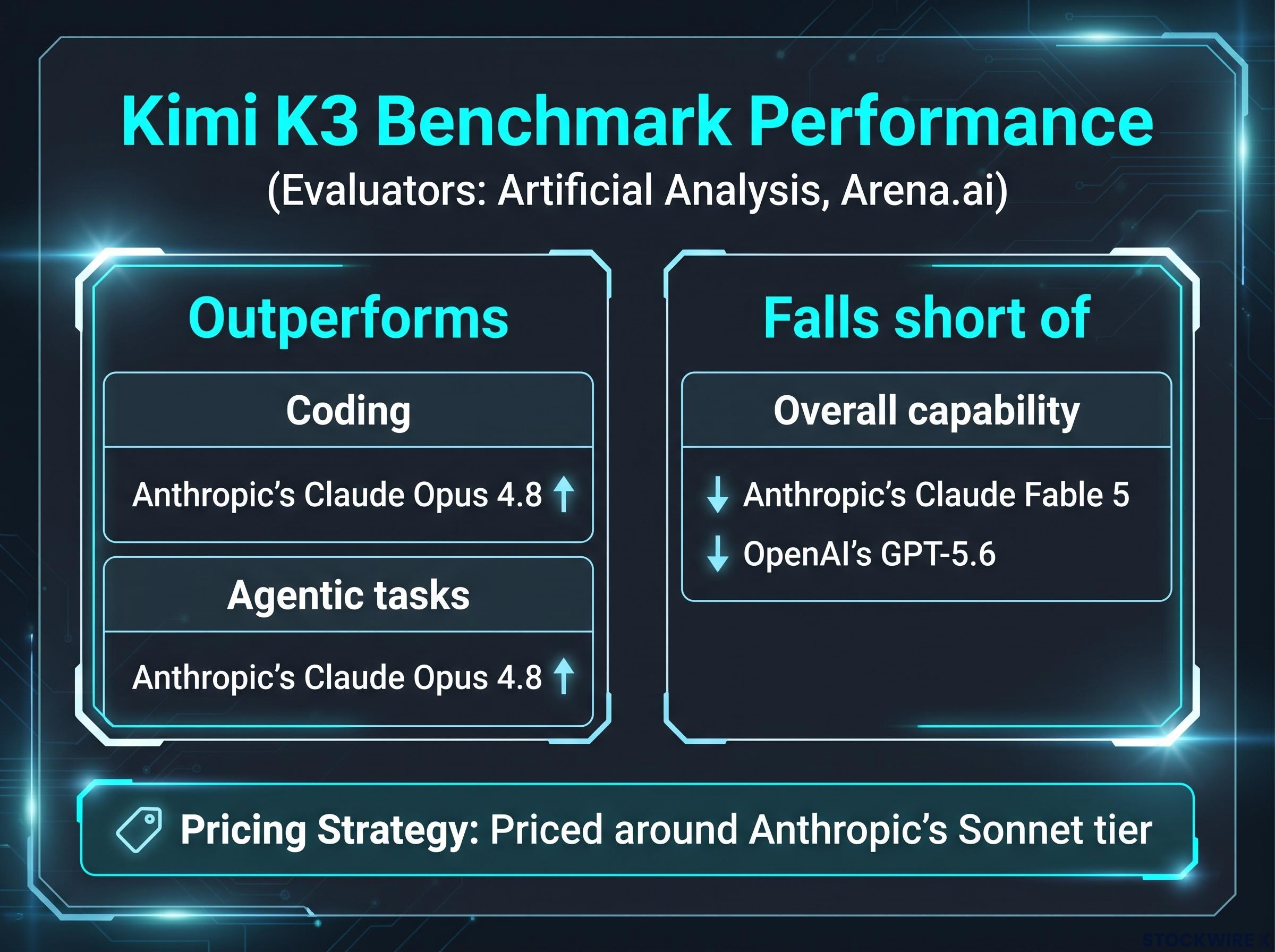
The pricing signal matters as much as the performance data. Kimi K3 is priced around Anthropic’s Sonnet tier, not at a discount. A model that prices at premium and outperforms Opus 4.8 in specific enterprise-relevant benchmarks does not need to be the global frontier leader to justify institutional attention. It needs to be close enough to matter commercially, and current data suggest it is.
Why open-weight matters for ecosystem adoption
The open-weight approach, consistent with Meta’s Llama strategy globally, accelerates developer and enterprise adoption by removing API lock-in. Developers can build on the model without being tethered to a single provider’s infrastructure. Over time, the external usage data and community feedback that open-weight models generate can feed back into model improvement, making the strategy a compounding advantage rather than a one-off distribution choice.
Revenue that changes the conversation
The capability story is one thing. The commercial proof is another, and it arrived faster than most observers expected.
Annualised recurring revenue (ARR): approximately $200 million in April 2026, rising to approximately $300 million by June 2026, driven by paid subscriptions and enterprise API usage.
ARR, or annualised recurring revenue, is the total value of subscription and contract revenue projected over a twelve-month period. It is the standard measure of commercial traction for software and AI businesses.
$100 million in ARR growth across two months is a rate of acceleration that shifts the category of scrutiny entirely. For a three-year-old foundation-model startup, that level of monetisation is unusual. Most peers of comparable age are still predominantly research-stage, generating minimal commercial revenue. Moonshot has moved beyond the research profile into enterprise API contracts and paid subscription products.
The question investors need to carry into the IPO prospectus is whether audited figures confirm or complicate what these pre-listing estimates imply.
The China enterprise AI deployment timeline adds a layer of complexity to Moonshot’s ARR trajectory: 47% of Chinese CIOs are targeting 2027 for initial AI project rollouts, driven by GPU supply constraints and domestic compute readiness gaps, meaning the ARR acceleration from April to June 2026 may be drawing from a relatively early adopter pool rather than the broad enterprise base.
Who is backing Moonshot, and what that signals
The investor list is not just a roster of names. Read it as a map of the distribution channels, compute infrastructure, and consumer platforms that Moonshot is being positioned to access.
Financial investors:
- Alibaba
- Tencent
- HongShan (formerly Sequoia China)
- ZhenFund
- IDG Capital
- 5Y Capital
Strategic investors:
- Meituan’s venture arm (consumer super-app with hundreds of millions of users)
- China Mobile (telecom and compute infrastructure)
The distinction between financial and strategic backing matters. Meituan represents consumer-platform distribution at enormous scale. China Mobile represents telecom infrastructure and compute access. When both a major consumer super-app and the country’s largest telecom are writing cheques, the investor base is telling you something about the planned deployment scale that the valuation number alone cannot.
This composition suggests Moonshot is being built with large-scale domestic deployment in mind, not purely as a research lab seeking a liquidity event.
The Hong Kong listing as a benchmark event for global AI markets
What the VIE unwinding tells investors about regulatory direction
Moonshot is dismantling its variable-interest-entity (VIE) structure to comply with evolving Chinese rules for offshore listings. A VIE is a corporate arrangement historically used by Chinese technology firms to allow foreign investment while maintaining Chinese ownership control. Moonshot’s decision to abandon this structure in favour of a more straightforward listing architecture reflects Beijing’s tightening rules around offshore structures for AI and data-sensitive companies.
That is a governance shift investors must factor into their risk model. It signals Beijing’s intent to keep AI assets under clearer domestic regulatory control while still permitting access to international capital via Hong Kong.
Hong Kong has relaxed IPO rules to attract AI and biotech firms, lowering minimum valuation thresholds and positioning the exchange as the primary public-market venue for China’s AI unicorn cohort.
The HKEX specialist technology listing rules introduced structural modifications to minimum valuation thresholds and profitability requirements, creating the regulatory opening that Chinese AI firms including Moonshot are now moving through.
Peer listings reinforce this trend. Zhipu AI and MiniMax have completed Hong Kong IPOs, and StepFun is reportedly targeting approximately $500 million in its own float. President Xi Jinping has publicly praised China’s advances in low-cost AI and called for a “more open global technological order,” framing AI as an area where China seeks both domestic leadership and international legitimacy.
If Moonshot prices above $30 billion, it will establish a public-market comparable that other Chinese AI firms, and eventually Western counterparts such as Anthropic or OpenAI, will be measured against. The choice of Hong Kong over a U.S. exchange is a regulatory and geopolitical signal as much as a financial one, and investors pricing Moonshot need to factor in what that structural choice implies for foreign-investor access and governance going forward. Export controls on advanced chips remain a structural qualifier for any Chinese AI valuation.
What to watch before the prospectus drops
The specifics matter more than the general categories. Four variables, in approximate order of when they will arrive:
- Private round final pricing. Where the current round closes relative to $30 billion, and whether the investor mix includes international participants or remains predominantly domestic, will be the first hard test of how broad the support base is for this valuation.
- Model benchmark releases before listing. Whether Moonshot’s next model release maintains or extends proximity to the global frontier will shape institutional sentiment in the months before any prospectus lands. A consistent R&D cadence is part of the investment case.
- IPO prospectus financial disclosure. Hong Kong listing rules will require detailed revenue breakdown, margin structure, cash burn, and compute capital expenditure. With ARR estimates in the $200-$300 million range, the gap (or alignment) between current reports and audited figures will be the single most important data point for setting a post-IPO position.
- Regulatory developments on chip access and data rules. U.S. export-control policy on high-end GPUs directly affects Moonshot’s long-term compute cost curve and training capacity. Changes in Chinese rules around AI safety, data localisation, and foreign ownership could affect the operating environment and foreign-investor access.
This article is for informational purposes only and should not be considered financial advice. Investors should conduct their own research and consult with financial professionals before making investment decisions.
Whether the $30 billion holds when public markets look closely
The case for the valuation has specific pillars: rapid ARR growth to $300 million, benchmark performance that challenges Western models in specific domains, strategic investor backing from both capital providers and infrastructure partners, and a Hong Kong market that has been structurally prepared to receive exactly this kind of listing.
The unresolved variables are equally specific. Private-round final pricing has not yet been confirmed. Prospectus financial disclosure has not yet arrived. The regulatory environment around chip controls and data rules remains subject to change. And Moonshot itself acknowledges the capability gap with the very latest frontier models, including Claude Fable 5 and GPT-5.6.
A $30 billion valuation for a three-year-old company with $300 million in ARR implies a revenue multiple that public markets will scrutinise harder than private ones did. That ratio will be the defining test of whether Chinese AI enthusiasm survives contact with audited financials.
The revenue multiple discipline that public markets apply to AI IPO revenue multiples is considerably stricter than private-round pricing, as the Anthropic and OpenAI cases illustrate: both carry implied forward price-to-sales figures derived from third-party projections rather than audited disclosures, the same gap Moonshot will face when its prospectus lands.
Moonshot’s IPO will be one of the clearest public tests yet of how markets price Chinese AI quality, regulatory risk, and open-weight commercial models simultaneously. With Zhipu AI and MiniMax as the only current public comparables among Chinese LLM firms, the pricing outcome will set a reference point that extends well beyond a single company.
Past performance does not guarantee future results. Financial projections are subject to market conditions and various risk factors.