An analyst asks about margin compression. The CEO responds with three paragraphs about the company’s five-year roadmap, the culture of innovation, and a partnership that has not been announced yet. The question goes unanswered. You have heard this before. You know something evasive just happened, but you process it as a feeling, not a measurement.
A Sydney-based fund manager has built a machine that catches exactly that, systematically, across approximately 25,000 earnings calls per year. Plato Investment Management spent roughly three years developing a Natural Language Processing (NLP) tool, a type of artificial intelligence that analyses human language, designed to detect when executives dodge questions during the unscripted Q&A portion of earnings calls.
Here is how the system actually works, what three specific things it measures, and what that means for how you listen to any earnings call differently, whether you manage institutional capital or a self-directed portfolio.
Why the Q&A session is the signal that matters most
Earnings calls have two distinct halves. The prepared remarks come first: scripted, rehearsed, reviewed by legal teams, and polished to land specific messages. Then the Q&A session begins. Analysts ask questions management has not seen in advance, and executives respond in real time. This is the structural distinction that makes the Q&A the higher-value signal for transparency analysis.
Plato’s system targets the Q&A exclusively. It ignores the prepared remarks entirely, and that design choice tells you something important: if a detection system built over three years deliberately skips the scripted portion, it is because management behaviour is most legible in the moments executives cannot prepare for.
| Prepared remarks | Q&A session |
|---|---|
| Scripted and rehearsed in advance | Unscripted, live responses |
| Reviewed by legal and IR teams | No advance sight of questions |
| Designed to land specific messages | Driven by analyst priorities |
| Consistent tone and structure | Variable in length, tone, and directness |
| Low transparency signal | High transparency signal |
Most investors who follow earnings calls focus on the headline guidance numbers delivered in the prepared remarks. The real informational signal, according to the teams building these tools, sits in the segment that follows.
The case for focusing on the Q&A rather than scripted remarks is reinforced by practical earnings call Q&A analysis frameworks, which treat hedging language, metric switching, and evasive redirects as the most analytically useful signals an investor can extract from a quarterly call.
When big ASX news breaks, our subscribers know first
What the system is actually measuring: the three evasion signals
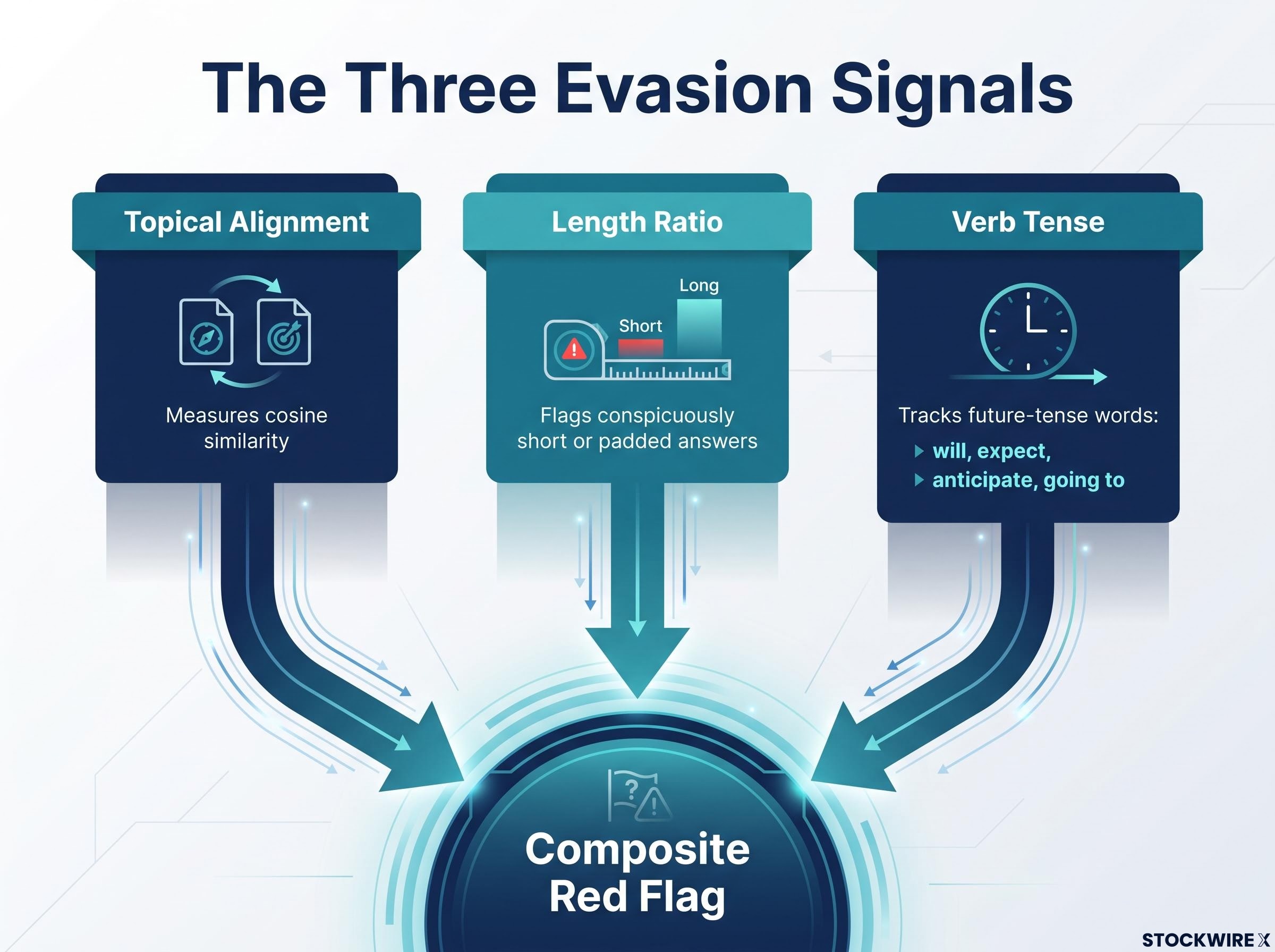
The system flags three distinct linguistic patterns. Each captures a different evasion strategy. A composite red flag is triggered only when all three signals fire together, never on the basis of any single measure alone.
Signal one: whether the answer actually addresses the question
The first signal measures topical alignment. Large language models (LLMs), the same AI technology behind modern chatbots, convert both the analyst’s question and the executive’s answer into vector embeddings. Think of these as coordinates that represent meaning, not just words. The system then calculates cosine similarity, a mathematical measure of how close in meaning two pieces of text are, between the question and the answer.
If the similarity score falls below a calibrated threshold, the answer is flagged. This is not keyword matching. An executive could use every word from the question and still be flagged if the substance of the response addresses something else entirely. That distinction, semantic alignment rather than surface overlap, is why LLMs are central to the detection.
Signal two: the length ratio and what abnormal looks like in both directions
The second signal tracks answer length relative to question length. Evasive answers show abnormal patterns in both directions.
A conspicuously short answer, where an analyst asks a detailed question about cost overruns and the CFO responds with two sentences about being “comfortable with the trajectory,” is one pattern. The opposite is equally telling: a question about a specific contract loss receiving a six-paragraph response that covers market conditions, long-term strategy, customer diversification, and competitive positioning without ever addressing the contract. The system computes a word-count ratio and compares it against historical norms for similar question types, flagging outliers on both ends.
Signal three: speaking about the future when asked about the past
The third signal measures verb tense. The system tags auxiliaries and modal verbs (“will,” “expect,” “anticipate,” “going to”) and computes the proportion of future-tense constructions in each answer. It then compares that proportion against baselines for similar question types.
When an analyst asks what happened to margins last quarter and the CEO’s response is dominated by what “will” happen, what the team “expects” to deliver, and what the company “anticipates” achieving, the system flags it. The strategy is redirection: management shifts accountability to a period that has not happened yet and therefore cannot be contested in the moment.
Cohen’s kappa of approximately 0.835: In the EvasionBench academic benchmark, built from 30,000 training samples and 1,000 human-annotated test samples across three evasion levels, independent experts agreed on evasion classifications at a rate that clears the threshold for high reliability. These signals are measurably consistent, not subjective impressions.
Together, the three signals capture a specific management behaviour pattern: deflect the substance of a question by going off-topic, bury it in volume, or redirect attention to a future that cannot yet be held accountable.
How a machine reads language that humans already find slippery
You might reasonably assume that detecting evasion is inherently subjective, something you feel rather than measure. The academic evidence says otherwise.
The EvasionBench benchmark demonstrated that evasive answers in financial Q&A have consistent, measurable linguistic signatures. Using the signal-based criteria described above (topical alignment, length ratio, and tense patterns), independent human experts agreed on what counts as evasive with a Cohen’s kappa of approximately 0.835. That level of agreement clears the threshold considered “high reliability” in social science research.
Experts independently agreed on evasion classifications at a rate that confirms these patterns are reliably measurable, not a matter of personal interpretation.
LLMs are specifically required here because earlier keyword-matching tools could not capture semantic alignment. Two sentences can share no words in common and mean the same thing; two sentences can share every word and mean something different. Only a model that processes meaning, not just vocabulary, can measure whether an answer genuinely addresses what was asked.
The consistency advantage matters as much as the accuracy. The same criteria apply to every CEO regardless of charisma, reputation, or delivery style. A confident communicator and an awkward one are evaluated on identical terms. Plato runs this across approximately 25,000 calls per year, a volume no human analyst team could scrutinise in real time with comparable consistency.
Where evasion detection sits inside a 150-signal risk framework
This evasion tool sits within a broader suite of more than 150 red flags that Plato monitors across its risk framework. Those red flags span a wide range of categories, including:
- Accounting quality
- Governance structures
- Executive behaviour and backgrounds
- Balance sheet stress indicators
- Environmental, social, and governance (ESG) considerations
A single evasive call is not grounds to exit a position. The framework’s power comes from accumulation. When evasion patterns coincide with accounting anomalies, governance red flags, or balance sheet stress, the composite risk picture sharpens considerably.
Management quality assessment sits alongside balance sheet strength, competitive dynamics, and customer concentration as one of six dimensions that value investors use to rate business risk before any valuation modelling begins, a framework that treats executive behaviour as a structured input rather than a subjective impression.
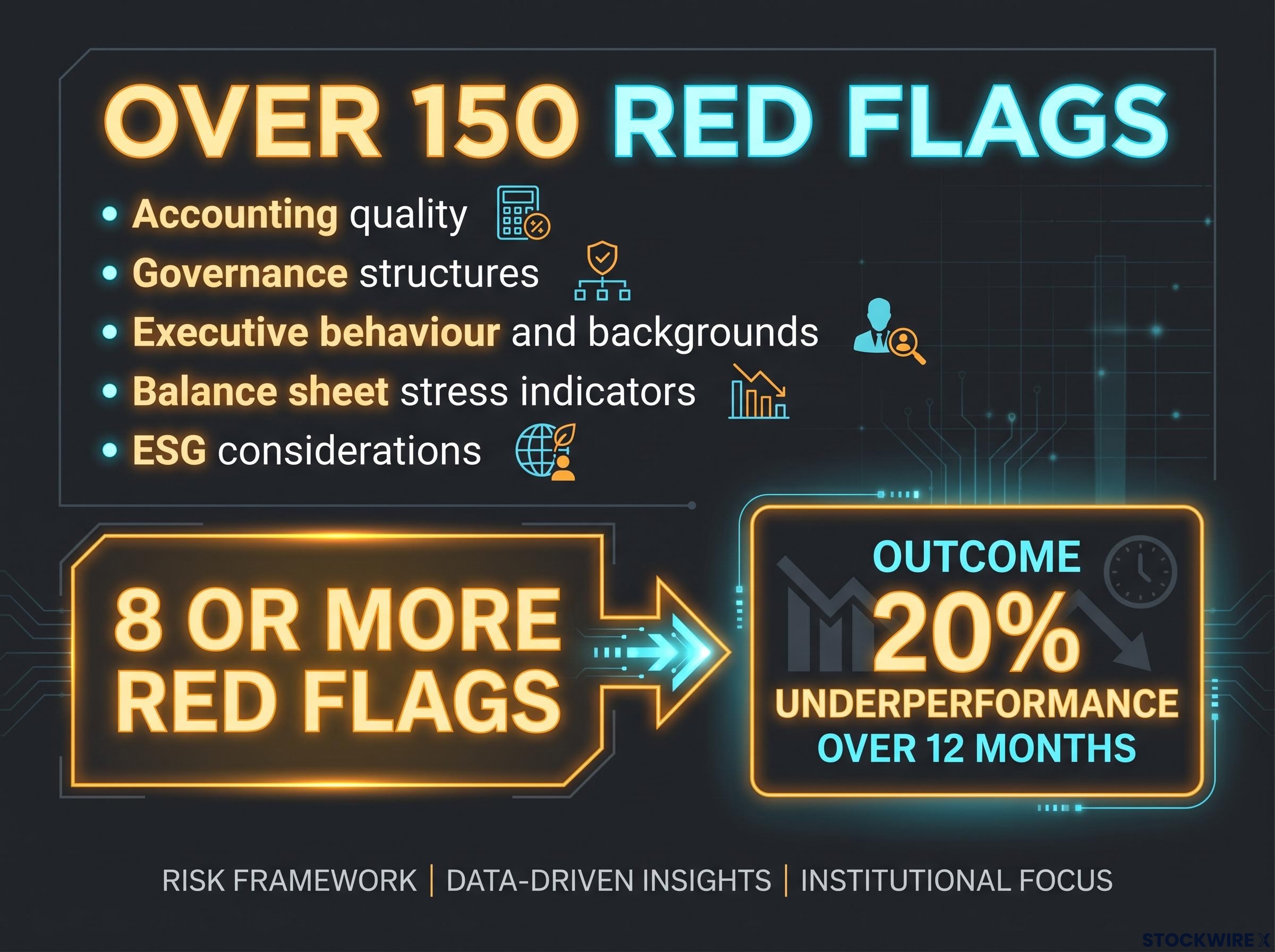
According to Plato’s research, businesses that accumulate eight or more red flags within the framework have historically underperformed the broader market by roughly 20% across the following 12-month period.
That 20% underperformance figure tells you this is not an academic exercise. The framework has been calibrated against actual market returns. When all three evasion signals fire simultaneously, the composite red flag can prompt a short position in Plato’s Alpha Plus Fund. And research from Plato indicates that companies whose executives repeatedly dodge questions on calls tend to lag the market over the next 3-6 months.
The architecture works the way a structural inspection works for a building: one crack is a maintenance item, but a pattern of cracks across load-bearing elements is a structural warning.
The next major ASX story will hit our subscribers first
What retail investors can take from an institutional AI playbook
You do not need to build software to use the logic behind it. Each of the three signals translates into a self-check you can apply while listening to a call or reading a transcript.
- Did the answer actually address what was asked? After the executive finishes responding, ask yourself whether they answered the analyst’s question or a different, more comfortable one. If you cannot connect the response back to the original question, that is the topical alignment signal firing.
- Was the length conspicuously short or padded with tangents? A two-sentence response to a detailed question is a deflection. A six-paragraph response that never returns to the specific issue raised is equally telling. Both patterns carry information.
- Was the response dominated by future-tense language when the question was about current or past performance? If the analyst asked what happened to margins last quarter and the executive spent the answer talking about what “will” happen next year, that is the tense signal. They redirected accountability to a period that cannot be verified yet.
This is not about catching every evasion. It is about training your attention. A single evasive exchange matters less than a persistent pattern across multiple calls, especially when it coincides with balance sheet stress, accounting anomalies, or governance concerns. Track behaviour over time, not isolated moments.
Portfolio risk signals work best in combination: evasion patterns in management communication carry more weight when they coincide with beta-weighted position concentration or deteriorating balance sheet metrics that quantitative screening can measure independently.
Whether AI catches what markets miss, and for how long
Systematic evasion detection captures qualitative risk that traditional quantitative screening misses because it operates on unstructured language rather than financial statement data. The financial statements tell you what the numbers are. The Q&A tells you how willing management is to explain them honestly.
The information edge is real now. Plato’s tool is proprietary and was developed over approximately three years. While NLP-based earnings call analysis is a growing institutional practice (tone and sentiment scoring, topic modelling, fraud and anomaly detection are all in active use), systematic evasion detection specifically remains a less crowded application. No regulatory prohibitions on this type of analysis have been identified as of July 2026.
The market-efficiency question is worth holding honestly. As more institutional investors deploy similar NLP tools, the informational edge of detecting evasion may compress over time. Information advantages in markets tend to diminish once enough capital chases the same signal. But even in a world of broad adoption, the enduring value is the transparency pressure itself. If every management team knows their Q&A responses are being systematically scored for evasion, the incentive to answer substantively increases. The discipline of transparency evaluation may outlast the specific return premium.
Institutional NLP adoption is reshaping the competitive landscape for financial data providers, with embedded infrastructure businesses facing a different disruption calculus than terminal-model aggregators despite markets applying an indiscriminate AI-displacement discount across the entire sector.
The three questions above cost you nothing to apply the next time you read a transcript. The machine formalises what your instinct already noticed. The difference is consistency.
This article is for informational purposes only and should not be considered financial advice. Investors should conduct their own research and consult with financial professionals before making investment decisions.