

Pacific Edge APAC business advances towards profitability in Q1 FY27
In its Q1 FY27 investor update, released 14 July 2026, Pacific Edge reported that its Asia Pacific (APAC) operations are advancing towards profitability on a direct-cost basis, supported by commercial volume growth and increasing adoption of its next-generation test, Cxbladder Triage Plus.
APAC commercial tests rose 12.9% to 1,158 in Q1 FY27, up from 1,026 in Q4 FY26. APAC cash burn reduced to $0.17m for the quarter, reflecting disciplined cost management, improved pricing, and a growing contribution from commercial testing.
The cancer diagnostics company noted the regional performance demonstrates the commercial model it aims to replicate in the United States. Pacific Edge stated it is releasing quarterly commercial volumes “for the first time” to provide greater transparency to investors, and intends to continue doing so in future updates.
When big ASX news breaks, our subscribers know first
Q1 FY27 test volume performance
The update detailed three test volume streams: APAC commercial, US commercial, and total laboratory throughput (TLT). The 12.9% rise in APAC commercial tests was aided by a shift in test mix towards Triage Plus, which offers superior performance and higher margins.
US commercial tests declined a modest 2.4% to 3,295, down from 3,375 in Q4 FY26. The company attributed the fall to continuing attrition in the sales team, which reduced to 5.0 FTEs from 7.7 FTEs, in line with cash preservation initiatives ahead of the draft Medicare policy decision.
TLT fell 8.3% to 5,116, largely due to an 82% reduction in clinical trials and investigator-initiated trial volumes, which dropped to 115 in Q1 FY27 from 642 in Q4 FY26. This reflected a decline in trial activity rather than a commercial contraction.
Notably, US sales force efficiency improved. Commercial tests per sales FTE rose to 659 from 440, while the number of ordering clinicians increased 7% to 814, from 764 in Q4 FY26.
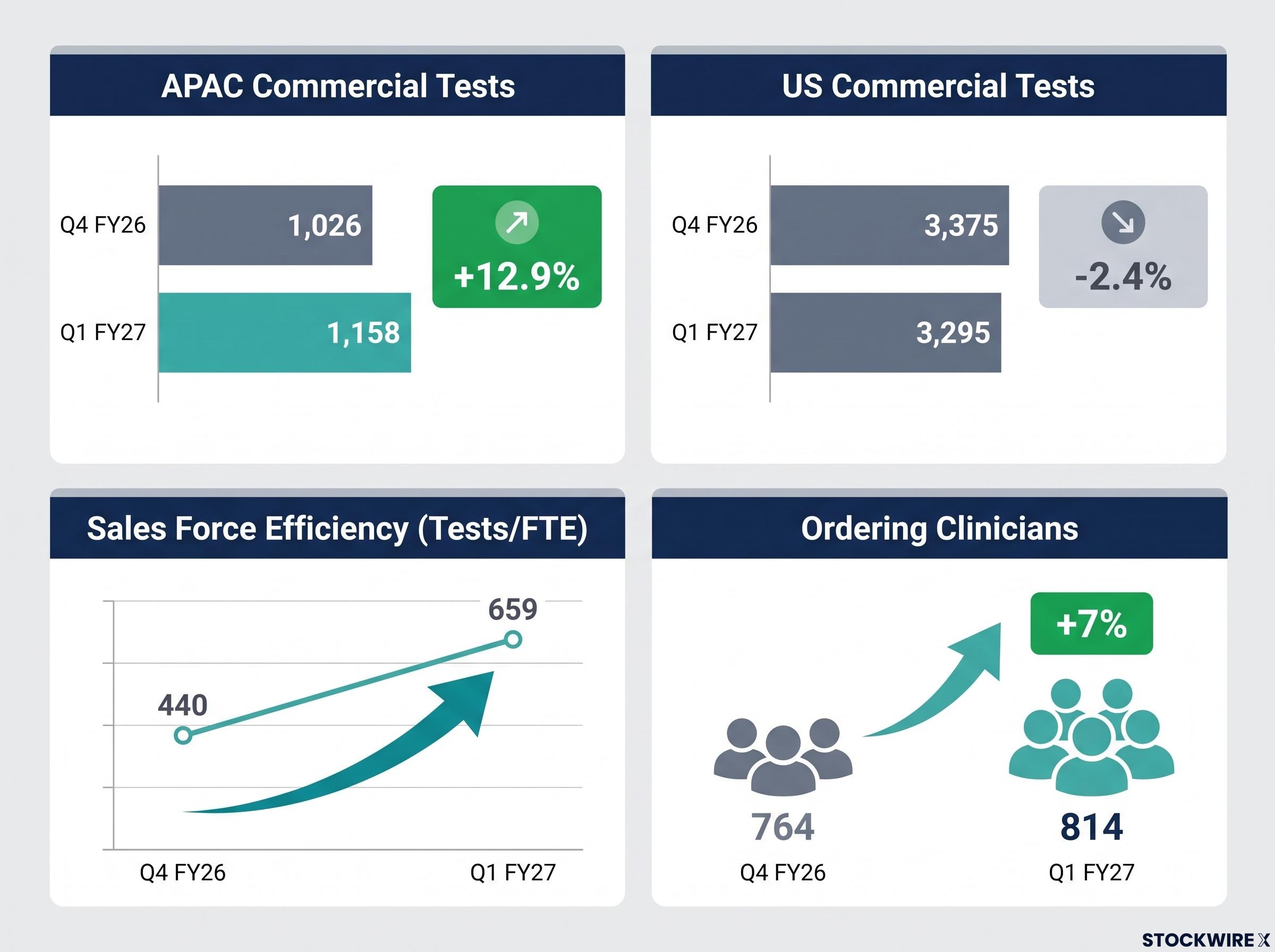
| Metric | Q4 FY26 | Q1 FY27 | Change | Note |
|---|---|---|---|---|
| APAC commercial tests | 1,026 | 1,158 | +12.9% | Triage Plus mix shift |
| US commercial tests | 3,375 | 3,295 | -2.4% | Planned sales attrition |
| Total lab throughput | 5,582 | 5,116 | -8.3% | 82% drop in trial volumes |
| Sales force efficiency (tests/FTE) | 440 | 659 | N/A | Fewer FTEs, profitable focus |
| Ordering clinicians | 764 | 814 | +7% | Broader clinician base |
APAC’s march towards break-even
The APAC business is advancing towards profitability on a direct-cost basis, with cash burn of $0.17m for the quarter. This represented an improvement of approximately 9% on Q4 FY26 and approximately 15% on Q1 FY26, driven by disciplined cost management, improved pricing, and a growing commercial contribution.
Revenue momentum also improved. APAC contributed 19% of operating revenue in 2H FY26, up from 8% in FY25, with APAC revenue of $2.0m. Pacific Edge noted these APAC financials are being disclosed as a one-off statement only to demonstrate commercial momentum, not as ongoing segment reporting.
The company identified three drivers behind the margin improvement:
-
The 2025 repricing programme lifted revenue per test by an average of 25%.
-
The shift to Triage Plus over legacy products delivered a further approximately 20% revenue uplift on the same testing volume.
-
This mix benefit is expected to be amplified as testing volumes grow across the region.
Regional progress during the period included several institutional wins:
- Singapore General Hospital implemented the first clinical pathway for Cxbladder products in March 2026.
The Singapore General Hospital partnership, announced in early 2026, established Pacific Edge’s first major institutional clinical pathway in Southeast Asia and provided a proof-of-concept model for the broader regional hospital integration strategy now producing volume across seven Asian markets.
-
Commercial samples were processed from seven Asian markets, either directly or through distributor or laboratory partners.
-
Northern Hospital and Townsville in Australia established clinical pathways for Cxbladder products.
-
Approximately 70% of New Zealanders have access to Cxbladder, with a national pathway being pursued in partnership with Te Whatu Ora.
Dr Peter Meintjes, Chief Executive Officer
“The quarterly performance of the Asia Pacific operations has demonstrated key results that we aim to replicate in the USA. Transition to Triage Plus and a focus on the strategic selling of clinical pathways to institutions has led to several quarters of consistent growth in commercial testing volume, revenue, margin and margin percentage. We are delighted with this progress and are seeking to maintain this momentum for multiple forward-looking quarters.”
What Cxbladder Triage Plus means for investors
Bladder cancer’s primary symptom is hematuria, or blood in the urine. The standard workup relies on cystoscopy, an invasive procedure involving the insertion of a camera into the urethra. Cxbladder is a non-invasive genomic urine test that risk-stratifies patients, helping to rule out cancer or prioritise those who genuinely require cystoscopy.
Triage Plus is the next-generation test. It is described as better performing and is also priced higher, improving revenue, margin, and margin percentage per test.
For investors, the significance lies in unit economics. A higher-margin product mix supports better economics as testing volumes scale, linking test performance directly to Pacific Edge’s financial profile.
US strategy reset and the Medicare coverage pathway
The US represents the larger opportunity, now being repositioned around a clearer reimbursement pathway. Novitas published its draft Local Coverage Determination (LCD) titled “Urine-based Biomarkers in Patients with Microhematuria” on 14 May 2026, covering Triage and Triage Plus for intermediate-risk microhematuria.
The draft Medicare coverage published by Novitas on 14 May 2026 named only Cxbladder Triage and Triage Plus among urine-based biomarkers, with Triage Plus carrying a reimbursement rate of US$1,328 per test, a 75% improvement over legacy product rates.
The company’s new US go-to-market model targets intermediate-risk microhematuria (IRMH) patients, an estimated 1.14m of whom are referred to urology annually. Commercial efforts are split between Integrated Delivery Networks (IDNs), which care for approximately 60% of these patients, and private practice providers.
At the Novitas Open Meeting on 18 June 2026, Pacific Edge made a specific request to expand coverage to include high-risk microhematuria patients. The company also sought several practical changes to the draft LCD to reduce barriers to appropriate physician ordering.
On payer momentum, commercial payers representing 10.5 million covered lives are now ready to reimburse Triage and Triage Plus. Finalised Medicare coverage would add a further approximately 66 million insured lives.
Key timeline expectations include:
-
A final LCD is expected before the end of calendar 2026.
-
Novitas must either finalise or withdraw the draft by 14 May 2027.
The company described its US commercial rebuild as being driven by “selective investments,” focused on proving a sharper go-to-market model before committing capital to broader expansion.
Clinical evidence and what comes next
Pacific Edge’s clinical evidence programme underpins guideline inclusion and reimbursement. During the quarter, the microDRIVE study reached its targeted patient numbers, with publication expected in Q1 27. This is expected to enable pooled analyses with the DRIVE and AUSSIE studies, providing further validation data for Triage Plus.
The AUA microhematuria guideline committee is not expected to reopen its literature review until mid-to-late 2027. The company aims to have its next wave of clinical validation publications ready ahead of, or during, that review window.
The next investor milestone is the Annual Shareholder Meeting, to be held in Auckland on Thursday 20 August 2026 at 2pm.
Taken together, the company points to a clearer reimbursement pathway, encouraging APAC momentum, a targeted US strategy, growing payer support, and an active clinical evidence programme as the elements underpinning a disciplined path towards profitability.
Don’t Miss the Next Healthcare Breakthrough on the ASX
Big News Blast delivers FREE breaking ASX healthcare news directly to your inbox within minutes of release, complete with in-depth analysis already done for you. Join 20,000+ investors who stay ahead of the market on every major announcement. Click the “Free Alerts” button to start receiving real-time alerts the moment ASX healthcare news breaks.