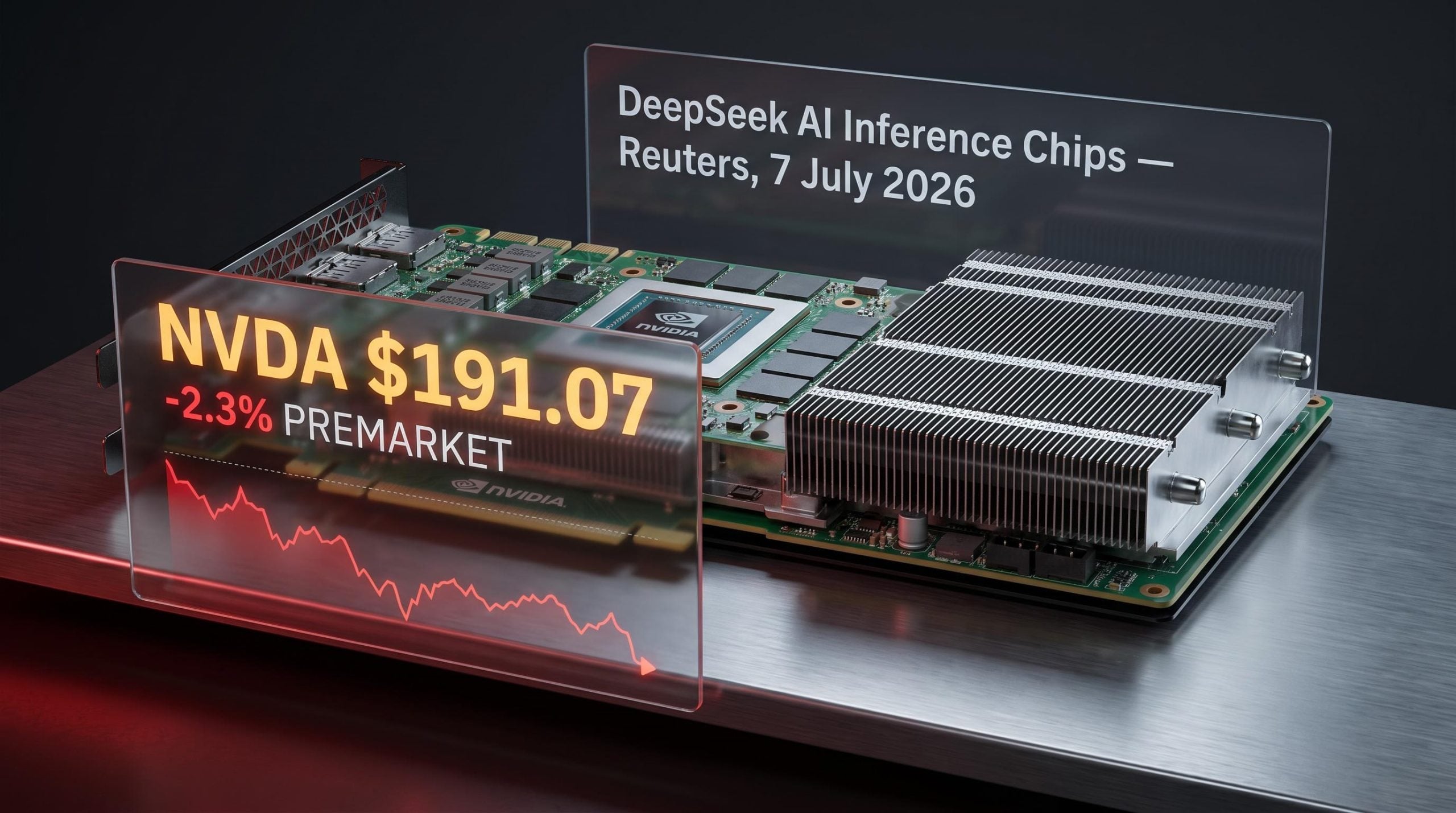
Nvidia closed Monday’s session at $195.55, up a quiet $0.72 on the day. Nothing in the price action suggested what was coming next.
By early Tuesday premarket, shares were changing hands near $191.07. The catalyst: a Reuters report that DeepSeek, the Chinese AI lab that already rattled markets in January 2025, is now building its own AI inference chips.
The percentage move is modest. The implication is not. Every time a credible AI developer signals it may reduce reliance on third-party GPU hardware, the market reassesses how durable Nvidia’s dominance actually is, and this report lands at a moment when investors are already watching for cracks in the AI spending story. Here is what the premarket price action is telling you, why DeepSeek’s chip ambitions represent a second-order escalation of a threat that started at the software layer, and what signals to track as the regular session opens.
DeepSeek chip report pulls Nvidia down roughly 2% before the open
The numbers are straightforward:
- July 6 close: $195.55 (+$0.72, +0.37%)
- July 7 premarket quote (approx. 06:59 ET): $191.07
- Premarket decline: approximately $4.48, or roughly 2.3% from the prior close
Catalyst: Reuters reported on 7 July 2026 that DeepSeek is developing its own AI inference chips, signalling hardware ambitions beyond the lab’s existing software and model efficiency work.
One transparency note on the percentage: the original source recorded the premarket move as 1.6% at the same timestamp, while the arithmetic from $195.55 to $191.07 produces a 2.29% decline. Both reference the same closing price and premarket quote. This article uses the arithmetically consistent figure as the primary framing.
The size of the move matters as much as the direction. A roughly 2% premarket slip tells you investors are repricing near-term sentiment, not abandoning the AI thesis. That distinction matters before drawing any conclusions about what comes next.
When big ASX news breaks, our subscribers know first
This is not DeepSeek’s first challenge to Nvidia’s dominance
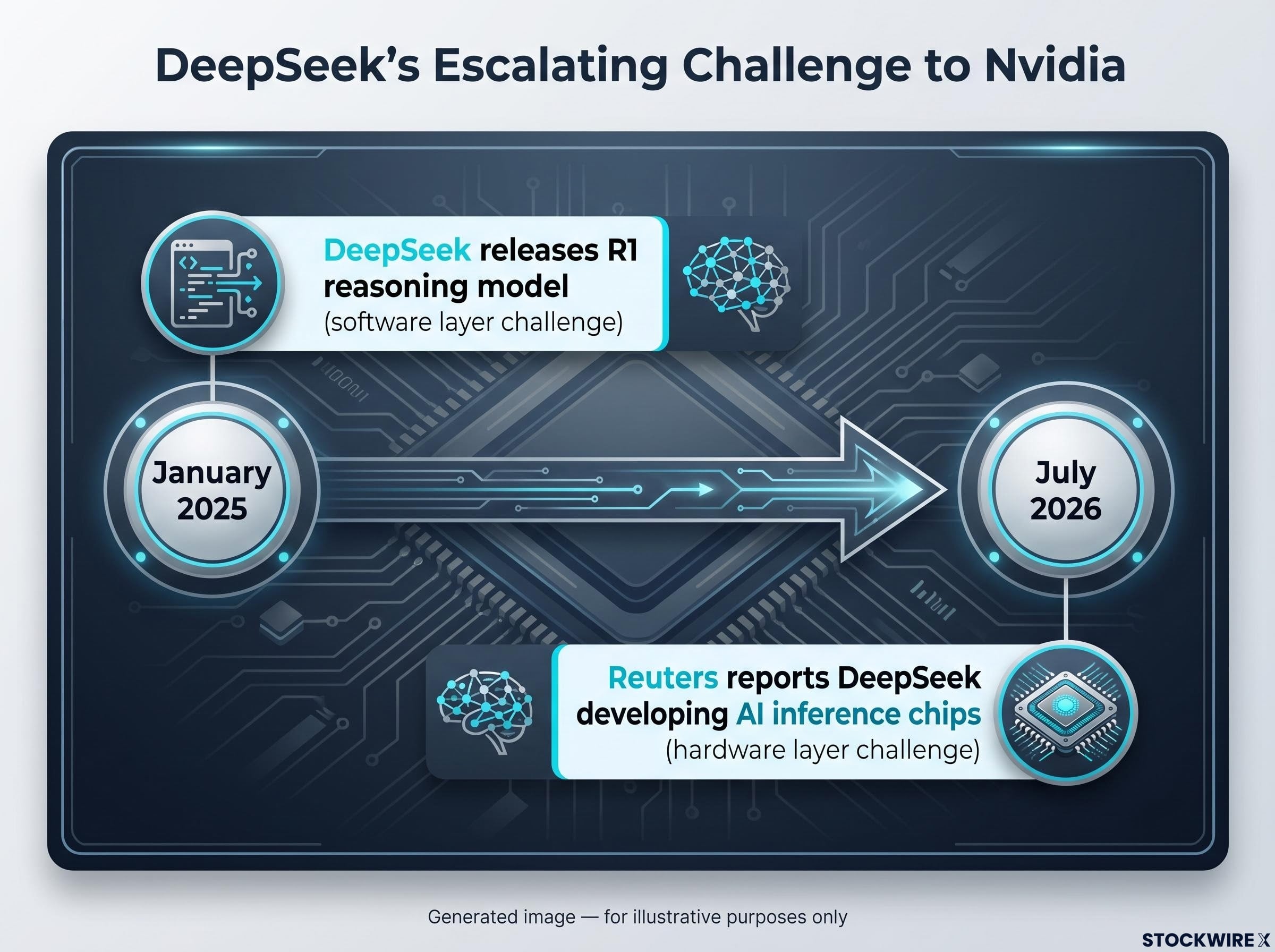
January 2025: when DeepSeek challenged Nvidia at the software layer
DeepSeek’s R1 reasoning model, released in January 2025, demonstrated that frontier AI could be trained and run at far lower cost than previously assumed. The so-called “DeepSeek shock” pressured Nvidia’s stock by threatening GPU demand at the training layer, the most compute-intensive stage of AI development.
July 2026: the threat moves to hardware
The Reuters report moves the competitive threat into a different category entirely. DeepSeek is now pursuing inference chip development, meaning chips whose purpose is to serve responses from AI models that have already been trained, rather than to handle the training process itself. This is not a general-purpose GPU replacement; it targets a specific, high-value workload category.
The pattern matters. First, DeepSeek demonstrated that software efficiency could reduce the amount of Nvidia hardware AI labs need. Now, it is investing in building the hardware itself. These are two phases of the same underlying challenge to Nvidia’s business model, and the directional logic, from reducing GPU dependence to eliminating it, tells you this is a trend to track rather than a one-off headline.
What DeepSeek building its own chips actually means for Nvidia’s business
Start with the barriers. Designing, manufacturing, and scaling competitive AI inference chips is capital-intensive, technically demanding, and slow. Any real revenue impact on Nvidia is likely years away. That is not reassurance; it is a timeline investors should hold against the headline.
Nvidia’s structural advantages remain formidable. Its CUDA software ecosystem, the programming framework that millions of AI developers already use, creates switching costs that are not easily replicated.
Nvidia’s CUDA ecosystem remains its most durable structural advantage. Developers have built years of tooling, libraries, and workflows around it, making any migration to alternative hardware a multi-year, resource-intensive decision even when viable alternatives exist.
But the directional risk is credible. The most sophisticated AI developers globally are actively investing in hardware independence. Even partial displacement in high-value inference workloads matters to long-run demand forecasts.
Even partial erosion of Nvidia’s position carries significant weight: the company commands an estimated 80-85% AI accelerator market share, and the gap between current dominance and any credible displacement scenario is the central variable in analyst fair value estimates that currently span from $700 to $1,400 per share.
| Competitor Type | Example | Workload Targeted | Timeline to Impact | Key Uncertainty |
|---|---|---|---|---|
| Hyperscaler in-house silicon | Google, Amazon, Microsoft | Training and inference | Already deployed internally | Scale of external GPU displacement |
| Merchant GPU competition | AMD | Training and inference | Near-term, ongoing | Software ecosystem maturity vs CUDA |
| AI lab chip development | DeepSeek | Inference (specialised) | Years away from production scale | Execution, funding, export control constraints |
The addition of AI labs themselves, not just cloud platforms, to the list of entities designing custom silicon is the new and escalating dynamic. U.S. export controls on advanced semiconductors to China add a structural motivator: DeepSeek’s chip effort is not purely a commercial decision. It is partly a geopolitical inevitability, which makes it more durable as a long-run trend regardless of Nvidia’s own competitive response.
The addition of AI labs to the list of entities designing custom chips extends a competitive pattern that hyperscaler custom silicon programmes from Alphabet, Amazon, and Microsoft have been building for years, with inference projected to represent approximately 80% of the AI accelerator market by 2030.
How U.S. export controls are accelerating the hardware independence trend
The policy dimension reframes the entire story. U.S. export restrictions on advanced AI semiconductors to China have cut off Chinese AI developers from Nvidia’s most capable hardware. That creates a direct commercial and strategic incentive to develop domestic alternatives.
This makes DeepSeek’s chip programme a forced adaptation to a policy environment, not a response to Nvidia’s business practices. Forced adaptations are structurally more durable than purely commercial competitive choices because the incentive persists regardless of how Nvidia prices or positions its products.
The current regulatory environment tightened further in late May 2026, when AI chip export restrictions were extended to require licences for any Chinese-headquartered entity purchasing advanced processors regardless of where that entity physically operates, closing a loophole that had allowed third-country subsidiaries to circumvent earlier controls.
Three categories of structural motivator are driving Chinese AI hardware independence simultaneously:
- Commercial: Reducing long-term procurement costs and supply chain risk
- Strategic: Eliminating dependence on a single foreign supplier for mission-critical technology
- Regulatory: Responding to U.S. export controls that restrict access to the most advanced chips
This dynamic is not unique to DeepSeek. It applies across the broader Chinese AI ecosystem, which means the addressable market compression for Nvidia in China is a policy-driven trend rather than a technology trend alone. For you as an investor, that means any diplomatic or regulatory changes to U.S. semiconductor policy toward China could directly affect the urgency and pace of these chip development programmes, making this a watchpoint well beyond the earnings calendar.
Four signals to watch when U.S. markets open today
Premarket data captures only a fraction of normal trading volume. Here are the four conditions worth evaluating as institutional liquidity enters:
- Whether the decline holds, narrows, or deepens at market open. Early premarket moves can reverse materially once full liquidity arrives. The direction at 09:30 ET is the first real data point.
- Official statements from Nvidia or DeepSeek. Nvidia downplaying near-term impact, or DeepSeek clarifying the scope and timeline of its chip programme, are the most likely market-moving disclosures today.
- Analyst commentary and model adjustments. If major analysts adjust AI chip demand estimates or Nvidia price targets, the story moves from a single headline to a sustained re-rating event. If commentary emphasises long timelines and execution risk, the impact is more likely short-lived.
- Sector breadth. If other AI hardware and semiconductor names also weaken at the open, the market is treating this as a sector-wide signal about future chip demand. If weakness is isolated to Nvidia, it is a sentiment event rather than a thesis shift.
The distinction between an isolated Nvidia sentiment event and a sector-wide signal is the single most important read you can make at market open today, because it determines whether this is a stock-specific consideration or a broader portfolio one.
A 2% slip, a credible trend, and a timeline that still matters
The premarket move is modest and sentiment-driven in the near term. The competitive narrative it reflects is directionally credible and structurally durable. Both of those statements are true at the same time, and holding them together is the correct investor response.
The real fundamental question is whether DeepSeek and comparable programmes reach meaningful production scale at workloads that would otherwise have run on Nvidia hardware. That answer is likely years away, and it depends on execution, funding, geopolitical conditions, and technical feasibility that no single Reuters report can resolve.
AI hardware spending sustainability is the macro backdrop against which today’s DeepSeek headline lands: if inference costs make generative AI applications structurally unprofitable, the $635-700 billion in hyperscaler capital expenditure committed for 2026 becomes a demand ceiling rather than a demand floor for chip suppliers including Nvidia.
This headline belongs in the category of signals to monitor rather than reasons to act today. The four watchpoints above are the appropriate tool for calibrating any near-term decision.
This article is for informational purposes only and should not be considered financial advice. Investors should conduct their own research and consult with financial professionals before making investment decisions. These statements are speculative and subject to change based on market developments and company performance.