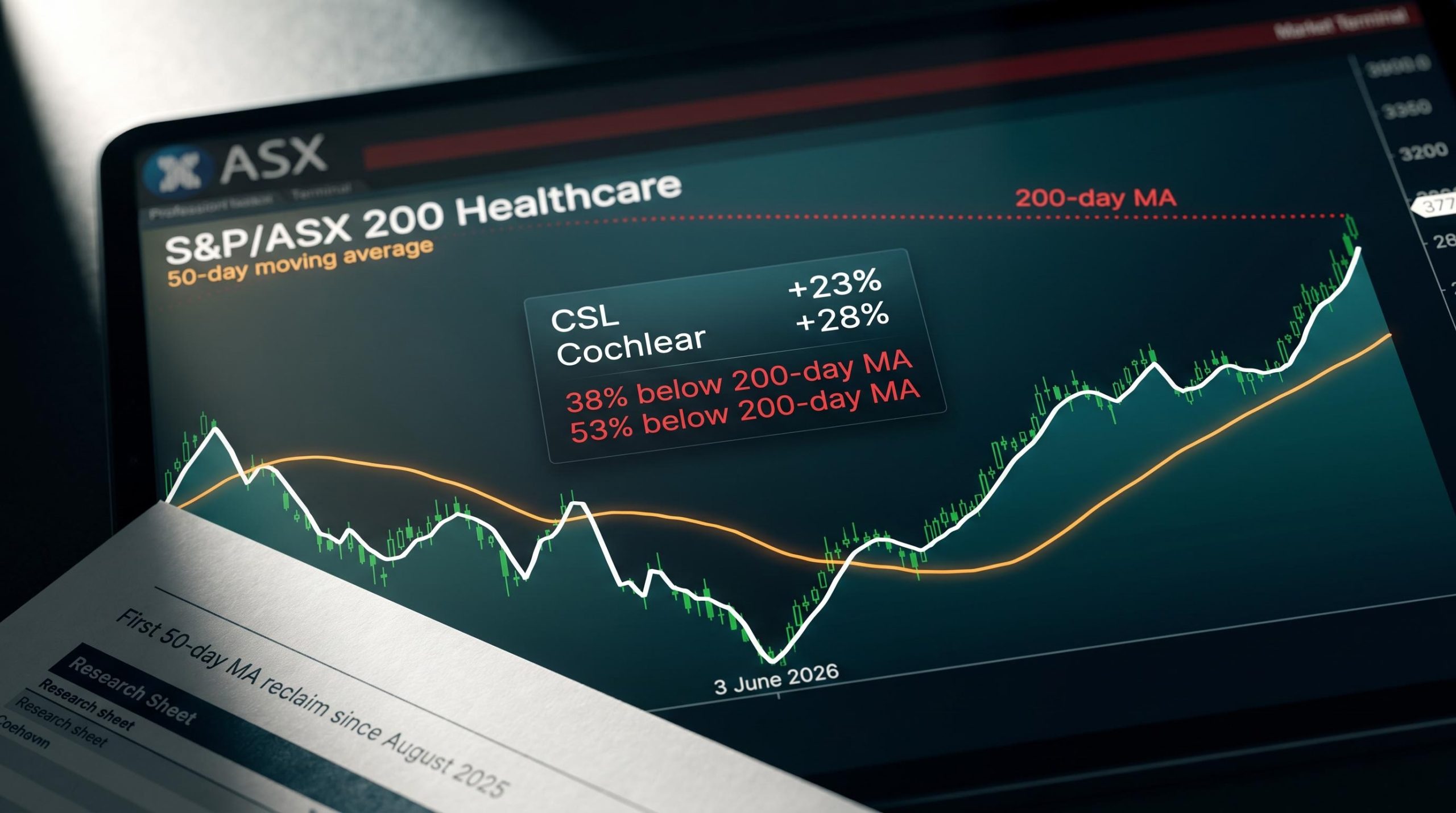
A sector that spent ten months producing nothing but failed rallies just crossed its 50-day moving average for the first time since August 2025. Whether that signal means anything is the only question worth asking right now.
The S&P/ASX 200 Healthcare index has rebounded sharply from its 3 June 2026 low, with the rally variously measured at approximately 13% (audited research) and 17% (original source reporting). From that same low, CSL has added roughly 23% and Cochlear roughly 28%. The move has coincided with a broad defensive rotation across the ASX, with Staples and Discretionary both rising in the range of 12-13% across the same period. But healthcare has spent the past year generating exactly this kind of short-term excitement before failing. The question is not whether the rally has happened. The question is what it is evidence of.
This piece lays out five objective checkpoints for distinguishing a genuine ASX healthcare sector recovery from another oversold bounce, tells you where the current evidence sits against each one, and gives you a practical framework for how to position around what comes next.
The rally that broke the pattern, and the pattern that keeps breaking rallies
The raw numbers are real. The healthcare index has advanced approximately 13% from its 3 June 2026 low based on audited research, with some original source reporting placing the figure closer to 17%. The discrepancy likely reflects different measurement points, but the direction is not in dispute: this is the strongest short-term move the sector has produced in nearly a year.
More importantly, the index has crossed back above its 50-day moving average for the first time in roughly ten months, since August 2025. The 20-day moving average has started to turn higher, which is a pattern typically associated with the early stages of a bottoming process. For a sector stuck in a grinding downtrend, that combination is notable.
But notable is not the same as conclusive. Over the past twelve months, the healthcare index followed a repeating sequence:
- A single session of heavy selling that opened the initial decline
- An extended stretch of weakness playing out over weeks or months
- A relief bounce that carried price back up toward the 50-day moving average
- A fresh leg lower that wiped out the recovery each time
The broad technical read of the index currently shows a “Neutral” outlook across moving averages from the 5-day to the 200-day, with buy and sell signals roughly balanced.
That sounds unimpressive. But for a sector that has been in sustained distribution for nearly a year, balanced signals represent a genuine shift in the weight of evidence. This is what early-stage regime change looks like before it becomes obvious.
When big ASX news breaks, our subscribers know first
What the 50-day moving average actually tells you, and where it falls short
A 50-day moving average is simply the average closing price over the prior 50 trading days. When price crosses above it, the short-term trend has shifted from down to up. But the strength of that signal depends entirely on how the cross happens.
A marginal, low-volume cross where price barely edges above the average and immediately stalls carries far less weight than a decisive break followed by consolidation above the level. For the signal to strengthen further, the 50-day average itself needs to flatten and begin to curl upward, confirming that the trend shift is not just price-driven but structurally embedded in the average’s trajectory.
The real limitation is what the 50-day moving average cannot tell you. It measures short-term trend direction, not the primary trend. The 200-day moving average, which smooths a full year of trading data, is the actual dividing line between bear-market conditions and a new bull phase.
Why the 200-day moving average is the real test
A market trading below its 200-day moving average is statistically in a downtrend regardless of what shorter-term indicators suggest. Professional and institutional investors frequently define their risk frameworks around this level, making it a self-reinforcing threshold: when enough capital treats the 200-day as the line, it becomes the line.
Here is where the current setup becomes sobering.
ASX market breadth data from May 2026 showed 84.5% of ASX 200 constituents trading at least 10% below their 52-week highs, with Healthcare among the hardest-hit sectors alongside Consumer Discretionary and Technology — that structural context explains why a 13-17% rally still leaves CSL and Cochlear so far below their 200-day moving averages.
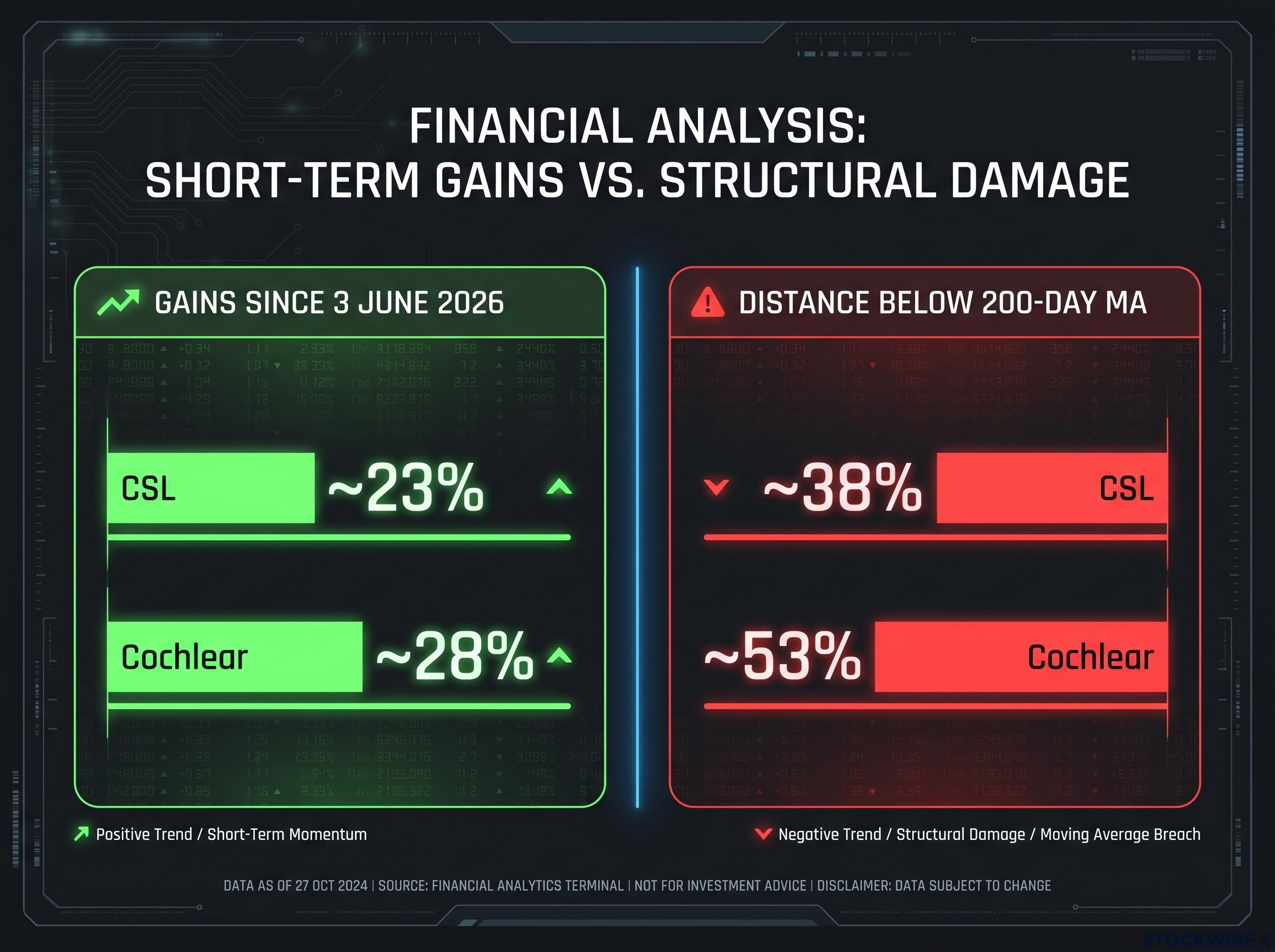
| Constituent | Gain since 3 June 2026 | Distance below 200-day MA |
|---|---|---|
| CSL | ~23% | ~38% |
| Cochlear | ~28% | ~53% |
A ~23% gain from its low still leaves CSL sitting roughly 38% below its 200-day moving average. A ~28% advance from the same point still leaves Cochlear approximately 53% adrift of that level. That tells you just how deep the structural damage in this sector has been. Hold that context before interpreting any short-term strength as confirmation of a trend change.
The required recovery sequence runs in three stages:
- Sustained trade above the 50-day moving average (currently in progress)
- Gradual approach toward the 200-day moving average
- Break and hold above the 200-day moving average, with that average flattening and turning upward
Until stage three occurs, the most conservative classification remains “late-stage bear-market rally” rather than “new bull trend.”
Five checkpoints that separate a real recovery from a repeat performance
Rather than guessing whether this time is different, you can track five objective signals as the evidence develops. Two are already providing some early data. Three remain unresolved.
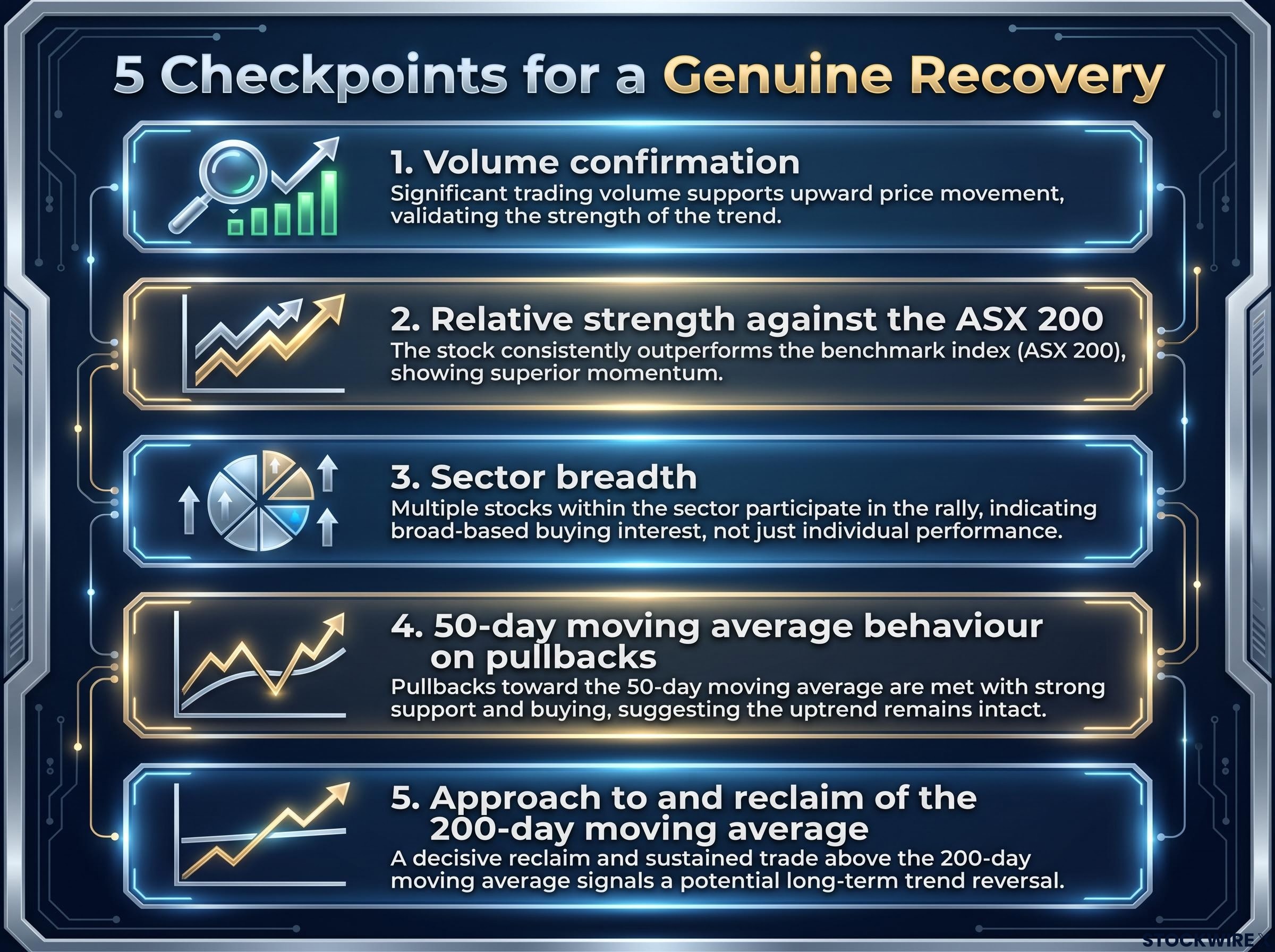
- Volume confirmation. Durable reversals typically show expanding volume on up-days and lighter volume on pullbacks. Bear-market bounces tend to reverse that profile: thin advances, heavy selling. Comparing the current rally’s volume character against the prior failed bounces over the past year is the first meaningful test.
- Relative strength against the ASX 200. Staples, Healthcare, and Discretionary have each risen 12-13% over the past month, confirming a broad defensive rotation. If healthcare continues to outperform the S&P/ASX 200 over multiple weeks, that indicates genuine capital reallocation into the sector. If it simply moves in lockstep with the broader index, the move is more consistent with a tactical rotation than a structural shift.
What the prior failed rallies looked like at this same stage
Each of the prior bounces over the past twelve months shared a common shape: a strong initial move off oversold conditions, apparent technical improvement as price approached the 50-day moving average, and then failure at or near that level as selling pressure resumed. The current rally has broken that pattern in one important respect by producing the first meaningful reclaim of the 50-day average since August 2025. But reclaiming it and holding it are two different things.
- Sector breadth. A durable sector bottom usually features broad participation: most large constituents rising together, more stocks making new short-term highs, fewer names breaking to new lows. CSL up approximately 23% and Cochlear up approximately 28% from the same low suggests the current bounce is at least broad within the sector’s top names, a more encouraging breadth signal than the prior failed rallies produced, even if it remains insufficient to confirm the full recovery thesis.
Sector breadth analysis from late May 2026 recorded only 13 new 52-week highs against 27 new lows across the ASX 200, with Consumer Discretionary producing zero new highs and eight new lows in the same week — illustrating how internal market deterioration can persist even when the headline index appears relatively stable.
- 50-day moving average behaviour on pullbacks. Does price hold above the average on subsequent weakness, or spike through and retreat as it did in every prior failed rally? This is the near-term litmus test that will be answered in the coming weeks.
- Approach to and reclaim of the 200-day moving average. The terminal test. Until the sector can close the gap to the 200-day average and hold above it, the primary trend classification remains bearish regardless of short-term improvement.
The current characterisation: a promising but unproven recovery, not a confirmed trend change.
Rotation, global context, and why neither settles the argument
The supportive evidence beyond the sector’s own technicals is real. Three factors deserve credit:
- Local defensive rotation. When Staples, Healthcare, and Discretionary advance in concert, the pattern has historically been associated with durable healthcare outperformance during periods of broader macro stress. The simultaneity of this rotation is a more meaningful signal than healthcare moving alone, because it suggests capital is being deliberately repositioned into lower-risk areas. The limitation: a rotation can end abruptly if macro conditions shift, and rotating into a sector does not by itself fix a broken trend.
- US healthcare near record highs. The S&P 500 Healthcare Index has notched back-to-back all-time highs, though its year-to-date advance stands at only approximately 3.3% as of late June 2026. This provides a constructive global backdrop. The limitation: Australian healthcare has significantly lagged this benchmark, and a constructive global backdrop does not automatically mean the local sector catches up.
- Constituent-level breadth. Both CSL and Cochlear participating in the rally from the same low gives the move more credibility than a narrow, index-level bounce. The limitation: two names, however large, do not constitute sector-wide breadth confirmation.
The gap between Australian healthcare’s performance and that of its US counterparts over this period highlights how pronounced the local underperformance has been. A constructive global backdrop improves the probability that the recovery thesis succeeds; it does not validate it independently.
The rate-hold thesis that emerged from Westpac and NAB data in early June 2026 added a macro catalyst to the defensive rotation, with Healthcare gaining 1.32% on 9 June as capital moved into income-generating, lower-volatility sectors — providing the fundamental policy context that separates this rotation from purely technical price recovery.
The simultaneous defensive rotation across three ASX sectors is the most credible external support for the recovery thesis because it suggests deliberate capital repositioning, not just an isolated technical bounce. But neither the rotation nor the US context settles the argument on its own.
How to position around an unconfirmed recovery
Already long the sector
- Use the reclaimed 50-day moving average as your active risk management reference. A decisive close back below it, not an intraday spike but a sustained move below the average with conviction, is the logical trigger to reassess exposure or tighten stops.
- As long as price holds above the 50-day average and that average stabilises or begins to slope higher, the technical case for staying invested strengthens incrementally.
Considering new exposure
- Chasing a 13-17% move off the lows carries meaningful entry risk at this stage. The bulk of the easy gains from oversold conditions have already been captured.
- A pullback toward the 50-day moving average that holds as support would offer a better entry and additional confirmation. A successful retest, where price declines to the average and bounces, would be a meaningful secondary signal that buying interest is durable rather than impulsive.
Sceptical or considering short positions
- The past year’s pattern of failed rallies makes scepticism historically well-founded. But shorting into a strong rebound from a deeply oversold base carries asymmetric risk: the potential for further upside compression on a short position is elevated precisely when the bounce has the most momentum.
- Wait for clear failure signals before acting on the sceptical thesis: a decisive loss of the 50-day moving average, deteriorating breadth across constituents, and renewed relative underperformance versus the ASX 200.
The most practical implication of this setup is that the burden of proof sits differently depending on which direction you are exposed. For longs, the technical environment now provides a defensible reference point for managing downside. For potential new buyers, patience for a retest costs very little given how far the index has already moved.
For readers wanting to map the current technical setup against the broader ASX 200 structure, our full explainer on ASX 200 supply zone positioning covers how the 8,984-9,022 overhead supply band interacts with sector-level risk allocation decisions, including pre-mapped entry and exit triggers for both the upside break and the downside failure scenarios.
Where the evidence sits today, and what changes the picture
The rally from the 3 June 2026 low, accompanied by the first meaningful reclaim of the 50-day moving average since August 2025, is the most credible bottoming signal the ASX healthcare sector has produced in approximately one year. It is broad enough at the constituent level to be notable: CSL up roughly 23%, Cochlear up roughly 28%, both from the same low. The short- and intermediate-term trend has improved.
The secular trend has not yet flipped. CSL remains approximately 38% below its 200-day moving average. Cochlear remains approximately 53% below. The same data that makes the recovery case credible also makes it look like every prior bear-market bounce that eventually failed. The evidence does not yet resolve that ambiguity.
| Bull case confirmation signals | Bear case reinstatement signals |
|---|---|
| Sustained trade above 50-day MA on healthy volume | Decisive loss of the 50-day MA |
| Improving sector breadth across constituents | Deteriorating breadth, fewer names participating |
| Continued relative outperformance vs ASX 200 | Renewed relative underperformance vs ASX 200 |
| Gradual approach toward the 200-day MA | Pattern consistent with prior failed rallies |
The rally is real and technically significant, but until the sector can sustain strength through the 200-day moving average with improving breadth and relative performance, it must still be treated as a potential bear-market relief rally rather than a fully confirmed sector recovery.
The five checkpoints outlined above give you a forward-looking diagnostic rather than a snapshot opinion. Track them as new data arrives. The picture will resolve itself; the framework ensures you are watching the right signals when it does.
This article is for informational purposes only and should not be considered financial advice. Investors should conduct their own research and consult with financial professionals before making investment decisions. Past performance does not guarantee future results, and technical analysis is subject to market conditions and various risk factors.