
Air New Zealand Outlines Three Priority Strategy Reset to Restore Profitability

Air New Zealand outlines “Our Future” strategy reset built on three priorities
In its 30 June 2026 investor presentation, Air New Zealand (NZX: AIR / ASX: AIZ / OTC: ANZLY) detailed its “Te Pae Hou – Our Future” strategy reset, a plan focused on returning the airline to profitability and generating strong returns for shareholders over time. Management confirmed implementation is already well under way.
The reset is anchored on three strategic priorities: Customer First, Targeted Growth, and Resilient and Future Fit. Together, they form the framework management intends to use to move the airline out of its recent recovery phase.
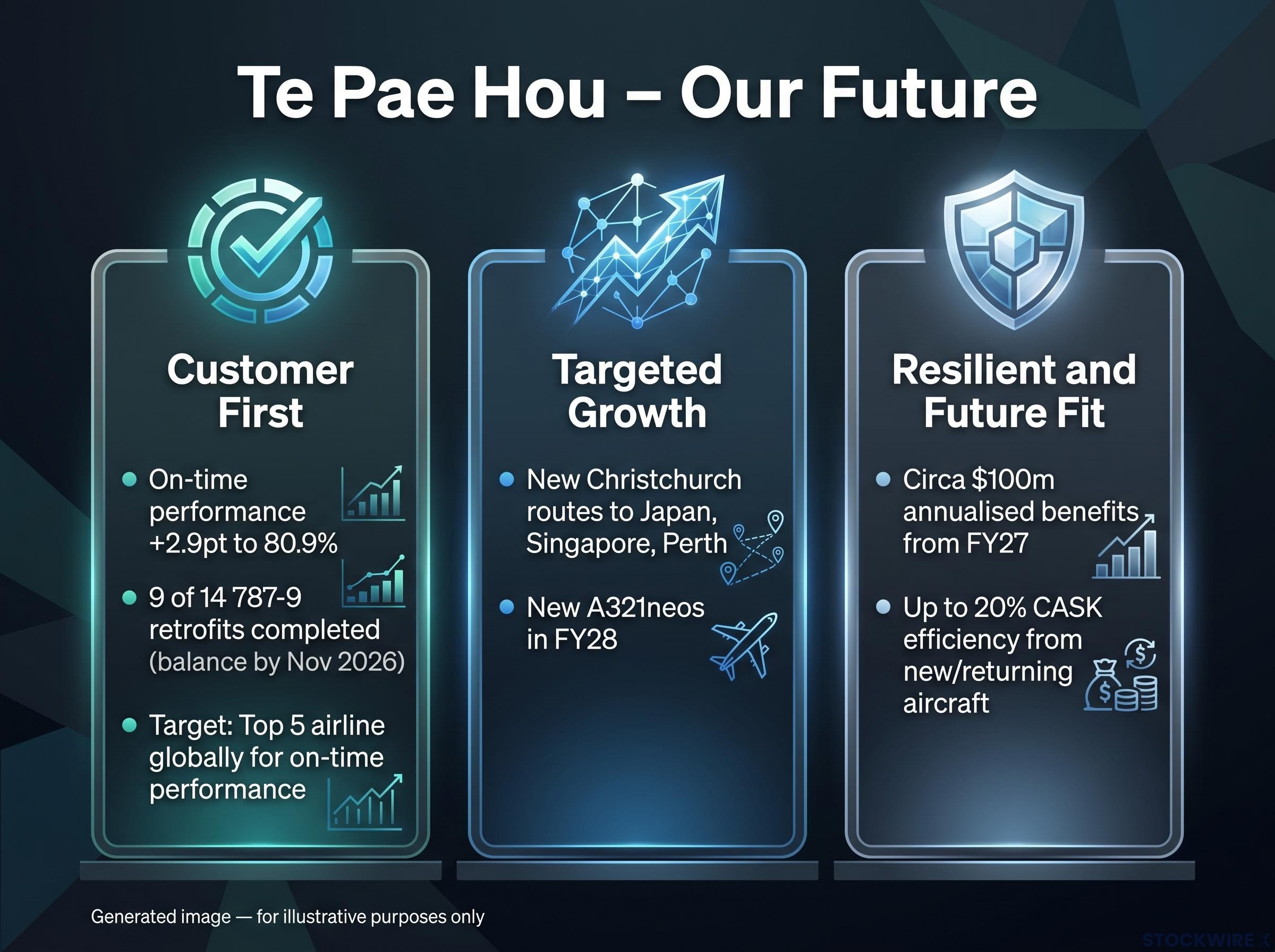
The strategy follows a full review the Board commissioned when Chief Executive Officer Nikhil Ravishankar took up the role in October 2025. The presentation set out the company’s direction, priorities, and actions taken to date.
Importantly, no new financial targets were provided. FY26 guidance remains unchanged at a loss before taxation in the range of $340 million to $390 million, originally guided on 14 May 2026. The update shares strategic direction rather than a full medium-term financial framework.
When big ASX news breaks, our subscribers know first
Why a strategy reset now — the pressures behind the pivot
Management framed the reset as a transition from crisis-era priorities into a new phase, following a period of significant operational and financial pressure over recent years. The presentation positioned the airline as moving from post-Covid and engine-disruption recovery into a forward-looking strategy.
The pressures outlined included:
The FY26 guidance suspension in March 2026 was itself triggered by jet fuel price spikes of up to 135%, with crack spreads widening sharply beyond what the airline’s Brent Crude hedges could absorb, adding a further layer of earnings uncertainty on top of the operational disruptions already weighing on the airline.
-
Aircraft and engine availability constraints
-
A weak New Zealand economy
-
Increasing aviation system costs
-
Recent fuel market disruption, with elevated and volatile fuel prices and crack spreads
This shift reflects a normalisation in priorities, moving away from protecting liquidity and securing the network towards profitable growth and capital discipline.
Inside the three strategic priorities
Customer First — reliability at the core
The first priority centres on delivering world-leading reliability and punctuality, with a relentless focus on priority segments such as business travellers and inbound premium tourists.
Key actions and targets include:
-
On-time performance (FY26 year-to-date A15) improved +2.9pt to 80.9%
-
9 of 14 787-9 retrofits completed, with the balance expected by November 2026
-
A target to become a top 5 airline globally for on-time performance
-
Transition to offer/order NDC (“next gen retailing”)
Targeted Growth — building resilient markets
The second priority focuses on profitable network growth in larger, resilient markets that support New Zealand tourism. Management highlighted a pivot towards inbound premium leisure flows.
Actions detailed include:
-
New Christchurch routes to Japan, Singapore, and Perth
-
New A321neos scheduled for delivery in FY28
-
A loyalty re-platform and re-brand, alongside an extension of the Westpac partnership
Resilient and Future Fit — cost and capital discipline
The third priority addresses cost transformation and rigorous capital allocation. The presentation noted the airline is delivering on its cost-out programme.
Key figures include:
-
Circa $100m of annualised benefits forecast to flow from FY27
-
Up to 20% CASK efficiency from new and returning aircraft
-
Reprofiling of 787 aircraft deliveries to smooth capital expenditure
Grounded aircraft return ahead of schedule
A notable operational tailwind detailed in the presentation is that grounded aircraft (AOG) are returning to service earlier than expected, supporting capacity recovery. The last 787 AOG was noted to return to service in June 2026.
The presentation compared peak grounding levels with current positions across two fleet types.
| Fleet type | Peak AOG | Peak detail | Now AOG | Now detail |
|---|---|---|---|---|
| 787-9 | 5 | of 14 aircraft; 4 leases | 0 | of 14; 3 dry leases |
| A320/1neo | 6 | of 20 aircraft; 15 extra engines | 2 | of 20; 10 extra engines |
Subject to economic conditions and demand growth, the total network is expected to grow at a CAGR of 3% to 4%.
What a strategy reset means for investors
A strategy reset realigns an airline’s priorities and capital allocation around a clearly defined set of goals. For Air New Zealand, the stated benchmark for sustainable shareholder returns is ROIC ≥ WACC, meaning the return on invested capital should meet or exceed the cost of that capital.
Return on invested capital (ROIC) measures how efficiently a company generates profit from the money invested in it. The weighted average cost of capital (WACC) reflects what it costs the company to fund itself through debt and equity. When ROIC meets or exceeds WACC, a business is generating value above its funding costs.
CASK, or cost per available seat kilometre, measures the cost of flying one seat one kilometre. Newer and more efficient aircraft typically lower CASK, which is why fleet renewal and the return of grounded aircraft support the airline’s economics.
The cost-out programme, capital discipline, and earlier-than-expected return of grounded aircraft together underpin the path management has outlined back to profitability. This represents a path, not a guarantee, and no new financial targets were disclosed in the presentation.
The next major ASX story will hit our subscribers first
What comes next
The presentation set out the airline’s ambition to become “the world’s most respected airline” while returning the company to profitability over time.
Strategic ambition (as presented)
Management framed the reset around an ambition to become “the world’s most respected airline,” with the strategy focused on returning Air New Zealand to profitability and generating strong returns for shareholders over time.
The next disclosure points outlined include:
-
An investor and analyst conference call hosted by CEO Nikhil Ravishankar and CFO Richard Thomson at 1:00pm NZST, 30 June 2026
-
Further commentary at the FY26 annual results
-
An Investor Day currently planned for November 2026, where the medium-term financial framework and targets are expected
For investors seeking hard numbers, detailed financial targets are deferred to the FY26 results and the November 2026 Investor Day. Those dates remain the key events to watch for the airline’s quantified medium-term framework.
Don’t Miss the Next Aviation Sector Move
Big News Blast delivers FREE breaking ASX news straight to your inbox within minutes of release, complete with in-depth analysis already done for you. Over 20,000+ subscribers rely on it to stay ahead of market-moving announcements across industrials and beyond. Click the “Free Alerts” button to start receiving alerts the moment news breaks.