Apple Price Hikes Signal Why the Tech Selloff Runs Deeper
1 hr ago

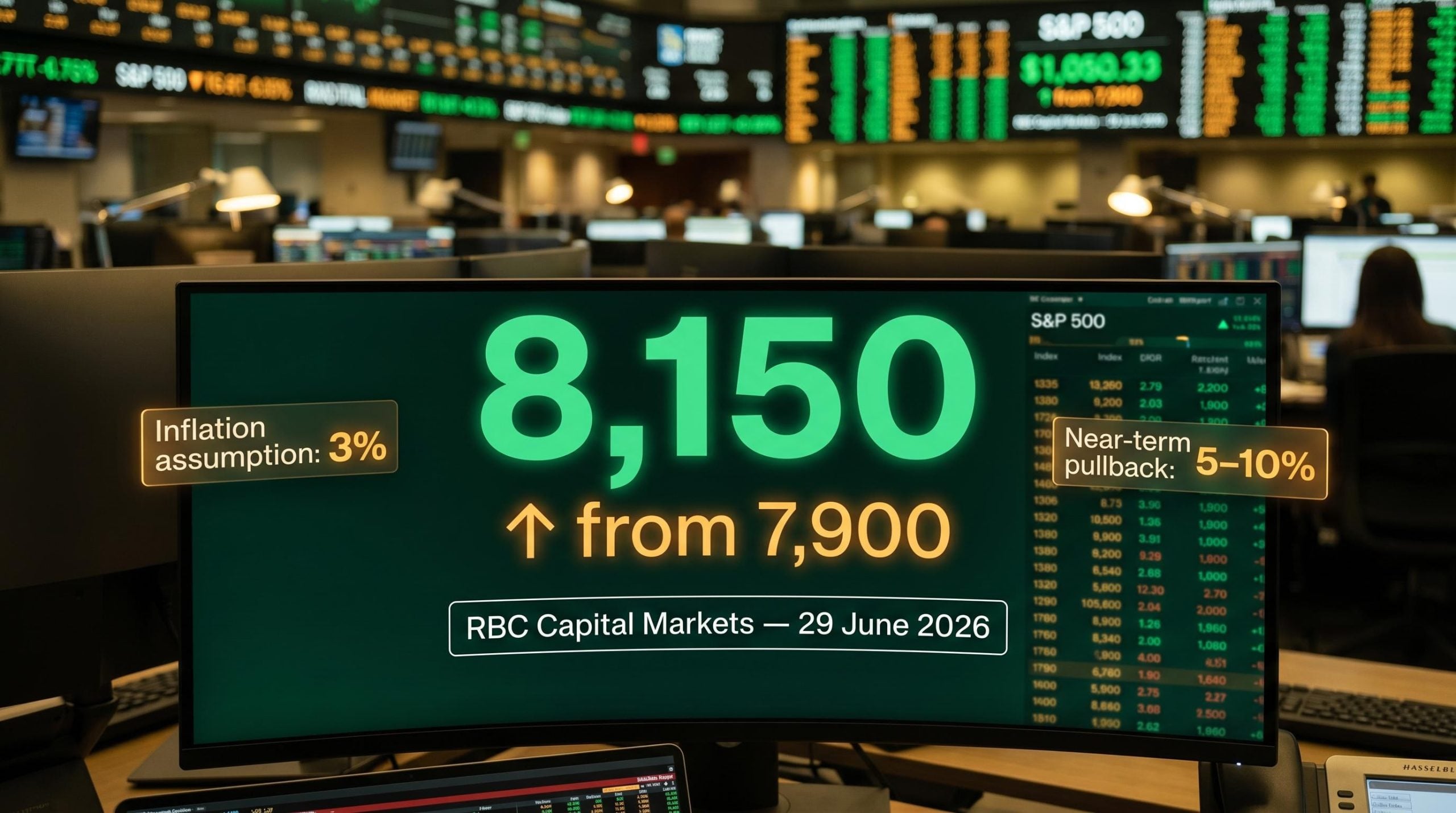
RBC Capital Markets raised its 12-month S&P 500 price target to 8,150 on 29 June 2026, up from a prior target of 7,900. The headline number is bullish. The fine print is more measured: lead strategist Lori Calvasina and her team flagged near-term volatility, crowded positioning in artificial intelligence trades, and a pullback window of 5% to 10% as conditions the market will need to absorb on the way there.
The upgrade is not a routine revision. It marks the moment RBC brought all five analytical models back into service, having set most of them aside while geopolitical pressures and questions around AI earnings made a multi-factor lens less reliable as a guide.
Here is what the five models are actually telling you, which risks RBC is explicitly watching, and how to weigh a target the firm believes is achievable but far from guaranteed.
The methodology shift matters as much as the number it produced. RBC had previously narrowed its analytical approach to the valuation model only, judging that distortions from AI earnings trends and Middle East tensions made a broader multi-model framework less useful as a reliable signal.
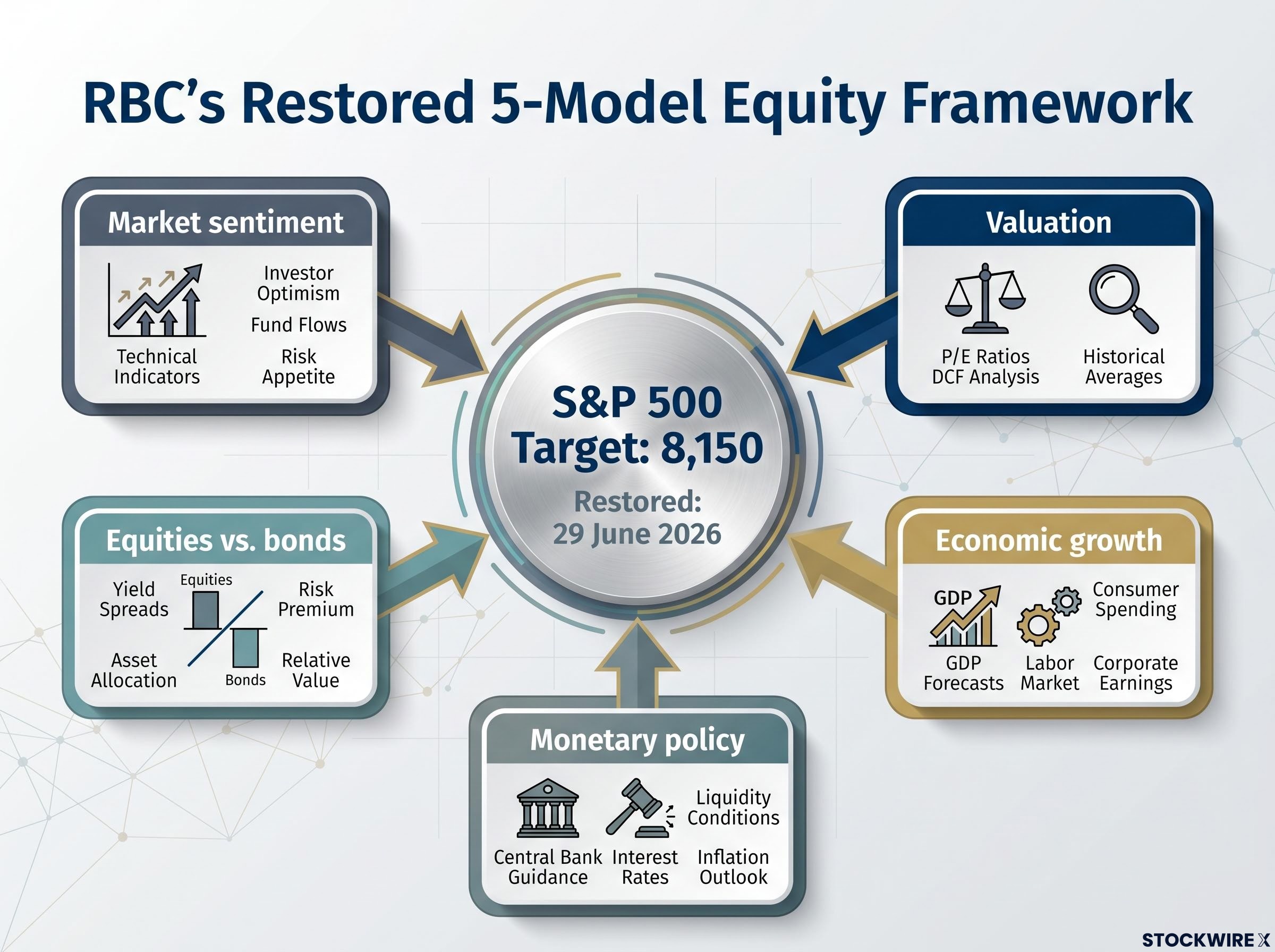
That changed on 29 June 2026. Calvasina’s team restored all five models, a decision that signals RBC’s internal risk barometer has moved from crisis-adjacent to navigable. The five models are:
The restoration of all five models on 29 June 2026 is only legible as a signal when read against RBC’s prior single-model approach, in which the firm deliberately set aside its standard multi-factor average and relied solely on a bifurcated earnings framework that separated AI and non-AI corporate profits.
The return to this framework tells you something specific: RBC believes conditions are normal enough to be assessed across multiple dimensions rather than through a crisis-era, single-factor lens. That distinction matters when evaluating whether 8,150 reflects genuine analytical confidence or a cautious bet.
Start with the mechanical anchor. Dropping its inflation assumption from 3.3% to 3% gave RBC room to apply a slightly more generous price-to-earnings multiple within the valuation model. Lower expected inflation means investors can justify paying a bit more per dollar of earnings without stretching valuations beyond what the macro environment supports.
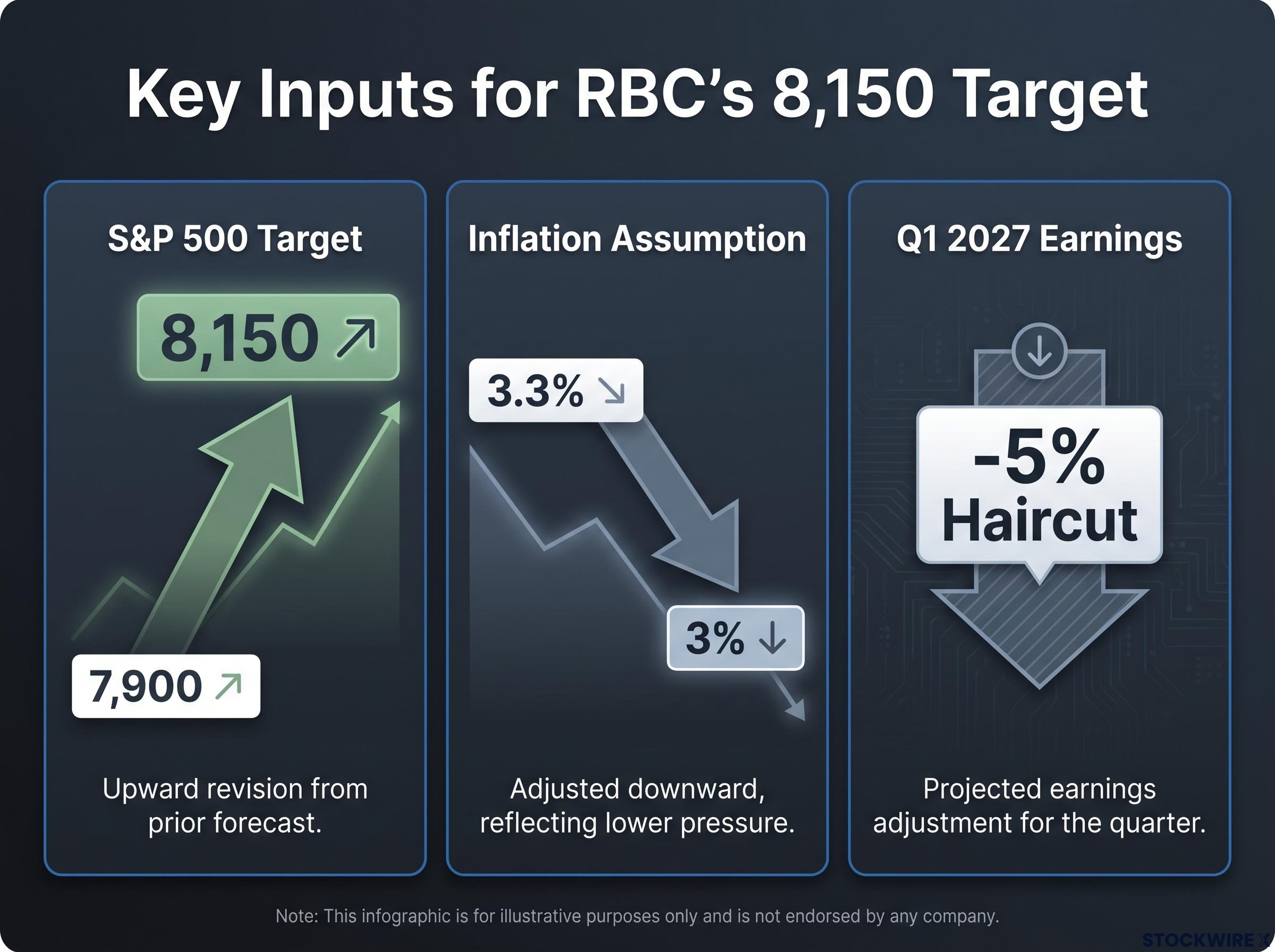
Key inputs behind the 8,150 target: Inflation assumption revised to 3% (down from 3.3%). A 5% haircut applied to bottom-up consensus earnings projections for Q1 2027.
That 5% earnings haircut is the detail that tells you how much conviction RBC actually has. The firm is bullish enough to raise the target from 7,900 to 8,150, but cautious enough to discount what the street is projecting for Q1 2027 earnings. Typical late-cycle analyst optimism, in RBC’s view, warrants a deliberate conservative adjustment.
The aggregate signal across all five models reads as constructive but not euphoric. Recession risk is present but not dominant. Equities remain preferred over bonds in the current rate environment. If any of these assumptions shift, particularly the inflation figure or the earnings trajectory, the 8,150 number moves with them.
The most proximate test arrives in weeks. Q2 earnings season begins in late July 2026, and from a data standpoint the expectations bar is already high, making it a potential trigger for near-term volatility. Decent results can still disappoint against stretched expectations, particularly in sectors where positioning is already crowded.
AI and semiconductor trades sit squarely in that category. After significant gains and heavy institutional positioning, the segment is susceptible to sharp reversals even if the long-term thesis holds. RBC treats this not as a structural concern but as a tactical vulnerability: a crowded trade can unwind fast regardless of its fundamental validity.
AI stock valuation risk is compounded by a distributional problem that index-level metrics obscure: large opposing moves by individual winners and losers cancel each other out within the benchmark, leaving investors exposed to single-stock volatility that aggregate readings do not capture, a dynamic that makes crowded positioning in the segment more dangerous than headline index stability implies.
The Russell index reconstitution, effective after the close on 26 June 2026, adds short-term noise. Heavy volumes and possible price distortions in small- and mid-caps are expected but treated as temporary rather than directional.
The remaining risk factors RBC is monitoring:
| Risk Factor | Key Date or Detail |
|---|---|
| Q2 earnings season | Late July 2026 |
| Russell reconstitution | Effective after close, 26 June 2026 |
| U.S. midterm elections | 3 November 2026 |
| AI positioning risk | Crowded trades, elevated valuations |
The 5% to 10% pullback estimate is not a warning to exit. It is a calibration tool: RBC considers drawdowns of that magnitude normal within a constructive trend, which is actionable information for deciding whether to hold through volatility or treat a dip as a reentry point.
RBC’s segment views map where the firm’s conviction runs strongest and where it is hedged.
| Segment | RBC Stance | Key Rationale |
|---|---|---|
| U.S. large-cap growth | Core long-term conviction | Valuation corrections seen as a phase, not a regime change |
| International developed markets | Tactical trade | Recent outperformance acknowledged but not read as durable rotation |
| Value stocks | Tactical trade | Attractive near-term but U.S. growth expected to reassert dominance |
| Small caps | Neutral | Positive and negative forces roughly in balance |
U.S. large-cap growth remains the firm’s expected long-term leader. Recent valuation corrections are treated as a correction within a continuing trend rather than a shift in market leadership.
RBC acknowledges that non-U.S. developed markets and value stocks have delivered strong recent performance, but the firm positions both as opportunistic trades rather than signs of a lasting shift in market leadership away from U.S. growth.
Small caps sit at neutral, with the reasoning split cleanly:
When a firm with a constructive overall view declines to make a directional call on a segment, that tells you the risk-reward does not yet justify a tilt in either direction.
A 12-month S&P 500 price target is a probability-weighted estimate of where the index will trade in 12 months. It is not a guarantee, not a floor, and not a ceiling. It is an output of modelled assumptions, and when those assumptions change, the target changes with them.
RBC’s 8,150 is the product of five models averaged together, with a 5% haircut applied to consensus earnings and a 3% inflation assumption baked in. Shift either input and the output shifts accordingly. The target is a living number, not a fixed prediction.
When a firm raises a target while simultaneously warning of 5% to 10% pullbacks, it is not contradicting itself. One figure is a 12-month destination estimate. The other is a description of the route. Conflating the two produces poor positioning decisions.
A higher price target and an expectation of near-term drawdowns are not contradictory. One describes where the market is heading over 12 months. The other describes how it gets there.
Understanding this distinction equips you to use institutional targets as one input among many rather than as standalone buy or sell signals.
The 8,150 target is conditional. Three things need to remain broadly true for it to hold:
If any of those conditions deteriorate, the logical implication is that the target softens before the market does. That sequencing is what makes the framework useful as a monitoring tool, not just a headline.
The calendar watchpoints worth tracking over the coming months:
RBC’s framework gives you a benchmark against which to measure each of these incoming data points. If inflation re-accelerates or earnings estimates fall, the 8,150 number is the first thing that moves.
Post-midterm equity performance has historically provided a constructive tailwind: the S&P 500 has delivered positive returns in the 12 months following every US midterm election since 1950, across all 19 cycles, though the 2026 setup is complicated by an already-elevated starting base that departs from the flat or negative entry points typical of prior cycles.
This article is for informational purposes only and should not be considered financial advice. Investors should conduct their own research and consult with financial professionals before making investment decisions. These statements are speculative and subject to change based on market developments and company performance.
RBC Capital Markets raised its 12-month S&P 500 price target to 8,150 on 29 June 2026, up from a prior target of 7,900, based on a revised inflation assumption of 3% and a 5% haircut applied to bottom-up consensus earnings projections for Q1 2027.
RBC raised the target after restoring all five of its analytical models, having previously relied on a single valuation model during a period of geopolitical uncertainty and AI earnings distortions; the move to a multi-model framework signals the firm views current conditions as navigable rather than crisis-adjacent.
RBC is explicitly monitoring Q2 earnings season beginning late July 2026, crowded AI and semiconductor positioning, sticky inflation reigniting rate pressure, potential cuts to 2027 earnings consensus, geopolitical setbacks in the Middle East, and U.S. midterm elections on 3 November 2026.
RBC treats a 5% to 10% drawdown as a normal feature of a constructive trend rather than a signal to exit; it is a calibration tool to help investors decide whether to hold through volatility or treat a dip as a reentry point within a 12-month upward path toward 8,150.
RBC averages signals from five models covering market sentiment, valuation, equities versus bonds, economic growth, and monetary policy; the 8,150 target is the output of those five models combined, with a 3% inflation assumption and a deliberate 5% discount applied to consensus earnings to account for typical late-cycle analyst optimism.