ECT submits REM PFAS destruction data to US EPA in rare four-year consultation window
Environmental Clean Technologies Limited (ASX: ECT) has lodged a public comment with the United States Environmental Protection Agency (EPA) on its Interim Guidance for the destruction and disposal of PFAS, a consultation that opens only once every four years.
The submission positions the Company’s exclusively licenced Rapid Electrothermal Mineralisation (REM) technology directly against the framework the EPA uses to evaluate emerging PFAS destruction technology.
REM has been independently tested to achieve >99.9% PFAS removal on Granular Activated Carbon (GAC) and ion-exchange (IX) resins, with full fluorine mass balance accounting for 96–99.9% of fluorine as inorganic fluoride. The data package targets the heart of how regulators now assess whether PFAS treatment is genuinely effective.
When big ASX news breaks, our subscribers know first
Why the EPA submission matters now
The EPA opens this request for public comment only once every four years, making the submission a time-sensitive positioning opportunity rather than a routine filing. For ECT, it offers a rare chance to place REM in front of the framework regulators apply to emerging PFAS destruction methods.
The submission speaks directly to the EPA’s Section 5 evaluation framework across four areas:
- Technology readiness
- Destruction efficacy and mass balance
- Byproduct and community protection
- Regulatory relevance
ECT is currently procuring commercial samples of PFAS-laden soil and GAC for validation with its pilot system, supporting the pathway to commercialisation. The submission draws on real-world testing rather than synthetic conditions alone.
REM was evaluated on GAC samples laden with aqueous film forming foam (AFFF), firefighting solutions provided by the U.S. Army Corps of Engineers. AFFF contains ~40 different types of PFAS, and the laboratory demonstration showed applicability to genuine PFAS waste streams.
What PFAS are and why “the fate of fluorine” is the key test
PFAS, often called “forever chemicals”, are man-made substances used in products such as plastics, textiles, food packaging and firefighting foams. They are extremely persistent in the environment, can build up in soil and water, and have been linked to serious health concerns including cancers, immune system effects, fertility issues and organ damage.
Destroying these compounds is difficult because of the strength of the carbon-fluorine bond, which is what makes PFAS both useful and stubbornly hard to break down.
Traditional approaches such as incineration, chemical oxidation, or filtration onto GAC and IX resins often do not fully break PFAS down. They can create secondary waste streams or new, smaller fluorinated compounds that are even harder to capture and regulate. The US Department of Defense and other stakeholders have raised concerns, and recent National Defense Authorization Acts have imposed temporary limits on PFAS incineration to reduce the risk of incomplete destruction.
Regulators now demand proof of where the fluorine atoms end up, not simply that PFAS concentrations drop. In practical terms, a credible destruction technology must:
- Prove the original PFAS concentrations are gone or below current detection capabilities.
- Prove that any breakdown products are not volatile organic fluorides (VOFs) or short-chain PFAS with similar or worse toxicity.
- Show the fluorine has been converted into stable, non-toxic inorganic mineral forms such as calcium fluoride or sodium fluoride.
For investors, the significance is straightforward: REM was designed and tested specifically around this “fate of fluorine” requirement, a feature that could form a meaningful competitive differentiator.
How REM works and what the testing showed
Inside the REM process
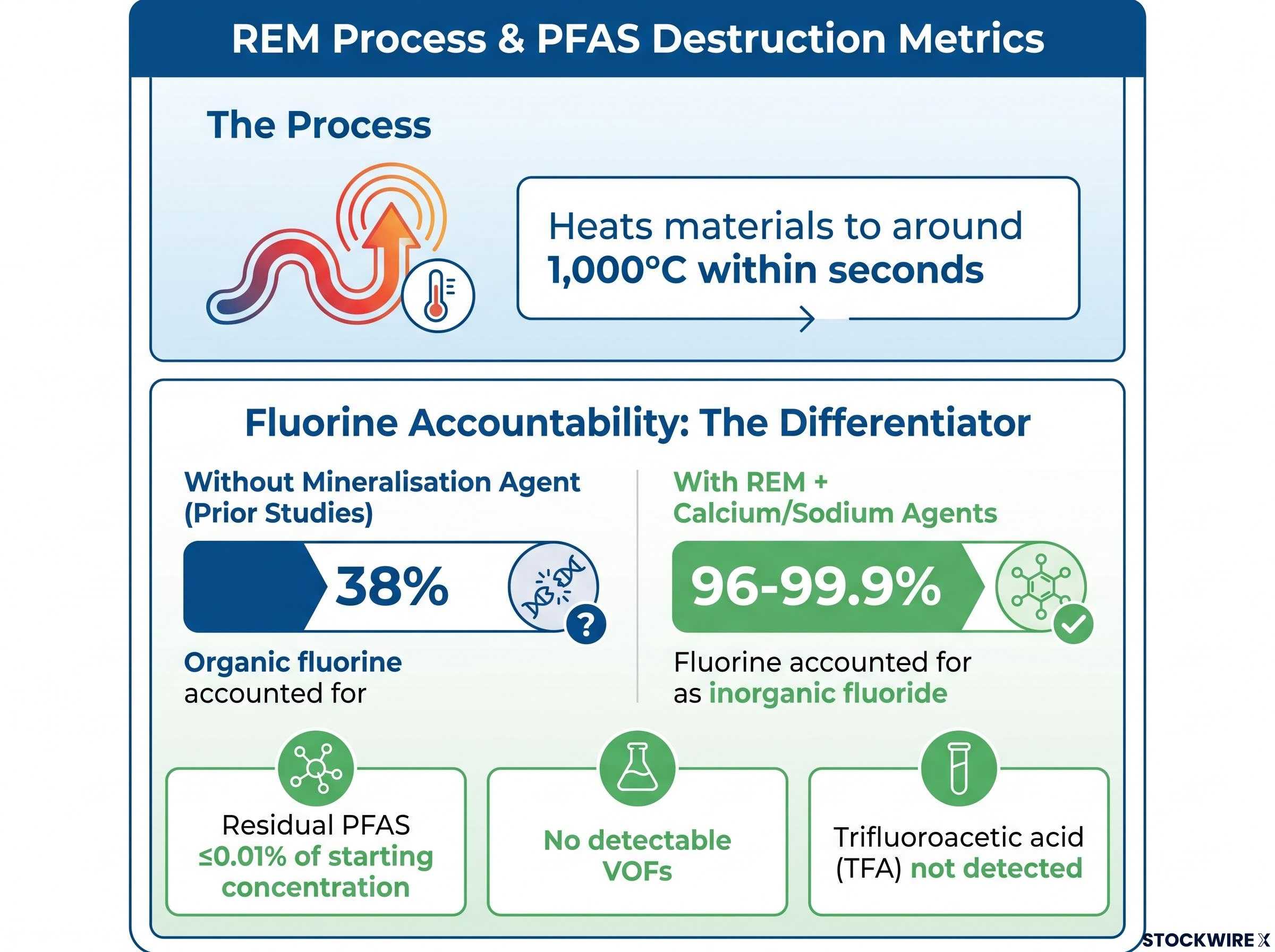
REM works by rapidly heating contaminated soil or sorbents, such as GAC and IX resin, to around 1,000°C within seconds using a controllable electrical current, then cooling them just as quickly. In soils, naturally occurring calcium acts as a built-in “mineralisation agent”, helping drive the fluorine away from the PFAS and into calcium fluoride, a naturally occurring, non-toxic mineral.
Independently verified results
Independent testing has demonstrated REM’s performance across two distinct material streams, summarised below.
| Material | PFAS Removal | Fluorine Accountability | Key Outcome |
|---|---|---|---|
| Contaminated soils | >99% PFAS removed | High mineralisation, near-complete accountability | Soil properties (particle size, water infiltration) preserved |
| GAC & IX resins | >99.9% PFAS removal | 96–99.9% fluorine as inorganic fluoride | No detectable VOFs; residual PFAS ≤0.01% of starting concentration |
The differentiator becomes clear when measured against alternatives. Prior peer-reviewed studies have shown that without any mineralisation agent, only about 38% of the organic fluorine from PFAS can be accounted for, and trace VOFs can form.
When REM is used together with carefully controlled amounts of calcium or sodium as mineralisation agents, 96–99.9% of the fluorine is accounted for as inorganic fluoride, with no detectable VOFs and residual PFAS at or below 0.01% of the starting concentration. Ultrashort-chain PFAS such as trifluoroacetic acid (TFA), which can appear after incomplete combustion in other processes, were not detected after REM treatment.
In plain terms, REM does not just make PFAS “disappear”. It converts the fluorine into known, non-toxic mineral forms and accounts for essentially every fluorine atom through testing.
Management perspective
Justin Sharp, Chief Technology Officer, ECT
“Proving not only that the carbon–fluorine bond in PFAS is broken, but where the fluorine ends up after destruction, is becoming central to how regulators evaluate PFAS treatment. In ECT’s testing, REM accounted for and mineralised essentially all of the fluorine released from the PFAS tested , predominantly as non‑toxic calcium fluoride, with no volatile organic fluorides or other short‑chain PFAS with even worse toxicity detected. We believe REM is well positioned to meet these requirements, with the potential to be deployed in situ for soil remediation or on-site for GAC and IX resin remediation at water treatment plants.”
Next steps on the path to commercialisation
ECT is currently procuring commercial samples of PFAS-laden soil and GAC for non-targeted analysis (NTA) with its pilot system. Validating REM with commercial rather than synthetic samples is intended to aid future regulatory validation, continually testing the method against real-world materials and paving the way to commercialisation.
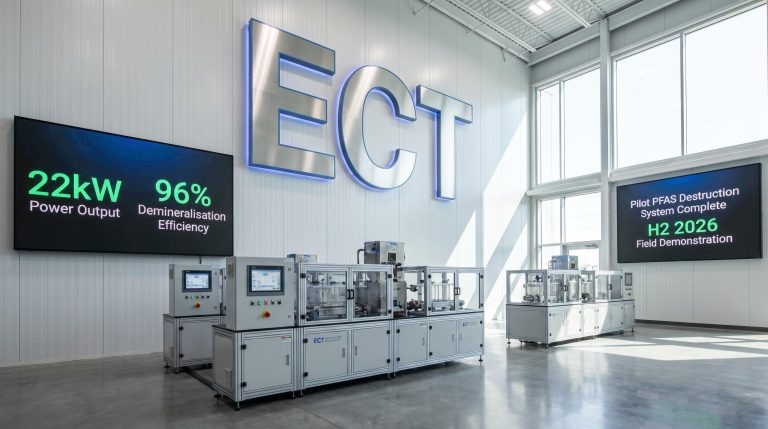
ECT’s completed pilot system delivers 22kW at 170 kHz and 2,200 V, representing 18 times the power output of the laboratory prototype and enabling commercially viable remediation timeframes across both soil and GAC treatment pathways.
The combination of high destruction performance, full fluorine mass balance and regulatory-grade analytics has been described by the Company as making REM a leading candidate to meet EPA expectations for safe, verifiable PFAS disposal.
ECT’s U.S. market positioning extends beyond the EPA submission itself: the company is pursuing an OTCQB listing under ticker ECTHF, a move designed to broaden its capital base and establish commercial credibility with U.S. environmental agencies ahead of pilot-scale trials.
For investors, the submission represents an early regulatory positioning step rather than an endorsement. It remains a public comment within the EPA’s consultation process, and no approval or validation has been granted. The development nonetheless aligns ECT’s exclusively licenced REM technology with the evaluation framework that will shape how emerging PFAS destruction technologies are assessed in the years ahead.
Don’t Miss the Next Environmental Tech Breakout
Big News Blast delivers FREE breaking ASX news straight to your inbox within minutes of release, complete with in-depth analysis. Over 20,000 subscribers are already getting the edge on emerging industrial and environmental technology stocks the moment announcements hit. Click the “Free Alerts” button to stay ahead of the market.