

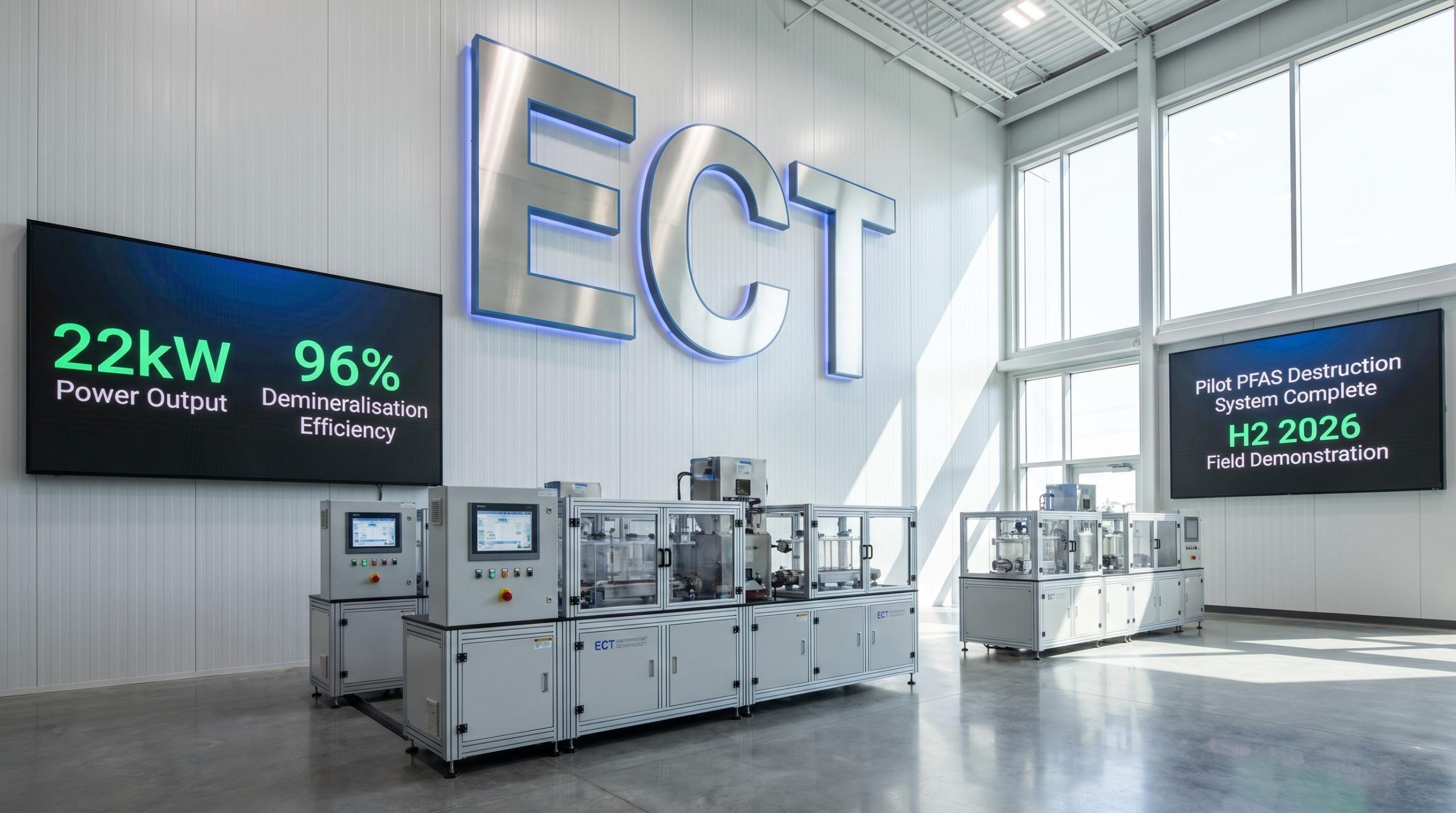
ECT completes pilot PFAS destruction system with 18x power upgrade
Environmental Clean Technologies has completed construction of its pilot Rapid Electrothermal Mineralisation (REM) system, delivering approximately 18 times the power output of the laboratory-scale prototype. The pilot system enables in-situ testing for destroying PFAS from contaminated soil and granular activated carbon (GAC), marking the company’s transition from laboratory validation to field-deployable technology. ECT is targeting its first in-field pilot demonstration for H2 2026, with the system operating without conductive additives such as biochar, a capability the company believes has not previously been demonstrated by any other PFAS remediation process.
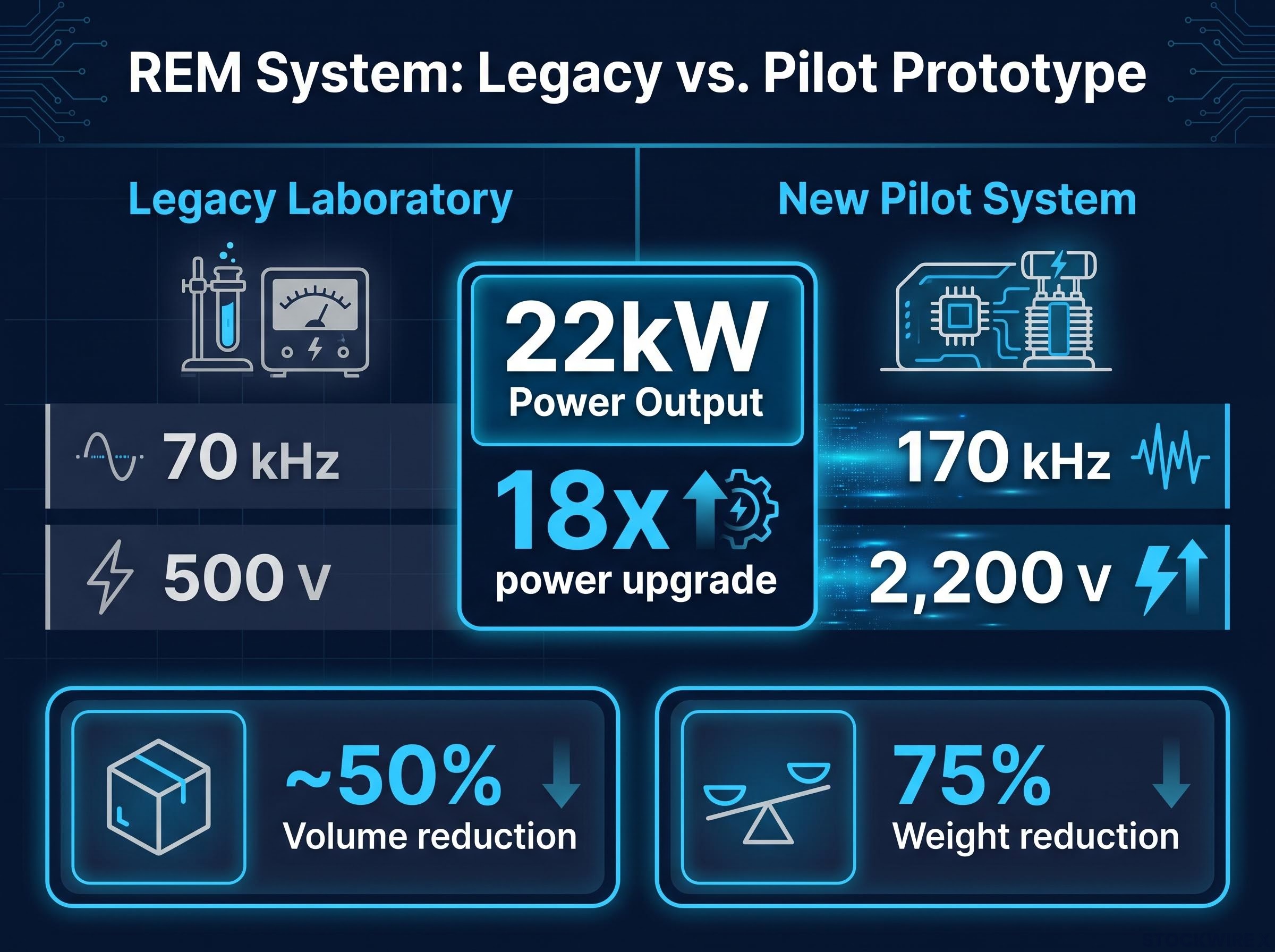
The pilot system operates at 170 kHz and 2,200 V, compared with the legacy laboratory setup limited to 70 kHz and 500 V, delivering 22kW of power output. The redesigned configuration is approximately 50% smaller in volume and 75% lighter than the laboratory prototype, making deployment across contaminated sites genuinely practical. This completion removes a critical commercialisation hurdle, transforming ECT from a laboratory-stage technology developer to one with licensable, field-ready intellectual property targeting commercial PFAS remediation.
When big ASX news breaks, our subscribers know first
Technical specifications driving commercial viability
The pilot system incorporates purpose-built power electronics and industry-grade components that deliver simultaneous high-frequency and high-power output, a combination the legacy laboratory system could not achieve. Higher voltage increases current output and therefore delivered power, shortening remediation time, while the higher frequency allows current to flow through soil without conductive additives.
Key performance improvements include:
- Operating frequency: 170 kHz (vs 70 kHz legacy)
- Operating voltage: 2,200 V (vs 500 V legacy)
- Power output: 22kW
- Volume reduction: ~50%
- Weight reduction: 75%
The size and weight reductions make the technology genuinely deployable across contaminated sites, with modular REM units designed for mounting onto existing commercial construction and farming equipment. The pilot system also incorporates aerospace-grade electrode materials selected to withstand the high temperatures and mechanical stresses of in-situ deployment, where electrodes are inserted directly into subsurface soil. Together, these specifications position the technology for integration with industry partners’ existing equipment fleets, reducing site-specific capital requirements and supporting deployment across diverse contamination scenarios.
What is PFAS and why does remediation matter?
PFAS (per- and polyfluoroalkyl substances) are a group of synthetic chemicals characterised by extremely strong carbon-fluorine bonds, which make them resistant to degradation in the environment. These bonds are among the strongest in organic chemistry, causing PFAS to persist in soil, water, and biological systems for decades or longer, earning them the designation “forever chemicals”.
REM addresses this challenge through a high-temperature destruction process. Graphite or metal electrodes are inserted into PFAS-contaminated soil, and a high-voltage, high-power current is applied between them, generating temperatures above approximately 1,000°C. This extreme heat breaks the carbon-fluorine bonds in PFAS and converts them into inert, non-toxic fluoride salts. REM is a subset of Flash Joule Heating (FJH), developed by Rice University.
In controlled laboratory testing, the process has achieved demineralisation efficiencies exceeding 96% and removal of perfluorooctanoic acid (PFOA) of up to 99.98%. PFAS contamination is a global environmental challenge with growing regulatory pressure across jurisdictions, creating substantial addressable markets for proven remediation technologies capable of destroying, rather than merely containing, these persistent compounds.
The additive-free breakthrough
Early REM configurations relied on conductive additives such as biochar to carry current through contaminated soil. While effective in the laboratory, additives add cost and complexity and limit suitability for large-scale in-situ use, creating a commercialisation barrier. The pilot system overcomes this limitation by operating at high voltage and high frequency simultaneously, allowing current to flow through soil without additives while maintaining treatment effectiveness.
The February 2026 update on ECT’s progress toward pilot-scale deployment documented defluorination efficiencies above 96% achieved within 60 seconds of treatment, alongside the engineering case for eliminating biochar additives as a prerequisite for commercial scalability.
CTO Justin Sharp
“Completion of our own pilot system marks the transition from a laboratory-validated concept to a system we can actually deploy in the field. This is the system we’ve been working towards for many years at Rice University. The step-change in power output is what unlocks in-situ soil remediation at a commercial scale, overcoming a longstanding challenge in pushing sufficient current through soil without conductive additives or fixed infrastructure, and making the technology far more commercially viable.”
The company states this additive-free, high-temperature REM capability in-situ has not previously been demonstrated by any other PFAS remediation process. Eliminating the need for additives reduces operational costs and complexity for licensing partners, strengthening the commercial case for technology adoption. Safety testing and hardware validation of the additive-free system are now in their final stages, with the current validation phase focused on replicating laboratory-tested demineralisation efficiencies at scale and in-situ.
Dual pathway targets soil and water remediation markets
The pilot system enables two distinct application pathways, broadening ECT’s addressable market beyond soil contamination. The first pathway involves in-situ soil remediation, where electrodes are inserted directly into contaminated subsurface soil. The second pathway targets PFAS captured on granular activated carbon (GAC), a widely used filtration medium in water treatment systems.
Laboratory validation of the GAC pathway has been completed, including a peer-reviewed, published study of commercial GAC samples sourced from the US Army Corps of Engineers. ECT is now procuring PFAS-laden commercial samples to confirm that results observed in the prototype are replicated and achieved at greater efficiency in the pilot system, providing the validation required ahead of commercial deployment. The dual pathway broadens ECT’s addressable market from soil contamination into the larger water remediation sector using the same core hardware, with both pathways progressing in parallel through the pilot validation phase.
The Rice University licence amendment underpinning water treatment GAC remediation was secured for a one-off fee of $10,000, with the shared hardware architecture meaning no duplicate capital investment is required to serve both the soil and water treatment verticals from the same core platform.
Commercialisation strategy and licensing model
ECT intends to commercialise REM primarily through licensing intellectual property, complemented by an integration route in which modular REM units are mounted onto standard agricultural and construction equipment already operated by industry partners. This approach reduces site-specific capital requirements and supports deployment across diverse contamination scenarios, allowing partners to integrate the technology into existing operational workflows rather than requiring purpose-built remediation infrastructure.
CTO Justin Sharp
“Just as importantly, we’ve cut system volume by around 50% and weight by 75%, making deployment across contaminated sites much more practical to mount onto existing, commercially available construction and farming equipment.”
The licensing-first model positions ECT to generate revenue through intellectual property without heavy capital expenditure on remediation operations. By focusing on technology licensing and equipment integration, the company aims to enable rapid market penetration through partners with established customer bases and operational capabilities in contaminated site management.
Staged pathway to commercial deployment
ECT is following a staged commercialisation pathway with clear milestones. Foundation work is complete, and the company is currently in the validation phase, progressing permitting for on-site soil remediation alongside the GAC pathway. Laboratory testing of the pilot system is underway and demonstrating optimal performance.
| Stage | Status | Focus |
|---|---|---|
| Foundation work | Complete | Core technology development |
| Validation phase | In progress | Pilot system testing, permitting |
| Field demonstration | Target H2 2026 | In-situ soil and GAC remediation |
| Commercial deployment | Post-demonstration | Licensing and OEM partnerships |
Subject to successful validation, ECT is targeting its first in-field pilot demonstration in H2 2026 across both soil and GAC pathways. Following demonstration, the company intends to convert that validation into commercial licensing arrangements and OEM partnerships. The staged approach provides clear milestones for investors to track progress toward revenue-generating commercial agreements.
Investment thesis
The pilot system completion represents a significant milestone in ECT’s commercialisation pathway, addressing key technical and deployment barriers that have constrained large-scale PFAS remediation:
- Commercialisation hurdle removed: Pilot completion transitions ECT from laboratory validation to field-deployable technology
- Commercial viability unlocked: 18x power increase enables commercially viable remediation timeframes that were not achievable with the laboratory prototype
- Cost structure improved: Additive-free operation reduces operational costs and complexity for licensing partners
- Market breadth expanded: Dual soil/GAC pathways target both contaminated site remediation and water treatment sectors
- Deployment flexibility enhanced: Compact, lightweight design enables integration with existing construction and farming equipment fleets
- Near-term catalyst identified: H2 2026 field demonstration provides clear timeline for commercial validation
Successful field validation positions ECT to convert demonstrations into commercial licensing arrangements, transforming the company’s intellectual property into revenue-generating partnerships. The global PFAS remediation market is expanding as regulatory pressure increases across jurisdictions, creating demand for destruction technologies capable of eliminating persistent contaminants rather than merely containing them.
Want the Next Environmental Tech Breakthrough in Your Inbox?
Join 20,000+ investors receiving FREE ASX breaking news within minutes of release, complete with in-depth analysis. Click the “Free Alerts” button at Big News Blast to get real-time alerts on environmental technology, industrials, and infrastructure stories the moment they break.