The largest IPO in history arrived on 12 June 2026, and the first major institutional verdict was not a buy. Fourteen days after SpaceX priced at $135 a share, Argus Research initiated coverage with a Hold rating. The number that explains everything: a price-to-sales multiple of roughly 95x projected 2025 revenues.
That caution was not confined to a single stock. The same AI-fuelled enthusiasm lifting space infrastructure valuations also pushed the SOXX semiconductor index up approximately 10% in a single month, prompting UBS to cut its hardware allocation by 15 percentage points in response. Two major institutions, two different asset classes, one shared discipline: price matters even when the business story is genuinely compelling.
Here is the analytical lens both moves share, with the specific numbers and named decisions behind them, so you can apply the same framework the next time a transformational story meets a stretched valuation.
The numbers behind the world’s largest IPO
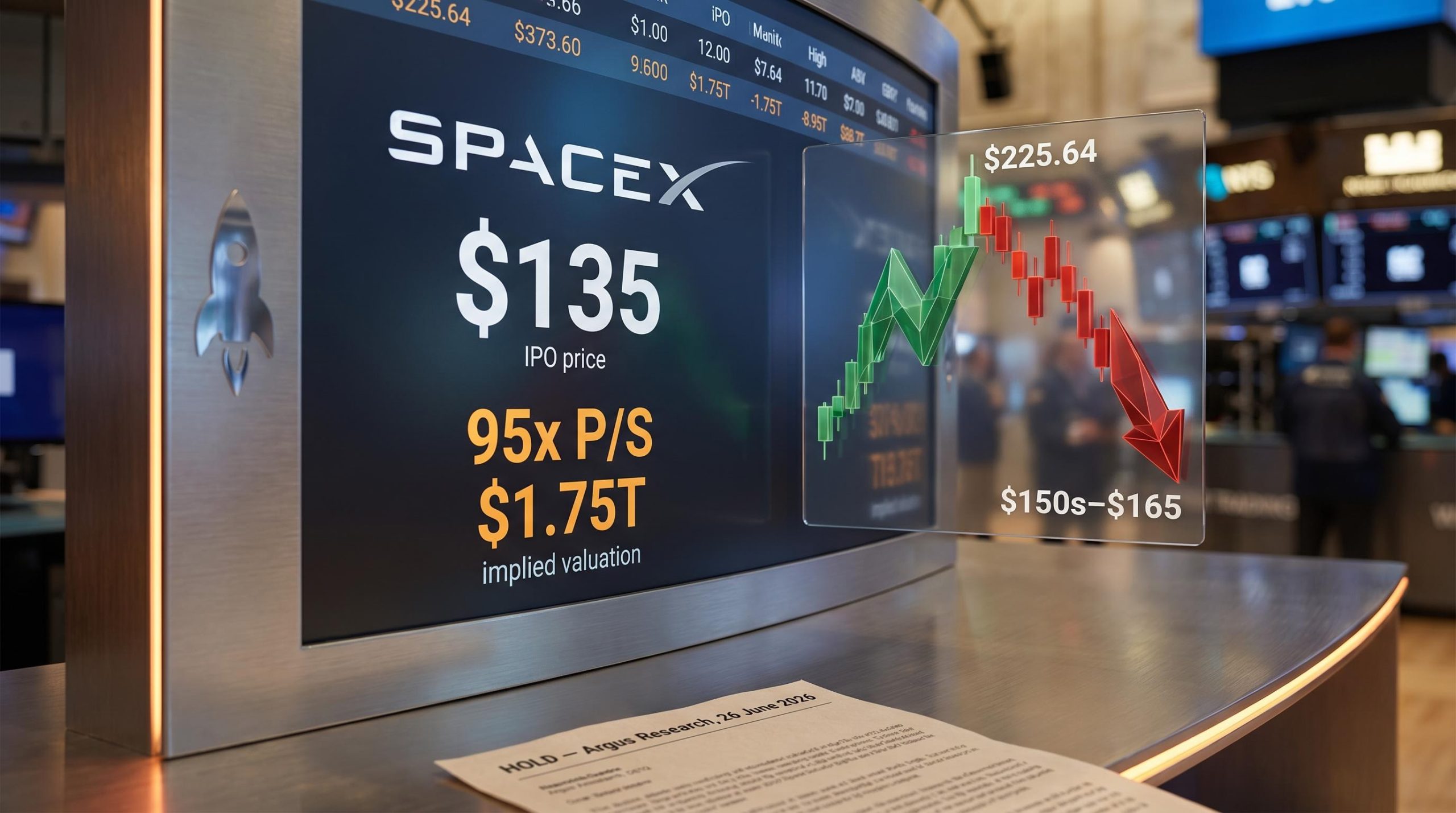
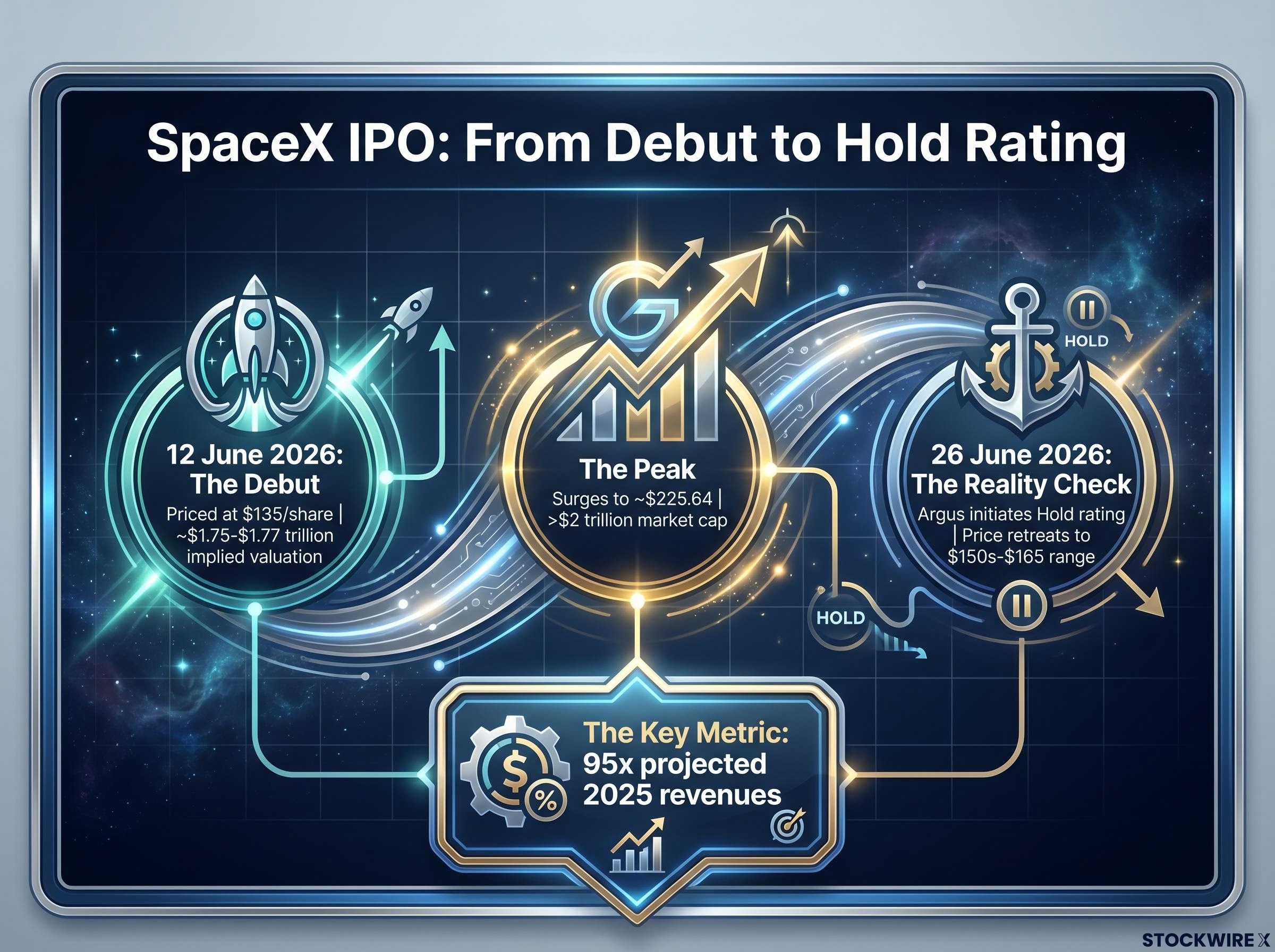
SpaceX priced its IPO at $135 per share on 12 June 2026, selling approximately 555.6 million shares and raising roughly $75 billion in base proceeds. When the likely overallotment exercise is included, total proceeds reached around $85.7 billion, with the deal placing the company’s implied valuation somewhere in the region of $1.75-$1.77 trillion and securing its place as the biggest public listing ever recorded.
| Metric | Value |
|---|---|
| IPO price | $135 per share |
| Shares sold | ~555.6 million |
| Base proceeds | ~$75 billion |
| Implied valuation | ~$1.75-$1.77 trillion |
| Post-IPO peak price | ~$225.64 |
| Peak gain vs. IPO price | ~67% |
| Market cap at peak | >$2 trillion |
| Post-peak trading range | ~$150s-$165 |
What happened after the opening bell
The debut was explosive. The stock surged to around $225.64, representing a gain of approximately 67% over the offer price and carrying the market capitalisation above $2 trillion at its high. The retreat followed swiftly. When Argus initiated coverage on 26 June, the shares had pulled back into the $150s-$165 range, holding roughly 10% above the offering price yet sitting well over 25-30% below where they had peaked.
Two structural forces amplified that volatility. First, the free float was small relative to the total market capitalisation, meaning relatively modest trading volumes could move the stock sharply in either direction. Second, strong index-inclusion mechanics and elevated retail participation created buying pressure in the first days that was always likely to fade. With lockup expirations approaching, further supply is set to enter the market. The first weeks of a mega-IPO are often more noise than signal, and SpaceX has been no exception.
When big ASX news breaks, our subscribers know first
How Argus reached a hold rating on a record-breaking IPO
Argus Research analyst Steve Silver initiated coverage on 26 June 2026 with a Hold rating, and the core of his argument was arithmetic. At the time of his note, SpaceX traded at approximately 95x projected 2025 revenues. A price-to-sales multiple that high, on a company that is not yet consistently profitable and whose revenue base is smaller than many comparably valued peers, leaves almost no room for anything to go wrong.
Silver characterised SpaceX as a company that blends the characteristics of a mature infrastructure business with those of a venture-stage growth investment. That hybrid identity is part of the appeal, but it also means the valuation will likely take years to normalise even under optimistic assumptions.
Argus’s core characterisation: SpaceX operates with the profile of an established infrastructure provider grafted onto a high-growth venture investment. At approximately 95x forward sales, the gap between today’s valuation and what would be considered a more normalised multiple is likely to take several years to close, even under conditions of strong execution.
At 95x sales, the investor is not buying the current business. They are buying a very specific forecast of how much that business will grow, and whether that forecast proves right is the central risk embedded in the price.
Argus identified two circumstances that could warrant an upgrade:
- A meaningful drop in the share price caused by factors unrelated to the underlying business (opening a more attractive entry point without any change in company fundamentals)
- Revenue and earnings growth coming in substantially ahead of current projections
Both conditions reinforce the same point. The Hold is about price, not about the company’s quality.
What price-to-sales multiples actually tell investors
Price-to-sales is a valuation metric that compares a company’s market capitalisation (its total stock market value) to its annual revenue. It is most commonly used when a company has minimal or negative earnings, making traditional profit-based measures like price-to-earnings ratios unreliable.
The price-to-sales ratio is the single metric doing the most analytical work in the Argus note, yet it is also one of the most misread tools in retail investing: a discounted multiple is a starting signal for deeper investigation, not a standalone buy verdict, and a stretched multiple is an instruction to examine what growth rate the market has already priced in, not an automatic sell.
Here is how to read the ratio in three steps:
- What it measures: how many dollars the market is paying for each dollar of a company’s annual revenue. A 10x price-to-sales multiple means investors are collectively paying $10 for every $1 the company earns in revenue.
- What a high ratio implies: the market expects revenue to grow substantially from here. The higher the multiple, the more growth is already baked into today’s price, and the less upside remains if the company merely meets expectations.
- What happens if growth disappoints: the multiple compresses, often sharply. A company trading at 95x sales that delivers 30x-worthy growth does not settle gently at 30x; the repricing can be abrupt and severe.
Applying the lens to SpaceX’s 95x multiple
At approximately $1.75 trillion implied valuation on a revenue base that Argus described as smaller than many peers trading at comparable or lower multiples, SpaceX’s 95x forward sales multiple implies years of compounding revenue growth at rates few companies in history have sustained. The company is not yet consistently profitable, which means the path from current revenue to the earnings that would justify this valuation is long and uncertain.
This is not a dismissal of the business. It is a mathematical observation: at 95x, the market has already priced in an extraordinary amount of success. What the investor is paying for is not today’s revenue but a specific trajectory of future revenue, and the gap between “good” and “good enough to justify 95x” is narrower than most people assume.
How UBS responded when AI enthusiasm got ahead of earnings
After Micron earnings sparked a move of approximately 4% in the SOXX semiconductor index within a single session in June 2026, the index went on to add around 10% across the month as a whole. UBS responded by cutting its combined semiconductor and hardware weighting within its AI strategy from around 76% down to roughly 61%, a reduction of 15 percentage points, while simultaneously building its defensive AI-adjacent allocation from below 1% to around 20%.
That is a substantial repositioning in a single month. UBS did not exit the semiconductor trade; it managed the position risk within it.
The AI capex lag between infrastructure investment and verifiable revenue generation is the structural tension behind the UBS rebalancing: Morningstar analysts have identified an 18-24 month delay between hyperscaler spending commitments and the supplier-level revenues that would justify the multiples already priced into the SOXX.
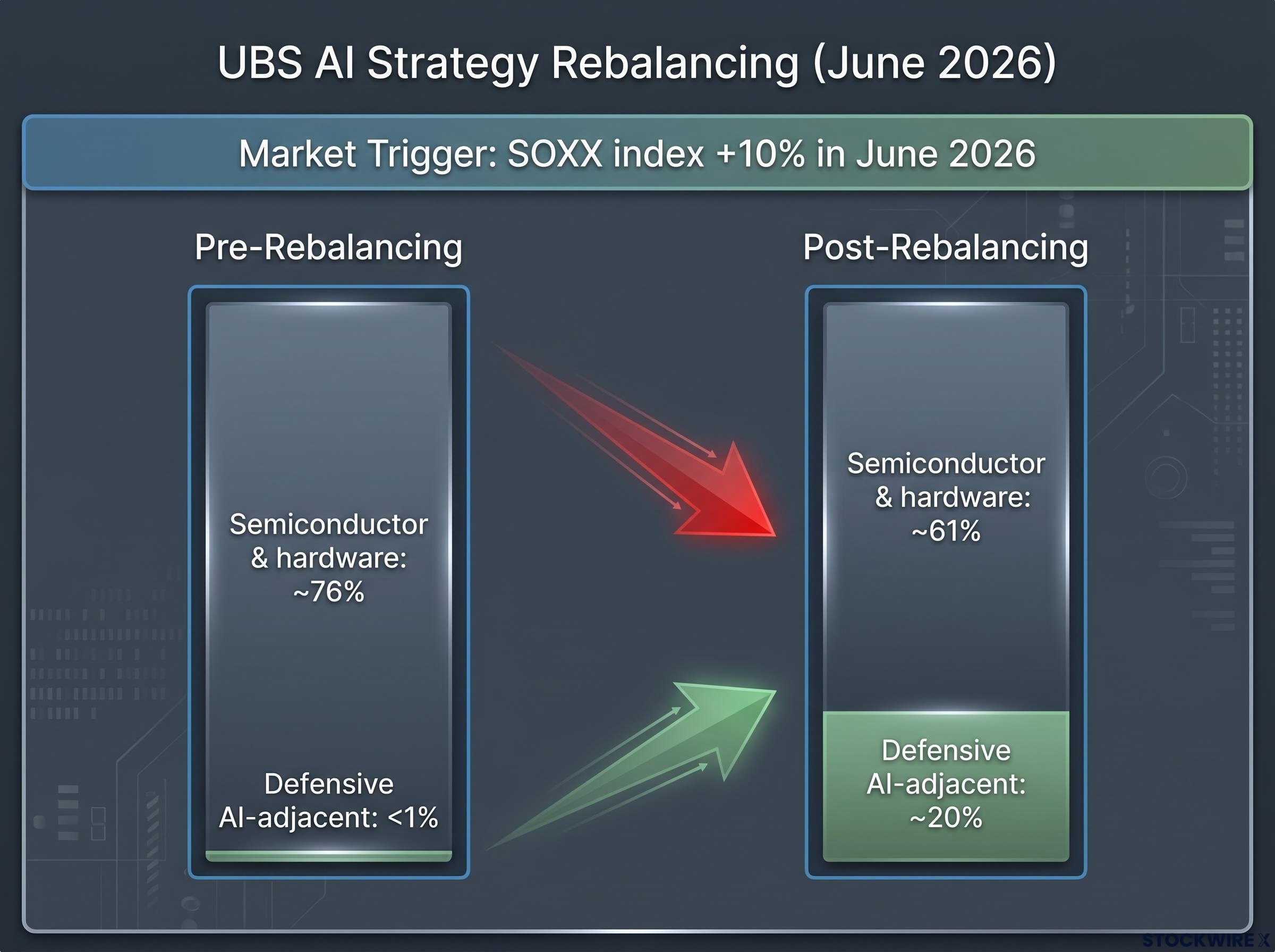
| Allocation category | Pre-rebalancing weight | Post-rebalancing weight |
|---|---|---|
| Semiconductor and hardware | ~76% | ~61% |
| Defensive AI-adjacent | <1% | ~20% |
| Magnificent Seven weight | ~18% (substantial underweight) | |
The selling was focused on AI supply chain companies at the smaller and mid-cap end of the market, where valuations had stretched the furthest, spanning names across:
- Optics
- Baseboard management controllers
- Substrates
- Cooling systems
- Advanced packaging
- Analog components
The defensive capital went into data centre operators, telecommunications companies, and select payments firms characterised by prudent balance sheets and stable dividends. These names provide exposure to the AI ecosystem without the full valuation risk of high-beta hardware stocks. Moving roughly 20% of a strategy into defensive names after a 10% sector rally in a single month is not a bearish call on AI. It is a disciplined acknowledgment that when prices run fast, valuation-adjusted risk changes, and position sizing should change with it.
What UBS still favours, and the one risk that could unwind the whole AI thesis
Within its semiconductor book, UBS maintained concentrated positions in three names it continues to back with conviction:
- TSMC, held for its foundry exposure as the manufacturer of the most advanced AI chips for multiple designers
- Applied Materials, held for semiconductor capital equipment access, providing exposure to the machines that produce the chips
- SK Hynix, held for memory exposure as a direct beneficiary of growing AI data processing demands
The common logic is clear: these are established, supply-chain-critical companies with diversified customer bases, not speculative mid-cap niche suppliers riding a single product cycle. UBS’s broader House View continues to position AI and technology as key sources of equity market upside, with medium-term demand supported by cloud acceleration and agentic AI workload growth. However, tech valuations sit above long-term averages, requiring selectivity. UBS recommends diversifying across the enabling, intelligence, and application layers of the AI value chain rather than concentrating in any single segment.
Semiconductor valuation dispersion in 2026 is wider than at any point in the dot-com era: Micron trades below 9x forward earnings while Intel sits at approximately 101x, meaning a sector-level bubble verdict obscures a stock-by-stock reality where some names are historically cheap and others are historically expensive simultaneously.
The risk UBS named explicitly: a sharp fall in the share prices of major hyperscaler companies could lead management teams to scale back their capital expenditure programmes going forward. That capex reduction would propagate rapidly through the entire AI supply chain, hitting the most richly valued, least diversified names hardest.
This is the lever worth watching most closely. If Amazon, Microsoft, Google, or Meta signal reduced AI infrastructure investment in upcoming earnings, the effect is not limited to their own share prices. It compresses forward revenue expectations across every supplier in the chain simultaneously.
Separating the business story from the stock story, now and going forward
The Argus Hold on SpaceX and the UBS semiconductor trim look like unrelated moves. One is a single-stock valuation call on a space infrastructure company. The other is a portfolio rotation within AI hardware. But the discipline underneath is identical: both represent institutional capital separating long-term business quality from near-term valuation risk.
That distinction is the most portable tool in this analysis. Any time you evaluate a high-growth position, three questions do the heavy lifting:
- What multiple is already embedded in the current price? At 95x sales, SpaceX’s price assumes years of compounding revenue growth. Know what assumption you are buying.
- How much of your portfolio’s return depends on everything going right? UBS trimmed when concentration in a single sub-sector exceeded what the risk-reward justified, even though the thesis had not changed.
- Is the risk-reward proportionate given current valuations and concentration? Argus set specific conditions for an upgrade. Knowing what would change your mind before prices move is how institutional investors avoid reacting emotionally after the fact.
What to watch in the months ahead
Three leading indicators are worth monitoring as the AI and space infrastructure investment narratives evolve:
- Hyperscaler capex guidance in the next round of earnings from the largest cloud and AI platform companies. Any downward revision propagates through the supply chain rapidly.
- SpaceX’s revenue growth trajectory relative to the 95x multiple. If revenues accelerate faster than projected, the multiple compresses naturally; if they do not, the price is the adjustment mechanism.
- Institutional AI strategy weightings from UBS and comparable firms. Further trimming or rebalancing would signal that the valuation concern is broadening, not fading.
These are forward signal anchors, not predictions. The point is not to forecast what will happen, but to know which data points change the picture first.
Institutional crowding signals provide independent corroboration for the UBS trim: the June 2026 Bank of America Global Fund Manager Survey recorded 80% of managers naming long global semiconductors as the most crowded trade in the survey’s history, a concentration level that escalated from roughly 24% in April to 80% in June with no historical precedent.
This article is for informational purposes only and should not be considered financial advice. Investors should conduct their own research and consult with financial professionals before making investment decisions. Forward-looking statements regarding SpaceX’s revenue trajectory, AI sector performance, and institutional strategy positioning are speculative and subject to change based on market developments and company performance.