Semiconductor investors are sitting on one of the strongest earnings stretches in the sector’s history, and most professional forecasts say it continues through 2026 into 2027. The discomfort is not the present. It is what comes after.
When semiconductor capacity waves arrive, they do not arrive gradually. They arrive all at once, because every major producer responds to the same demand signal with the same multi-year construction timeline, and the supply additions cluster in the same narrow window. The AI-driven supercycle has produced genuine structural demand, not speculative excess, which makes an early exit genuinely costly. At the same time, the capital expenditure commitments made in 2024 and 2025 by TSMC, Samsung, and their peers are largely locked in, and the supply response they represent is approximately 18 to 24 months from becoming a market reality.
The window between now and then is the analytically important zone. Here is a framework for navigating it with discipline rather than guesswork: how the supply wave mechanics work, where each segment of the sector sits on the risk spectrum, which indicators to monitor, and when to start moving.
Why the semiconductor cycle is nothing like other industries
The central distortion in the semiconductor cycle is the lag between the demand signal and the supply response. In most industries, that lag is measured in months. In semiconductors, it is measured in years.
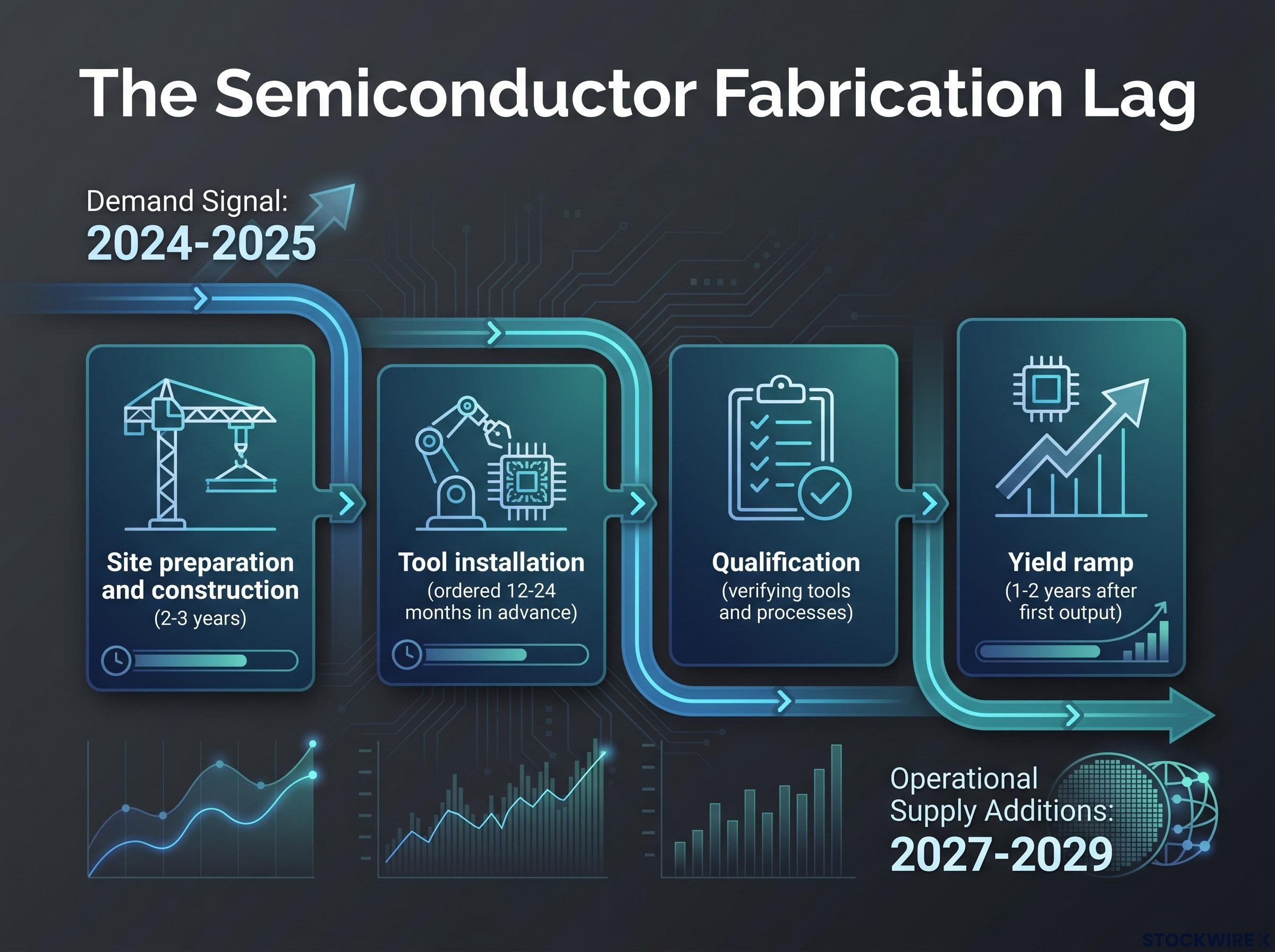
A new fabrication plant moves through a multi-year sequence before it produces a single commercial chip:
The capex-to-revenue lag sits at the structural centre of this risk: Morningstar analyst Dennis Li has quantified it at 18-24 months for hyperscaler AI infrastructure spending, which aligns closely with the fab construction timelines that place meaningful supply additions in the 2027-2029 window.
- Site preparation and construction: typically 2-3 years from ground-breaking to structural completion.
- Tool installation: high-precision lithography and deposition equipment, ordered 12-24 months in advance.
- Qualification: verifying that the tools and processes meet customer specifications.
- Yield ramp: the months-long process of moving from initial output to commercially viable production volumes, typically reaching full production 1-2 years after first output.
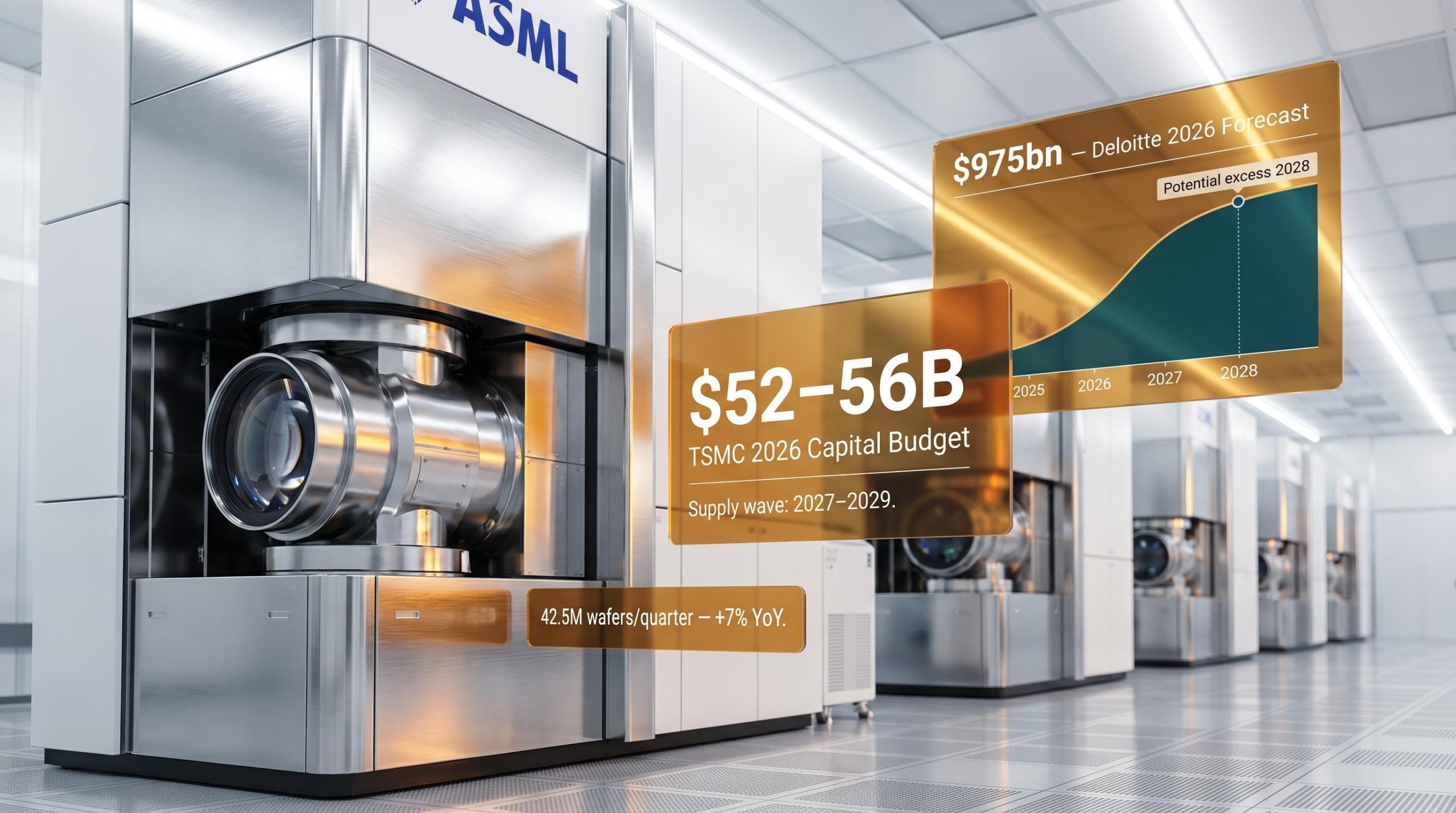
That timeline means the AI demand signal from 2024-2025 translates to operational supply additions clustered in 2027-2029. Global wafer fab capacity currently stands at 42.5 million wafers per quarter, growing 7% year-on-year. Additional mega-fab lines are moving to first output around 2027, with full production around 2028.
The synchronisation problem: when everyone builds at once
The lag alone would be manageable. The problem is synchronisation. Multiple major producers all received the same demand signal, and all made large capital expenditure commitments within a similar window.
TSMC has guided a 2026 capital budget of $52-56 billion, explicitly to expand capacity and advance leading-edge processes. Samsung’s total outlay across capital expenditure and R&D is understood to run in the range of $70-80 billion annually. TSMC’s Arizona Fab 2 (3nm) targets volume production in 2027-2028; Fab 3 (2nm/A16) is planned before 2030. A European joint fab is targeting production in 2027.
TSMC’s 2026 capital budget guidance of $52-56 billion confirms that the supply additions now in motion are not speculative commitments subject to revision, but locked expenditures with equipment lead times already running, making the 2027-2029 supply wave a structural certainty rather than a conditional risk.
These commitments are largely locked in. Given equipment lead times of 12-24 months, the order books visible today provide a reliable map of where supply will materialise. The supply wave is not contingent on future decisions; it is already in motion, with delivery windows that can be tracked against announced construction schedules. Investors should treat the 2027-2029 window as a known structural pressure point on the supply side, regardless of what happens to demand.
When big ASX news breaks, our subscribers know first
Where the sector actually stands in mid-2026
Before the risks, the current numbers explain why staying invested is the rational choice right now.
Global semiconductor revenues reached approximately $700 billion in the most recent reported year, up 21% year-on-year. Deloitte’s 2026 Global Semiconductor Industry Outlook projects $975 billion in sales for 2026, with growth of 22% in 2025 and 26% projected for 2026.
Deloitte’s 2026 forecast: $975 billion in global semiconductor sales, representing 26% year-on-year growth.
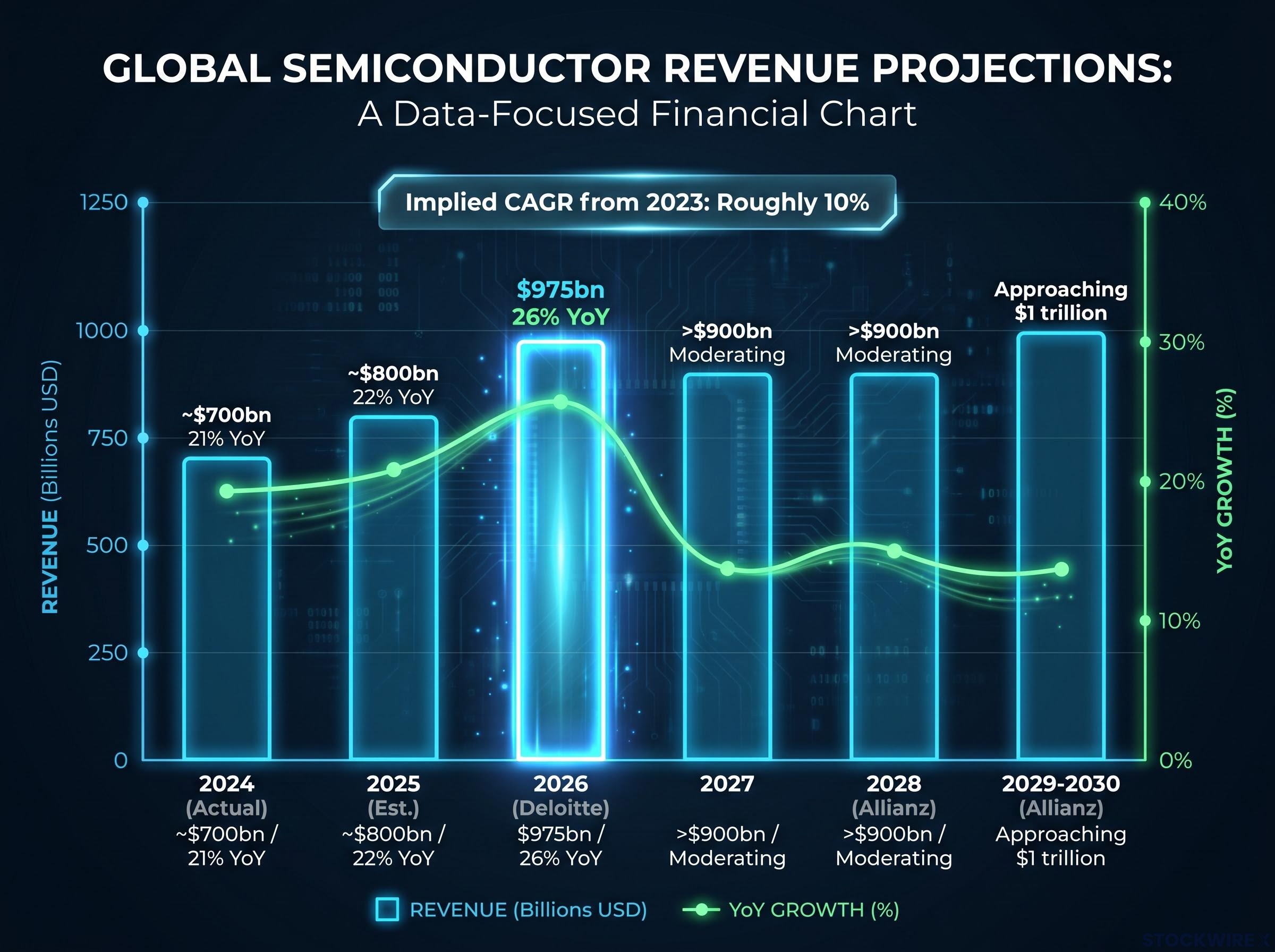
The trajectory beyond that remains strong. According to Allianz Research, the market is tracking to exceed $900 billion by 2028 and approach $1 trillion by 2029-2030, implying roughly 10% compound annual growth from 2023 levels. IDC characterises the current phase as a semiconductor supercycle with double-digit revenue compound annual growth for 2024-2028.
The supply side explains the earnings power. Memory is experiencing a structural supply constraint, with DRAM prices elevated sharply year-on-year and NAND supply tightened following capital expenditure cuts in 2024. High Bandwidth Memory (HBM), the specialised memory required for AI accelerators, is particularly constrained because wafer capacity has been reallocated from commodity DRAM to HBM production. Micron has publicly highlighted demand and supply constraints expected to persist beyond calendar year 2026.
| Year | Revenue Estimate | YoY Growth | Supply Condition |
|---|---|---|---|
| 2024 | ~$700bn (actual) | 21% | Tight |
| 2025 | ~$800bn (est.) | 22% | Tight |
| 2026 | $975bn (Deloitte) | 26% | Tight |
| 2027 | >$900bn baseline | Moderating | Loosening |
| 2028 | >$900bn (Allianz) | Moderating | Potential excess |
What matters to you is not the 26% growth figure in isolation. Growth at this rate places the sector firmly in the uppermost tier of its own historical distribution. It is that positioning which gives cover for elevated valuation multiples, and it is also that positioning which makes the eventual return to trend so consequential: when growth reverts, the multiples built around exceptional performance have no foundation to rest on.
The double hit: how semiconductor down-cycles actually destroy value
When the semiconductor cycle turns, value is destroyed through two channels simultaneously, not one. Understanding both is what separates a manageable drawdown from a compounding one.
- The earnings channel: as supply loosens and pricing power erodes, revenue and margin growth slow. Results begin arriving below the trajectory the market had already priced into share prices.
- The multiple compression channel: as growth normalises, the valuation premium investors previously accepted becomes harder to defend. A stock priced at 35 times forward earnings on the back of 25% growth will struggle to hold that rating once growth recedes to 8%, because the premium existed to compensate for growth that is no longer there.
These two forces do not arrive sequentially. They arrive at the same time, because markets begin pricing in lower future earnings before the current quarter’s results actually deteriorate. That is where the compounding effect bites hardest.
Forced deleveraging can accelerate the double hit well before fundamental deterioration materialises: the June 2026 semiconductor selloff, triggered by a Korean regulatory misstep, demonstrated how a mechanical redemption event in a heavily positioned sector can cascade into a 7.8% single-session decline in the NYSE Semiconductor index, compressing multiples independently of any quarterly earnings miss.
Illustrative scenario (not a forecast): suppose 2026 delivers earnings growth of approximately 25%, in line with current forecasts, but growth in 2027 disappoints at 5% rather than the 15% the market had anticipated. The resulting earnings shortfall, combined with investors repricing away from a growth premium, could together drive a market drawdown of the order of 20-25%, with the valuation re-rating amplifying what would otherwise be a modest fundamental miss.
The framework from Damien Klassen at Nucleus Wealth helps quantify this: according to his analysis, when growth reaches the uppermost percentiles of historical experience, it may reasonably support valuations well above long-run norms, but once growth steps down toward more ordinary levels, those elevated ratings tend to compress in parallel. Bloomsbury Intelligence explicitly warns that oversupply in 2028-2029 is a realistic possibility if AI demand growth moderates as capacity expands.
Why analyst consensus almost always misses the turn
Consensus estimates systematically project recent peak growth rates into out-years. That structural bias means downward revisions, when growth normalises, are typically larger than expected.
The specific warning signal to watch: upgrades to 2026 estimates that come at the cost of muted 2028 estimates. That pattern tells you the market is pulling demand forward rather than creating durable growth. It is a leading indicator of the double hit, visible before the current quarter’s results disappoint.
Not all chips are equal: reading the risk map by segment
Where you are positioned within the semiconductor sector matters as much as whether you are in the sector at all. Four segments carry materially different risk profiles.
| Segment | Cyclical Exposure | Key Risk Driver | Recommended Exit Horizon |
|---|---|---|---|
| Memory (DRAM, NAND, HBM) | Highest | Supply wave, price commoditisation | Strict exit before 2028 capacity peak |
| AI Accelerators | Moderate-high | Hyperscaler in-house silicon displacement | Longer hold; monitor plateau signals |
| Foundries / IDMs | Moderate | Operating leverage from heavy capex | Medium-term hold with active monitoring |
| Equipment Makers | Moderate (leading) | Order book deceleration | Hold for signal value; use as leading indicator |
Memory is the most cyclically exposed. Bloomsbury Intelligence characterises current conditions as a structural crisis driven by wafer reallocation from commodity DRAM to HBM, with tight supply expected through 2027-2028 and oversupply in 2028-2029 a realistic possibility. Pure-play memory names like Micron, SK Hynix, and Samsung’s memory division warrant the strictest exit discipline.
China’s DDR5 supply ramp adds a forward-looking dimension that the current consensus largely underweights: ChangXin Memory Technologies has achieved commercial DDR5 delivery with yields above 80%, shifting from a theoretical competitive threat to a present supply-side reality that could bring forward the memory pricing correction the market currently places in 2028-2029.
AI accelerators, particularly those with strong software ecosystems and deep customer integration such as NVIDIA, may sustain elevated margins longer. But they are not immune. Google’s TPU, Amazon’s Trainium, Microsoft’s Maia, and Meta’s MTIA represent meaningful displacement risk over the medium term.
Foundries and diversified IDMs benefit from policy support through the US CHIPS Act and EU Chips Act, but face significant operating leverage risk once heavy capital expenditure translates into excess capacity. Equipment makers like ASML, Applied Materials, Lam Research, and Tokyo Electron serve a dual purpose: they participate in the ongoing build-out, and their order book trends peak 12-24 months ahead of chip maker earnings, making them leading indicators for the broader cycle.
Treating semiconductor exposure as monolithic creates blind spots. A pure-play memory name requires a different exit trigger and timeline than an ecosystem-anchored AI logic name.
The five indicators that tell you when to start moving
The framework below is ordered by lead time, longest first. The indicators closest to the top give you the most advance warning. The ones further down are confirmation signals.
- Equipment orders: ASML, Applied Materials, Lam Research, and Tokyo Electron typically peak in order activity 12-24 months ahead of chip makers. Watch for deceleration in order books as the supply wave approaches completion. This is your earliest warning.
- Fab construction progression: track the announced, committed, and operational stages for TSMC Arizona Fabs 2 and 3 (2027-2028), the European joint fab (2027), and Intel’s US expansions. Movement from tool installation to yield ramp is an increasing probability signal that supply constraint relief is approaching.
- Forward earnings revisions: focus on 2027-2029 estimates for memory pure-plays and AI accelerator vendors. Flat or declining 2028 estimates during a strong 2026 print is a warning that the market is pricing in demand pull-forward, not durable growth. This is the single most important data point for the timing question.
- Memory spot versus contract pricing: a widening gap where spot prices fall below contract prices is an early warning of supply loosening and impending contract repricing. Monitor the direction and rate of change, not the absolute level.
- Macro indicators: watch monetary policy signals from the Fed, ECB, and BoJ, including shifts in inflation trajectory and the direction of interest rate guidance, for evidence of renewed tightening that could weigh on infrastructure spending. Hyperscaler data-centre capital expenditure guidance for end-market demand deceleration. These are the broadest signals and typically confirm what the sector-specific indicators have already suggested.
The two-or-three-indicators-flashing-amber rule: begin scaling back before indicators confirm the cycle has turned, not after. Waiting for red confirmation is structurally too late. When two or three of the five indicators above move into amber territory, that is the signal to begin graduated de-risking.**
The signal that matters is not the near-term earnings beat. It is whether the 2028 and 2029 estimates are holding firm during a strong 2026 print. That divergence is where the cycle’s durability is being assessed by the market in real time.
The case for staying invested, and the discipline required to exit well
The affirmative case for holding semiconductor positions through this phase is straightforward. Broad consensus from Deloitte, Allianz, IDC, and TrendForce supports strong growth and tight memory supply into 2026-2027. When growth is running at historically exceptional rates, accepting a valuation premium is a rational response, not a reckless one. Reducing exposure simply because absolute prices feel high, without evidence that the earnings foundation is deteriorating, means sacrificing returns that the fundamentals genuinely support.
The analysis from Nucleus Wealth’s Damien Klassen makes this point clearly: his framework holds that genuinely exceptional earnings growth can rationally support valuations well above historical norms. The analytical task is identifying when current premiums become unjustifiable as growth steps down, not treating all premiums as inherently dangerous.
The risk in this environment cuts both ways. Sitting out a semiconductor supercycle carries a real opportunity cost. Equally, remaining concentrated in high-multiple positions once the exceptional growth that justified those multiples has passed is where the most serious losses compound.
The graduated de-risking sequence, when indicators trigger it:
- Reduce first: pure-play memory names and marginal AI plays with thin competitive moats.
- Reduce second: leading foundries, once capital expenditure translates into visible excess capacity.
- Hold longest: ecosystem-anchored logic players and equipment names with active order books.
The monitoring window and what to do with it
The active monitoring period runs from late 2026 through 2028. This is when the transition from constraint to potential loosening is most likely to begin, and it requires quarterly reassessment of where each indicator sits relative to the amber thresholds described above.
This framework is not passive. It requires active, regular engagement with the five indicators. Investors entering the 2027 capacity wave with a prepared framework are not predicting the top. They are managing the risk of holding premium valuations past the point where those premiums are justified.
This article is for informational purposes only and should not be considered financial advice. Investors should conduct their own research and consult with financial professionals before making investment decisions.
Financial projections referenced in this article are subject to market conditions and various risk factors. Past performance does not guarantee future results.
What the supply wave changes, and what the long-term AI thesis does not
The supply wave changes the terms, not the thesis. The distinction matters.
What the supply wave changes:
- Peak-cycle earnings growth rates normalise from exceptional to above-average.
- Memory pricing power compresses as constraint conditions ease.
- Valuation multiples contract from peak-cycle premiums to levels consistent with lower (but still healthy) growth.
- The urgency of data-centre procurement eases, shifting spending from front-loaded to more measured.
What the long-term AI thesis does not change:
- Large-scale model training and inference infrastructure demand remains durable and multi-year.
- IDC characterises the post-wave environment as lower-growth continuation, not collapse, with double-digit revenue compound annual growth for 2024-2028.
- Deloitte assumes growth moderates after 2026 even as the secular AI story remains strong. The transition is from exceptional to good, not from good to bad.
- The $1 trillion market milestone projected by Allianz Research for 2029-2030 represents a sector that has permanently expanded, even after the supply wave resets pricing dynamics.
The long-range semiconductor market forecast from Bank of America, projecting $2.7 trillion by 2030 at a 28% compound annual growth rate from 2025, frames current hyperscaler spending as a floor rather than a midpoint of the demand curve, providing the analytical backdrop against which the supply wave’s normalising effect should be calibrated.
The supply wave does not invalidate the investment thesis for semiconductors. It changes how that thesis is expressed: from exceptional near-term earnings growth that justifies premium multiples, to sustained above-average growth that justifies reasonable but not peak multiples.
The investors who will navigate this environment well are those who hold both truths simultaneously, that the secular demand story is real and that the peak-cycle earnings rate is not permanent, and act on the distinction. That is the difference between semiconductor cycle investing as a reactive exercise and semiconductor cycle investing as a disciplined one.
—