Alphabet shed roughly 5% of its market value in a single session after losing two of the most consequential researchers in artificial intelligence history to its two most direct rivals, and the damage rippled well beyond one stock. Noam Shazeer, co-author of the paper that made modern AI possible, left for OpenAI. John Jumper, a Nobel laureate whose work at DeepMind produced one of the most celebrated scientific breakthroughs of the decade, departed for Anthropic. Both exits landed in the same week. The Bloomberg Magnificent 7 Index recorded an intraday drop of up to 2.2%, and Communication Services became the worst-performing S&P 500 sector on 23 June 2026. What follows breaks down exactly what these two departures mean for Alphabet’s competitive standing in AI, why the market reacted as sharply as it did, and what the 5% selloff signals for anyone holding or evaluating positions in large-cap AI-exposed equities.
The architect of modern AI just moved to Alphabet’s biggest competitor
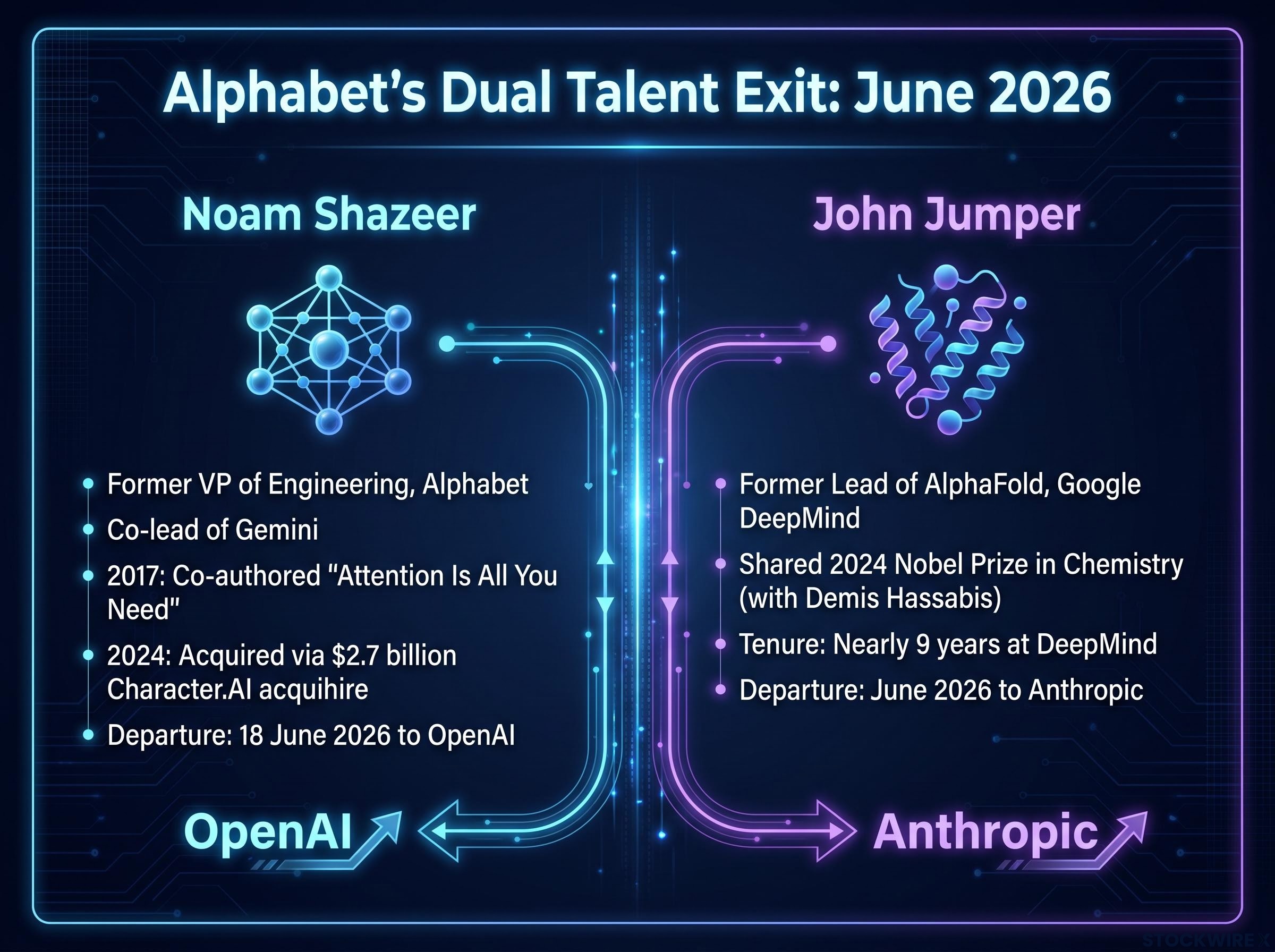
Noam Shazeer held the title of Vice President of Engineering at Alphabet and served as co-lead of the company’s flagship AI system, Gemini. Those credentials alone would make his departure significant. What elevates it is the paper.
In 2017, Shazeer co-authored “Attention Is All You Need”, the transformer research paper that introduced the architecture underpinning virtually every modern large language model, from GPT to Gemini itself.
The transformer architecture introduced in Attention Is All You Need became the structural foundation for every major large language model that followed, making Shazeer’s authorship of that paper one of the most consequential individual contributions in the history of applied AI research.
Alphabet understood what it had. In 2024, the company executed a $2.7 billion acquihire through Character.AI, the startup Shazeer had co-founded, specifically to bring him back. That figure was a statement about how much a single researcher at the frontier of AI is worth.
Two years later, around 18 June 2026, Shazeer announced he was leaving for OpenAI, the organisation building the product most directly competing with the system he co-led. The $2.7 billion Alphabet paid to retain him tells you that financial commitment alone cannot hold the most consequential researchers when competitive pull is strong enough. Gemini’s co-lead is now working on the other side of the AI race.
When big ASX news breaks, our subscribers know first
A Nobel laureate exits DeepMind for Anthropic in the same week
- Role: Lead of the AlphaFold team at Google DeepMind
- Recognition: Shared the 2024 Nobel Prize in Chemistry with DeepMind CEO Demis Hassabis
- Tenure: Nearly nine years at DeepMind
- Destination: Anthropic
John Jumper’s departure is not simply a second data point confirming Shazeer’s. It is a qualitatively different kind of loss. AlphaFold, the protein-structure prediction system Jumper led, is widely regarded as one of the most significant scientific contributions of the past decade, with direct implications for pharmaceutical research and drug discovery. Winning a Nobel Prize for that work made Jumper one of the most visible scientists in the world.
Google DeepMind’s Nobel Prize announcement confirmed that Jumper shared the 2024 Chemistry award with DeepMind CEO Demis Hassabis specifically for AlphaFold’s protein-structure predictions, a breakthrough the announcement described as unlocking one of biology’s greatest mysteries.
After nearly a decade at the organisation, he left in June 2026 for Anthropic. The timing matters as much as the destination. One departure of this calibre is a personnel event. Two in the same week carry informational content about the state of Alphabet’s AI talent environment that no official statement can fully rebut. When a Nobel laureate leaves voluntarily after that tenure, the market reads it as a signal about internal culture and competitive trajectory, and that signal becomes considerably louder when it arrives alongside another headline exit.
What Alphabet’s 5% decline actually tells you about how markets price AI talent
On 23 June 2026, Alphabet finished the session down roughly 5%, marking its sharpest one-day fall in well over a year. No earnings miss triggered it. No revenue shortfall. The catalyst was two researchers leaving for competitors.
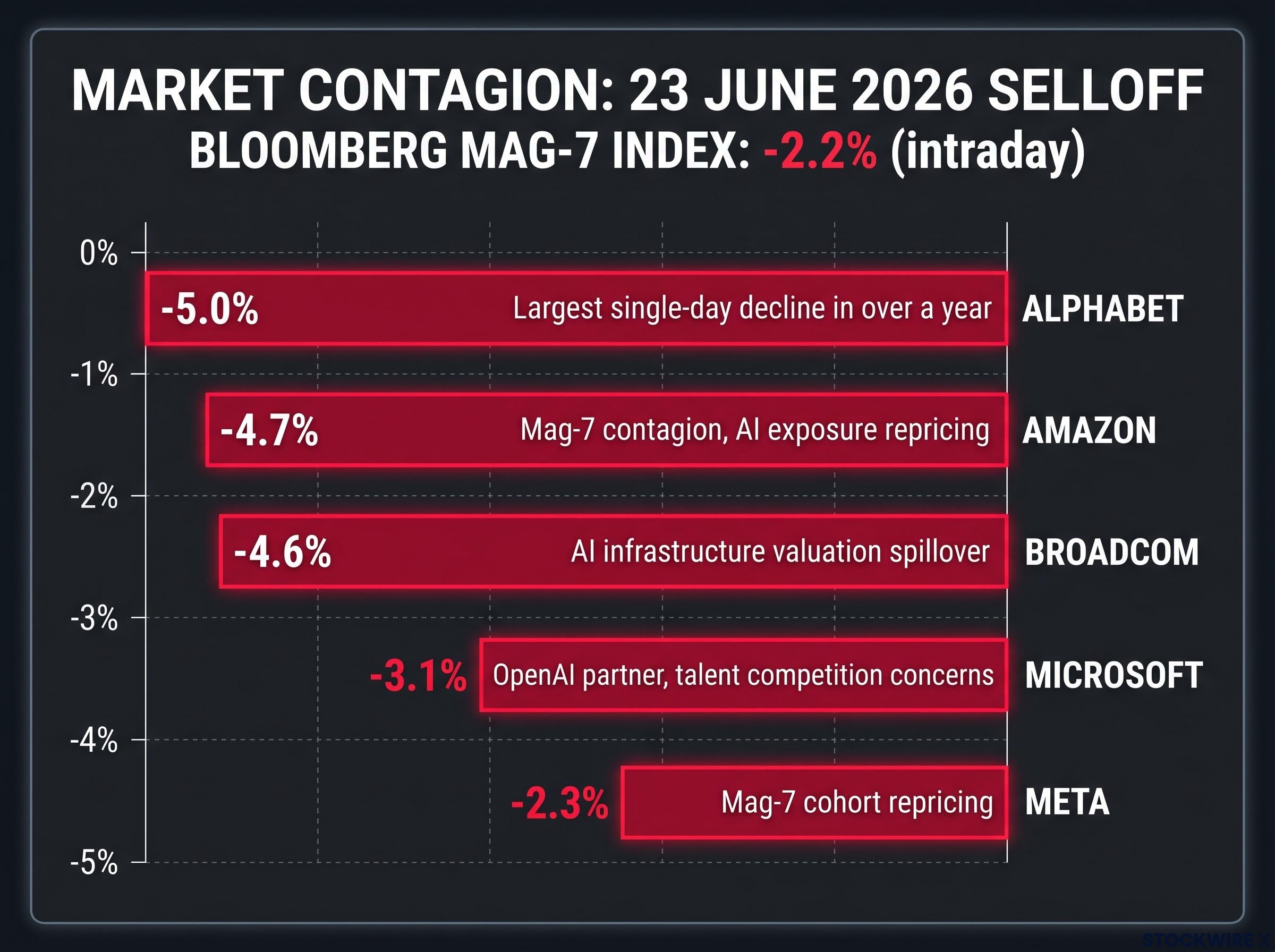
The contagion across the Magnificent 7 cohort confirmed that professional investors treated the departures as a read on AI competitive dynamics across the group, not an Alphabet-specific event.
| Company | Session Move (%) | Context |
|---|---|---|
| Alphabet | -5.0% | Largest single-day decline in over a year |
| Amazon | -4.7% | Mag-7 contagion, AI exposure repricing |
| Broadcom | -4.6% | AI infrastructure valuation spillover |
| Microsoft | -3.1% | OpenAI partner, talent competition concerns |
| Meta | -2.3% | Mag-7 cohort repricing |
The Bloomberg Mag-7 Index shed up to 2.2% during the session, its sharpest decline driven by a talent event rather than an earnings or macro catalyst.
The contagion tells you that professional investors do not view AI talent risk as an Alphabet-specific problem. They repriced the entire cohort because the exits raised questions about whether any of the incumbent large-cap AI players can hold elite researchers against the competitive pull of OpenAI and Anthropic. If you hold any of the Magnificent 7 names with AI valuations embedded in the price, this session’s contagion is worth examining closely.
Broader market on 23 June: why the Dow rose while the Nasdaq fell
The session’s full index picture reframes the story. This was large-cap tech weakness, not broad economic stress.
| Index | Close | Session Change (%) |
|---|---|---|
| S&P 500 | 7,473 | -0.37% |
| Nasdaq Composite | 26,167 | -1.32% |
| Dow Jones Industrial Average | 51,713 | +0.29% |
| Russell 2000 | 3,004 | +0.83% |
| Bloomberg Mag-7 Index | N/A | -2.2% (intraday) |
- Communication Services shed nearly 4% on the day, its worst single-session performance since the April 2025 tariff-driven selloff
- Seven of eleven S&P 500 sectors closed in positive territory
- The equal-weighted S&P 500 posted a loss of around 0.17%, beating the cap-weighted version by approximately 20 basis points, confirming that mega-cap names skewed the headline result
The Dow’s advance was substantially driven by Caterpillar, which added approximately 180 points to the index. Meanwhile, the Russell 2000’s 0.83% gain pushed its year-to-date return to close to 21% through 2026, a performance that towers over the sub-10% advance recorded by the S&P 500 across the same stretch.
The fact that small-cap equities and most of the S&P 500 held up or advanced means the market is not pricing in broad economic deterioration. It is pricing in a specific risk concentrated in large-cap AI-exposed names, a more precise and actionable signal for your portfolio than a generalised selloff would be.
Magnificent Seven concentration risk has been building independently of individual talent events, with the cohort representing approximately 34-35% of the S&P 500 by mid-2026 and the Shiller CAPE ratio at levels breached only once in recorded market history, meaning the 23 June repricing landed on an index structure that was already carrying concentrated AI-premium exposure.
Why elite AI researchers are now priced assets, and what that means for big tech valuations
The $2.7 billion Alphabet paid to bring Shazeer back through the Character.AI acquihire was not an acquisition price for a product. It was a price tag on a person. Alphabet itself had already established that an individual researcher at the frontier of AI carries a financially quantifiable value. When that researcher then leaves for a direct competitor, the loss is financially legible, not just symbolically painful.
Coverage from Reuters and CNBC framed the departures using a telling comparison.
Shazeer’s move to OpenAI was described as resembling a “high-value soccer transfer,” a framing that signals something new in how markets understand AI competition: individual frontier researchers, not just products or platforms, are now treated as primary determinants of competitive advantage.
What this means for Mag-7 valuations
Alphabet and its Magnificent 7 peers trade at multiples that embed aggressive AI expectations into current prices. Those multiples assume continued AI leadership. When two of the most visible researchers responsible for building that leadership defect to direct competitors in the same week, the probability-weighted expectation of sustained dominance shifts, and equity markets reprice accordingly.
AI premium sustainability was already the central question heading into mid-2026, with the Nasdaq 100 having surged approximately 18% from its April lows and momentum indicators pushing into overbought territory at defined resistance levels, a setup in which any credible negative signal about AI leadership could accelerate a valuation reset rather than simply trim a single name.
If the market has established that individual researcher exits are financially material events, then the standard investment lens for evaluating large-cap AI equities needs a new risk variable: talent concentration risk at the level of named individuals, not just the workforce broadly.
Buying opportunity or warning signal? How to think about Alphabet’s selloff
The bull case
- A 5% single-session decline on a stock of Alphabet’s scale and revenue diversification may represent an overreaction to a talent signal
- Alphabet retains a diversified revenue base across Search, Google Cloud, and YouTube
- DeepMind’s broader team extends well beyond two researchers, however prominent
- Alphabet has demonstrated a willingness to spend aggressively on talent retention (the $2.7 billion acquihire being the most visible example)
The bear case
- The departures are compounding signals about talent culture and competitive trajectory, not isolated events
- If Alphabet cannot retain the researchers who built Gemini and AlphaFold, the AI premium the market assigns to its pipeline deserves scrutiny
- Both OpenAI and Anthropic are positioned as direct competitors in the frontier AI space; these are not departures to academia or retirement
- The Gemini product roadmap is the most directly affected output, given Shazeer’s co-lead role
The most useful question is not whether the 5% decline will reverse. It is whether the AI expectations already priced into Alphabet’s valuation were realistic before these departures, and how much those expectations should be discounted now that two of the researchers most responsible for building them have left.
Alphabet’s valuation scenarios were already contested before 23 June, with DOJ antitrust proceedings covering search distribution and the ad tech stack running alongside AI competition from ChatGPT and Perplexity; the talent departures add a third variable to a bull-bear framework that was already carrying significant unresolved uncertainty.
This article is for informational purposes only and should not be considered financial advice. Investors should conduct their own research and consult with financial professionals before making investment decisions.
The AI talent war has a new scoreboard, and big tech is not winning every match
The two departures are evidence of a structural shift. OpenAI and Anthropic are now credibly pulling the most elite talent away from the best-resourced incumbents in the technology industry. Capital and product distribution advantages do not automatically translate into talent retention. The $2.7 billion acquihire proved that. The next phase of the AI race will likely be characterised as much by which organisations can attract and hold frontier researchers as by which ones can ship the best products, and those two capabilities are directly connected.
AI competitive dynamics at the infrastructure layer reinforce this talent-flow story: Alphabet’s own custom TPU programme, which Shazeer and his colleagues helped build, sits at the centre of a broader pattern where hyperscalers are simultaneously the largest customers and the most credible long-term challengers to each other across chip design, model training, and inference.
The Alphabet selloff and the Mag-7 contagion on 23 June are a preview of a repricing dynamic that could affect any large-cap name whose valuation embeds AI leadership expectations. The talent scoreboard is now publicly visible in a way it was not twelve months ago.
The practical implication for any investor with large-cap AI exposure is that talent flow is now a leading indicator worth tracking alongside earnings revisions and product announcements, because the researchers who leave today are building the products that will challenge your holdings in two years.
Forward-looking statements in this article are speculative and subject to change based on market developments and company performance. Past performance does not guarantee future results.
—