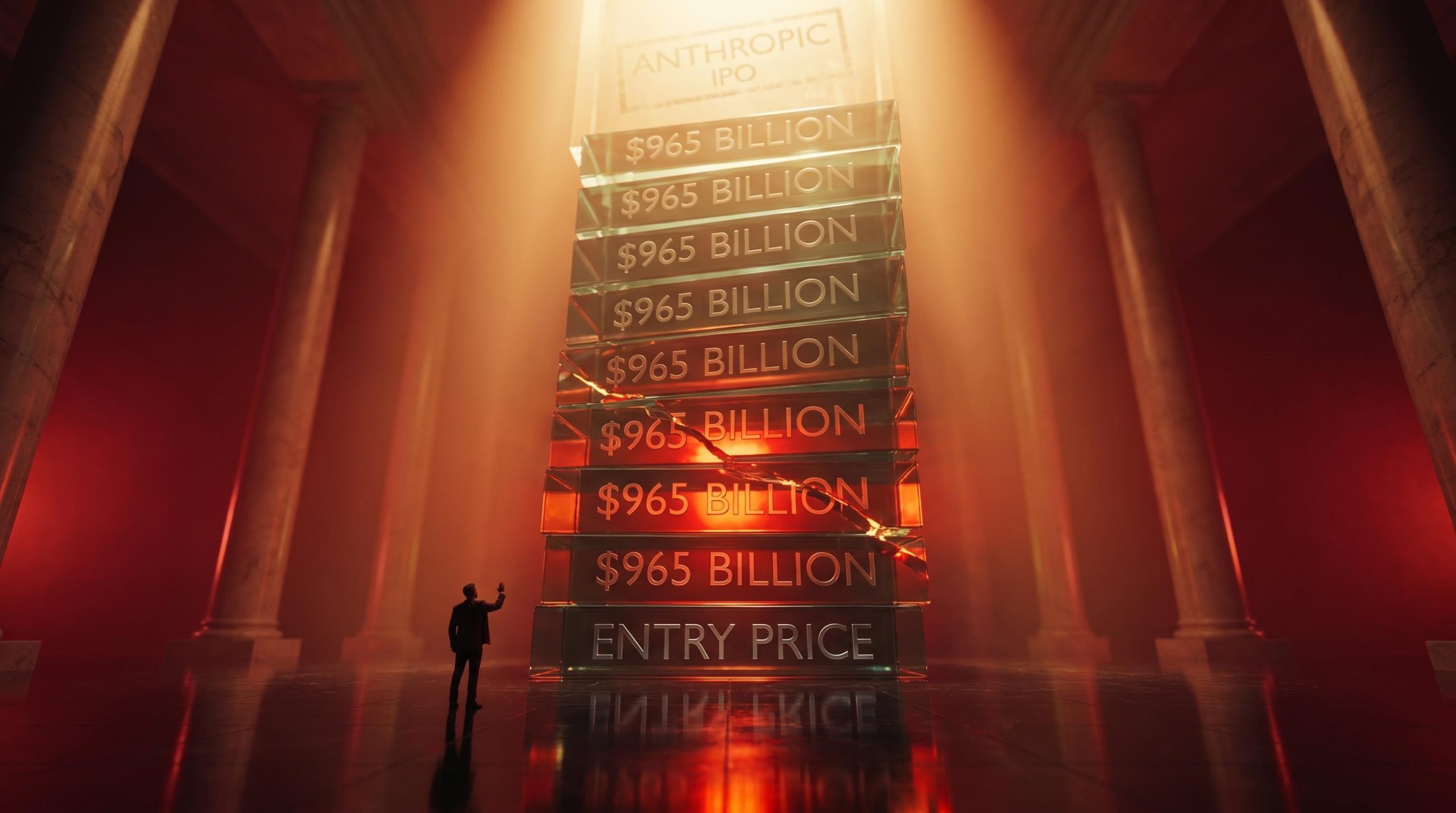
Approximately $1 trillion in committed AI capital expenditure sits against roughly $60 billion in reported revenue across the sector’s largest players. That gap is not a rounding error. It is a bill, and someone will pay it. With Anthropic filing confidentially for a U.S. IPO on 1 June 2026, less than two weeks after closing a $65 billion private round at a $965 billion post-money valuation, the question of who absorbs downside risk in AI’s public market debut has moved from theoretical to immediate. The AI valuation trap facing retail investors is not a matter of whether the technology works. It is a matter of who enters the transaction at what price, and whether the structural mechanics of the IPO process, index fund inclusion, and competitive pressure leave ordinary investors holding exposure they never explicitly chose, at valuations they cannot independently stress-test.
The IPO lifecycle is engineered to transfer risk, not share it
The mechanics of a large-scale IPO are not designed to invite public participation in upside. They are designed to convert private paper gains into realised returns. The sequence is predictable:

- Private gains accumulate. Venture and late-stage investors hold shares at cost bases dramatically lower than any price a public market buyer will encounter at listing.
- The IPO creates a liquidity event. The company lists, and a pool of willing buyers, retail investors, institutional allocations, and passive funds, absorbs shares at the IPO price or above.
- Public buyers enter at peak-implied valuations. The forward-looking assumptions required to justify the IPO price are ones the early investors were never required to meet from their entry points.
For this transfer to function, public buyers must support valuations on a forward basis that bears no resemblance to the cost basis of the sellers on the other side of the trade.
Bill Maris illustrated the scale of embedded private gains with a hypothetical example: a single fund generating $100 billion in returns from $200 million in invested capital. Those paper gains only become real when external buyers, in the public market, are willing to purchase at prices that validate them.
The longer a company stays private, the more of the growth curve is consumed before public investors arrive. What remains for IPO buyers is not the beginning of the story. It is the tail end.
The reason IPO mechanics favour insiders is not incidental to the process; it is the architecture of it, with private investors entering at cost bases that public buyers will never see, and roadshow narratives calibrated to support prices that make those early positions whole at the buyer’s expense.
When big ASX news breaks, our subscribers know first
Anthropic’s valuation arithmetic requires a lot of things to go right
Anthropic raised $65 billion in late May 2026 at a confirmed $965 billion post-money valuation. Days later, on 1 June 2026, the company filed confidentially for a U.S. IPO.
The confirmed figures alone establish the scale of the valuation ambition. The unconfirmed figures sharpen the picture further.
Anthropic has been reported as exploring an IPO at a valuation as high as $1.75-$1.8 trillion, implying a revenue multiple of approximately 38x revenue. These figures have not been independently confirmed and should be treated as reported estimates, not established facts.
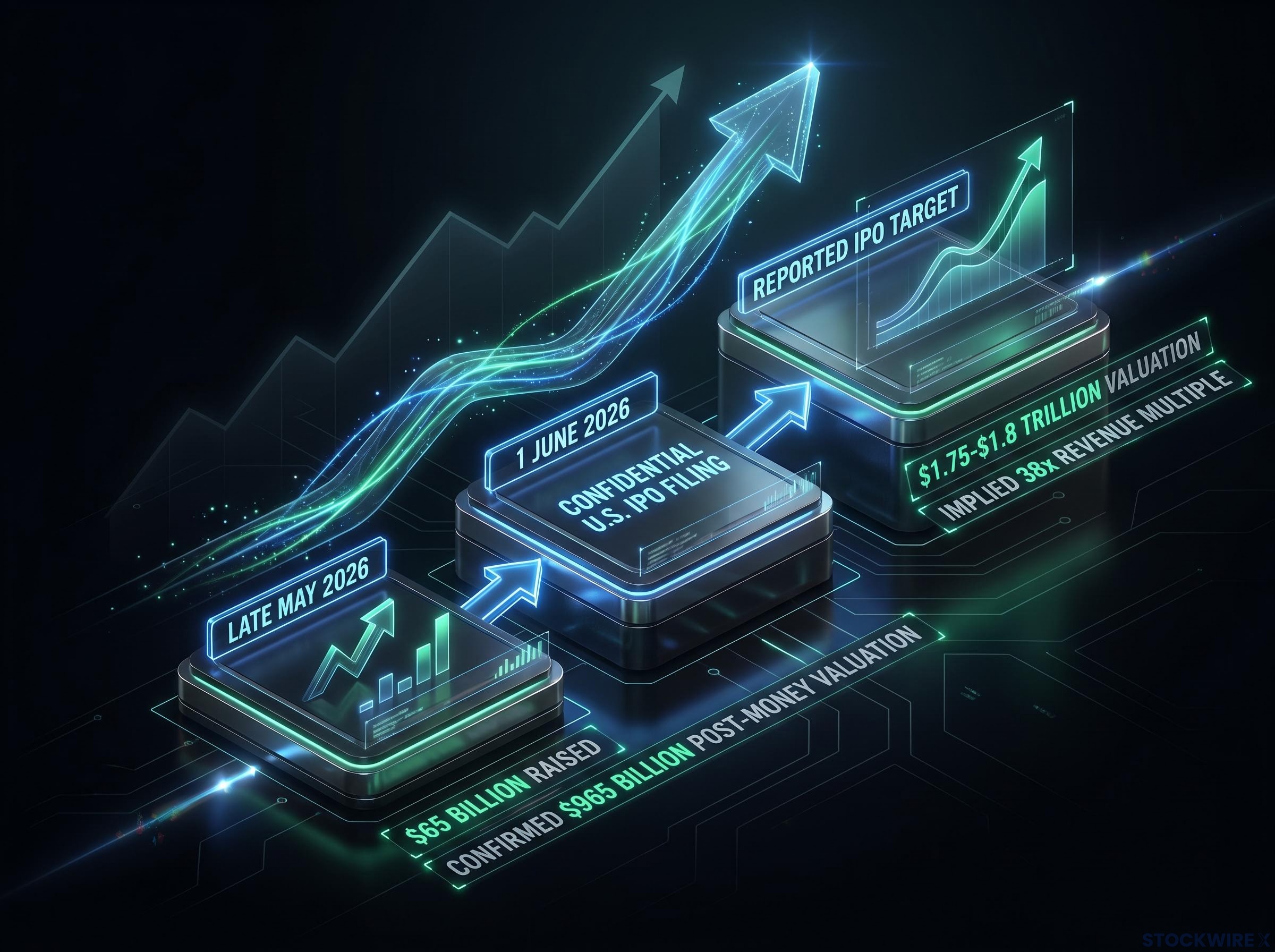
| Valuation Stage | Amount / Valuation | Status |
|---|---|---|
| Last private round (late May 2026) | $65 billion raised | Confirmed |
| Post-money valuation | $965 billion | Confirmed |
| Reported IPO target | $1.75-$1.8 trillion | Reported, not independently confirmed |
Whether the IPO prices at the confirmed private round valuation or at the higher reported target, the revenue required to justify either figure on any conventional long-term multiple framework would need to reach hundreds of billions of dollars annually. That is not impossible if AI becomes a foundational technology comparable to the internet. It is, however, a demanding assumption. Each compounding variable, adoption speed, margin durability, competitive positioning, regulatory trajectory, must land favourably. A disruption to any single input does not trim the valuation case. It undermines the structural logic holding it together.
Why your index fund might buy the IPO whether you choose to or not
The risk extends beyond investors who actively choose to participate in an AI IPO. It reaches into the retirement accounts of savers who have never selected a single AI stock.
Broad market index funds and S&P 500 ETFs are obligated to buy whatever the benchmark holds, in proportion to its weight, without valuation discretion. If a large AI company lists at a high valuation and achieves rapid index inclusion, passive capital flows mechanically into the name at whatever price prevails at the time of inclusion. The fund manager does not evaluate whether the stock looks expensive. The benchmark dictates; the fund executes.
- A company lists at a high valuation
- It achieves inclusion in a major index
- Passive funds, including retirement accounts and target-date funds, are obligated to buy
- Retail retirement holders become shareholders at IPO-era prices without having chosen the position
Bill Maris noted that exceptions to standard S&P 500 eligibility criteria are reportedly being considered for some AI companies. Standard inclusion requires a company to meet profitability thresholds, among other criteria. Any waiver for an unprofitable AI firm would represent a deliberate committee decision, not an automatic outcome.
Nasdaq fast-track index inclusion, effective from 1 May 2026, allows qualifying mega-cap companies to enter the Nasdaq-100 within 15 trading days of listing, compressing the window between IPO pricing and the point at which passive retirement capital is mechanically obligated to buy at whatever price prevails.
What index eligibility waivers would mean in practice
The distinction matters. Automatic index inclusion based on market capitalisation is mechanical. A deliberate waiver of profitability requirements is a policy choice, one that would channel billions of dollars in passive retirement capital into a company that has not yet demonstrated sustainable earnings. This is a scenario to monitor as Anthropic’s IPO process unfolds, not an established certainty.
The aggregate scale of this dynamic is considerable. According to an Investing.com survey of 938 investors, 62% of U.S. retail investors now use AI tools to inform their investment decisions. Heightened AI enthusiasm among the same population whose retirement capital could be passively directed into AI IPOs compounds the exposure in both directions: discretionary interest layered on top of structural obligation.
Google’s pricing power could make the revenue projections look fictional
The valuation arithmetic described above depends on revenue growing rapidly at durable margins. A single well-funded competitor with strategic reasons to compress those margins could collapse the entire projection.
Bill Maris outlined a speculative but structurally plausible scenario: Google could reduce token costs by approximately 80%, incentivising enterprise migration to its Gemini platform and creating severe margin compression for competing AI providers.
Maris compared this potential strategy to Uber’s historical approach of deploying investor capital as a competitive weapon to capture market share, a strategy sustainable by a company with profitable legacy businesses for far longer than a venture-backed challenger can tolerate.
The competitive positions are asymmetric:
- Google: Profitable legacy businesses generating substantial cash flow, enormous distribution through existing enterprise relationships, capacity to subsidise token pricing indefinitely as a strategic investment
- Challenger AI companies: Venture-backed, cash-burning, revenue dependent on maintaining the pricing power that an incumbent price war would specifically target
Google has not announced any such strategy. This remains a forward-looking competitive risk scenario, not a confirmed development. Yet for a retail investor considering an AI IPO priced at extreme revenue multiples, the relevant question is not whether Google will do this. It is whether the valuation leaves room for the possibility that it could. If per-token prices fall sharply, the high-margin AI services revenue embedded in the IPO valuation becomes a commodity utility, and the earnings path underpinning the multiple ceases to exist.
What retail investors often misunderstand about IPO risk and AI specifically
Not all AI exposure carries the same risk profile. The distinction between categories of AI investment is the difference between riding a proven trend and absorbing the downside of an untested one.
| Factor | Established Public AI Exposure | Pure-Play AI IPO |
|---|---|---|
| Profitability status | Profitable, with current earnings providing a valuation floor | Cash-burning, with valuation resting on projected future revenue |
| Valuation basis | Priced against current earnings and diversified revenue streams | Priced against aggressive growth projections at high revenue multiples |
| Retail buyer’s information position | Years of public filings, analyst coverage, observable earnings history | Limited public data, entering after insiders with lower cost bases and better operational knowledge |
Established semiconductor companies and mega-cap platforms with AI revenue are profitable, already incorporated into indexes at prices reflecting current earnings, and covered by years of public disclosure. Amazon and Google are among Anthropic’s strategic investors, meaning they entered at structurally different prices and with strategic motivations distinct from a retail buyer’s financial calculus.
The information asymmetry is stark. Early investors hold shares at lower cost bases, have deeper operational knowledge of the business, and retain legal counsel on optimal timing. Public market buyers have none of these advantages.
The SEC IPO disclosure requirements mandated through registration statements give public buyers their primary window into a company’s financial position, but those disclosures capture a historical snapshot at filing, not the forward revenue trajectories that justify extreme valuation multiples at listing.
The reinforcement bias problem for retail AI investors
Retail investors who profited from established public AI beneficiaries may incorrectly generalise that success to late-stage AI IPOs. The conditions are structurally different, but the narrative feels continuous. According to the Investing.com survey, 62% of U.S. retail investors now use AI tools to inform their investment decisions. When those same tools amplify pro-AI sentiment, the investors consulting them face a compounding bias: AI enthusiasm guiding investment decisions, reinforcing further AI enthusiasm, at the precise moment when independent evaluation of entry price and risk profile matters most.
Four signals that separate a credible AI IPO from a retail exit event
Diagnosis without navigation is incomplete. Four observable signals can help retail investors distinguish between an AI IPO worth evaluating and one structured primarily as an exit for early holders.
- Lockup expiration selling volume. Lockup periods typically last six months post-IPO. When insiders, early investors, and employees become eligible to sell, their behaviour reveals conviction more reliably than any roadshow presentation. Aggressive selling immediately after lockup expiration indicates the most informed holders view the IPO price as a favourable exit. Light or no selling suggests they see further upside from their cost basis.
- Revenue trajectory versus IPO-implied projections. Compare the first two quarters of public earnings against the growth rate the IPO valuation requires. If actual revenue runs below the implied trajectory, the valuation thesis is under direct pressure.
- Index inclusion timing and eligibility decisions. Watch whether index committees waive standard profitability criteria for inclusion. Early inclusion of an unprofitable AI company signals structural passive demand that supports the price mechanically, not fundamentally.
- Total AI concentration across passive and discretionary holdings. If broad index funds already provide AI exposure, adding discretionary positions in AI IPOs doubles the concentration beyond what the investor may recognise. Sizing AI exposure as a portfolio-level decision, accounting for both passive and active holdings, is a hygiene check, not an enthusiasm check.
Bill Maris specifically cited the lockup expiration window as the most informative observable signal for retail investors evaluating whether insiders view the IPO price as an exit or a hold. The roadshow is designed to sell. The lockup window is where actual beliefs become visible.
For investors wanting a structured framework for navigating the post-IPO window, our full explainer on lockup expiration timing examines historical selling patterns across marquee listings including Facebook, Uber, and Snap, and explains why the six-month window after listing has consistently produced better entry points than buying at the moment of maximum public enthusiasm.
The money has already been made. The question is who pays for it.
The AI IPO pipeline is not the beginning of the sector’s value creation for retail investors. It is closer to the distribution phase for those who participated earlier. Venture funds and late-stage investors have accumulated paper gains over years of private funding rounds. The public market is the mechanism by which those gains become real, and the public buyer is the counterparty.
AI may well prove to be a technology as consequential as the internet. That does not mean every AI company at every valuation represents a sound entry point for the buyers arriving last. The technology’s promise and the investment vehicle’s price are separate questions that deserve separate analysis.
Three concrete actions apply as Anthropic’s IPO process advances: monitor the filing and pricing details as they become public, track lockup expiration disclosures and insider selling patterns in the months following listing, and audit total AI concentration across both passive index holdings and discretionary positions before adding further exposure.
Investors who want to stress-test the current AI valuation environment against historical precedent will find our deep-dive into AI bubble frameworks, which applies the Shiller CAPE ratio at 40.11, Minsky’s financing stages, and three other analytical lenses to the question of whether the sector’s concentration and capex commitments constitute a classic speculative episode or something structurally different.
This article is for informational purposes only and should not be considered financial advice. Investors should conduct their own research and consult with financial professionals before making investment decisions. These statements regarding future valuations, revenue trajectories, and competitive scenarios are speculative and subject to change based on market developments and company performance.