U.S. Shuts AI Chip Export Loophole Used by Chinese Firms
20 hrs ago


On the same day Nvidia’s chief executive announced the company’s most significant hardware expansion in its history, the stock closed down 1.45% as the highest-volume equity on U.S. markets. Jensen Huang took the stage at COMPUTEX in Taipei on 1 June 2026 to introduce RTX Spark, a family of processors designed to place Nvidia silicon at the centre of Windows PCs for the first time. The announcement pulls in Microsoft, MediaTek, and Arm, and positions Nvidia directly against Qualcomm and Intel in a market it has never competed in as a CPU vendor. What follows covers what RTX Spark actually is, why the move into Windows PC processing matters strategically, what the co-development structure with Microsoft signals, how it reshapes the competitive map for semiconductor investors, and what the market’s muted reaction on announcement day might be telling us.
Huang’s keynote did not build to the announcement gradually. The RTX Spark processor family was presented as a finished strategic decision: Nvidia will now serve as the central processing unit in Windows-based laptops and desktops, a role it has never occupied.
Within the RTX Spark family, the N1X is the flagship chip, co-developed with Microsoft and designed by MediaTek on Arm architecture. The software layer sits on top: an AI agent platform built jointly with Microsoft’s Windows division, engineered to run AI workloads locally on the device rather than routing them through cloud infrastructure.
The core specifications announced:
For investors tracking Nvidia’s revenue trajectory, the details of who built what matter. This is not a solo Nvidia bet. It is a jointly underwritten platform play, and that distinction changes both the upside opportunity and the risk profile.
Nvidia has been inside Windows PCs for decades, but always as the accelerator, never the brain. Its discrete GPUs rendered graphics and, more recently, handled AI inference workloads. The CPU, the chip that orchestrates the entire system, belonged to Intel or, more recently, Qualcomm on Arm-based Windows machines.
RTX Spark changes that relationship entirely. Nvidia is no longer sitting alongside a third-party CPU. It is the CPU.
The functional difference is significant. A GPU accelerates specific tasks (graphics rendering, parallel computation) at the direction of a CPU. The CPU controls the system: it manages memory, runs the operating system, schedules tasks, and decides what gets sent to the GPU. Moving from the first role to the second is not a product iteration. It is a claim on a different layer of the computing stack.
Nvidia’s CPU market ambitions extend well beyond the PC segment: Jensen Huang’s May 2026 claim of a $200 billion CPU opportunity over the next decade, which drew a sharp divide between Barclays and Bernstein analysts on whether the Vera platform could realistically capture meaningful share, positions RTX Spark as the consumer-facing expression of a much broader stack-level CPU strategy.
The architectural rationale comes from the on-device AI trend. As AI agents move from cloud-processed services to locally run applications, the chip that hosts those agents captures the new value layer. Qualcomm’s Snapdragon X series had already established momentum on the Arm-on-Windows platform with this thesis. Nvidia is now contesting it directly.
RTX Spark represents the first Windows-based computers to feature Nvidia’s high-end chips as the CPU, not the accelerator.
For semiconductor investors, the distinction between a product refresh and a genuine market entry defines how to size the long-term revenue opportunity. RTX Spark is the latter, and once a company of Nvidia’s scale commits to a CPU platform with Microsoft co-development, the competitive consequences compound.
The RTX Spark announcement is not a single company’s product launch. It is a four-party platform, and each partner’s role tells investors something about how deeply the commitment runs.
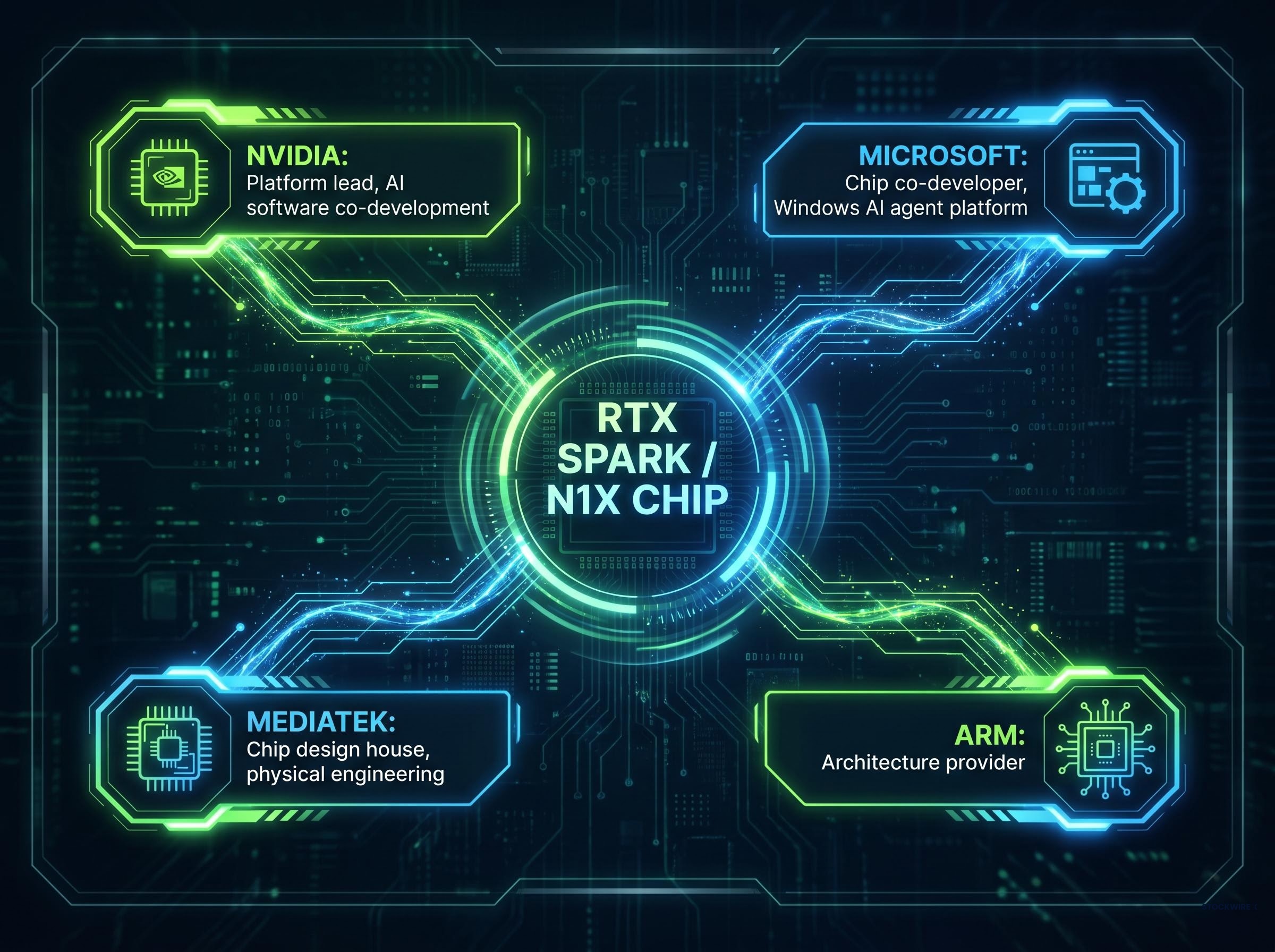
| Partner | Role | Contribution | What remains unconfirmed |
|---|---|---|---|
| Nvidia | Platform lead | RTX Spark product family direction, brand, AI software co-development | Formal partnership terms, revenue-sharing structure |
| Microsoft | Chip co-developer and software partner | N1X chip design direction, Windows AI agent platform | Named executive statements, specific Windows integration details |
| MediaTek | Chip design house | Physical chip design and engineering of the N1X | Manufacturing details, volume commitments |
| Arm | Architecture provider | Underlying instruction set architecture for the N1X | Licensing terms specific to RTX Spark |
Microsoft’s dual role matters most for the durability calculus. Redmond is not licensing Windows compatibility to an Nvidia chip after the fact. Microsoft co-developed both the silicon and the software platform. That signals RTX Spark is embedded in the Windows roadmap rather than sitting alongside it.
Confirmed gaps at the time of publication:
The market is currently pricing a platform promise. The shipping product has not arrived.
Arm’s supply constraints at TSMC represent a background variable for the RTX Spark timeline that no confirmed disclosure has yet addressed: Arm’s own AGI CPU attracted more than $2 billion in forward hyperscaler demand against confirmed supply of only roughly half that figure, a bottleneck that affects every chip programme running on Arm architecture including the N1X.
Nvidia’s CPU entry does not land in empty territory. Two incumbents already occupy the ground RTX Spark is claiming, and the market’s reaction on 1 June 2026 offered its own preliminary verdict on who stands to lose most.
Intel closed down 5.14% on the day, with trading volume of approximately 191.68 million shares. The decline is contextually notable given Intel’s position as the dominant Windows PC CPU vendor, though no sourced analysis directly linking the sell-off to the RTX Spark announcement was available at the time of publication.
Qualcomm’s Snapdragon X Elite represents the more direct competitive overlap. It is already an Arm-based Windows PC processor with AI acceleration capabilities, the same architectural thesis RTX Spark now pursues with Nvidia branding and Microsoft co-development behind it.
| Vendor | Product | Architecture | AI acceleration approach | Windows PC position |
|---|---|---|---|---|
| Nvidia | RTX Spark / N1X | Arm (via MediaTek design) | On-device AI agent platform (co-built with Microsoft) | New entrant; first CPU role |
| Qualcomm | Snapdragon X Elite | Arm (custom cores) | Integrated neural processing unit | Incumbent Arm-on-Windows platform |
| Intel | Core Ultra | x86 (with integrated AI accelerators) | Integrated neural processing unit | Dominant incumbent CPU vendor |
No independent benchmarking data comparing these three platforms was available at the time of publication. Performance claims remain unverified until RTX Spark devices ship and third-party testing begins.
Server CPU market projections from Bank of America place the total addressable market at $125 billion by 2030 with a 31% CAGR, and the same research that named AMD and Nvidia as top beneficiaries flagged ARM-based custom silicon reaching 37% of that market by 2030, the same architectural platform RTX Spark occupies, suggesting the PC CPU entry and the data centre CPU ambition share a common long-term thesis.
A company at peak relevance, announcing a historic category expansion, closed down on its own announcement day. The contradiction is worth sitting with.
Nvidia traded approximately 289.41 million shares on 1 June 2026, the highest volume of any U.S. equity that session.
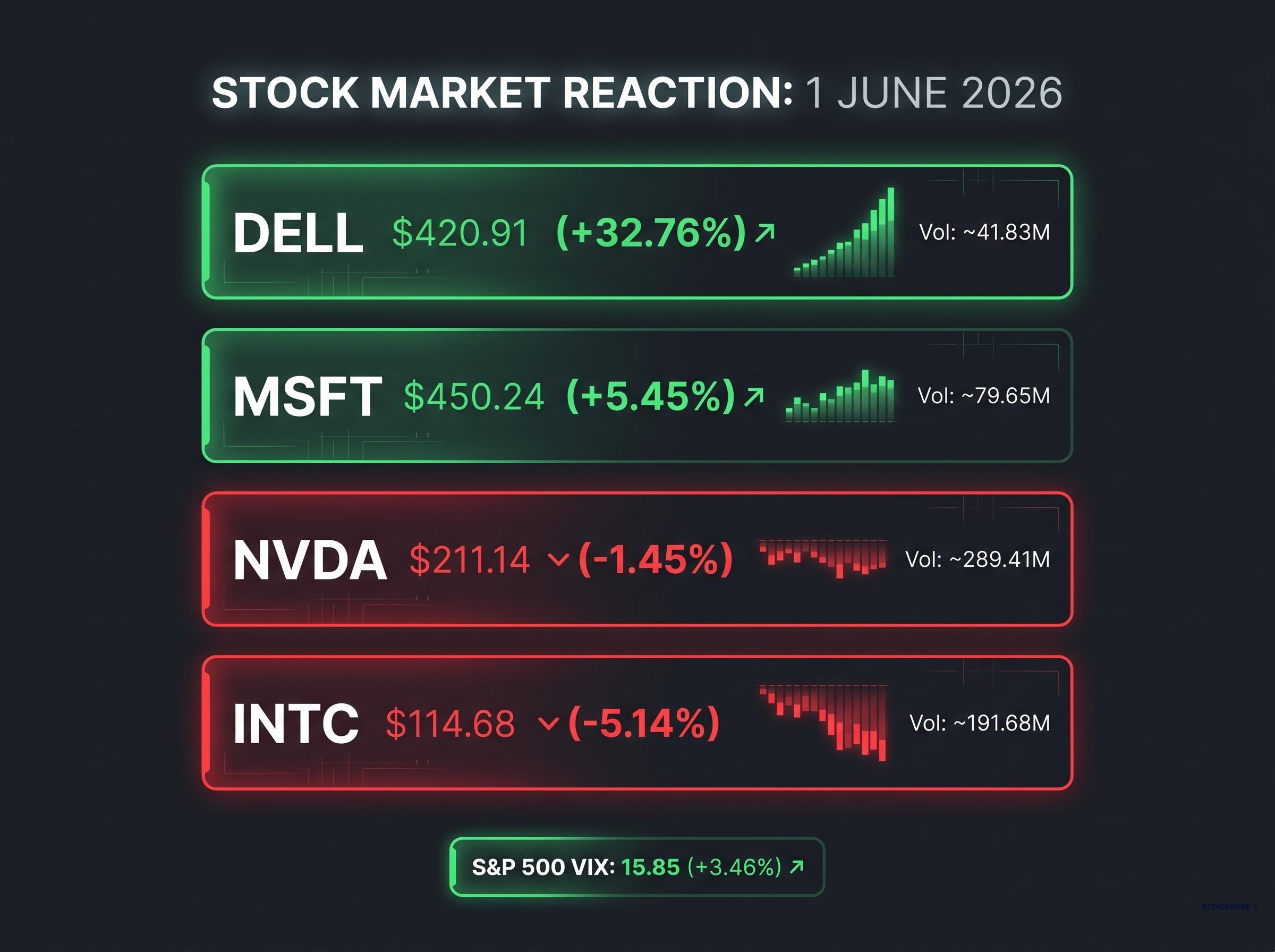
That volume figure means the market was not ignoring the news. It was processing it at scale and, on balance, selling into the announcement. The question is why.
Elevated expectations compressing upside is not a new dynamic for Nvidia: when the company reported record Q1 FY2027 revenue of $81.6 billion and guided Q2 to $91 billion, beating consensus by more than $4 billion, shares still slipped after hours, demonstrating that the options market had already priced in the historic beat and leaving no incremental catalyst for buyers to act on.
| Ticker | Close price | Change (%) | Volume | Context |
|---|---|---|---|---|
| NVDA | $211.14 | −1.45% | ~289.41M shares | RTX Spark announcement; highest U.S. volume |
| MSFT | $450.24 | +5.45% | ~79.65M shares | Co-developer of N1X and Windows AI platform |
| INTC | $114.68 | −5.14% | ~191.68M shares | Incumbent PC CPU vendor |
| DELL | $420.91 | +32.76% | ~41.83M shares | Upgraded annual guidance |
Several possible investor-logic explanations fit the data. Expectations for Nvidia had been elevated heading into COMPUTEX, and a “sell the news” dynamic is consistent with a stock that had already priced in a major announcement. Execution risk in an unfamiliar market, the PC CPU segment where Nvidia has no track record, could have tempered enthusiasm. The absence of confirmed OEM partners, pricing, and availability timelines left the announcement without the commercial specificity that would convert a platform promise into a revenue forecast.
Dell’s 32.76% single-session gain on upgraded guidance, on the same day, illustrates that the broader technology market was not uniformly risk-off. The S&P 500 VIX closed at 15.85, up 3.46%, reflecting only modestly elevated uncertainty. No named analyst commentary linking Nvidia’s decline specifically to the RTX Spark announcement was available at the time of publication.
The paradox is the point. A 1.45% decline on record volume is not a verdict. It is a market waiting for the next piece of evidence.
RTX Spark is a platform commitment from four of the most consequential companies in computing. It is also, as of today, a platform without a confirmed shipping date, a named hardware partner, or a retail price.
The market’s day-one pricing reflects that gap. Microsoft gained 5.45% and Dell surged 32.76% on the same session that Nvidia closed down 1.45%. The hardware ecosystem around RTX Spark may reward partners before it rewards Nvidia itself.
Three threads will determine whether the announcement converts into a revenue story:
Investors who act on announcement-day sentiment without tracking these follow-on confirmations risk mispricing a platform story that may take 12-18 months to resolve into revenue. The announcement landed today. The investment thesis has not finished forming.
This article is for informational purposes only and should not be considered financial advice. Investors should conduct their own research and consult with financial professionals before making investment decisions.
These statements are speculative and subject to change based on market developments and company performance. Past performance does not guarantee future results.
Nvidia RTX Spark is a new processor family that positions Nvidia as a central processing unit (CPU) inside Windows PCs, a role it has never held before. Unlike Nvidia's discrete GPUs, which accelerate specific tasks at a CPU's direction, the RTX Spark N1X chip controls the entire system, representing a move into a different layer of the computing stack.
The N1X chip was co-developed with Microsoft's Windows division and physically designed by MediaTek on Arm architecture, making RTX Spark a four-party platform rather than a solo Nvidia product. Microsoft's involvement extends to both silicon design direction and the Windows AI agent software platform built to run on the chip.
Nvidia closed down 1.45% on 1 June 2026 despite the historic announcement, with analysts pointing to elevated pre-event expectations, a classic sell-the-news dynamic, and the absence of confirmed OEM partners, pricing, or shipping timelines. The 289.41 million shares traded that session indicate the market was actively processing the news rather than ignoring it.
Both RTX Spark and Qualcomm's Snapdragon X Elite are Arm-based Windows PC processors designed to run AI workloads locally on the device, making them direct architectural rivals. Qualcomm is the incumbent Arm-on-Windows platform with established OEM momentum, while Nvidia enters as a new CPU vendor backed by Microsoft co-development but without yet-named hardware partners or confirmed benchmarks.
Investors should watch for OEM partner announcements confirming which PC manufacturers will ship RTX Spark devices, independent performance benchmarks comparing the N1X against Snapdragon X Elite and Intel Core Ultra, and the depth of Microsoft's ongoing Windows AI agent integration. Analyst price target revisions following COMPUTEX will also signal how institutional investors are repositioning around the announcement.