
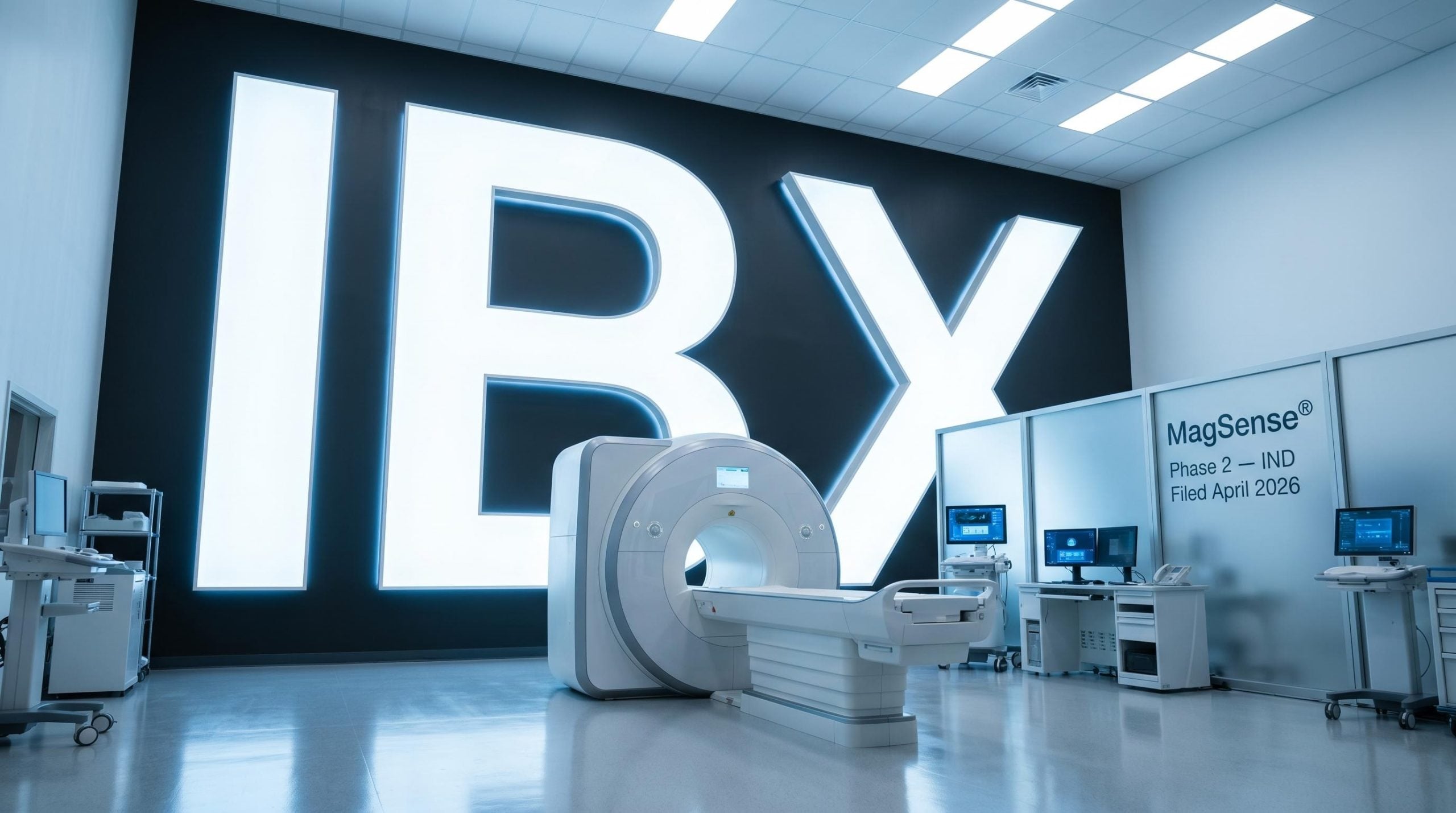
A new way to see cancer: Imagion Biosystems presents its MagSense® molecular MRI platform
In its 2026 investor presentation, Imagion Biosystems (ASX: IBX) outlined its strategy to commercialise MagSense®, described as a first-of-its-kind class of molecularly targeted imaging agents for early cancer detection, without the use of radioactivity. The clinical-stage company is targeting a $100 billion global cancer diagnostics market at a time when over 50% of cancers are diagnosed at late stage, a point at which survival outcomes deteriorate sharply.
The survival rate disparity between early and late-stage diagnosis underpins the entire investment thesis:
| Cancer Type | 5-Year Survival Rate (Early) | 5-Year Survival Rate (Late) |
|---|---|---|
| Breast Cancer | 99% | 24% |
| Prostate Cancer | 100% | 28% |
| Ovarian Cancer | 92% | 27% |
| Lung Cancer | 54% | 4% |
These figures, drawn from the presentation, illustrate why earlier, more accurate detection is not merely a clinical ambition but a commercial imperative.
When big ASX news breaks, our subscribers know first
What is MagSense® and why does it matter?
MagSense® is IBX’s proprietary molecular MRI imaging agent, designed to bind selectively to specific cancer cells when administered to a patient. Unlike conventional contrast agents, it aims to provide molecular confirmation of cancer rather than a non-specific enhancement that highlights both benign and malignant tissue. The result, as the presentation outlines, is a platform intended to support earlier and more definitive diagnoses.
How MagSense® works
The agent is built from four integrated components:
- A superparamagnetic iron oxide nanoparticle core (SPIONs), providing the magnetic contrast signal
- A biocompatible protective polymer coating to improve bioavailability and stability
- A PEG stealth coating to minimise non-specific binding
- Targeting moieties, being antibodies specific to the target cancer type, which direct the agent to bind only to targeted tumour cells
Critically, the platform’s architecture means that changing the targeting molecule allows MagSense® to be applied across multiple cancer types. This modularity is central to IBX’s pipeline strategy spanning HER2+ breast cancer, prostate cancer, and ovarian cancer.
Why MagSense® is different from current imaging
The presentation positions MagSense® molecular MRI against the two dominant existing modalities:
| Modality | Key Advantage | Key Limitation |
|---|---|---|
| Gadolinium-based contrast MRI | High resolution imaging | Not molecularly targeted; enhances both benign and malignant lesions, increasing false positive risk |
| PET | High sensitivity; can be molecularly targeted | Uses radioactivity; poor resolution; tracer half-life limits utility |
| MagSense® mMRI | Molecularly targeted; no radioactivity; compatible with 50,000+ MRI scanners globally | Still in clinical development; regulatory approval pending |
The absence of radioactivity is a recurring point throughout the presentation. IBX argues this may improve patient safety and tolerability while also simplifying manufacturing and distribution logistics, since no radioactive isotopes are required.
Phase 1 success and the path to Phase 2
Phase 1: all endpoints met
IBX reported that its Phase 1 trial met all endpoints, as confirmed in the ASX release of 18 October 2023. The trial was conducted in 13 patients with HER2+ breast cancer. The imaging agent was generally safe and well tolerated across all participants, and a blinded review by an independent expert panel of radiologists corroborated a detectable magnetic signature.
The data indicated that MagSense® aided in two clinically meaningful outcomes:
- Identification and discrimination of tumour-containing axillary lymph nodes from normal lymph nodes
- The potential to reduce the need for Sentinel Lymph Node Biopsy and Axillary Lymph Node Dissection
These results formed the basis for advancing to Phase 2, with the lead indication remaining HER2+ breast cancer.
Phase 2 trial design and timeline
The Phase 2 study is structured across three sequential parts:
- Part A (N=3–10): Pharmacokinetics and further safety profile, anticipated approximately 3–6 months
- Part B (N=10–20): Imaging schedule optimisation to establish effective lowest dose and post-dose imaging schedule, anticipated approximately 6 months
- Part C (N=40): Diagnostic performance compared to standard of care, anticipated approximately 12 months
The Investigational New Drug (IND) application was submitted to the US FDA in April 2026, with Phase 2 commencement anticipated following FDA IND acceptance in Q2 2026.
Market opportunity, investment case, and next steps
A $100 billion market and growing
The global cancer diagnostics market is presented at $100 billion, growing at a 7% CAGR. IBX’s three lead indications represent substantial sub-markets within this figure:
- Breast cancer diagnostics: $20.1 billion
- Prostate cancer diagnostics: $9.6 billion
- Ovarian cancer diagnostics: $7.2 billion
The population burden reinforces the commercial scale. Approximately 316,950 women were diagnosed with invasive breast cancer in the US in 2025. More than 1 million prostate biopsies are performed annually in the US alone. Globally, more than 300,000 women per year are diagnosed with ovarian cancer. IBX’s presentation identifies a US$2.1 billion target market for its lead indications.
Why the investment case holds
Management presented three pillars underpinning the investment rationale:
- Large markets with unmet medical need: Molecular imaging has to date been limited to methods using radioactivity, with MRI lacking the specificity to target cancer cells
- Reduced technical risk: Contrast media products historically achieve near-100% regulatory approval rates; Phase 1 safety and detectability data are established
- Upside leverage: Platform technology with theranostics and AI potential, supported by a strategic partnering commercialisation model
The presentation also cited comparable peer transactions as reference points for potential strategic value:
| Acquirer | Target | Value (AUD) | Year | Notes |
|---|---|---|---|---|
| Lilly | ARMO Biosciences | $1.6B | 2018 | Immuno-oncology agent; acquired following successful Phase 3 |
| Novartis | Endocyte | $3.9B | 2018 | Acquired in Phase 3, pending FDA clearance; radioligand therapy |
| Lantheus | Progenics Pharmaceuticals | $310M | 2024 | $35M upfront; magnetic tissue localisation prior to breast cancer surgery |
| Hologic | Endomag | ~$328M | 2019 | All-stock acquisition plus milestone payments; estimated market cap at transaction date |
Key milestones ahead
The presentation outlined four next steps in IBX’s clinical development strategy:
- IND filed with the US FDA — April 2026
- Initiate Phase 2 HER2+ breast cancer study following IND acceptance, anticipated Q2 2026
- Complete IND-enabling studies for ovarian and prostate cancer
- Enter the clinical phase for secondary indications
Company snapshot
Note: The cash balance and market capitalisation figures below are drawn from different reference dates and should not be read as contemporaneous.
Cash balance: A$1.85M (as at 31 December 2025)
Market capitalisation: A$7.36M (as at 22 May 2026)
Share price: A$0.015 (as at 22 May 2026)
Shares on issue: 490,590,239
Don’t Miss the Next Healthcare Breakthrough on the ASX
Big News Blast delivers FREE breaking ASX healthcare news directly to your inbox within minutes of release, complete with in-depth analysis. Join 20,000+ investors who stay ahead of the market the moment announcements drop. Click the “Free Alerts” button at StockWire X to start receiving alerts today.