
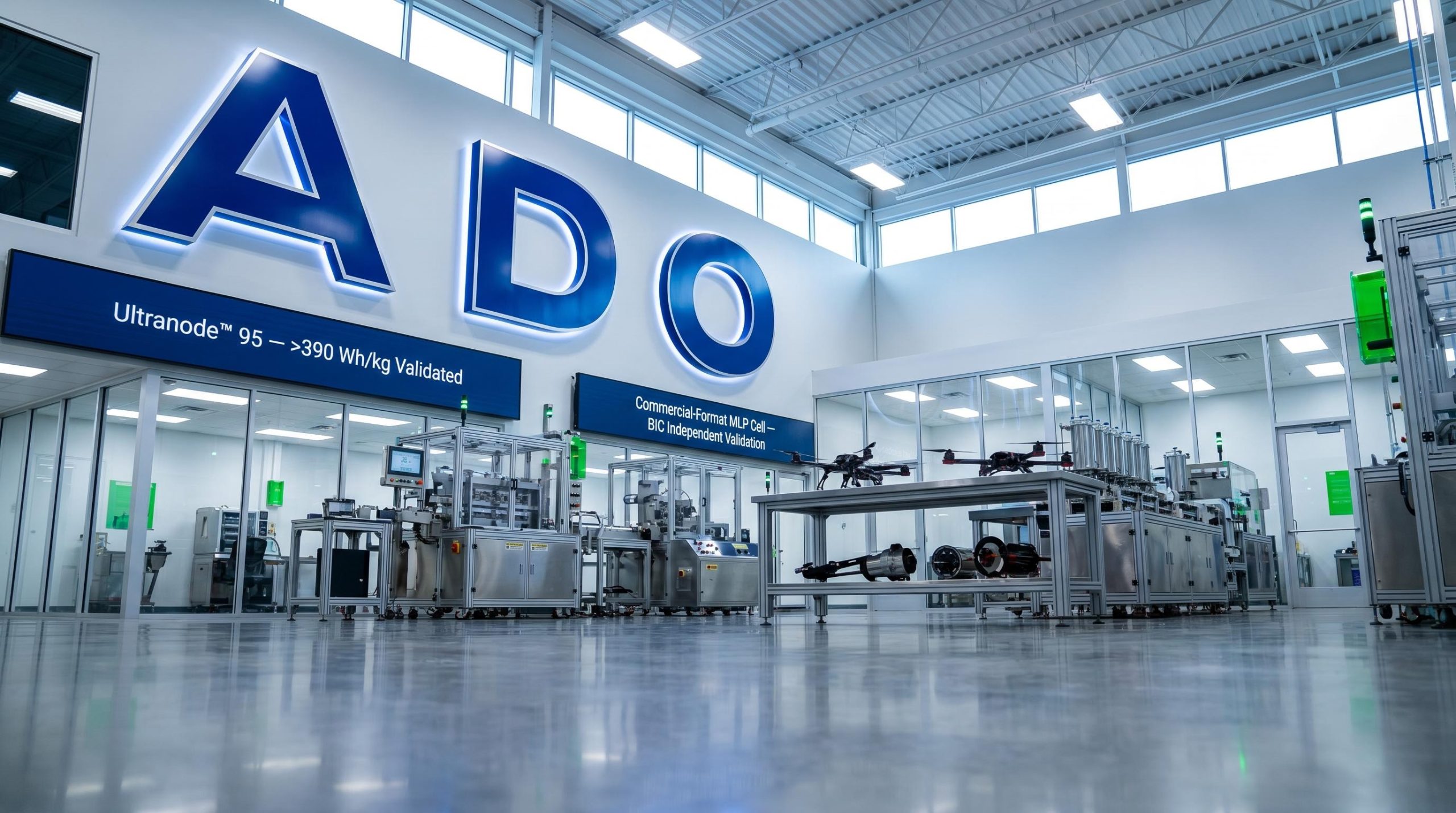
Ultranode 95 clears commercial-format validation as drone battery race intensifies
AnteoTech Limited (ASX: ADO) has completed independent third-party validation of its AnteoTech Ultranode 95 drone battery technology in 5 Ah Multi-Layer Pouch (MLP) commercial-format cells at the Battery Innovation Centre (BIC) in Indiana, USA. The milestone follows earlier coin cell and Single Layer Pouch (SLP) validations at BIC in March 2026, completing a sequential scale-up journey that has now reached commercial cell formats. The MLP configuration is capable of enabling >390 Wh/kg at battery cell level, representing more than 40% higher specific energy density than traditional graphite anodes. Notably, BIC described Ultranode™ 95 as “one of the most straightforward scale-up efforts observed by BIC,” an independent endorsement with direct implications for the drone, UAV, and defence battery markets.
Merrill Gray, Managing Director and Chief Executive Officer, AnteoTech
“The successful independent third-party validation of Ultranode™ 95 in a commercial-format Multi-Layer Pouch cell is an important milestone in our scale-up and commercialisation pathway.”
When big ASX news breaks, our subscribers know first
What the BIC results actually mean — and why they matter
Breaking down the test results
A 5 Ah MLP cell is a flat, layered battery format where multiple electrode sheets are stacked to build up capacity. To put the 5 Ah figure in context, it is comparable to the battery capacity of Apple’s iPhone 17 Pro Max (5.088 Ah), making it a commercially meaningful cell size rather than a laboratory curiosity.
Specific energy, expressed in watt-hours per kilogram (Wh/kg), measures how much energy a battery stores relative to its weight. For any weight-sensitive application such as a drone, this is the defining performance metric.
BIC’s independent testing achieved more than 300 cycles at 70% capacity retention, exceeding the 200-cycle target performance threshold for many defence drone applications. The first silicon active material discharge capacity recorded was 1,966 mAh/g (utilised Si capacity), with a first discharge coating capacity of 1,729 mAh/g.
BIC itself is an independent, not-for-profit organisation with more than 500 customers and 12 years of operation. Critically, it holds no equity position in AnteoTech, meaning its validation carries no commercial bias.
How Ultranode 95 stacks up against rivals
The table below compares the estimated energy-density potential of Ultranode™ 95 against competing anode chemistries, paired with a nickel-rich NMC cathode in large-format pouch cells.
| Cell Type | Specific Active Material Capacity (mAh/g) | Estimated Cell Capacity (Wh/kg) | Example Source |
|---|---|---|---|
| Silicon (theoretical) | 3,600 | 450 Wh/kg | Literature |
| Ultranode™ 95 (elemental micro-silicon) | 2,000–2,500 | >390 to <450 Wh/kg | AnteoTech |
| Silicon-carbon composite | 1,600–2,000 | 335 Wh/kg | Group 14, Sila |
| Graphite, high quality | 370 | 300 Wh/kg* | BTR |
Note: Figures represent modelled and idealised cell configurations. Commercial graphite cells, including Tesla 4680-type cells, typically achieve approximately 270 Wh/kg.
Beyond performance, Ultranode™ 95 carries a material cost advantage. The technology uses low-cost micro-silicon priced at US$10–US$25/kg, compared to silane-derived silicon-carbon composite alternatives, and can achieve a $/Wh anode cost metric up to 85–95% lower than the most expensive Western Si/C materials. These figures are based on active material costs only and do not represent full cell production costs.
A market built for exactly this technology
The global drone battery market was valued at US$8.07 billion and is forecast to grow at a compound annual growth rate of approximately 18%, reaching roughly US$42 billion by 2034. The United States is expected to account for approximately one-third of total global demand over that period.
Two geopolitical programmes are driving near-term demand. The US SkyFoundry Act of 2025, already enacted into law via the National Defence Authorization Act, targets domestic drone production of one million units annually. Separately, the European Union announced the European Drone Defence Initiative in October 2025, a continental drone defence programme designed to protect against foreign threats. Both initiatives share a direct requirement for advanced, lightweight battery technology capable of extending drone flight time and operational range.
The supply chain position of Ultranode™ 95 is a further strategic differentiator. Qualified micro-silicon suppliers maintain industrial-scale production capacity in the hundreds to thousands of tonnes annually, providing access to sovereign, low-cost silicon active materials rather than reliance on imported silane-derived composites. In a defence procurement context, that supply chain independence carries considerable weight.
A secondary addressable market adds further optionality. The portable and wearable defence battery systems market, covering soldier-worn systems and portable communications equipment, is projected to reach US$10.3 billion by 2030.
The three competitive advantages of Ultranode™ 95 are:
- Superior energy density (>390 Wh/kg, 2,000–2,500 mAh/g anode coating capacity)
- Supply chain security using readily available micro-silicon from multiple global sources
- Longer cycle life exceeding defence drone thresholds (300+ cycles at 70% capacity retention)
What’s next — cylindrical cells and customer pipeline
Following the positive MLP results, production of 18650 cylindrical cells incorporating Ultranode™ 95 has commenced at BIC, marking the next format milestone in the scale-up programme.
Battery Innovation Centre
“Based on the positive electrochemical and manufacturing results achieved thus far, BIC is confident in progressing to cylindrical cell builds, and work in this area is currently underway.”
The commercial pipeline is advancing across several concurrent workstreams:
- Multiple potential customers have received Ultranode™ 95 for internal evaluation, with positive feedback received to date.
- Additional roll-to-roll (R2R) Ultranode™ 95 samples produced at BIC are undergoing QA/QC assessment prior to dispatch to two USA-based drone battery manufacturers.
- Dispatch of the R2R samples establishes the agreed basis for advancing Joint Development Agreement (JDA) discussions with those two US-based companies.
- Discussions are underway with Australian companies supplying drones, drone-related systems, and UAV into the Australian defence sector regarding a future cell evaluation programme.
Merrill Gray, Managing Director and Chief Executive Officer, AnteoTech
“We are also excited to be engaging with Australian drone and battery ecosystem participants regarding potential future testing and integration opportunities involving Ultranode™ 95 cylindrical cells, based on highly positive BIC test results.”
With coin cell, SLP, and MLP validation now complete and cylindrical cell production underway, Ultranode™ 95 is moving from independent laboratory validation into active commercial engagement, its scale-up pathway de-risked by credible, unbiased third-party data.
Don’t Miss the Next ASX Tech Breakthrough
Big News Blast delivers FREE breaking ASX announcements straight to your inbox within minutes of release, complete with in-depth analysis already done for you. Join 20,000+ subscribers who stay ahead of the market on ASX tech, defence, and innovation stocks. Click the “Free Alerts” button at StockWire X to get started today.