
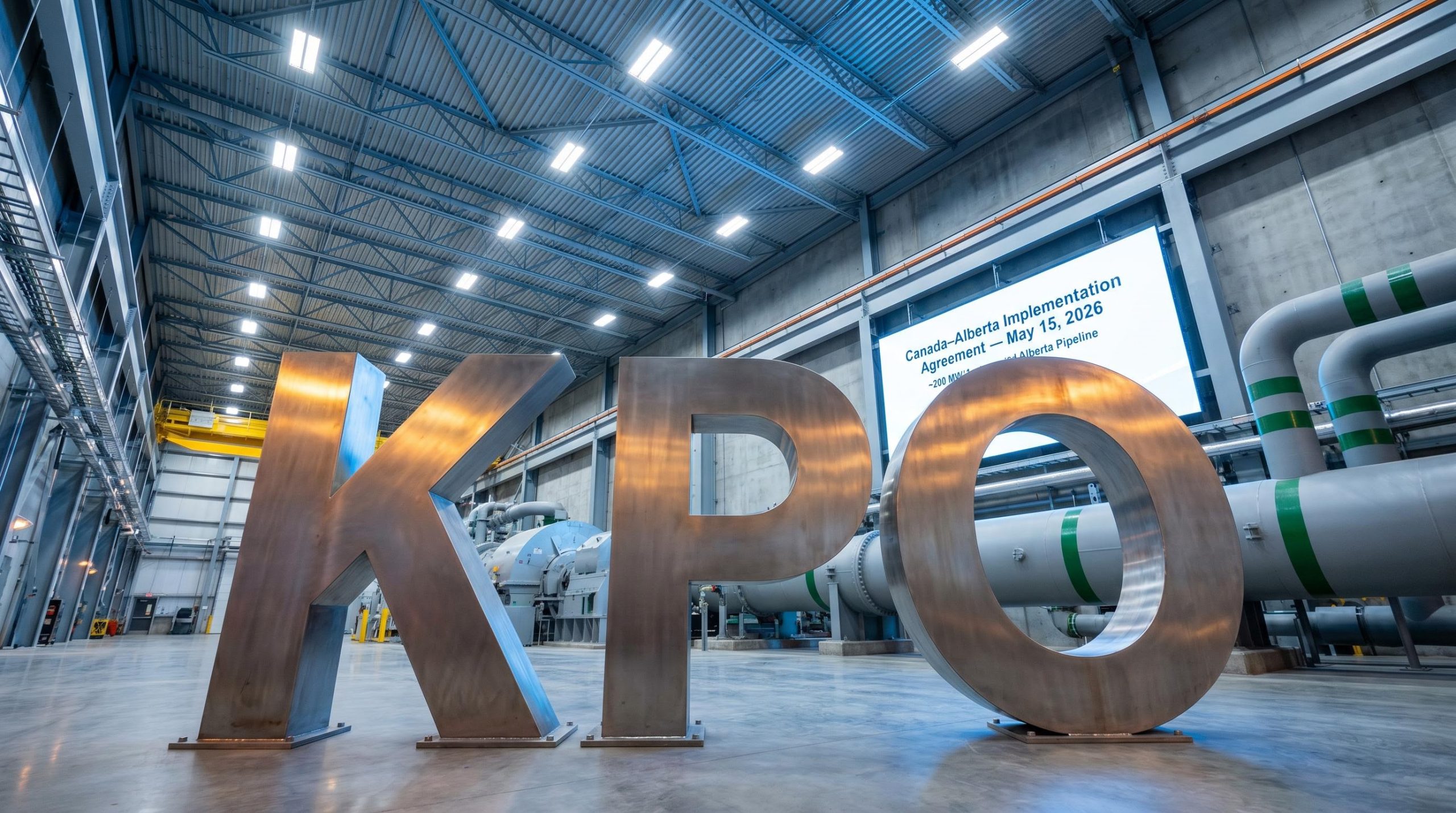
Canada and Alberta sign Implementation Agreement, clearing path for KALiNA’s ~200 MW pipeline
On 15 May 2026, Prime Minister Mark Carney and Premier Danielle Smith signed a formal Implementation Agreement, codifying the regulatory framework first signalled in a November 2025 Memorandum of Understanding (MOU) between Canada and Alberta. KALiNA Power (ASX: KPO), through its 100%-owned subsidiary KALiNA Distributed Power (KDP), holds a ~200 MW pipeline of Alberta projects positioned to benefit directly from the new framework. The agreement represents a regulatory catalyst the company had been tracking, now formally delivered.
When big ASX news breaks, our subscribers know first
What the Implementation Agreement means and why it matters for KPO
The regulatory shift explained
Canada’s Clean Electricity Regulations (CER) previously required gas-fired generators to physically abate emissions by 2035. Under the Implementation Agreement, the CER has been placed “in abeyance” for Alberta, meaning the deadline is conditionally suspended rather than permanently removed.
Critically, gas-fired generators now have the choice, not the requirement, to deploy Carbon Capture and Sequestration (CCS). Projects may connect to the grid by paying a prescribed carbon tax instead, increasing flexibility in gas-fired generation configuration and operations. Alberta’s Technology Innovation and Emissions Reduction (TIER) system will administer the new emissions compliance framework.
The carbon pricing framework at a glance
The Agreement establishes a transparent schedule of emissions compliance costs and CO2 credit floor prices designed to minimise volatility and support project financing.
| Year | Emissions Compliance Cost (CA$/tonne) | CO2 Credit Floor Price (CA$/tonne) | Notes |
|---|---|---|---|
| 2027–2029 | CA$100 | — | Locked rate for three years |
| 2030 | CA$115 | CA$60 | Floor price introduced |
| 2040 | CA$140 | CA$110 | Long-term trajectory |
The CCS incentive stack
For developers choosing to deploy CCS, the Agreement includes a suite of financial support mechanisms:
- Carbon Contracts for Difference (CCfDs) guarantee a fixed minimum carbon credit price, de-risking large-scale CCS investments and supporting project financing
- 75 million tonnes of CCfDs committed to CCS projects deployed between 2030 and 2040
- Canada Growth Fund to set aside CA$70 billion for carbon credit support
- Increased underlying market value for CO2 sequestration offsets
KDP’s strategic position inside the new framework
All of KDP’s ~200 MW of project sites have access to CCS infrastructure, meaning the company is not required to retrofit. This preserves a dual-path optionality: KDP can proceed with or without CCS depending on offtaker priorities, whether that means speed to market or long-term cost effectiveness.
The Alberta Electric System Operator’s (AESO) “tethering” rule adds another dimension to KDP’s positioning. Under the rule, data centres of 75 MW or greater seeking grid access must contractually pair with equivalent new power generation on effectively a 1:1 MW basis. This structurally increases KDP’s potential to become an attractive partner for data centre developers seeking grid connection in Alberta. The AESO’s Large Load Application Process is expected to be published by the end of May 2026, representing an imminent near-term catalyst for the company.
KALiNA Managing Director Ross MacLachlan offered the following commentary on the Agreement:
Ross MacLachlan, Managing Director
“This Agreement represents an important regulatory catalyst that we have been waiting for… the impact of which may serve to align Federal regulations with Alberta’s publicly stated objective to attract over $100 billion of data centre investment and position the province as North America’s premier destination for Artificial Intelligence and Data Centres infrastructure.”
A convergence of regulatory tailwinds
The Implementation Agreement does not sit in isolation. It is one of four concurrent regulatory developments that together shape a materially more supportive environment for KDP’s pipeline:
- Canada–Alberta Implementation Agreement signed 15 May 2026: formalises the carbon and emissions compliance framework, places the CER in abeyance for Alberta, and establishes transparent carbon pricing through to 2040
- Canada’s National Electricity Strategy (“Powering Canada Strong”), announced 14 May 2026: a federal plan to double the country’s grid capacity by 2050 to serve surging demand from AI data centres, electric vehicles, and industrial reshoring
- Alberta’s comprehensive data centre policy framework: to be implemented on or before 1 July 2026, including incentives for Canadian sovereign computing, emerging from the joint federal-provincial MOU and Alberta’s previously announced Artificial Intelligence Data Centres Strategy
- AESO Large Load Application Process: criteria for 75 MW+ load applications expected to be published in late May 2026, mandating 1:1 MW tethering arrangements between large loads and new power generation
The convergence of these developments creates a regulatory environment in which KDP’s pipeline, already site-located with CCS access and designed for large-load partnerships, is structurally well-positioned to capitalise on Alberta’s emerging role as a destination for large-scale data centre and AI infrastructure investment.
Don’t Miss the Next ASX Energy and Utilities Winner
Big News Blast delivers FREE breaking ASX news straight to your inbox within minutes of release, complete with in-depth analysis already done for you. Join 20,000+ subscribers staying ahead of market-moving announcements across ASX sectors. Click the “Free Alerts” button at Big News Blast to start receiving alerts the moment news breaks.