
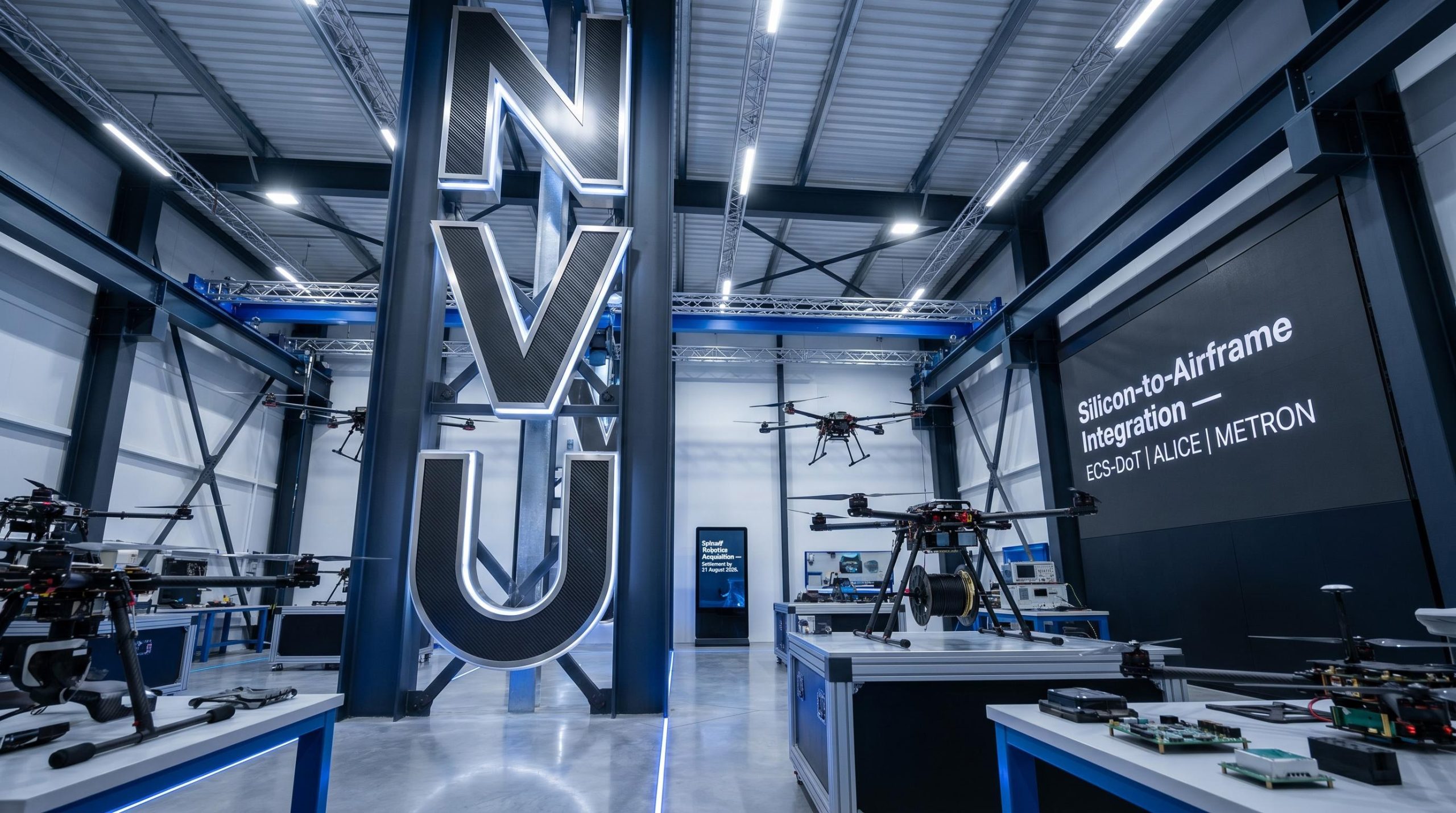
Nanoveu moves to acquire Spinoff Robotics, completing silicon-to-airframe drone stack
Nanoveu Limited (ASX: NVU) has entered into a binding sale and purchase agreement to acquire 100% of Spinoff Robotics Pte Ltd, a Singapore-based deep-tech spinout from the Singapore University of Technology and Design (SUTD) founded in 2021, in a transaction that completes the company’s full-stack vertical integration strategy. The deal brings proprietary airframe and sensing engineering in-house, placing these capabilities alongside Nanoveu’s existing silicon (ECS-DoT), tethered station-keeping (ALICE), sub-millimetre sensing (METRON), and on-device AI assets.
The structural significance of owning silicon and airframe simultaneously is considerable. With this combination, the ECS-DoT chip can be engineered into a drone from the outset rather than added as a payload afterthought, allowing sensor placement, power envelope, and control-loop latency to be optimised within a single integrated design loop. That engineering cohesion creates a structural moat that assembled-component competitors would find difficult to replicate.
Dr David Pevcic, Executive Chairman
“The proposed acquisition of Spinoff Robotics is a defining step in the build-out of Nanoveu’s autonomous drone platform, providing the in-house deployment surface to scale ECS-DoT silicon and validate next-generation edge-AI functions — including multi-chip configurations, GPS-free navigation and mission-specific perception workloads — in one of the highest-volume edge-AI markets. With proprietary airframes and sensing sitting alongside the Company’s silicon, edge-AI IP and autonomy algorithms, Nanoveu is placed to own every layer of the stack required to ship validated reference designs into defence, critical-infrastructure security and industrial inspection.”
When big ASX news breaks, our subscribers know first
What Spinoff Robotics brings to the table
Spinoff designs and custom-builds aerial platforms from first principles, retaining full in-house control over airframe, aerodynamics, flight control, and on-board sensing. Both of its proprietary platforms, ALICE and METRON, have been validated with tier-1 Singaporean customers, including Gardens by the Bay, the Home Team Science and Technology Agency, and the Land Transport Authority.
ALICE — the proprietary tethered drone platform
ALICE is a continuously powered tethered aerial platform engineered for persistent fixed-point missions, drawing power from a ground-based supply to deliver uninterrupted presence where coverage gaps are operationally unacceptable.
Key technical advantages include:
- High payload capacity: ground-side power offloads power-electronics weight from the airframe, freeing lift budget for higher-grade sensor payloads
- Electronic warfare resilience: hardened tether eliminates GPS-spoofing, RF-jamming, and hijack vulnerabilities
- Sub-degree payload stabilisation: proprietary control algorithm, deployable on ECS-DoT, locks camera, electro-optical/infrared, or sensor payloads on target under wind, tether tension, and dynamic payload reaction forces
- Rapid deployment: single-operator, sub-hour deployable as a persistent fixed-point surveillance asset
METRON — sub-millimetre sensing and AI deviation detection
METRON (Measurement Extraction for Targeted Region Observation in Narrow-space) is a camera-based 3D measurement system built around a proprietary camera assembly and multi-image measurement algorithm, delivering sub-millimetre dimensional accuracy in confined and inaccessible spaces.
The system performs a dual function: it operates simultaneously as a precision measurement tool and a persistent scene-mapping and change-detection sensor. Its pre-trained baseline-deviation AI pipeline, originally validated on critical bridge infrastructure inspection, transfers directly to surveillance and anomaly detection applications. Critically, all analytics can be executed on-device on ECS-DoT with no off-platform compute, communications, or cloud dependency. Commercial validation has been provided by the Land Transport Authority, Singapore.
Four priority verticals and the markets behind them
The combination of ECS-DoT silicon with Spinoff’s aerial robotics capability positions Nanoveu to address four priority verticals where conventional surveillance and inspection technologies are currently constrained:
- Defence: persistent ISR (intelligence, surveillance, and reconnaissance) overwatch, electronic warfare-resilient surveillance, and sovereign drone capability
- Surveillance: hyperscaler data-centre and critical-infrastructure perimeter security, alongside airport perimeter and runway foreign-object-debris (FOD) detection
- Battlefield and tactical operations: purpose-built tactical-grade drones leveraging clean-sheet airframe design and on-device AI for GPS-denied and contested electromagnetic environments
- Nuclear and hazardous inspection: sub-millimetre structural monitoring of human-inaccessible facilities at fidelity human inspectors physically cannot achieve
The addressable market opportunity across these verticals is substantial, as summarised below.
| Vertical | Key Application | Technology Used | Market Size | Source / Year |
|---|---|---|---|---|
| Defence / ISR | Persistent tethered overwatch, EW-resilient surveillance | ALICE + ECS-DoT | ~US$98.24B by 2033 | GVR, Jan 2026 |
| Hyperscaler / Critical Infrastructure | Perimeter security, thermal anomaly detection | ALICE + METRON + ECS-DoT | ~US$595B by 2030 (global hyperscale data-centre market) | MI Research, Jan 2026 |
| Airport FOD Detection | Tethered runway and perimeter monitoring | ALICE + METRON | ~US$1.5B by 2034 | DI Research, Apr 2026 |
| Nuclear / Hazardous Inspection | Sub-mm structural monitoring of reactor and containment infrastructure | METRON | ~US$9.5B/yr by 2030 (nuclear decommissioning services) | MI, Jul 2025 |
Transaction terms, team, and next steps
How the deal is structured
Under the binding sale and purchase agreement, Nanoveu will acquire 100% of the issued share capital of Spinoff Robotics Pte Ltd in consideration for:
Consideration Shares (Spinoff acquisition):
- 3,000,000 fully paid NVU shares, issued at a deemed issue price equal to the volume weighted average price of NVU shares on ASX over the 10 trading days immediately preceding the Settlement Date, subject to 12 months escrow
Performance Rights (Spinoff acquisition — 4,000,000 total):
- 2,000,000 Class A performance rights: vest upon Spinoff achieving cumulative receipted revenue of not less than SGD$1,000,000 within 24 months from the issue date
- 1,000,000 Class B performance rights: vest upon Spinoff integrating at least 3 items of intellectual property licensed from any Singapore Institute of Higher Learning (not previously owned or used by Spinoff) within 5 years
- 1,000,000 Class C performance rights: vest upon NVU achieving a 20 consecutive trading day VWAP of at least AU$0.20 per NVU share within 5 years
Settlement is required by 31 August 2026, subject to satisfactory due diligence and receipt of any required regulatory, statutory, and governmental consents and approvals. The consideration securities will be issued pursuant to the company’s placement capacity under ASX Listing Rule 7.1.
Separately from the acquisition consideration, the company has agreed to issue 2,000,000 incentive performance rights to Dr Chee How Tan. These rights vest in equal portions tied to NVU VWAP milestones: the first tranche vests upon the earlier of NVU achieving a 20-day VWAP of AU$0.20 per NVU share or 24 months of continuous employment; the second tranche vests upon the earlier of NVU achieving a 20-day VWAP of AU$0.30 per NVU share or 36 months of continuous employment. All rights expire on the earlier of cessation of employment or 5 years from the issue date, and are to be issued under ASX Listing Rule 7.1 capacity.
The expert joining the team
Dr Chee How Tan, co-founder of Spinoff and lead researcher in lean sensing and embodied perception for lightweight aerial robotics autonomy, will join Nanoveu upon completion. Dr Tan holds a Ph.D. in aerial robotics and lightweight autonomous systems, has spent more than 4 years as a research fellow at SUTD, and serves as Director of Spinoff Robotics.
Near-term workstreams
The acquisition will accelerate Nanoveu’s drone-vertical strategy within the broader ECS-DoT commercialisation programme. Near-term workstreams include:
- Live drone trials on ECS-DoT silicon: advancing validation of Phase 2 flight endurance simulation results in real-world conditions with a specialist US partner, with near-term IP filings planned
- Advanced edge-AI solutions development: targeting GPS-free navigation, counter-drone detection, and AI-driven flight optimisation on ECS-DoT
- Drone OEM and end-user engagement: direct pursuit of drone OEMs, system integrators, and end users across military and commercial applications
- Bespoke airframe development: designing new airframes purpose-built around ECS-DoT where commercially attractive
What “full-stack vertical integration” means for drone companies — and why it matters
Most drone manufacturers assemble their products from third-party components: they buy a chip from one supplier, a camera from another, and an airframe from a third. Full-stack vertical integration means owning every layer of that capability stack in-house, from the semiconductor silicon through to the airframe, sensing hardware, and AI software.
For investors, this distinction matters for three reasons. Engineering integration becomes tighter, reducing cost and time-to-market. Products become more differentiated because each layer is designed to work with the others rather than to a generic interface standard. And the resulting architecture is harder for competitors to replicate, because they would need to build or acquire equivalent capability at every layer simultaneously.
With this acquisition, Nanoveu holds silicon (ECS-DoT), airframe and aerodynamics (Spinoff), tethered station-keeping (ALICE), sub-millimetre sensing (METRON), and on-device AI. Future drone platforms can therefore be engineered from a single design loop rather than integrating mismatched external components, a capability that management contends is the foundation for shipping validated reference designs into high-value defence and commercial markets.
Don’t Miss the Next ASX Tech Breakout
Big News Blast delivers FREE breaking ASX tech news directly to your inbox within minutes of release, complete with in-depth analysis already done for you. Join 20,000+ investors who stay ahead of the market on every major announcement. Click the “Free Alerts” button to start receiving alerts the moment news breaks.