
Only around 300,000 of Xero’s 4.6 million subscribers have adopted the company’s newer generative AI features. That is a narrow base on which to build an entirely new revenue line. Yet on 13 May 2026, Xero announced exactly that: XeroForce, an AI agent builder launching in invite-only alpha, designed to sit on top of the company’s accounting platform and eventually generate revenue through bundled, add-on, and usage-based pricing mechanisms.
For Australian investors and accounting professionals, the announcement carries weight beyond a single product launch. Xero is the dominant practice platform in the ANZ market, and the decisions it makes on AI architecture and monetisation will set expectations across the sector. This analysis unpacks what XeroForce actually is, how Xero plans to make AI pay across three distinct mechanisms, how that compares to the approaches of MYOB, Intuit, and Sage, and what Australian regulatory and professional standards mean for how far these agents can realistically go.
What XeroForce actually is and why it matters now
XeroForce is a natural language AI agent builder. It allows accountants, bookkeepers, and small business owners to create automated workflows by describing what they want in plain English, without writing code or engaging IT resources. An accountant could, in principle, instruct an agent to reconcile a specific bank feed, chase overdue invoices, or model a client’s cash flow for the quarter ahead.
What separates it from a chatbot embedded in a single product is its design scope. XeroForce is built to operate across both Xero’s own platform and third-party applications, making it an orchestration layer rather than a closed tool. Three characteristics define the product at this stage:
- Natural language interface: users describe tasks in conversational English rather than configuring rule-based automations
- No-code workflow automation: agents execute multi-step processes without requiring developer involvement
- Cross-platform operation: agents can interact with third-party applications connected to Xero’s ecosystem, not just Xero’s own modules
The product remains in invite-only alpha as of May 2026, meaning its commercial shape will evolve considerably before any broad release.
The gap between AI awareness and AI adoption in Australian SMEs
The no-code design is not an abstract product decision. It responds to a specific capacity problem in the Australian small business market. Xero’s own research found that 23% of Australian small businesses say they lack time to research and learn AI, double the rate of counterparts in the US and UK. Only 29% of regional organisations use AI, compared with 40% in metropolitan areas.
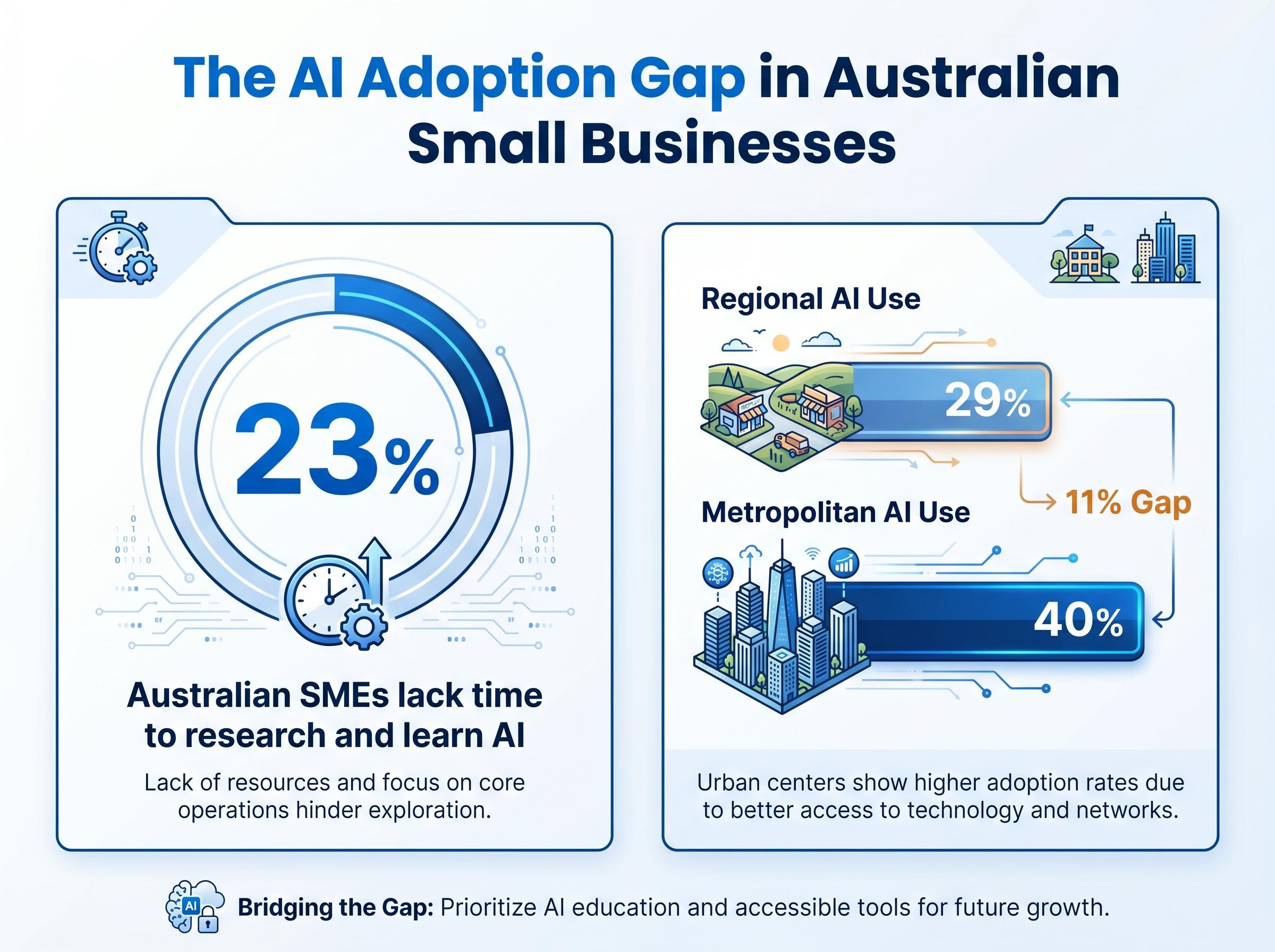
These figures surface a gap between interest and deployment that XeroForce is explicitly designed to close. If a small business owner can build an automated workflow by typing a sentence rather than navigating a configuration panel, the time barrier drops. Whether that design translates into adoption at scale remains the open question.
When big ASX news breaks, our subscribers know first
The data moat argument: why Xero believes it can win the agent race
Xero’s leadership has presented investors with a specific thesis on competitive defensibility, and it does not rest on the user interface. Management has explicitly tested how easy it is to replicate Xero’s product experience using AI tools. The conclusion is direct.
Replicating the user experience is straightforward. Replicating the underlying data plumbing and bank connections is not.
The moat, as Xero frames it, consists of three interlocking elements:
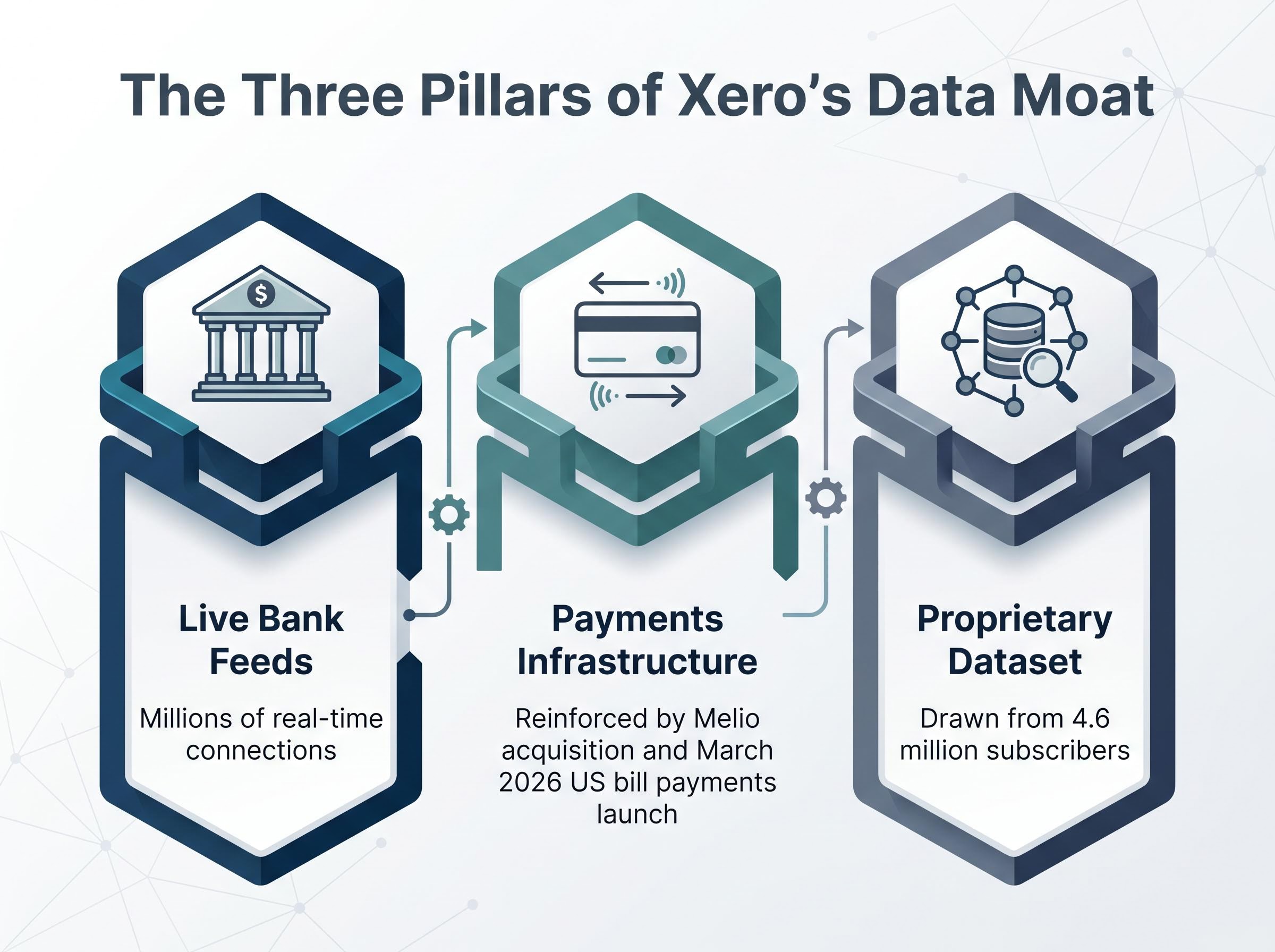
- Millions of live bank feeds connecting Xero to financial institutions in real time, providing the transaction data that agents need to operate
- Deep payments infrastructure, reinforced by the Melio acquisition, which launched US bill payments capability in March 2026 and contributed to annualised monthly recurring revenue (AMRR) growing 37% overall in FY26 (25% organically)
- A large proprietary dataset drawn from 4.6 million total subscribers as of FY26, used for training and fine-tuning AI models
XeroForce sits on top of this infrastructure. An agent that can read live bank feeds, initiate payments, and reference years of categorised transaction history has access to context that a generic AI tool, however capable its language model, cannot replicate without building equivalent financial plumbing from scratch.
The early market reaction to this data and AI thesis has been mildly positive, with The Aussie Corporate reporting a share price bounce following the February 2026 update in which management laid out the argument. Whether the moat holds depends on how quickly competitors build comparable infrastructure, a question the competitive comparison below addresses.
Xero’s AI pricing strategy: how subscription tiers, feature packs, and consumption charges fit together
Xero has outlined a three-pronged monetisation approach for AI, and the sequencing is as deliberate as the mechanisms themselves. Each pricing layer targets a different stage of customer maturity and a different revenue objective.
The first layer, bundled AI, is already underway. Xero embeds AI features within existing subscription tiers to drive adoption, reduce churn, and justify the price increases that have already lifted average revenue per connection (ARPC) by 23% to $55.44 in FY26. Bundling builds the habit. It gets accountants and small business owners using AI daily before any premium charge is introduced.
The second layer, standalone add-ons, creates an explicit monetisation line. Specific AI modules or agent capabilities, such as advanced cash-flow modelling or practice-level workflow automation, could be sold as discrete feature packs to segments willing to pay for deeper functionality.
The third layer, usage-based pricing, aligns revenue with actual AI task volume. This is the mechanism that could turn heavy users into meaningfully higher-value customers, charging per AI task processed, per transaction reconciled automatically, or per agent action executed at scale. Xero has signalled that an explicit AI revenue ramp is expected from late FY27 onward.
| Pricing Mechanism | Description | Primary Purpose | Likely Timeline |
|---|---|---|---|
| Bundled AI | Embed AI features in existing subscription tiers | Drive adoption and reduce churn | Near-term, already underway |
| Standalone Add-ons | AI feature packs or modules sold separately | Create explicit monetisation line | Medium-term |
| Usage-Based Pricing | Charge per AI task or transaction volume | Capture value from heavy users | Late FY27 onward |
For context, FY27 revenue guidance sits at $3.62 billion to $3.73 billion, with adjusted EBITDA guidance of $860 million to $920 million. Management’s medium-term target is to double FY25 revenue by FY28 on an organic basis, excluding Melio synergies. The AI monetisation layers are designed to contribute to that trajectory, not carry it alone.
How Xero’s AI model compares to MYOB, Intuit, and Sage
Across the accounting software sector, bundled AI is now table stakes. Every major platform offers some form of automated categorisation, reconciliation assistance, or predictive cash-flow tools within existing subscriptions. None of the primary competitors has yet implemented a clean, publicly announced per-use AI pricing model.
Intuit is the closest analogue to Xero in overall AI ambition. Intuit Assist, launched in 2023 and expanded across QuickBooks and TurboTax through 2024-2025, provides a natural language assistant powered by Intuit’s proprietary financial graph and GenOS foundation. The end vision mirrors Xero’s: AI agents running workflows with humans approving and judging. Monetisation, however, remains primarily tier-based in public pricing rather than usage-based.
Sage launched its Copilot in January 2026 within Sage Operations, expanding across finance, HR, and operations in April 2026. The product is bundled into higher-value Sage Accounting and Sage for Accountants packages. There is no major public move toward metered AI pricing.
MYOB has positioned AI as “workflow automation” and “augmented practice” tooling, bundled into MYOB Business and Practice subscriptions. No standalone AI SKU exists as of early 2026. AI serves a defensive function: maintaining relevance and justifying subscription pricing rather than creating a new revenue line.
FreshBooks has added AI-assisted categorisation and invoice drafting, folded into standard plan tiers with no separate AI charge.
| Vendor | AI Product/Feature | Monetisation Model | Relative Aggressiveness |
|---|---|---|---|
| Xero | XeroForce (agent builder, alpha) | Bundled + add-on + usage-based (planned) | Most aggressive; explicit AI revenue target |
| Intuit | Intuit Assist, GenOS | Primarily tier-based | High ambition; monetisation still bundled |
| Sage | Sage Copilot | Bundled into higher-value tiers | Moderate; enrichment-focused |
| MYOB | Workflow automation tools | Bundled into existing plans | Defensive; churn prevention |
| FreshBooks | AI categorisation, drafting | Bundled into standard tiers | Low; feature-level integration |
The fact that explicit AI monetisation remains rare across the sector gives Xero a first-mover opportunity. It also signals that the market has not yet validated whether SME customers will pay separately for AI capabilities that competitors absorb into base pricing.
The Australian regulatory and professional context that shapes how far AI agents can go
XeroForce does not operate in a vacuum. Australian professional standards and an evolving regulatory framework define a structural constraint on how autonomous any AI agent can become in the accounting context.
Professional bodies including CPA Australia and CA ANZ mandate human-in-the-loop oversight for any AI that posts to ledgers, lodges with the Australian Taxation Office, or provides tax advice. Members remain accountable for the quality and accuracy of AI-assisted work. This is not discretionary guidance; it is a professional liability ceiling that fully autonomous accounting agents cannot cross.
The regulatory environment is tightening in parallel. The National AI Plan, released on 2 December 2025, committed $29.9 million to establish an AI Safety Institute tasked with monitoring AI risks and supporting regulators. Privacy Act reforms currently in progress propose stronger consent requirements for using client financial data to train AI, more explicit disclosure of automated decision-making, and tighter rules around cross-border data transfers.
Four specific barriers shape the pace of AI adoption in Australian small business:
- Time and skills shortages: 23% of Australian SMEs lack time to research AI, double the US and UK rate
- Trust and perceived risk: concerns about data privacy, security, and penalties from errors in tax or payroll calculations
- Regulatory uncertainty: businesses anticipate new guidance on automated decision-making, leading to “wait and see” behaviour
- Regional digital inclusion gap: only 29% of regional organisations use AI versus 40% in metropolitan areas
Why the liability ceiling is also a competitive advantage for Xero
The human-in-the-loop requirement constrains agent autonomy, but it also favours embedded platform providers over standalone AI tools. Accountants will route AI tasks through platforms they already trust, platforms that carry compliance infrastructure, audit trails, and explicit approval workflows.
Xero’s agent design, cross-platform operation with built-in approval steps, is consistent with professional standards precisely because it anticipates this constraint. A standalone AI tool that attempts to bypass the accountant faces the professional liability ceiling head on. A platform-embedded agent that augments the accountant’s workflow operates within it.
XeroForce as an options position: what needs to go right for the AI revenue thesis to pay off
Analysts and commentators currently treat XeroForce as upside optionality rather than baked-in earnings. The investment case for Xero does not require XeroForce to succeed immediately; the company’s AMRR reached $3.27 billion in FY26 on 37% growth, with AI revenue not yet a discrete line item.
Synthesised sell-side commentary has described XeroForce as “nice optionality if executed well.”
For the AI revenue thesis to pay off, three execution conditions need to be met:
- Ship regulator-friendly agent tooling at scale before Intuit does the same with Intuit Assist, securing a first-mover advantage in the professional accounting segment
- Demonstrate that SME customers will pay separately for AI on top of existing subscription costs, in a market where competitors are absorbing most AI features into base pricing
- Convert bank feeds and payments data into differentiated agent capabilities that competitors cannot replicate with generic infrastructure, proving the data moat thesis in practice rather than in investor presentations
The monetisation risk is real. If the broader industry continues to bundle AI into core plans, Xero is betting that customers will accept an additional charge that rivals are absorbing. Xero’s share price declined approximately 53% in the twelve months prior to 14 May 2026, according to Rask Media analysis by Jaz Harrison, reflecting broader market scepticism that has not yet been offset by the AI narrative.
Both things can be true simultaneously. The strategy can be directionally correct, with a genuine data moat and a well-sequenced monetisation architecture, and the execution timeline can still prove longer and harder than management’s roadmap implies.
This article is for informational purposes only and should not be considered financial advice. Investors should conduct their own research and consult with financial professionals before making investment decisions. Past performance does not guarantee future results. Financial projections are subject to market conditions and various risk factors.
The accounting software industry’s AI moment is arriving; Xero is placing its bet early
Xero’s AI strategy is not a feature story. It is a deliberate repositioning from accounting SaaS provider to data platform and financial automation layer, with XeroForce as the clearest expression of where that repositioning is heading. The three-pronged monetisation model, the data moat narrative built on bank feeds and payments infrastructure, and the agent architecture designed around professional oversight all point toward a company building for a category shift, not a product cycle.
What remains unresolved is substantial. XeroForce is in alpha. The willingness of SMEs to pay usage-based AI charges is unproven. The Australian regulatory environment will constrain agent autonomy for the foreseeable future.
For Australian investors, the AI narrative is now central to how Xero is being valued and how competitors like MYOB will need to respond. For accounting professionals, the question is no longer whether AI enters the practice but how much control they retain over the workflows it automates. Xero’s FY27 results period will provide the next meaningful checkpoint: whether AI monetisation is beginning to show up in ARPU growth above the organic baseline, or whether the optionality remains just that.