
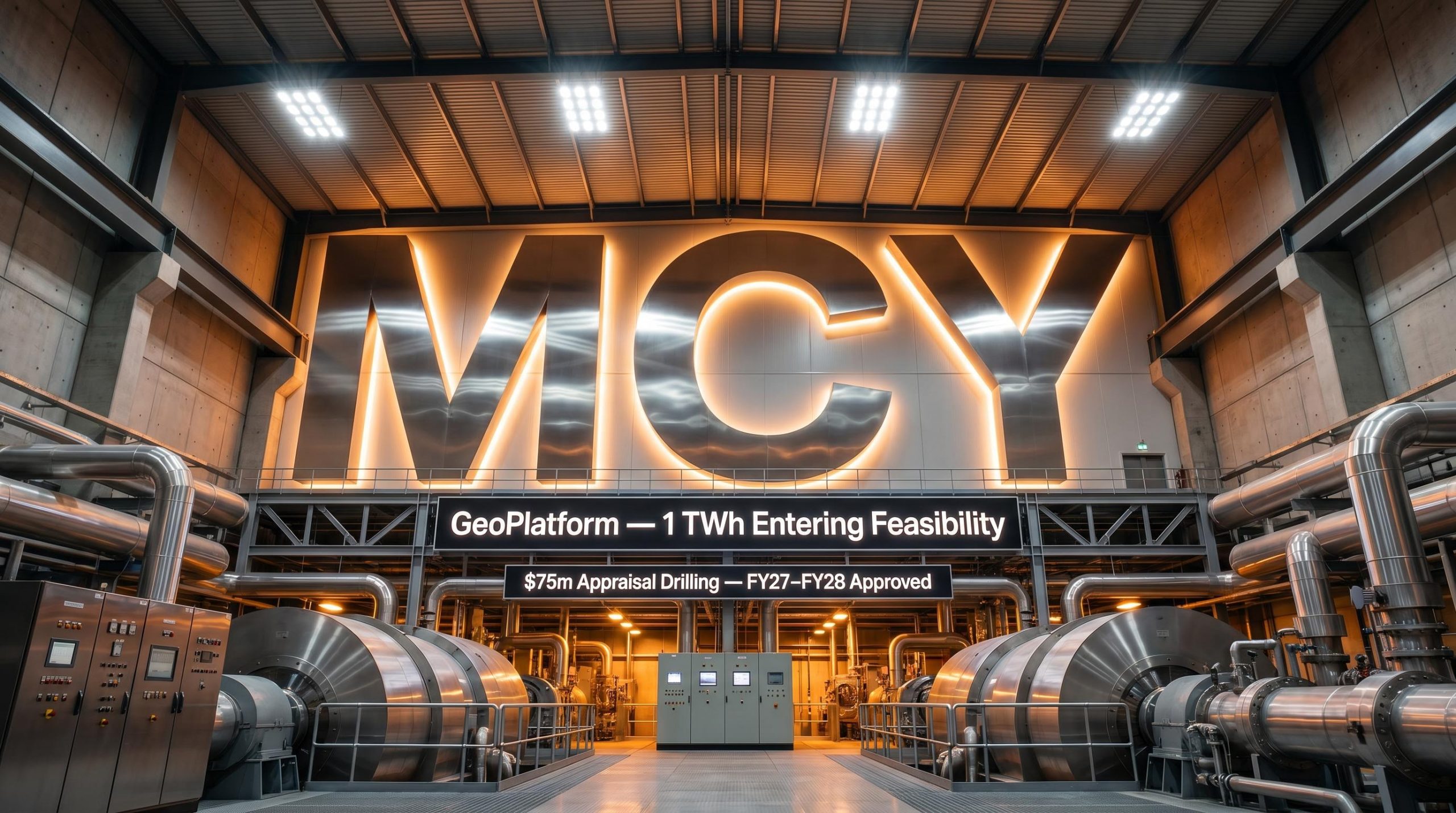
Mercury scales its GeoPlatform with up to $1 billion geothermal commitment
In its Geothermal Investor Day presentation on 14 May 2026, Mercury NZ Limited (ASX: MCY) outlined a scaled-up geothermal growth strategy centred on three headline commitments: a $75 million Board-approved appraisal drilling campaign across FY27–FY28, 1 TWh of new generation entering feasibility across the Ngā Tamariki and Rotokawa projects, and a total estimated investment cost of $0.8 billion to $1.0 billion for those projects at $6.5–8m/MW. The presentation framed these not as aspirational targets but as funded, staged steps in converting a geothermal pipeline into executable projects.
CE Stew Hamilton
“We have a credible, investable and repeatable geothermal platform, a strong pipeline of opportunities, and the capability and partnerships to deliver.”
When big ASX news breaks, our subscribers know first
Understanding Mercury’s GeoPlatform and why geothermal matters
Geothermal vs. other renewables — the firm generation advantage
For ASX investors less familiar with geothermal energy, its defining characteristic is consistency. Unlike wind and solar, geothermal generation runs 24/7 and is entirely weather-independent, making it well suited to baseload contracting with large energy users that require reliable renewable supply.
The presentation highlighted several investor-relevant structural advantages:
- Geothermal price capture remains robust as more capacity is added, unlike wind and solar, which cannibalise their own market value as penetration increases
- The technology is particularly well matched to data centres and industrially electrifying businesses that require firm, long-dated renewable supply agreements
- Geothermal supports grid firming during winter peaks and dry-year periods, directly addressing New Zealand’s hydrology risk from its weather-dependent hydro fleet
Mercury’s three geothermal horizons
Management presented a three-horizon framework spanning to 2050:
- Horizon 1 (to 2035): Brownfield development at Ngā Tamariki and Rotokawa, with 1 TWh entering feasibility and first generation targeted for 2030
- Horizon 2 (to 2040): Maximise the conventional pipeline up to 5 TWh, unlock greenfield options, and pilot Enhanced Geothermal Systems (EGS)
- Horizon 3 (to 2050): Next-generation geothermal via Superhot and EGS technologies as technical and economic conditions mature
It is worth noting that Horizon 3 technologies, including EGS, Closed Loop, and Superhot systems, have no commercial-scale operations globally today. The presentation positioned these as long-term upside options rather than near-term deliverables.
The two projects at the centre of Mercury’s next growth phase
Ngā Tamariki and Rotokawa expansion projects
Both Horizon 1 projects are currently at the appraisal drilling stage. The table below summarises the key parameters as presented at the Geothermal Investor Day.
| Project | Current Capacity | Target Capacity | Target Output | Earliest FID |
|---|---|---|---|---|
| Ngā Tamariki Expansion | 132MW | Up to 180–260MW | 75MW / 620GWh | Late CY28 |
| Rotokawa Expansion | 175MW | Up to 225–300MW | 50MW / 420GWh | Late CY28 |
Major capital decisions for both projects will follow appraisal drilling results, technical work, and investment gate approvals. A final investment decision (FID) is not guaranteed at this stage. Combined, the two projects carry a total estimated investment cost of $0.8 billion to $1.0 billion at $6.5–8m/MW, representing a feasibility-stage estimate rather than committed capex.
The committed spend is the $75 million appraisal drilling campaign across FY27–FY28. The presentation noted this programme is expected to be a positive NPV investment in its own right. If drilling outcomes fall short of expectations, management characterised the downside as a one-off write-off rather than an ongoing operating cost.
A track record that supports confidence in execution
Mercury presented its recent delivery record as evidence that the GeoPlatform can execute at scale. Key credentials cited include:
- The $220 million Ngā Tamariki OEC5 expansion was completed on time and on budget in March 2026
- A 100% success rate on a recent eight-well drilling programme, with approximately 50 wells successfully targeted across the platform’s history
- Vertically integrated capability spanning exploration, drilling, subsurface engineering, consenting, project delivery, and operations
CE Stew Hamilton
“Our team is match fit, having successfully completed the $220m expansion of the Ngā Tamariki Geothermal Station on budget and on time in March.”
Capital discipline and the investment case for ASX shareholders
Funded within clear financial guardrails
Mercury’s CFO Richard Hopkins outlined that the geothermal growth programme is being funded entirely from the company’s own balance sheet. No equity raise is associated with this announcement. On Mercury’s current plan, leverage is expected to peak at approximately 2.6x before declining, a profile described as consistent with the company’s existing S&P credit settings. Progressive dividends are expected to continue alongside the investment programme.
Why this strengthens the investment thesis
Management framed four shareholder value pillars during the capital allocation section of the presentation:
- Earnings quality: Geothermal adds firm, weather-independent renewable baseload to the portfolio, supporting durable earnings and long-term contracting with data centres and major energy users
- Growth visibility: Staged investment gates (appraisal, feasibility, FID) reduce uncertainty before major capital is deployed; rising digital and industrial electricity demand underpins market need, with NZ demand projected to grow from approximately 40 TWh (2025) to between 43 and 52 TWh by 2035 across Mercury’s scenario range
- Balance sheet resilience: Growth is pursued within clear financial guardrails, with leverage remaining consistent with existing credit settings while progressive dividends continue
- Long-term upside: Up to 5 TWh of conventional geothermal options have been identified; next-generation Superhot and EGS options provide additional upside as technology and economics mature
Supporting New Zealand’s energy future
Mercury’s geothermal investment aligns directly with the New Zealand Government’s goal of doubling geothermal use by 2040. The NZ Government has committed $60 million through MBIE to support Superhot geothermal development, with Mercury a partner in the NZ Superhot programme at Rotokawa. Against a backdrop of electricity demand growth from approximately 40 TWh today to a projected 43–52 TWh by 2035, Mercury’s GeoPlatform positions the company as the dominant geothermal operator in New Zealand, backed by a pipeline depth and breadth that no domestic competitor can match at this scale.
Don’t Miss the Next Utilities Sector Breakout
Big News Blast delivers FREE breaking ASX news to your inbox within minutes of release, complete with in-depth analysis so the work is already done. Over 20,000 active subscribers rely on it to stay ahead of market-moving announcements across utilities and beyond. Click the “Free Alerts” button to start receiving alerts the moment news breaks.