
AGL lifts FY26 profit guidance as operational momentum builds
In its May 2026 investor presentation delivered at the Macquarie Australia Conference, AGL Energy outlined upgraded earnings guidance for FY26 as plant performance and margin discipline strengthened across the business. The company narrowed its Underlying NPAT range to $610 million to $680 million (previously $580 million to $680 million), raising the floor by $30 million, while the Underlying EBITDA range shifted to $2,060 million to $2,180 million (previously $2,020 million to $2,180 million), a $40 million lift at the bottom end.
Management attributed the upgrade to improved plant availability, stabilised consumer margins, and disciplined cost management. The presentation also highlighted AGL’s diesel fuel security position during the current global fuel crisis, with storage near capacity for generation assets and ongoing supply expected as an essential services provider.
The guidance revision signals stronger-than-expected second half performance, with the company reaffirming its intention to pay fully franked dividends in FY26. Managing Director & CEO Damien Nicks emphasised the company’s ability to execute against its strategic plan while navigating near-term market dynamics. The updated guidance ranges reflect confidence in operational resilience despite a backdrop of lower wholesale price volatility in some locations.
Managing Director & CEO Damien Nicks
“AGL is well placed for at least the next three months during the global fuel crisis, with current diesel storage near capacity for the generation assets, and we expect ongoing supply as an essential services provider.”
When big ASX news breaks, our subscribers know first
Flexible generation fleet delivers premium pricing in low-volatility markets
AGL’s asset mix demonstrated its ability to capture value even when average spot prices remained subdued, a dynamic highlighted in the presentation’s analysis of April pricing behaviour. The company reported a year-to-date Fleet Equivalent Availability Factor of 83.2% for the nine months to 31 March 2026, 3.1 percentage points higher than the first half. Bayswater delivered a standout Q3 EAF of 98.6%, underscoring the thermal fleet’s sustained operational performance.
The presentation illustrated this premium capture using 15 April 2026 as a case study. On that day, Bayswater achieved a realised volume-weighted average price of $84/MWh, compared to a time-weighted average price of $71/MWh. The company noted that with Liddell and Tomago batteries operational, the indicative combined portfolio VWAP would have reached $93/MWh, a 10% improvement over Bayswater’s realised price.
This premium capture demonstrates earnings resilience independent of high-volatility events. AGL’s flexible assets generate value by ramping down during periods of near-zero pool pricing and capturing elevated pricing during evening peaks. The company positioned this operational flexibility as a core driver of risk-adjusted returns as the fleet transitions away from capital-intensive thermal generation toward lower-cost firming assets and renewables.
What is a volume-weighted average price (VWAP)?
A volume-weighted average price measures the average price received for electricity weighted by the volume sold at each price point throughout the day. Unlike a time-weighted average price (TWAP), which simply averages all prices across each trading interval, VWAP accounts for how much energy was actually sold at each price level.
When a generator achieves a VWAP higher than the TWAP, it indicates the generator sold more energy during periods when prices were elevated, typically during morning and evening peaks. For AGL, this premium demonstrates the commercial value of flexible, dispatchable generation that can reduce output when pool prices drop to near-zero during mid-day solar generation and increase output when evening demand pushes prices higher.
In a transitioning energy market where baseload thermal generation is progressively replaced by variable renewable energy, the ability to consistently achieve VWAP premiums over TWAP signals operational discipline and strategic positioning to capture peak demand pricing.
$2 billion flexible asset program progresses toward completion
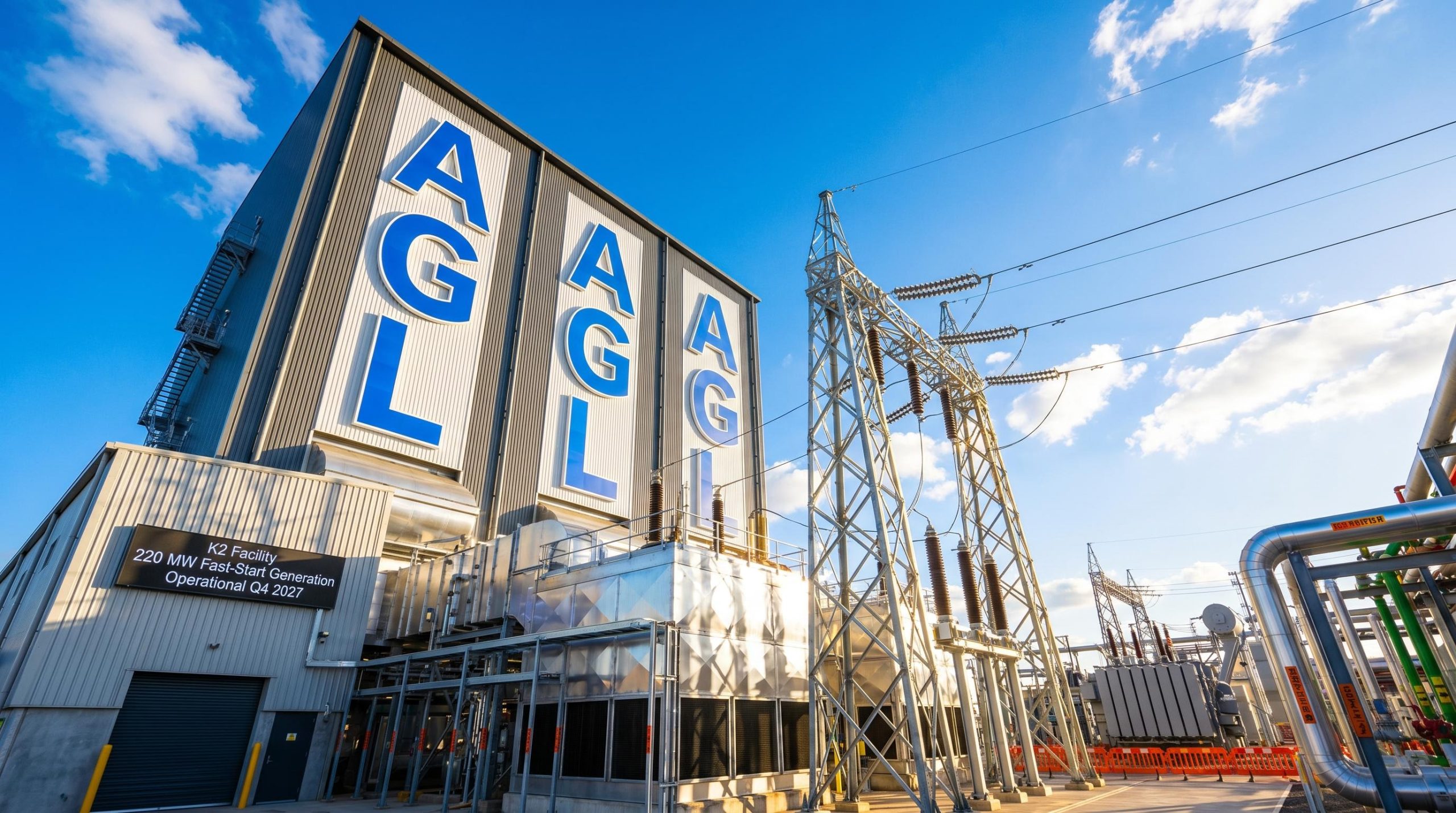
AGL outlined progress across its major capital projects, with commissioning underway on the first 250 MW tranche of the Liddell Battery in New South Wales. The full 500 MW capacity is expected to be operational by the end of FY26, with construction of the 500 MW Tomago Battery progressing well. The company also confirmed a final investment decision on the K2 project, a 220 MW fast-start gas peaker in Western Australia co-located with the existing Kwinana Swift facility.
The presentation detailed expected completion milestones and the strategic rationale for each project. The Liddell and Tomago batteries will provide critical firming capacity to capture peak pricing events, while K2 supports AGL’s objective to own a gas peaker in each mainland state. The K2 project targets post-tax ungeared returns above 8%, with expected EBITDA of $50 million to $70 million per annum (nominal) for the first 10 years.
AGL also expects to receive approximately $750 million in proceeds from the sale of its 19.9% interest in Tilt Renewables by 31 May 2026. This capital recycling positions the company to complete its flexible asset program while maintaining balance sheet discipline. The near-term project completions are expected to enhance AGL’s ability to capture growing peak demand premiums from FY27 as the energy market transitions away from baseload generation.
| Project | Capacity | Location | Status |
|---|---|---|---|
| Liddell Battery | 500 MW | NSW | First 250 MW commissioning; full capacity by end FY26 |
| Tomago Battery | 500 MW | NSW | Construction progressing |
| K2 Gas Peaker | 220 MW | WA | Final investment decision taken |
Data centre demand underpins long-term electricity growth outlook
The presentation outlined structural demand tailwinds driven by data centre expansion that may outpace official forecasts. Current operational data centre demand in the NEM sits at approximately 5 TWh, with total forecast demand across operating, construction, and development projects reaching 34 TWh. This exceeds AEMO’s FY36 Step Change forecast of 23 TWh and the Sensitivity case of 29 TWh.
Management noted that while not all projects in development may reach final construction, the scale of the pipeline signals significant upside to electricity demand forecasts. The company positioned its dispatchable generation portfolio as strategically placed to benefit from this structural growth, particularly as data centres require reliable, 24/7 power supply that variable renewable energy cannot provide without firming capacity.
The presentation also highlighted rising peak demand profiles during winter months, when solar contribution is lowest and wind generation historically weakest. AGL noted that peak demand periods are becoming more pronounced, with the market finely balanced and highly susceptible to volatility during extreme weather events, thermal generator outages, or interconnector constraints.
The company framed data centre demand growth as a key driver supporting the commercial case for its flexible asset investments. As the NEM transitions toward higher renewable penetration, AGL’s firming capacity becomes increasingly valuable in meeting elevated peak demand and ensuring system stability during periods of low renewable generation.
Western Australia expansion diversifies earnings base
AGL’s Perth Energy business was positioned as a strategic growth platform to diversify earnings beyond the East Coast. The company outlined current portfolio metrics: generation portfolio of 120 MW, customer electricity portfolio of approximately 1.1 TWh, gas portfolio of approximately 12 PJ, contracted renewables of 105 MW, and a development pipeline of 900 MW.
The K2 project underpins AGL’s WA expansion strategy. The 220 MW fast-start gas peaker is co-located with the existing Kwinana Swift facility, with operations expected in Q4 2027. The project targets post-tax ungeared returns above 8% and expected EBITDA of $50 million to $70 million per annum (nominal) for the first 10 years. Management highlighted the WA capacity market’s provision of predictable, capacity-backed cash flows as a key attraction for the project.
The presentation detailed the WEM supply-demand outlook, noting approximately 1.1 GW of coal-fired generation is committed to exit by 2031, creating a forecast capacity gap of 2.1 GW by 2033. This tightening balance supports the commercial rationale for new firming capacity, with gas and other dispatchable technologies positioned to play a critical role as coal exits.
AGL outlined broader Perth Energy growth initiatives, including expanding its Energy Management Service customer base through contracted renewables and behind-the-meter assets, progressing the Twin Hills Wind Farm project (a proposed large-scale wind farm and associated BESS), and leveraging its flexible gas portfolio to increase wholesale gas customer base.
K2 Project Highlights:
- Capacity: 220 MW fast-start gas peaker
- Location: Co-located with existing Kwinana Swift facility
- Operations expected: Q4 2027
- Target returns: Post-tax ungeared above 8%
- Expected EBITDA: $50m – $70m per annum (nominal) for first 10 years
FY27 guidance to follow in August
AGL will provide FY27 earnings guidance at its FY26 Results announcement in August. The presentation flagged expected factors influencing FY27 performance, including full-year contribution from the Liddell battery, ongoing cost optimisation, lower wholesale prices in some locations, and potential softer local and global market conditions.
Management maintained a balanced tone, acknowledging near-term headwinds while emphasising operational momentum and the strategic positioning gained through flexible asset completions. The company noted that FY27 guidance will be subject to impacts from regulatory and government intervention, variability in market and trading conditions, and plant availability.
The approach signals management’s intention to provide a comprehensive FY27 outlook once full-year planning processes are complete. Investors should anticipate potential near-term earnings normalisation as wholesale price volatility moderates in some locations, balanced against structural positioning gains from battery asset commissioning and the completion of the flexible asset program. The full-year results announcement will provide clarity on how these factors are expected to flow through to FY27 financial performance.
Stay Ahead on Utilities Sector News
Join 20,000+ investors receiving FREE breaking ASX announcements within minutes of release, complete with in-depth analysis. Click the “Free Alerts” button at StockWire X to get utilities sector news and expert coverage delivered straight to your inbox the moment it breaks.