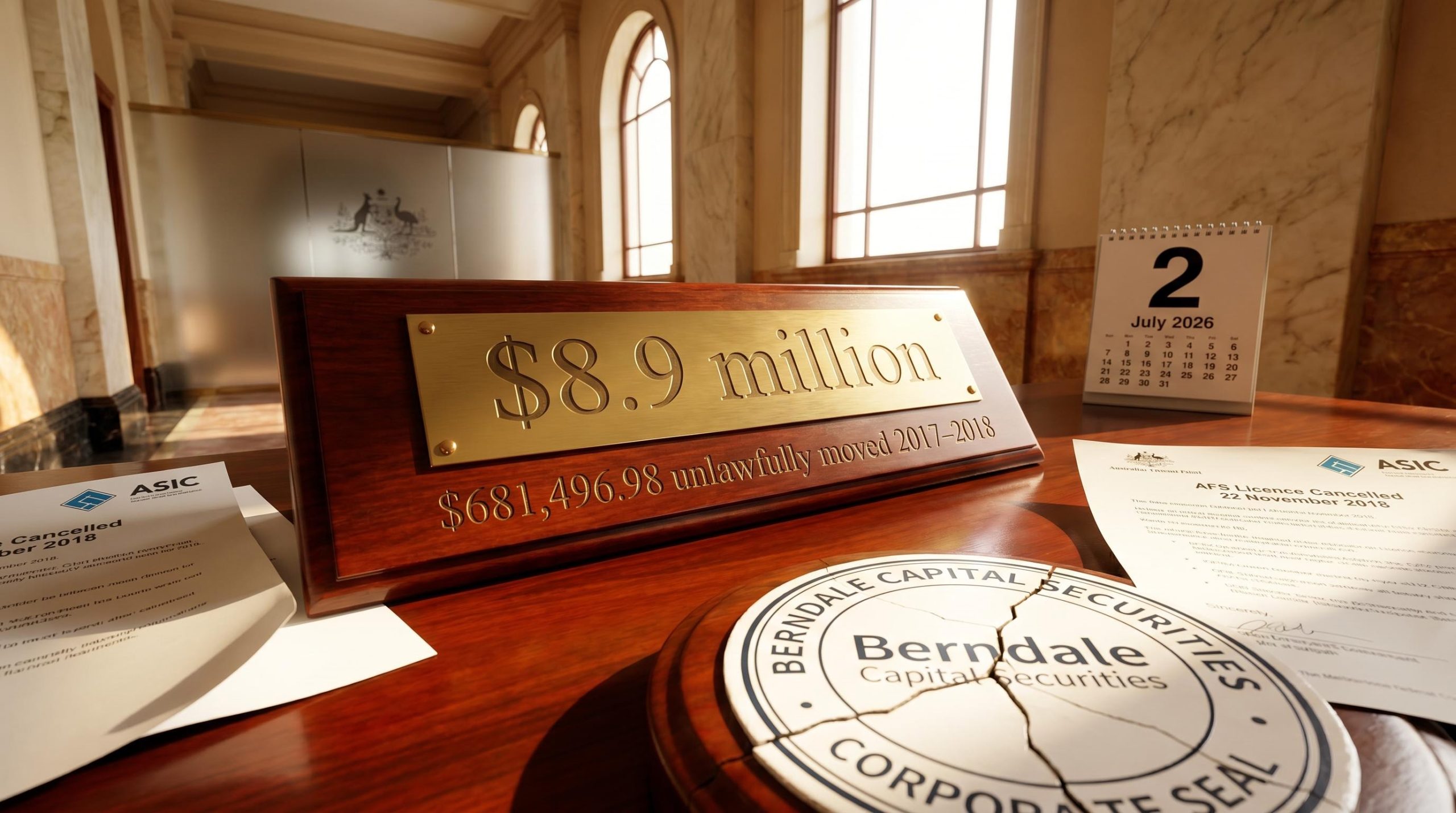
On 30 April 2026, Stavro D’Amore stood before the Federal Court of Australia and pleaded guilty to three criminal charges arising from the collapse of Berndale Capital Securities, a Melbourne firm that left former clients collectively owed more than $8.9 million. The plea caps a seven-year trajectory that began with the Australian Securities and Investments Commission (ASIC) cancelling Berndale’s financial services licence in November 2018 and ends, for now, with sentencing scheduled for 2 July 2026. The case is significant not just as a legal outcome but as a documented case study in how retail OTC derivative broker misconduct compounds across regulatory, civil, and criminal dimensions. What follows traces the full arc of the Berndale collapse, examines what the D’Amore guilty plea means alongside the earlier sentencing of co-director Daniel Kirby, and extracts the specific warning signs retail investors can use when evaluating any CFD or OTC derivative broker.
Three charges, one guilty plea, and what D’Amore admitted
D’Amore pleaded guilty to three rolled-up charges, each consolidating multiple individual offences into a single count. The first charge relates to dishonestly exploiting his position as a director to move $681,496.98 in company funds unlawfully between 2017 and 2018.
$681,496.98 in company funds were moved unlawfully by D’Amore between 2017 and 2018, forming the basis of the first charge.
The second charge covers dishonest conduct within a financial services business. The third addresses his role in authorising false documentation submitted to ASIC, including overseas financial account records that either did not exist or contained substantially inaccurate information.
Each charge carries significant maximum penalties. The prosecution was carried out by the Commonwealth Director of Public Prosecutions (CDPP) following an ASIC referral.
| Charge Description | Legal Basis | Maximum Penalty Units | Maximum Imprisonment |
|---|---|---|---|
| Dishonestly exploiting a directorial position | Corporations Act | 2,000 | 5 years |
| Dishonest conduct in a financial services business | Corporations Act | 4,500 | 10 years |
| False filings with ASIC | Corporations Act | 200 | 5 years |
D’Amore had contested all charges following committal proceedings before reversing his position in April 2026. Sentencing is scheduled for 2 July 2026 in the Federal Court of Australia (ASIC 26-088MR).
ASIC media release 26-088MR, published 1 May 2026, is the primary official record of D’Amore’s guilty plea, confirming the three rolled-up charges, the quantum of unlawfully transferred funds, and the 2 July 2026 sentencing date in the Federal Court of Australia.
When big ASX news breaks, our subscribers know first
How Berndale Capital unravelled: from AFSL cancellation to wind-up
Berndale Capital Securities operated as a Melbourne-based issuer and market-maker of retail OTC derivative products, including contracts for difference (CFDs), which allow traders to speculate on price movements without owning the underlying asset. Its collapse did not arrive as a single event. It unfolded as a chain of regulatory failures, each one compounding the next.
Berndale operated as an issuer of contracts for difference, instruments that give retail traders price exposure to assets they never own; with CFD trading explained alongside the documented loss rates across regulated jurisdictions, the scale of consumer harm when a licensed issuer fails becomes considerably clearer.
ASIC’s concerns about Berndale centred on non-compliance with reporting obligations, failure to respond to statutory notices, and doubts about D’Amore’s qualifications and fitness to hold an Australian Financial Services Licence (AFSL). The firm’s licence conditions required net tangible assets at the higher of $1 million or 10% of average revenue, plus lodgement of audited financial statements.
Berndale met neither.
The regulatory conditions Berndale could not meet
The net tangible assets threshold exists to ensure that licensed firms can meet their obligations to clients. Berndale’s failure against this requirement was compounded by overseas financial account claims referenced in company documentation that either did not exist or contained substantially inaccurate information. This finding became central to the false filing charge against D’Amore.
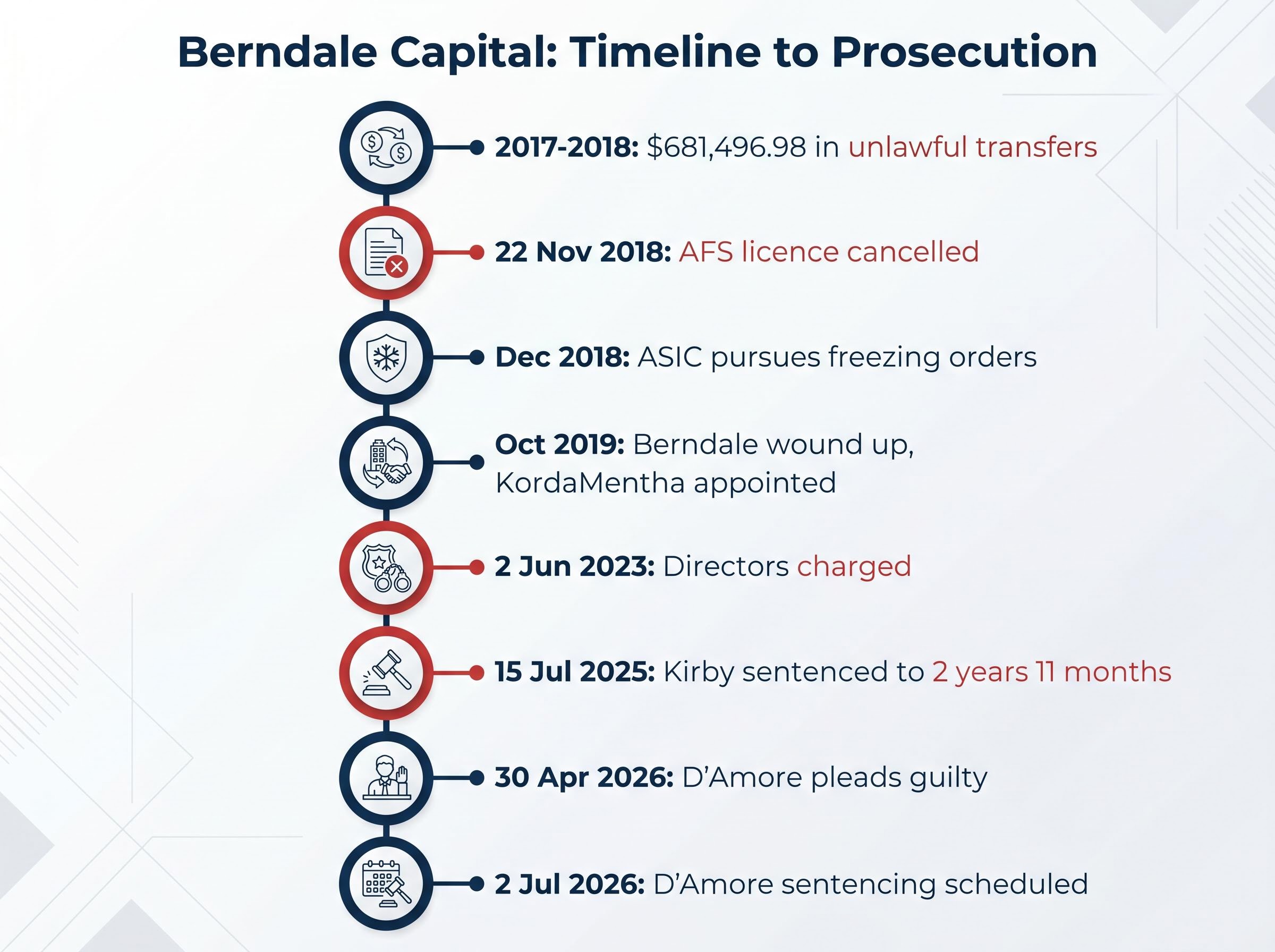
The regulatory sequence followed a recognisable pattern:
- Breach of AFSL conditions (net tangible assets and audited accounts requirements)
- ASIC statutory notices issued; Berndale failed to respond
- AFS licence cancelled on 22 November 2018 (ASIC 18-363MR)
- D’Amore received a six-year ban from providing financial services, November 2018
- ASIC pursued freezing orders in December 2018
- Berndale and associated entities wound up in October 2019
Each step in this sequence was visible in the public record. For retail investors, the lesson is that regulatory failures accumulate before they become collapses, and the pattern is often observable before funds are committed.
What retail OTC derivative brokers are required to do under Australian law
The regulatory architecture that Berndale operated within, and ultimately breached, exists because of the documented risks retail investors face in OTC derivative markets. Understanding these baseline obligations makes the Berndale failures concrete rather than abstract.
Under s912A of the Corporations Act, any entity holding an AFSL to issue OTC derivatives must meet obligations across several categories:
- Competency: Directors and key personnel must be adequately trained and qualified
- Financial resources: The firm must maintain sufficient capital to meet its obligations, including net tangible asset thresholds
- Dispute resolution: Membership of an external dispute resolution scheme is mandatory
- Compliance systems: Internal compliance arrangements must be maintained and documented
- Client money: Client funds must be handled in accordance with segregation rules, kept separate from the firm’s own operating funds
ASIC’s Regulatory Guide 239 (RG 239) is the primary guidance document for retail OTC derivative issuers. It establishes the specific obligations that interact with licence conditions, including how client money should be segregated and what disclosures issuers must make about the risks of their products.
More than 70% of retail clients lose money trading CFDs, according to ASIC product heatmap data. This loss rate is the reason the regulatory architecture imposes the requirements it does.
ASIC’s Product Intervention Order further constrains the market, imposing leverage limits of up to 30:1 for major currency pairs and lower ratios for other asset classes. These protections were designed in direct response to the consumer harm patterns observed across the sector.
Daniel Kirby’s sentencing sets the precedent D’Amore now faces
Both Berndale directors were charged on 2 June 2023 by the CDPP following an ASIC referral (ASIC 23-143MR). Their cases have since diverged in timing and, potentially, in consequence.
Kirby pleaded guilty on 16 September 2024 (ASIC 24-204MR) and was sentenced on 15 July 2025 (ASIC 25-135MR). His sentence: 2 years and 11 months imprisonment, with release after 12 months conditional on a $1,000 recognisance and three years of good behaviour. Kirby’s earlier guilty plea is relevant because sentencing courts in Australia typically apply a discount for pleas entered at an earlier stage, reflecting the savings to the court and the avoidance of a contested trial.
D’Amore pleaded guilty more than 19 months after Kirby and faces an additional charge that Kirby did not: authorising false filings with ASIC. That additional element, combined with the late timing of his plea, may narrow any sentencing discount available to him.
| Director | Charges | Guilty Plea Date | Sentencing Date | Sentence |
|---|---|---|---|---|
| Daniel Kirby | Dishonest exploitation of position; dishonest conduct in financial services | 16 September 2024 | 15 July 2025 | 2 years 11 months; release after 12 months on $1,000 recognisance, 3 years good behaviour |
| Stavro D’Amore | Dishonest exploitation of position; dishonest conduct in financial services; false filings with ASIC | 30 April 2026 | 2 July 2026 (scheduled) | Pending |
Kirby’s outcome is the most concrete data point available for calibrating what D’Amore may face. The comparison gives retail investors and the financial services industry a realistic picture of how ASIC-referred director prosecutions resolve in the Federal Court.
Seven warning signs retail investors should check before choosing a CFD broker
The Berndale collapse was preceded by warning signs that were observable in the public record. The following red flags, drawn directly from the Berndale case, ASIC guidance (RG 239, ASIC INFO 265), and the Product Intervention Order, are checks any retail investor can perform before committing funds to a CFD or OTC derivative broker.
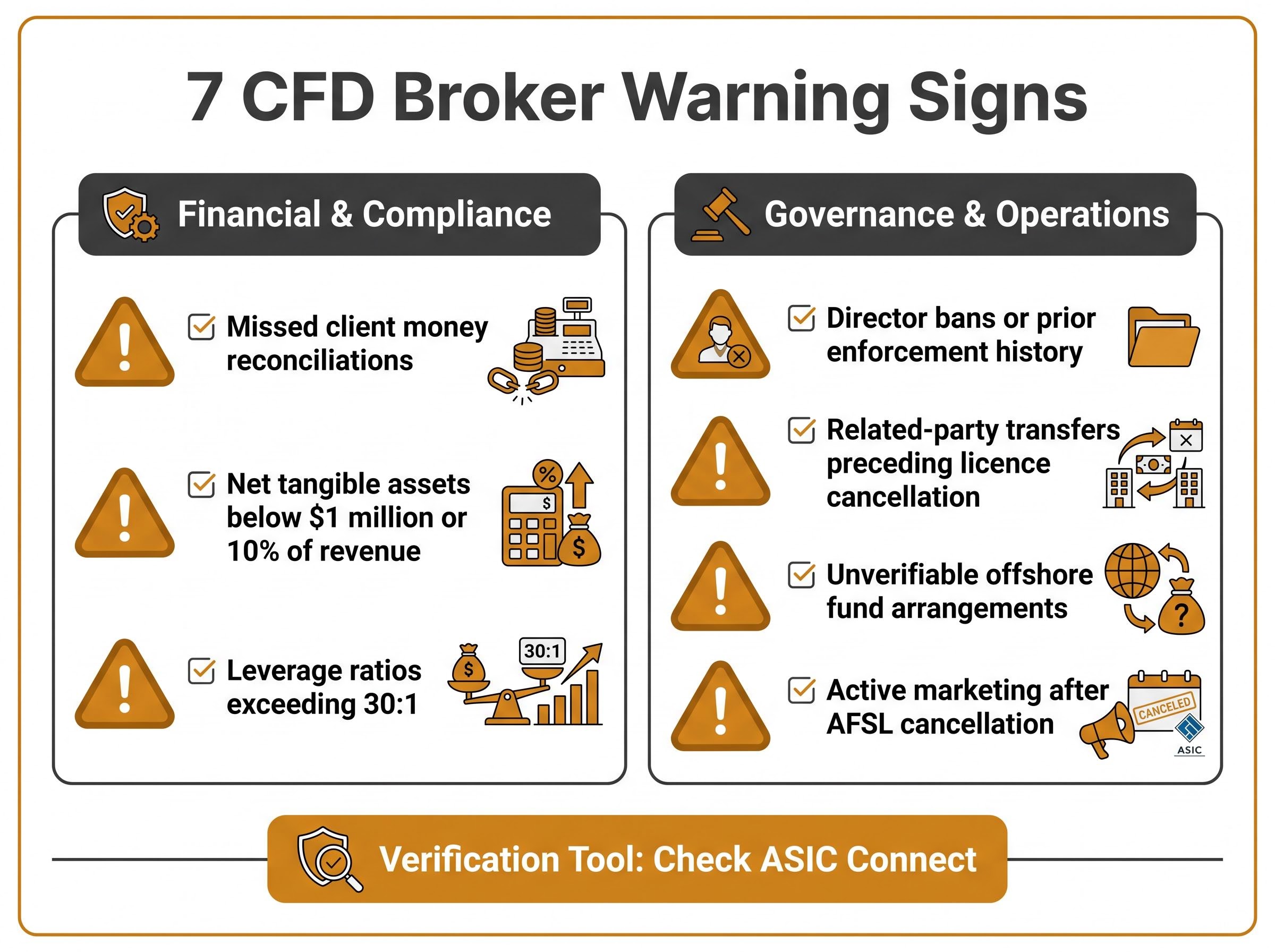
- Missed client money reconciliations: ASIC INFO 265 (April 2025) identifies client money reconciliation failures as among the most serious compliance breaches. Berndale’s client money handling was a central element of its collapse.
- Net tangible assets below threshold: Licensed brokers must maintain net tangible assets at the higher of $1 million or 10% of average revenue. Failure to meet this threshold signals financial distress.
- Leverage ratios exceeding 30:1: ASIC’s Product Intervention Order caps leverage at 30:1 for major currency pairs. Any broker offering ratios above this limit is operating outside Australian regulatory requirements.
Governance and operational red flags
- Director bans or prior enforcement history: ASIC Connect allows investors to check whether a broker’s directors have active bans or enforcement actions against them. D’Amore received a six-year industry ban in 2018, a fact that was publicly available.
- Related-party transfers preceding licence cancellation: Movements of company funds to related parties in the period before a licence is cancelled may indicate asset-stripping. The $681,496.98 in unlawful fund transfers at Berndale occurred between 2017 and 2018, the period directly preceding ASIC’s intervention.
- Offshore fund arrangements that cannot be verified: Berndale’s overseas account claims were either non-existent or inaccurate. Unverifiable offshore client money arrangements obscure fund traceability and represent a direct risk to client capital.
- Active marketing after AFSL cancellation: Any broker continuing to solicit clients after its licence has been cancelled is operating unlawfully. This is a late-stage warning sign, but one that continues to appear in ASIC enforcement actions.
Audited financial statements, not sales materials, are the appropriate basis for assessing a broker’s financial health. ASIC Connect remains the primary tool for checking bans and enforcement actions against any broker or its directors.
The Berndale case as a marker in ASIC’s approach to director accountability
D’Amore’s guilty plea is not an isolated outcome. It sits within a broader enforcement pattern in which ASIC has increasingly pursued criminal sanctions over civil penalties for cases involving retail investor harm.
Directors of AFSL holders face personal exposure under s1041G of the Corporations Act for dishonest conduct. This provision enables criminal prosecution of individuals, not just the entities they direct.
ASIC’s 2023 charge announcement against both Berndale directors confirmed that the prosecution rested on contraventions of s1041G of the Corporations Act, the provision enabling criminal liability to attach to individuals rather than the entity, a structural feature of Australian financial services law that distinguishes director prosecutions from the civil remedies more commonly pursued against firms.
ASIC’s Summary of Enforcement Outcomes: July to December 2025, published 25 February 2026, serves as the current benchmark for the regulator’s stated priorities. The Berndale prosecutions, with guilty pleas from both Kirby in 2024 and D’Amore in 2026, are being watched by the financial services legal community as evidence of ASIC’s willingness to pursue criminal charges rather than civil remedies.
ASIC’s retail client protections have been enforced not only against unlicensed or collapsed operators but against large regulated platforms: the Federal Court’s $10 million penalty against Binance Australia Derivatives in March 2026 for misclassifying 524 retail investors as wholesale clients demonstrates that the regulator applies consistent scrutiny regardless of the platform’s size or global profile.
That posture extends beyond OTC derivatives:
The Federal Court’s ruling in ASIC v Bekier extended executive compliance liability beyond financial reporting failures to encompass AML/CTF risk escalation obligations, drawing a precise line that holds executives personally responsible for controlling information flows to their boards while absolving non-executive directors who received inadequate reporting.
- A former Westpac director received a 10-year ban for insider trading (ASIC 25-200MR)
- A former NAB executive received a 5-year ban for misleading conduct (Federal Court judgment, 2025)
D’Amore’s own six-year industry ban, imposed in 2018, ran alongside the criminal prosecution, an example of how regulatory consequences can layer: administrative bans, civil proceedings, and criminal charges applied to the same individual for the same underlying conduct. Financial Counselling Australia has called for mandatory director training on derivative risks and longer personal ban durations following high-profile collapses, reflecting a broader push for accountability that the Berndale case has helped catalyse.
Berndale’s unresolved client losses and what comes next on 2 July
The criminal proceedings address D’Amore’s personal liability. They do not, on their own, return money to former clients.
KordaMentha was appointed as liquidator in October 2019. The Australian Financial Complaints Authority (AFCA) serves as the designated claims pathway for affected clients, and interim hardship payments were made through the National Guarantee Fund in 2024 (ASIC 24-204MR addendum). As of April 2026, no further distributions had been reported.
Money Management reported in February 2025 that meaningful client recovery was unlikely without asset forfeiture outcomes tied to D’Amore’s sentencing. Specific recovery figures remain unconfirmed pending KordaMentha liquidator reports or Federal Court filings. The next liquidator progress report was expected in June 2026.
Several questions remain unanswered:
- The total quantum recoverable through liquidation proceedings
- Whether asset forfeiture orders will be sought as part of D’Amore’s sentencing
- The timeline for any further distributions to former clients
What former Berndale clients can do now
Former clients with outstanding claims should contact AFCA directly. ASIC Connect can be used to check the current enforcement status of the Berndale proceedings. The two dates to monitor are the June 2026 liquidator progress report and the 2 July 2026 sentencing hearing in the Federal Court.
For former Berndale clients and for retail investors watching the case as a precedent, the 2 July sentencing will determine whether court-ordered remedies can translate criminal accountability into at least partial financial restitution. D’Amore faces charges with maximum penalties of up to 10 years imprisonment.
A case that will define director accountability in Australian financial services for years
The Berndale prosecutions have produced a documented record of what unchecked director misconduct in a licensed financial services firm looks like: layered charges spanning corporate law, financial services law, and regulatory disclosure; a co-director already sentenced; more than $8.9 million owed to former clients; and a regulator that chose criminal prosecution over civil remedies.
The 2 July 2026 sentencing of Stavro D’Amore is a live development that the financial services industry will be watching for what it signals about penalty ranges for directors of AFSL holders. For retail investors, the case offers something more immediately useful: a checklist of observable warning signs, and the tools to apply it. ASIC Connect, RG 239 guidance, and AFCA exist today for any investor willing to verify a broker’s compliance before committing capital.
This article is for informational purposes only and should not be considered financial advice. Investors should conduct their own research and consult with financial professionals before making investment decisions. Forward-looking statements regarding sentencing outcomes and asset recovery are speculative and subject to change based on judicial proceedings and liquidation developments.