

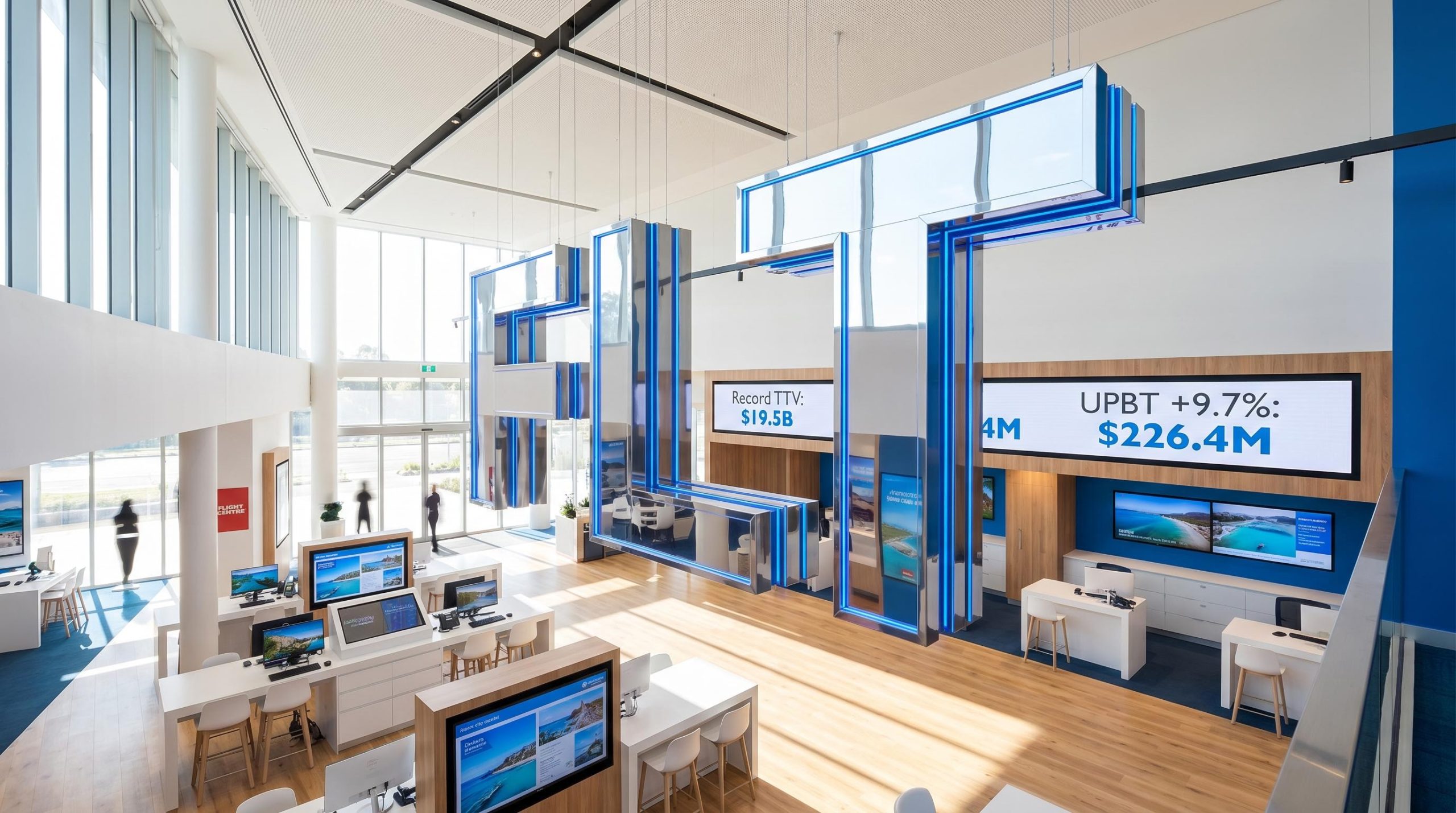
Flight Centre posts record TTV as corporate division drives profit surge
In its Macquarie Conference presentation on 5 May 2026, Flight Centre Travel Group reported Total Transaction Value (TTV) up 7.6% to $19.5 billion and Underlying Profit Before Tax (UPBT) up 9.7% to $226.4 million for the nine months to 31 March 2026. CFO Adam Campbell highlighted accelerating momentum through the third quarter, with TTV rising 6.8% to $7 billion and UPBT surging 18.5% to $102.6 million.
The company achieved record Corporate and Leisure TTV in March 2026, demonstrating resilient demand despite geopolitical disruption in the Middle East. Q3 TTV growth of 9.4% in constant currency terms materially exceeded the first-half run rate, signalling strengthening trading conditions heading into the key fourth-quarter booking period.
When big ASX news breaks, our subscribers know first
Corporate division delivers 23% profit growth on expanding service offering
Flight Centre’s corporate division delivered UPBT growth of 23% to $177 million during the nine-month period, driven by TTV growth of just 4% to $9.6 billion. This operating leverage dynamic reflects profit growth significantly outpacing TTV expansion as fixed costs are absorbed and higher-margin complementary services scale.
Productivity gains underpinned the result, with TTV per average full-time employee rising 11% compared to the prior corresponding period. The company’s US SME business delivered particularly strong performance, with profit and TTV broadly matching full FY25 results by the end of Q3.
Management highlighted the fast-tracking success of the US small-to-medium enterprise segment, which is now positioned as a material growth engine within the global corporate portfolio. The division maintained a large pipeline of potential accounts globally, supporting the medium-term growth outlook.
Revenue diversification beyond travel management
The corporate division is expanding into higher-margin complementary services that broaden client relevance and improve unit economics. These revenue streams include:
- Meetings & events (FCM Meetings & Events, Fresh)
- Payments & expense solutions (CT Pay, Melon)
- Professional consulting (FCM Consulting)
- VIP travel and entertainment services (Stage & Screen)
The company is integrating AI across its operating model to enhance customer experience while maintaining the high-touch service culture that differentiates the business. Air booking capability is being added to the Sam assistant, currently at proof-of-concept stage within FCM.
The corporate division is demonstrating classic SaaS-like dynamics where incremental revenue drops to profit at higher margins, suggesting structural improvement in earnings quality. Management’s productivity increase of 13% across the global corporate business during H1 provides evidence of this operational leverage taking hold.
Understanding travel agency operating leverage
Travel management companies generate profit through a combination of transaction-based commissions, service fees, and technology platform charges. TTV measures the total value of bookings processed rather than revenue recognised, making it a key volume indicator distinct from top-line performance.
When fixed costs such as platform infrastructure, compliance systems, and corporate overheads are absorbed across a growing transaction base, profit can expand faster than TTV. This dynamic is amplified when companies add higher-margin services—such as meetings and events, payments, or consulting—that leverage the existing client relationship without proportional cost increases.
Flight Centre’s corporate profit growth of 23% materially exceeding its TTV growth of 4% signals improving unit economics rather than pure volume expansion. The 13% productivity increase across the global corporate business during H1 demonstrates how technology-enabled efficiency gains translate into margin expansion.
This operating leverage is a hallmark of scaled service platforms where incremental transactions and complementary revenue streams flow to profit at progressively higher rates. For investors, it indicates the business is extracting more value per dollar of transaction volume processed, a key indicator of competitive positioning and pricing power.
Leisure navigates Middle East disruption with resilient demand patterns
The leisure division reported TTV up 12% to $9.6 billion and UPBT up 2% to $136 million for the nine months to 31 March 2026. The business achieved nine consecutive months of double-digit TTV growth across all categories—mass market, luxury, independent, and specialist—before facing disruption from escalating Middle East tensions in April.
Management disclosed the conflict created a circa $10 million year-on-year profit impact in April, with more than 25,000 bookings disrupted and approximately 6% cancelled. Importantly, the luxury segment demonstrated a “rerouting not cancelling” dynamic, with high-end travellers adjusting itineraries rather than abandoning trips entirely.
Customer engagement with Flight Centre’s consultant network strengthened during the crisis period. Net Promoter Scores (NPS) tracked to record levels as agents proactively contacted customers before they knew problems existed, resolved complex multi-leg itineraries under pressure, and found creative routing alternatives in real time.
Customer Reactivation
Circa 20% increase in “reactivated” customers returning to Flight Centre stores after a multi-year absence in March 2026.
This reactivation trend suggests the crisis reinforced Flight Centre’s value proposition during periods of disruption, potentially creating a lasting shift in customer behaviour toward agent-assisted bookings.
Gulf route recovery underway
Airlines have progressively resumed Middle East services as security conditions stabilised:
- Emirates: Daily or twice-daily flights from five Australian cities
- Qatar Airways: Brisbane service resuming 15 May 2026 (already operating from Sydney, Melbourne, Perth, Adelaide)
- Virgin Australia: Sydney and Melbourne to Doha services resuming 15 June 2026
Flight Centre UK achieved 92% of bookings on non-Gulf carriers by rerouting customers to alternative airlines, demonstrating the operational agility of its agent network. The company cited historical data showing Australian outbound travel has grown year-on-year in 42 of the past 50 years, with downturns typically short-lived and followed by strong rebounds—most notably +28.8% growth in CY2004 following the 2003 SARS and Iraq war declines.
Management noted that if macroeconomic volatility persists, early FY27 corporate results could face pressure from higher airfare pricing and broader demand softening, though the global corporate business has not been significantly impacted to date.
World360 Rewards launches as new growth engine
Flight Centre launched World360 Rewards, a points-based loyalty programme designed to acquire new customers and generate recurring engagement across its brand portfolio. The programme operates on two tiers—a free entry level where members earn from day one, and a paid tier offering accelerated earn rates and premium redemption options.
Early member data revealed 52% of joiners were new to the Flight Centre group, with the top joining age cohorts spanning 20–29, 50–59, and 60–69 years. The programme launched across Flight Centre, Travel Associates, and Cruiseabout brands, with plans to expand to additional banners.
The partner ecosystem includes:
- Financial partners: ANZ
- Everyday partners: Caltex, Bupa, HelloFresh, 350+ online retailers
- Travel inventory: 500 airlines, 900,000 hotels, 41 cruise lines
Members can earn and redeem points across all travel products within Flight Centre’s ecosystem, with the Travel Rewards Store positioned as the programme’s differentiator—offering superior redemption value across all product categories and destinations without blackout dates or fare restrictions.
The loyalty programme is designed to unlock partner-funded revenue streams beyond traditional transaction margins, diversify revenue pools, and provide standardised customer data across all brands. Management positioned it as a new engine of sustainable growth that expands Flight Centre’s addressable market beyond transaction-based services.
Capital management delivers on all commitments
Flight Centre completed its $200 million on-market share buyback in mid-April 2026, repurchasing 16.2 million shares representing 7.3% of shares on issue at the programme’s commencement. The buyback is materially EPS-accretive given the significant capital reduction.
The company restructured its convertible note maturity profile during FY26. In September 2025, it issued $450 million in new longer-dated convertible notes. The 2028 notes were fully retired in May 2026, while the 2027 notes were reduced to $200 million face value following $125 million in buybacks.
Shareholder returns totalled $87 million in FY26, comprising a $25 million interim dividend at $0.12 per share (fully franked, up 9% on the prior period) paid in April 2026, plus a $62 million FY25 final dividend paid in October 2025.
| Metric | Value |
|---|---|
| Total cash | $916m |
| Unrestricted cash | $621m |
| Net debt | $313m |
| Syndicated facility (undrawn) | $225m |
The extended debt maturity profile removes near-term refinancing risk, with the $125 million drawn syndicated facility maturing in April 2028 and the $171 million receivables facility maturing in December 2027. The balance sheet is well positioned heading into FY27, with substantial liquidity headroom and manageable debt service obligations.
FY26 outlook maintained despite near-term uncertainty
Management maintained its UPBT guidance range of $315 million to $350 million for FY26, acknowledging close monitoring of Middle East hostilities ahead of the key May-June booking period. The company identified potential Q4 foreign exchange headwinds from Australian dollar strength on overseas profit translation.
While the leisure business faced a circa $10 million profit impact in April, the global corporate business has not been significantly affected to date. Management noted possible flow-on effects from higher airfare pricing and macroeconomic factors if volatility continues, with any material impact more likely in early FY27 than the current financial year.
The company implemented cost discipline measures in response to the April disruption, reducing the cost margin to 9.2% after Q3. Discretionary spending was halted, support roles frozen, and investment and capital expenditure prioritised. Management is modelling scenarios to fine-tune response plans in a constantly evolving trading climate.
The guidance maintenance despite the $10 million April leisure impact suggests management confidence in the H2 recovery trajectory and the corporate division’s ability to provide a profit buffer. Heavy promotion of short- to mid-haul international travel and domestic itineraries is underway to capture demand shifting away from disrupted routes.
Strategic portfolio reshaping continues
Flight Centre progressed its divestiture programme during the period, with the Cross Hotels sale complete and the Pedal Group divestiture expected to finalise during FY26. The combined transactions represent approximately 4% of the company’s current market capitalisation and will generate a circa $30 million accounting gain in FY26, in addition to boosting cash reserves.
The company closed or pivoted several underperforming brands:
- Closures: Discova Americas, GoGo, The Travel Junction, StudentUniverse
- Strategic pivots: Topdeck (refocused on small-group tours), Liberty (rebranded Envoyage in the USA)
Acquisitions targeted defensible high-growth sectors with higher barriers to entry:
- Cruise: Iglu, Cruise Club (UK)
- Luxury: Scott Dunn
- Meetings & events: Fresh
Organic expansion accelerated in the corporate division through meetings and events, Stage & Screen (entertainment and sports travel), and energy and marine sectors. The leisure division expanded TA Reserved (luxury), Scott Dunn Hong Kong, Cruiseabout, and Cruise HQ (wholesale).
Capital is being recycled from non-core assets into cruise and luxury segments characterised by more defensible margins and structural growth tailwinds. The portfolio reshaping reflects management’s focus on capturing emerging opportunities, leveraging new technology (particularly AI), and creating longer-term shareholder value through selective capital allocation.
Don’t Miss the Next Travel & Leisure Winner
Join 20,000+ investors getting FREE breaking ASX news delivered to your inbox within minutes of release, complete with in-depth analysis. Click the “Free Alerts” button at StockWire X to start receiving alerts the moment market-moving announcements drop across consumer, finance, healthcare, tech, and manufacturing sectors.