
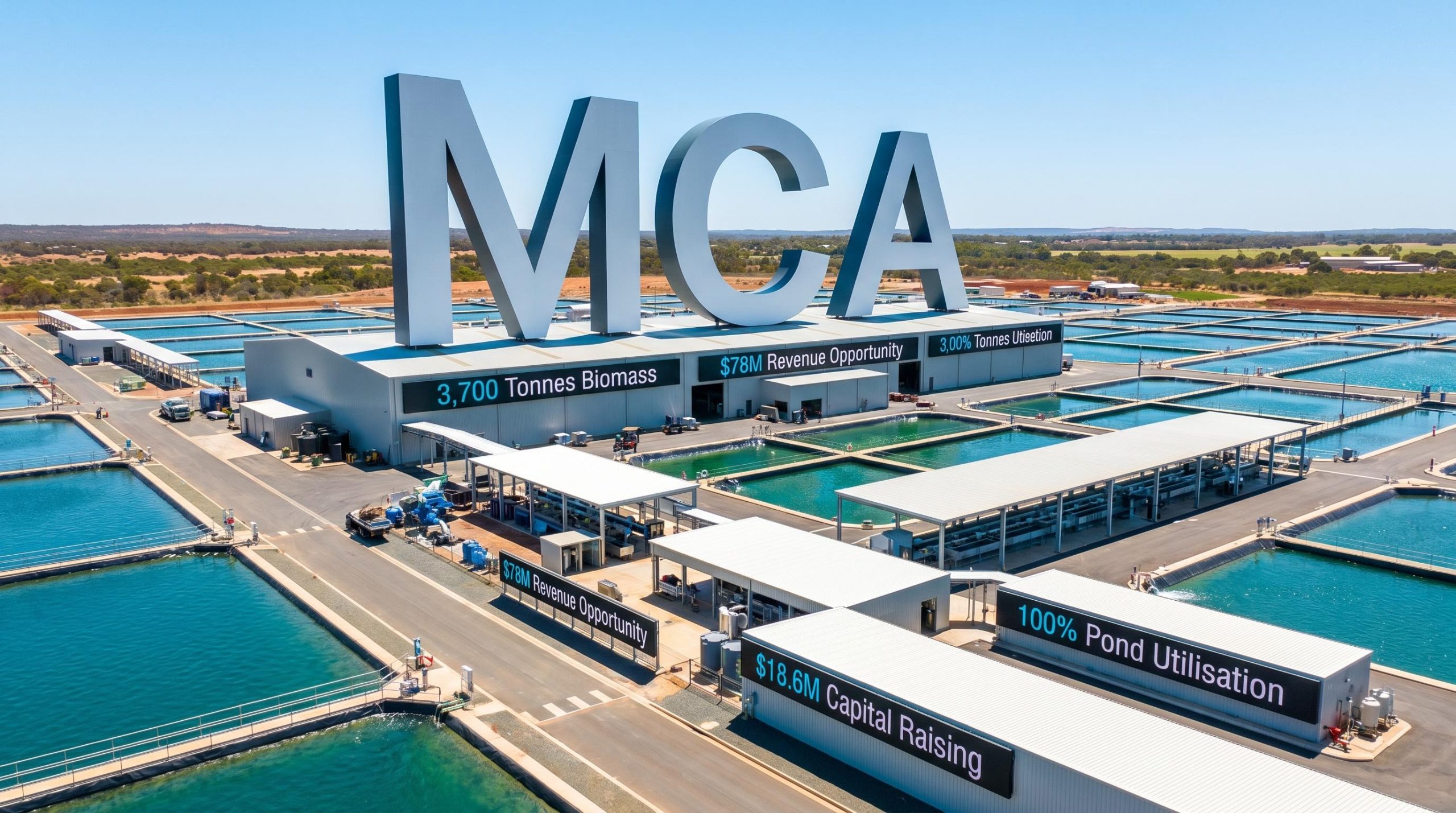
Murray Cod Australia launches $18.6 million capital raising to convert record 3,700-tonne biomass into cash
In its May 2026 capital raising presentation, Murray Cod Australia (ASX: MCA) outlined a fully underwritten 1 for 1 accelerated non-renounceable entitlement offer (ANREO) to raise approximately $18.6 million. The Offer Price is set at $0.15 per New Share, representing a 42.9% discount to the last traded price of $0.2625 on 30 April 2026 and a 27.3% discount to the theoretical ex-rights price (TERP) of $0.2063.
Ord Minnett Limited and Stralis Capital Partners Pty Ltd have been appointed as Joint Lead Managers and Underwriters. The company intends to use proceeds for general working capital to support biomass-to-cash conversion, together with growth capital to expand processing capacity and product formats.
The presentation revealed MCA holds 3,700 tonnes of saleable biomass, representing a potential $78 million wholesale revenue opportunity at current market prices. Management described the raise as providing the runway to execute a revised commercial strategy under new leadership while monetising an already-built biological asset.
When big ASX news breaks, our subscribers know first
New leadership driving strategic pivot from premium pricing to volume-led FMCG model
MCA detailed two key leadership appointments designed to realign the business. Steven Chaur commenced as CEO and Managing Director on 20 April 2026, while Jerome Joseph commenced as Chief Commercial Officer on 30 March 2026. The presentation positioned these appointments as instigating a step-change to realign MCA as a customer-led, large-scale, predictable volume-based FMCG food business driven by the experience, leadership, and commercial discipline to convert its premium biological asset of 3,700 tonnes into cash—currently estimated at $78 million in saleable fish revenues.
Management outlined a strategic pivot from the previous approach:
Previous Strategy:
- Biomass replenishment – completed
- Infrastructure build-out – completed
- Prioritise price per kilogram over volume – revised
- Export markets, high-end distribution channels – revised
- Disease prevention and management – ongoing
Revised Strategy:
- Unconstrained biomass available to sell to meet high demand for product
- Recruited sales skills in foodservice and FMCG
- Programme to drive volume uplift, predictable sales, and higher service levels
- Multi-channel domestic sales strategy focus, while nurturing existing exports
- Price set by the market and appropriate to move volume and premium
- Expand product formats to support distribution channels – frozen fillets
- Reduce costs, drive innovation and efficiencies
Both Chaur and Joseph bring FMCG and agribusiness executive experience. The presentation emphasised the shift signals operational discipline and addresses previous underperformance in converting biomass to revenue.
What is an entitlement offer and why do companies use them?
A non-renounceable entitlement offer allows existing shareholders to subscribe for new shares in proportion to their current holdings. In MCA’s case, the 1 for 1 structure means eligible shareholders can purchase one new share for every share they already own at the offer price of $0.15.
Companies choose this structure for several reasons. It treats existing shareholders fairly by offering them the opportunity to maintain their ownership percentage. It can be executed quickly, which is important when companies need capital to fund time-sensitive opportunities. Underwriting provides certainty that the full amount will be raised even if not all shareholders participate.
Shareholders who do not participate will see their ownership diluted as new shares are issued. Unlike a renounceable offer, shareholders cannot sell their entitlement rights to others—they must either take up the offer or forfeit their right to subscribe.
MCA selected this structure to address the urgent need to fund working capital for biomass conversion and processing expansion while maintaining existing shareholder participation opportunity. The fully underwritten nature ensures the company receives the full $18.6 million regardless of retail shareholder take-up.
Key dates for eligible shareholders
| Event | Date |
|---|---|
| Trading halt | Friday, 1 May 2026 |
| Announcement of Institutional Entitlement Offer | Monday, 4 May 2026 |
| Institutional Entitlement Offer opens | Monday, 4 May 2026 |
| Institutional Entitlement Offer closes | Monday, 4 May 2026 |
| Announcement of results of Institutional Entitlement Offer / Trading halt lifted | Tuesday, 5 May 2026 |
| Record Date (7:00pm AEST) | Tuesday, 5 May 2026 |
| Retail Entitlement Offer opens | Friday, 8 May 2026 |
| Settlement of New Shares under Institutional Entitlement Offer | Monday, 11 May 2026 |
| Quotation of New Shares issued under Institutional Entitlement Offer | Tuesday, 12 May 2026 |
| Retail Entitlement Offer closes | Wednesday, 20 May 2026 |
| Announcement of results of Retail Entitlement Offer | Wednesday, 27 May 2026 |
| Retail shares allotment and issue | Wednesday, 27 May 2026 |
| Retail shares commence trading on ASX | Thursday, 28 May 2026 |
| Holding statements sent for New Shares issued under Retail Entitlement Offer | Thursday, 28 May 2026 |
Eligible institutional shareholders participated in a bookbuild process on 4 May 2026. Eligible retail shareholders can participate between 8 May and 20 May 2026, with new shares expected to commence trading on 28 May 2026. All dates and times refer to Sydney, Australia and are subject to change.
Record biomass positions MCA to accelerate domestic sales strategy
The presentation detailed that MCA reached 100% pond utilisation as at 31 March 2026, with all 128 ponds stocked and operational. The biomass trajectory accelerated significantly, increasing from 2,481 tonnes at 30 June 2025 to 3,700 tonnes at 31 March 2026.
Management outlined the biomass composition, highlighting more than 90,000 premium-sized fish at 3.0kg+ commanding average prices of approximately $27/kg. The 1.0–2.0kg size grade accounts for 46% of biomass by weight and $37.3 million in wholesale value, positioning this segment as the commercial engine.
The presentation provided a detailed breakdown by size range:
- <1.0kg: 911 tonnes, $15.8 million wholesale value at $17.38/kg
- 1.0–2.0kg: 1,691 tonnes, $37.3 million wholesale value at $22.03/kg
- 2.0–2.5kg: 561 tonnes, $10.9 million wholesale value at $19.43/kg
- 2.5–3.0kg: 219 tonnes, $5.7 million wholesale value at $26.01/kg
- 3.0kg+: 318 tonnes, $8.6 million wholesale value at $27.04/kg
Management emphasised that all size grades now have available markets to sell into. Holding fish in ponds to 3kg+ weight is no longer required. New product formats (chilled and frozen) enable MCA to access new retail and distributor channels and place less reliance on harvest times and growing out biomass composition.
The infrastructure build-out is complete. The constraint is now execution (sales), not production.
Multi-channel domestic expansion roadmap
The presentation outlined a four-pronged domestic sales strategy for the next 12–18 months:
-
Grocery: Expand from 134 Woolworths stores, target Coles wet fish counter ranging, launch new second-tier brand to protect Aquna in premium customer markets, commence frozen fillet product development for FY27 across all grocery accounts, and explore collaborations with current consumer fish brands for crumbed species offerings.
-
Foodservice: Accelerate partnerships with major national distributors (PFD, Bidfood, Foodlink) to drive increased volume. Management noted the frozen shatter pack Aquna fillet range is already in market. Additional foodservice sales representatives will be deployed in Victoria and Queensland. Targets include replacing Barramundi, Flathead, Snapper, and ‘fish of the day’ volumes with large venue operators such as ALH, Merivale, Sodexo, and Compass.
-
Wet Fish Distributors: Engage the top 5–10 state volume distributors with new pricing and volume agreements and incentive targets. Pricing will be market-set versus company-set to drive volume uplift. MCA aims to remain competitive with other species while retaining Aquna premium pricing. This channel is focused on larger fish and small plate fish, leveraging current biomass to move unconstrained volumes.
-
Export: Nurture existing relationships in Singapore, Hong Kong, and Japan as a priority. Maintain distributor relationships in China, the Middle East, and North America while retaining domestic market focus. The frozen fillet product enables easier market access and establishment of local in-market distributors. Management will pursue customer acquisition on an enquiry basis versus a current push strategy for the next 12–18 months.
New product formats—frozen bulk pack fillets for foodservice and export, and frozen retail products for grocery—enable easier market access domestically and internationally. The strategy reduces reliance on single customers or export markets and addresses timing constraints inherent in fresh product distribution.
Investment thesis: converting biological assets to cash under proven FMCG leadership
The presentation synthesised the investment case around four pillars. First, the asset base: 3,700 tonnes biomass represents a $78 million wholesale revenue opportunity at current prices. Second, the infrastructure: 128 ponds at 100% utilisation with approximately 4,000 tonne capacity. Third, the leadership: new CEO and CCO with FMCG and agribusiness track records. Fourth, the capital: $18.6 million raise to fund working capital and processing expansion.
Management positioned Murray Cod as native only to Australia, with no commercial wild fishing allowed and limited import competition. Growing Australian seafood consumption, which has reached 25–25.2kg per capita annually, underpins domestic demand. The fish is not a globally farmed species, providing MCA with direct exposure to a high-quality, scarce biological asset.
Competitive advantages outlined in the presentation include:
- Land-based biosecurity: Each pond can be isolated with dedicated piping, wiring, and catchment zones, allowing better control over water quality, feed delivery, and dissolved oxygen levels.
- Lower cost base: No ships, boats, or exposure to bad weather variability. Calm freshwater reduces unanticipated maintenance or damage. Less regulatory complexity compared to marine aquaculture.
- Sustainability certifications: 3-Star BAP, Kosher, and Halal certifications support growth in key domestic channels including grocery, airlines, and hotel chains. Nutrient-enriched water is recycled through production units, then used to irrigate adjoining crops and pastures.
- Optimal biomass composition: 1.7 million fish at 1.0kg+ with an average weight of 1.65kg. Improved feed formulations and optimised feeding methods (CSIRO trials underway) support accelerated summer growth.
The raise is designed to bridge the gap between biological asset value and realised revenue. Execution under new leadership is the key variable for investors to monitor.
Want the Next Consumer Staples Breakout in Your Inbox?
Join 20,000+ investors receiving FREE breaking ASX news within minutes of release, complete with in-depth analysis. Big News Blast delivers capital raisings, strategic pivots, and market-moving announcements straight to your inbox. Click the “Free Alerts” button to get ahead of the market.