
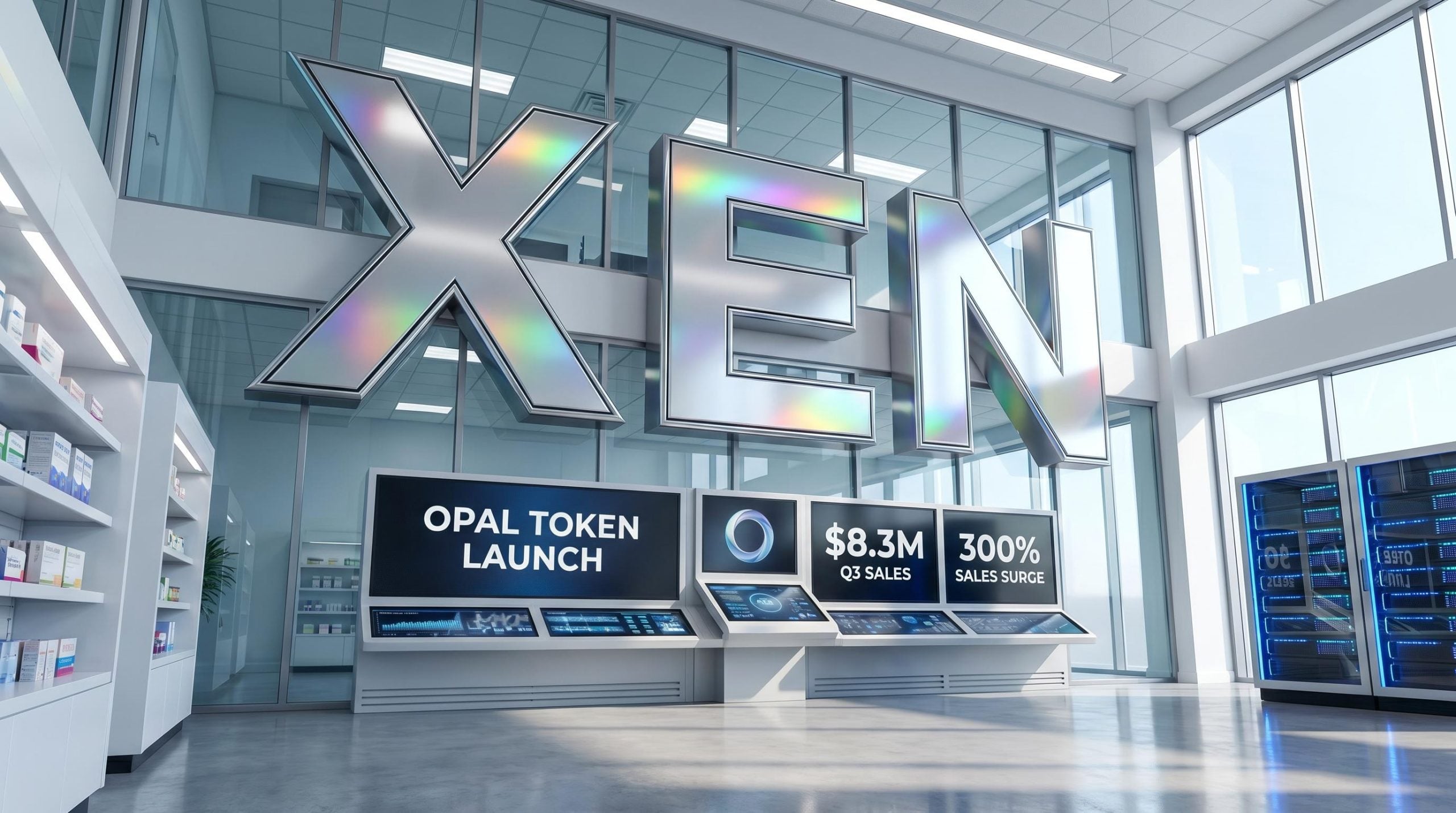
Xenitra delivers 300% sales surge and launches OPAL tokenised sales ecosystem
In its Q3 FY26 quarterly update, Xenitra Limited (ASX: XEN) reported a more than 300% quarter-on-quarter increase in sales to $8.3 million (preliminary unaudited), driven by renewed momentum in its Nutritionals business and the Xenitra OPAL tokenised sales launch. Cash receipts from customers rose by over 200% versus Q2, signalling a sharp return in sales velocity.
Management reported that sales in March alone surpassed $4 million, which Chairman Anthony Noble said represents an “almost full recovery [to] the annualised sales levels of FY24, after a year of business restructuring and turnaround.” At the same time, the company initiated two new high-margin business units, OTC Medicines and RWA-Tokenised Sales, which are expected to materially improve operating cash flow and profit margins in coming quarters.
During the quarter, Xenitra launched its OPAL token, a blockchain-based utility and membership token that underpins its new RWA-Tokenised Sales ecosystem. The launch generated more than $100,000 of initial sales within the first week, with more than 20 distributors already onboarded.
For investors, the combination of a sales rebound, structural cost reductions, and the introduction of higher-margin channels suggests Xenitra is moving from a turnaround phase into a growth-focused operating model.
When big ASX news breaks, our subscribers know first
What is RWA tokenisation and why does it matter for FMCG?
Real World Asset (RWA) tokenisation refers to the process of creating digital tokens on a blockchain that represent claims tied to physical or financial assets. In Xenitra’s case, the OPAL token is used as a utility and membership token that sits alongside fast-moving consumer goods (FMCG) products rather than replacing them.
The company described OPAL as a blockchain based utility and membership token owned by Xenitra that is physically and/or digitally associated with products. Consumers in Asia accumulate tokens through purchases of products distributed by Xenitra and can then exchange these tokens for rewards inside a defined ecosystem.
In practical terms, when a participating product is purchased, OPAL tokens linked to that product are automatically distributed to the consumer’s account. These tokens then have “utility within the rewards ecosystem”, which, according to the company, increases engagement and retention and supports repeat purchases over time.
The company characterises this as a self-reinforcing commercial flywheel. Product purchases drive automatic token distribution, which encourages consumers to interact with the rewards ecosystem and redeem benefits. This interaction is intended to deepen loyalty and shift customers from being passive buyers to active participants who drive repurchase and potentially promote brands within their networks.
The funding model is designed so that the sales ecosystem is largely self funding. Xenitra stated that a percentage of the sales value is retained and invested in a Token Reserve to fund customer rewards, with margins also structured to fund sales and marketing costs. This means the tokenised sales model can, in the company’s view, scale across multiple brands and markets without requiring high levels of additional working capital.
For FMCG distribution economics, this structure is significant. It offers a potential pathway to:
- Higher gross margins per unit sold.
- More scalable growth, as incremental sales can be supported by the token reserve mechanism rather than proportional capital investment in promotions.
- Stronger, data-rich relationships with end consumers, despite operating through distributor and e-commerce channels.
For investors, this represents a materially different earnings profile compared with traditional distribution, where expansion typically requires increased working capital and marketing spend to support growth.
OPAL tokenised sales launch delivers early commercial validation
Xenitra reported that its RWA-Tokenised Sales ecosystem is now live with the OPAL token at its core. The first products integrated into the OPAL token sales ecosystem are from EZZ, which the company states are exclusively distributed globally by Xenitra.
In the first week after launch, more than $100,000 of initial sales were generated within the OPAL ecosystem, with more than 20 distributors already onboarded. Management noted that the sales impact of tokenised products in Xenitra’s distribution contracts is expected to be significantly higher than the offtake value of equivalent non-tokenised contracts, as margins in this channel are described as considerably higher than those in the existing Nutritionals and OTC Medicines channels.
Multiple additional brands are already earmarked to launch in the ecosystem over the coming months and years, with plans to expand across broader product categories and geographies. According to the company, tokenisation has been designated a core sales strategy and is expected to be scaled quickly as more brands join.
Chairman Anthony Noble
“The launch of our first tokenised products marks a significant milestone for Xenitra. Strong early uptake from our distributor network in China highlights the commercial potential of this strategy and provides early validation of the model.”
From an investment perspective, the early sales velocity and distributor onboarding provide an initial commercial proof-of-concept for the tokenised model ahead of a wider rollout. If margins track as management expects, incremental OPAL-linked sales could have a leveraged impact on future profitability relative to traditional wholesale distribution.
Nutritionals business secures $30m Rockcheck offtake agreement
Within the Nutritionals division, Xenitra secured an offtake agreement for Danone products with sales targets of 140 million RMB (approximately $30 million) over a one-year period from 1 May 2026 to 30 April 2027 with Rockcheck Group.
Rockcheck has been a key B2B customer since 2023, with FY26 sales to date of more than $10 million. The new agreement includes an option to extend for a further three years, subject to successful completion of the first quarter of sales under the arrangement.
The company also signed a supply framework agreement that establishes Xenitra’s Australian trading subsidiary as an authorised supplier to Rockcheck. This framework allows Xenitra to procure products in Australia and sell them B2B into Rockcheck Group companies in China. Management highlighted that this sits alongside sales through Xenitra’s existing e-commerce network covering major platforms in China, suggesting potential for incremental volumes and product lines over time.
For investors, the Rockcheck offtake agreement effectively provides a revenue floor of around $30 million for the Nutritionals division in FY27, while the broader supplier status with Rockcheck creates scope for additional SKU and brand expansion beyond the initial Danone product set.
OTC Medicine business established via Fukang acquisition
Xenitra has also moved to establish its OTC Medicine business unit through the acquisition of Fukang. The company reported that it has acquired:
- The Hong Kong Pharmaceutical License.
- The Hong Kong pharmaceutical licence premise lease.
- An online store group across JD Health and Tmall.
- Class 35 Trademarks.
- Warehouse Logistics Service from Hong Kong Kanghong Pharmaceutical Group Co., Ltd.
The company received authorisation for a Hong Kong pharmaceutical wholesale license and to launch its cross-border OTC Medicine business on 18 December 2025. The Fukang acquisition now enables Xenitra to assume those operations directly and expand its OTC product offering into the China market under the Hong Kong Pharmaceutical licence and the established Fukang eCommerce shopfronts.
Xenitra stated that it has commenced operations of the Fukang digital sales and marketing ecosystem and will be fully resourcing the OTC medicine function from May. Active negotiations with key OTC brands are ongoing, with new product launches expected over Q4 and the business unit expected to be operating at scale by Q1 FY27.
For investors, Fukang provides a form of turnkey infrastructure, combining regulatory licence, physical premises, existing online storefronts and logistics support. This reduces the time and capital typically required to enter a regulated medicines category and potentially accelerates revenue generation from the OTC segment.
Financial position and corporate restructuring progress
At 31 March 2026, Xenitra reported cash and cash equivalents of $1.83 million, current trade receivables of $1.7 million, and other receivables of $300,000 (including monies owed by joint venture partners). The company indicated it expects to receive approximately $2.0 million of receivables during Q4, which it believes will provide sufficient working capital for ongoing operations.
The company has continued to execute its corporate restructuring and cost-reduction programme. Staff Costs were reduced to $301,000, a 37% reduction versus the prior corresponding period (Q3 FY25). Administrative Costs fell to $317,000, a 50% reduction over the same comparison.
Xenitra also invested $8 million in inventory across the quarter to support strong growth in the Nutritionals business and the launch of the OTC and Tokenised Sales business units. According to the Appendix 4C, the company’s estimated quarters of funding available as at quarter end stood at 1.4 quarters.
Management stated that the restructuring and cost-reduction programme, which includes exiting joint ventures and reducing head office overheads, remains on track to deliver expected savings of $1 million per annum compared with the prior corporate structure. The company expects this programme to be completed by the end of Q4.
Key cost and balance sheet metrics are summarised below.
| Metric | Q3 FY26 | Change vs PCP |
|---|---|---|
| Staff Costs | $301k | -37% |
| Administrative Costs | $317k | -50% |
| Cash at Quarter End | $1.83m | n/a |
| Trade Receivables | $1.7m | n/a |
Because the reported funding runway is relatively tight at 1.4 quarters, investors are likely to focus on the timing of the expected $2.0 million in receivables, the impact of extraordinary cash outflows that are not expected to recur, and the contribution of the higher-margin business units to operating cash flow.
Xenitra addressed this in the Appendix 4C, stating that operating cash flows are expected to materially improve due to (i) the non-recurrence of an extraordinary $460,000 refund paid in Q3, and (ii) the receipt of receivables in Q4. The company also reiterated its expectation that it can continue operating and meet business objectives based on these expected inflows.
Looking ahead to Q4 and FY27
Chairman Anthony Noble outlined three strategic growth pillars that are expected to drive results in Q4 and FY27:
- Nutritionals: supported by the $30 million Rockcheck offtake agreement, which provides a floor to FY27 revenue and a pathway for additional product lines into Rockcheck’s network in China.
- OTC Medicines: scaling from May as the Fukang acquisition is fully integrated, with new OTC product launches anticipated during Q4 and full-scale operations targeted for Q1 FY27.
- Tokenised Sales: expanding OPAL-based sales across additional brand partners, product categories and geographies, leveraging higher-margin tokenised distribution.
Noble noted that the value of the two new business units (OTC Medicines and RWA-Tokenised Sales) is not reflected in the strong Q3 result, as they were in launch and setup stages during the quarter, but he indicated that they will begin contributing sales in Q4.
The company also stated that it expects to provide further articulation of the Strategic Growth Pillars for FY27 in the coming weeks, signalling additional detail on how these three pillars will be scaled and prioritised.
Key near-term catalysts highlighted include:
- OTC Medicine product launches expected in Q4.
- Rockcheck offtake agreement commencing on 1 May 2026.
- Additional brand partners joining the OPAL tokenised ecosystem.
For investors, Q4 appears to be a transition quarter in which Xenitra’s new higher-margin channels begin to show through in reported revenue and cash flow. If execution aligns with management commentary, FY27 results may reflect a business with a more diversified revenue base, structurally higher margins, and a differentiated RWA-Tokenised Sales model alongside its established Nutritionals operations.
Want the Next Consumer Stock Breakout in Your Inbox?
Join 20,000+ investors receiving FREE ASX Consumer alerts delivered within minutes of release, complete with in-depth analysis. Click the “Free Alerts” button at Big News Blast to get breaking news and expert coverage the moment market-moving announcements drop.