Gold pushed past $4,700 per ounce in late April 2026, while West Texas Intermediate crude exceeded $103 per barrel. These commodity spikes have arrived against a backdrop of sticky global pricing pressures, creating a challenging environment for capital preservation. The International Monetary Fund projects 4.4% headline inflation for the year, prompting major central banks to maintain cautious policy holds.
This prolonged environment of elevated costs forces market participants to rigorously reassess their capital allocation. Crafting an effective inflation investment strategy requires moving beyond reactive portfolio adjustments and understanding the deeper macroeconomic currents. Investors must distinguish between short-term geopolitical shocks and structural economic shifts to protect their wealth.
This analysis decodes current market signals to provide an actionable framework for protecting purchasing power. The following sections outline systematic approaches for accumulating financial assets during periods of economic turbulence. By matching specific asset classes to prevailing monetary conditions, market participants can turn volatility into an accumulation mechanism.
Assessing the April 2026 Macroeconomic Crosscurrents
The immediate impact of Middle Eastern conflicts has materialised clearly in petroleum costs and broader financial market sentiment. Gold spot prices peaked at $4,702 per ounce on 27 April, reflecting elevated demand for safe-haven assets. Concurrently, West Texas Intermediate April 2026 futures are trading at approximately $103.36 per barrel.
However, the shape of the forward energy curve tells a different story from the daily headlines. A distinct backwardation has emerged in oil futures, signalling that financial participants anticipate a rapid resolution to immediate supply constraints. Buyers are willing to pay a premium for immediate delivery, pricing the geopolitical shock as a contained disruption rather than a permanent structural deficit.
These short-term inflationary spikes obscure powerful global deflationary catalysts active throughout 2026. JP Morgan forecasts global core inflation will settle at 2.8% for the year, highlighting a stark divergence from the headline commodity noise.
The April 2026 IMF World Economic Outlook emphasizes that while immediate geopolitical conflicts exert upward pressure on commodity prices, the underlying economic growth dynamics still support a broader disinflationary trend.
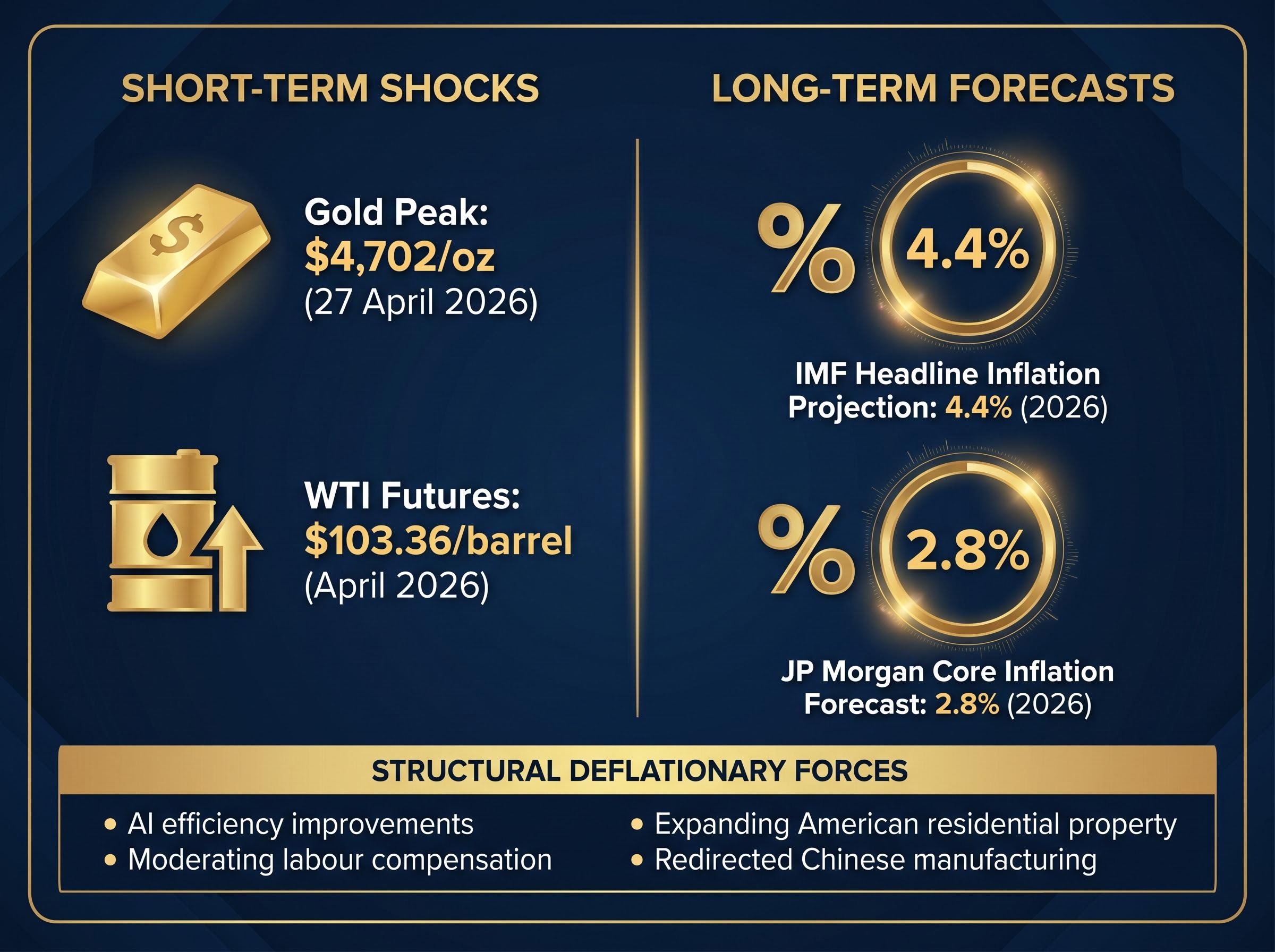
Baseline Projection Context According to the International Monetary Fund, global headline inflation is projected to reach 4.4% in 2026 before entering a period of sustained decline in 2027.
Investors who can distinguish between temporary geopolitical friction and long-term economic trends are better positioned to prevent panic-driven portfolio adjustments. Several structural forces are actively suppressing long-term cost escalation:
Artificial intelligence efficiency improvements accelerating commercial productivity Moderating labour compensation growth across major developed economies Expanding American residential property availability easing shelter costs Redirected Chinese manufacturing outputs saturating global consumer goods markets
When big ASX news breaks, our subscribers know first
The Mechanics of Price Escalation and Capital Depreciation
Understanding how unhedged cash loses purchasing power begins with the mechanics of monetary policy. Supply-side energy disruptions historically force central banks into difficult positions, often requiring temporary rate hikes or prolonged policy holds. When the cost of production inputs rises, central banks adjust benchmark lending rates to suppress societal consumption and stabilise domestic pricing.
Because broad price appreciation silently erodes the purchasing power of uninvested capital, central banks manipulate these benchmark rates to trigger economic cooling before structural damage occurs.
Excessive cost growth actively harms economic output by eroding consumer discretionary spending. Conversely, moderate price appreciation encourages commercial expansion by incentivising investment over cash hoarding. As of February 2026, the Organisation for Economic Co-operation and Development reported a headline inflation metric of 3.4%.
This environment dictates central bank behaviour. According to economic models, historical implementations of the Taylor Rule suggest policymakers typically require 1.5% in rate hikes for every 1% of excess inflation. While major institutions are not currently hiking, they are holding rates at restrictive levels to ensure target compliance.
| Central Bank | Current Policy Stance (April 2026) | 2026 Inflation Forecast / Target |
|---|---|---|
| European Central Bank | Maintained restrictive hold; active debate on future hikes | 2.6% revised forecast |
| U.S. Federal Reserve | Holding rates restrictive; potential late-2026 cuts if pressures ease | Targeting return to 2.0% |
| Bank of Canada | Holding benchmark rate at 2.25% | Managing balanced economic risks near 2.0% |
Uninvested capital degrades rapidly under these conditions. The gap between cash yields and real-world cost escalation forms the mathematical necessity for defensive asset allocation.
Tactical Asset Allocation for Sustained Inflation
A sustained period of elevated capital costs requires immediate sector rotation to shield portfolios. Investors must secure vehicles that offer protected yields or act as core inflation hedges. Treasury Inflation-Protected Securities and I Bonds provide direct mathematical links to inflation indices, preserving baseline purchasing power.
Alternative assets also serve distinct defensive functions. High-yield savings accounts protect liquid reserves, while real estate investment trusts, Gold IRAs, and Crypto IRAs offer non-correlated stores of value. Capital must simultaneously flow away from assets vulnerable to persistent pricing pressures.
Long-duration bonds suffer severe capital depreciation as their fixed yields lose purchasing power over time. Furthermore, speculative high-growth equities struggle when elevated discount rates compress their future earnings valuation.
| Core Hedging Assets | Vulnerable Assets to Avoid |
|---|---|
| Treasury Inflation-Protected Securities (TIPS) | Long-duration government bonds |
| Real Estate Investment Trusts (REITs) | Speculative high-growth equities |
| Physical gold and Gold IRAs | Fixed-rate corporate debt instruments |
| High-yield savings accounts | Unhedged cash equivalents |
Selecting Equities with Pricing Power
Defensive equity plays require targeting corporations with impeccable balance sheets and sufficient market dominance to transfer operational expenses to consumers. Utilities, healthcare, and renewable energy stand out as primary defensive sectors. These industries provide non-discretionary services, ensuring demand remains inelastic even as consumer budgets tighten.
Identifying companies capable of passing elevated freight and compensation expenses onto consumers is highly important. Resilient international enterprises typically possess high gross margins, distinct competitive moats, and low capital intensity. When an enterprise can raise prices without sacrificing volume, it turns inflation from a margin threat into a revenue driver.
For readers interested in how rising input costs are splitting market returns, our detailed coverage of inflation impacts on stock sectors examines the stark divergence between margin-squeezed aviation companies and resilient value retailers.
Systemizing Global Diversification and Opportunistic Accumulation
Market volatility shifts from a risk into an accumulation mechanism when approached with structural discipline. Geographically distributed equity holdings are necessary for effectively diversifying portfolios away from localised geopolitical turbulence. Broad international exposure vehicles provide immediate access to this scale.
Observing how global conflict reallocates investment capital provides critical insight for building a resilient portfolio, as institutional money rapidly shifts away from vulnerable consumer sectors toward fortified technology and alternative energy infrastructure.
This specific global diversification spans premier corporations across developed jurisdictions. Such breadth ensures that localised supply chain shocks or regional rate holds do not disproportionately damage total portfolio returns.
The structural optimisation of acquiring financial assets relies on executing purchases at predetermined intervals. Maintaining highly liquid capital reserves is vital for capitalising on severe market downswings. When high-conviction market dislocations materialise, cash readiness allows for rapid execution of discounted global securities.
Implementing a predetermined wealth accumulation schedule requires a systematic approach:
- Establish a target allocation percentage for international equities and inflation-protected fixed income.
- Automate baseline monthly capital deployments regardless of current headline volatility.
- According to financial advisors, maintain a strategic cash buffer equivalent to 10% to 15% of the total portfolio value.
- Deploy excess reserves aggressively when broad market indices experience drawdowns.
- Rebalance quarterly to ensure regional exposures align with the original geographic diversification target.
Securing Long-Term Yields in a Fragmented Global Market
Managing the macroeconomic crosscurrents of 2026 requires a disciplined synthesis of defensive positioning and aggressive accumulation. Success depends on balancing immediate inflation hedging with the steady acquisition of discounted global assets during uncertain economic cycles.
Market participants must base their capital allocation on underlying deflationary data and central bank mechanics, rather than reacting impulsively to short-term geopolitical headlines. The divergence between temporary commodity spikes and long-term technological efficiency provides a distinct advantage for methodical investors.
Recent BIS macroeconomic research on AI confirms that machine learning adoption drives sustained productivity gains, which act as a structural counterweight to short-term inflationary shocks.
Investors should conduct an immediate audit of their current asset allocation against these recommended fixed-income and globally diversified equity strategies. Rebalancing away from vulnerable long-duration debt and toward entities with proven pricing power will fortify portfolios against persistent cost pressures.
This article is for informational purposes only and should not be considered financial advice. Investors should conduct their own research and consult with financial professionals before making investment decisions. Past performance does not guarantee future results, and financial projections are subject to market conditions and various risk factors.