Australian inflation reached a persistent 4.6% in the March 2026 quarter, while geopolitical conflict pushed global oil prices near $120 per barrel. The Reserve Bank of Australia is trapped between these international supply shocks and a domestic consumer market that refuses to cool. Retail portfolios are facing intense pressure as these dual forces compress standard investment returns and erode forward earnings projections.
Constructing an approach for investing during inflation requires more than just holding traditional defensive assets. Passive allocations that worked during the previous decade are now actively losing purchasing power on a real-return basis. This guide provides a clear framework to restructure capital for resilience and protect wealth against the current macroeconomic pressures.
Investors will learn how to diagnose portfolio vulnerabilities and execute a systematic defence against elevated cash rates. By understanding the underlying economic triggers, readers can position their assets to weather supply chain volatility and prolonged geopolitical stress. The goal is to move from reactive anxiety to disciplined, structured capital deployment that thrives despite the Australian CPI data.
The Mechanics of Modern Wealth Erosion
Widespread price increases fundamentally diminish the purchasing power of uninvested capital. When the cost of everyday goods rises faster than the yield on standard savings accounts, bank deposits generate negative real returns. The Australian economy in early 2026 is demonstrating exactly how this structural wealth erosion occurs for retail investors.
A cash balance held in a standard account is actively losing value when measured against the rising cost of living. Consumer demand is actively wrestling with severe supply chain blockades to create this challenging environment. The latest CPI data shows a year-on-year increase of 4.6% and a quarter-on-quarter jump of 1.1%.
The official Australian Consumer Price Index data confirms that domestic price pressures remain stubbornly above target levels, complicating the central bank’s path toward monetary easing.
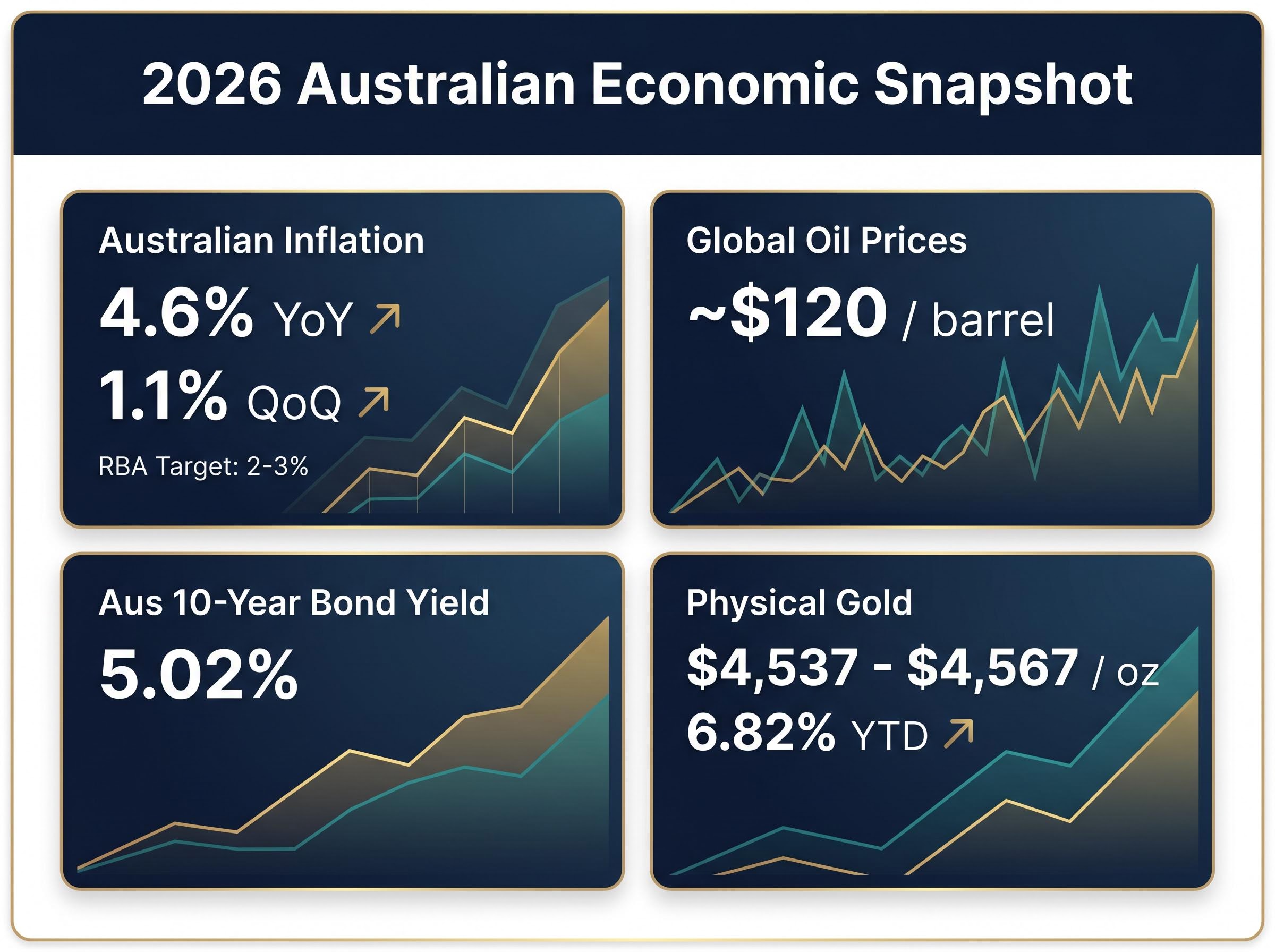
This keeps national price growth firmly above the RBA target band of 2-3%. As a result, policymakers are forced to maintain restrictive monetary conditions that ripple through every asset class. However, the current economic environment is not a simple case of uniform price increases across all sectors.
Conflicting forces are pulling the global economy in opposite directions simultaneously. Identifying these crosscurrents is the first step in building a defensive portfolio that can withstand 2026 market conditions.
Supply-side inflation: Geopolitical port blockades are driving up energy transport costs and disrupting global shipping routes. Demand-side pressure: Domestic consumption remains elevated despite higher borrowing costs impacting household budgets. Technological disinflation: Artificial intelligence efficiency gains are structurally lowering corporate operational expenses across the services sector. Labour market shifts: Cooling worker compensation is beginning to offset broader wage-driven inflation in specific industries.
Understanding these competing factors ensures investors know exactly what forces their portfolio is fighting against. A static portfolio cannot absorb the compounding damage of sustained 4.6% inflation without suffering structural capital degradation. To maintain long-term wealth, capital must be deployed into vehicles that can outpace this specific combination of macroeconomic pressures.
When big ASX news breaks, our subscribers know first
Reassessing Traditional Safe Havens Under Pressure
Historical assumptions about defensive assets are fracturing under the weight of rising bond yields and shifting monetary policy. Investors retreating into conventional safe assets often discover these instruments perform poorly in an elevated interest rate environment. The current geopolitical climate has completely altered how traditional safety nets function within a diversified portfolio.
The Taylor Rule suggests that central banks must raise nominal interest rates by more than the increase in inflation to create genuinely restrictive monetary conditions. This theoretical framework is playing out in real time across global fixed-income markets. As central banks hold rates higher for longer, the mechanical relationship between yields and bond prices punishes passive investors.
These prolonged elevated interest rates also mechanistically depress equity valuations by expanding discount rates and constraining the spending power of the underlying consumer base.
Australian 10-year government bond yields have risen to 5.02%, putting intense downward pressure on the capital value of existing fixed-rate bonds. Meanwhile, physical gold has benefited directly from geopolitical stress and supply chain blockades. Physical gold is trading between $4,537 and $4,567 per troy ounce, reflecting a year-to-date return of roughly 6.82%.
| Asset Type | Traditional Role | 2026 Performance Reality | Risk Factor |
|---|---|---|---|
| Long-Duration Bonds | Capital preservation | Falling capital value under 5.02% yields | Interest rate duration risk |
| Physical Gold | Inflation hedge | Trading at $4,537 to $4,567 (6.82% YTD) | No yield generation |
| Short-Term Debt | Liquidity management | Stable principal with rising cash rates | Reinvestment risk |
| Broad Equities | Growth engine | Mixed results based on pricing power | Margin compression |
Navigating Fixed Income Nuances
The current rate environment requires a clear distinction between long-duration bonds and short-term high-quality debt. Long-duration government bonds carry significant duration risk, meaning their underlying prices fall sharply when the RBA raises the cash rate. Investors holding these instruments to maturity will receive their principal, but the opportunity cost of holding depreciating assets is severe.
Short-term debt instruments are far less sensitive to these central bank adjustments because their capital is returned and reinvested quickly. Furthermore, inflation-protected securities offer a localised buffer by linking their principal value directly to consumer price indexes. Shifting fixed-income allocations toward these shorter-duration and inflation-linked assets provides superior capital preservation while generating reliable yield.
Targeting Pricing Power on the ASX
Protecting wealth requires moving from defence to offence by identifying companies that can absorb rising input costs. Pricing leverage is the ultimate corporate shield against widespread price increases and supply chain disruptions. Companies with this leverage can pass higher operational expenses directly to consumers without sacrificing overall product demand.
The ASX 200 is currently trading near the 8,710 mark, but performance beneath the index level is heavily divided by this pricing power. When evaluating equities, investors should target benchmark profitability metrics like a Return on Equity (ROE) greater than 15%. This metric indicates that management is efficiently generating profits from shareholder capital despite the broader inflationary pressures.
Strong profitability must be paired with low debt-to-equity ratios to survive the current interest rate cycle. High corporate debt becomes a massive liability if the RBA initiates further cash rate hikes to combat the 4.6% inflation reading. Companies requiring constant debt refinancing will see their margins destroyed by rising interest expenses long before supply chains normalise.
Institutional Strategy Outline “Investors should exercise caution around rate-sensitive assets while maintaining diversified portfolios with a long-term outlook, as trimmed mean inflation is expected to moderate only gradually.”
Sector Specific Opportunities
Certain market segments traditionally maintain their margins during economic constraints due to the non-discretionary nature of their services. Technology and healthcare firms often operate with minimal physical supply chain vulnerability, insulating them from current shipping blockades. Mach7 Technologies (ASX: M7T) functions as a targeted healthcare example, noted for its low debt profile and strong growth potential.
Broad market exposure also plays a critical role in capturing structural pricing power without taking on single-stock risk. Consumer staples exchange-traded funds maintain stable earnings across volatile cycles because their underlying companies sell essential daily goods. Vehicles like the Vanguard Australian Shares Index ETF (ASX: VAS) capture high-quality domestic firms that can defend their margins against escalating input costs.
Individual constituents often demonstrate this resilience firsthand, with recent Coles Group financial performance revealing strong margin expansion and solid earnings growth despite broader macroeconomic headwinds.
Executing a Disciplined Capital Deployment Strategy
Translating macroeconomic theory into actual portfolio defence requires a mechanical execution plan that prioritises consistency. Trying to time the geopolitical news cycle usually results in reactive trading, poor entry prices, and crystallised losses. A systematic approach removes the anxiety of market volatility and ensures capital is deployed logically regardless of the daily headlines.
Systematic investing actively lowers average purchase costs over an extended timeframe by capitalising on price fluctuations. Market anticipation data shows that benchmark rates typically peak and decline following major supply shocks. By maintaining a structured deployment schedule, investors automatically buy more shares during these inevitable market downturns.
Setting up this automated portfolio defence system involves three specific actions.
- Establish a Cash Buffer: Hold adequate liquid reserves in high-yield accounts to prevent forced asset selling during temporary market dips.
- Automate Dollar-Cost Averaging: Set fixed monthly investment amounts to smooth out market volatility and remove emotional timing decisions.
- Execute Risk-Efficient Rebalancing: Review asset weightings quarterly to lock in gains and realign the portfolio with personal risk tolerances.
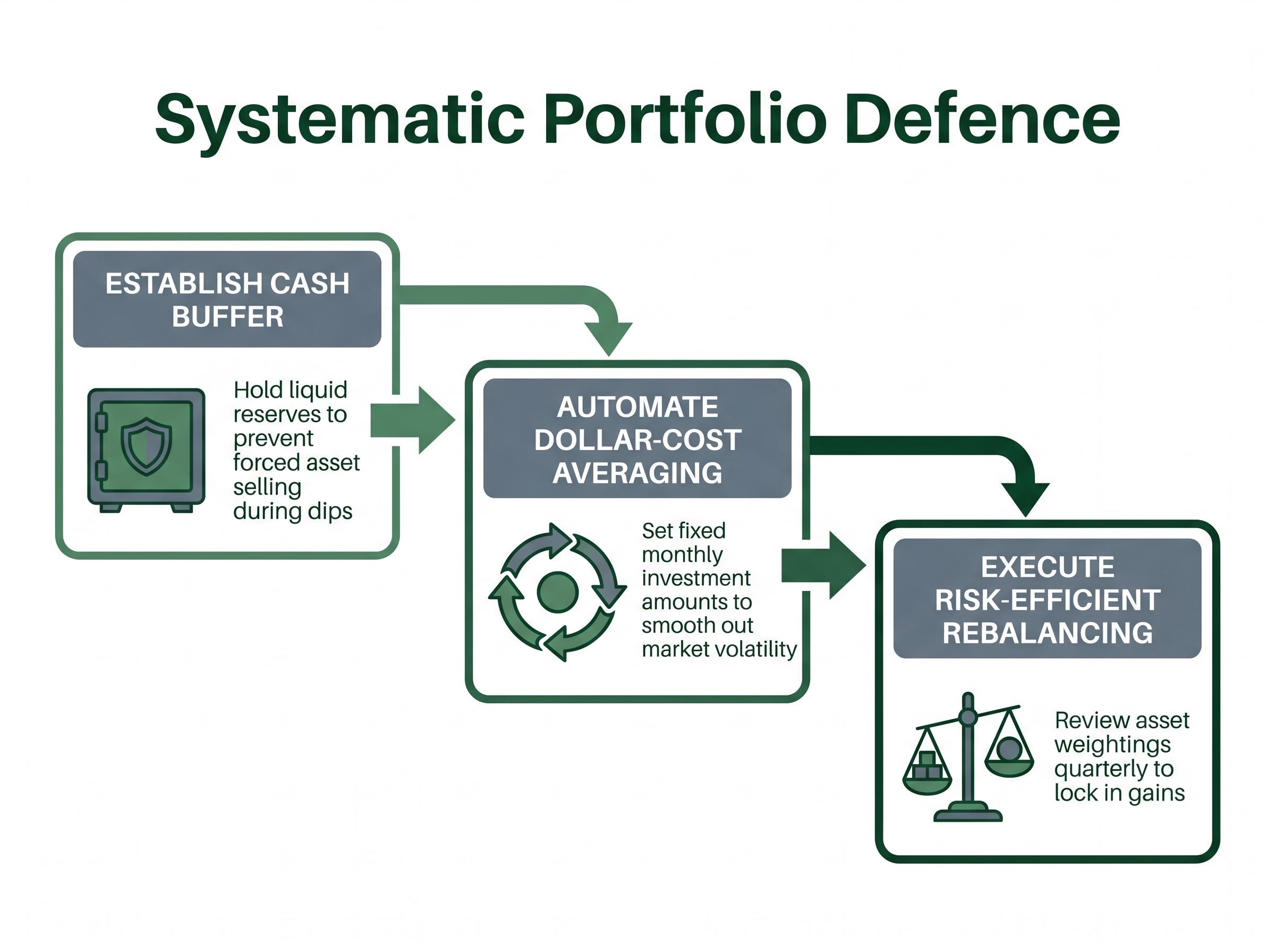
This structural discipline is the primary defence against the behavioral mistakes that destroy capital during inflationary periods. Investors who automate their processes are mathematically more likely to capture the upside when supply bottlenecks eventually clear. Keeping cash reserves specifically prevents the disastrous outcome of selling high-quality equities at the bottom of a panic cycle.
Positioning for the Inevitable Market Normalisation
Successfully navigating the 2026 economic environment means balancing high-quality equities with adequate liquid reserves. The current macroeconomic pressures are severe, but global supply bottlenecks will eventually resolve as global trade routes adjust. Forward pricing in commodity markets is already signalling this impending shift for those who know where to look.
A backwardation in oil markets serves as a positive leading indicator that supply constraints are expected to ease. When near-term oil contracts price higher than longer-dated ones, it means commercial buyers anticipate the current $120 per barrel spike is strictly temporary. This structural pricing curve suggests that the intense inflationary pressure driving the RBA’s current stance will eventually subside.
Until that broader market normalisation occurs, long-term discipline must override short-term reaction. Investors who maintain their dollar-cost averaging schedules and avoid panic selling will be best positioned for the eventual recovery.
For readers wanting to contextualise the current petroleum spike, our deep-dive into historical energy shocks analyses previous periods of record fuel prices to map out the typical six-month portfolio drawdown and subsequent recovery timelines.
This article is for informational purposes only and should not be considered financial advice. Investors should conduct their own research and consult with financial professionals before making investment decisions. Past performance does not guarantee future results. Financial projections are subject to market conditions and various risk factors.