Record Highs Are Not the Risk Most Investors Think They Are
9 hrs ago


Microsoft has never offered a voluntary retirement programme in 51 years of operation. On 23 April 2026, that changed. Chief People Officer Amy Coleman sent an internal memo announcing a one-time, U.S.-only voluntary retirement offering targeting approximately 8,750 employees, the first such programme in the company’s history and a clear signal that the AI era is reshaping how Microsoft manages its workforce.
The announcement arrives as the company spends tens of billions of dollars per quarter building AI infrastructure while managing the cost pressures that come with that scale of investment. The voluntary approach marks a deliberate departure from the mass layoffs that defined 2025, when Microsoft shed more than 21,000 positions. What follows covers who is eligible, what the programme signals about the company’s AI-era workforce strategy, how it connects to the broader financial and competitive position, and what analysts say it means for employees, investors, and the wider technology sector.
No major technology company has used this instrument at this scale. Microsoft’s voluntary retirement programme, announced via an internal memo from Executive Vice President and Chief People Officer Amy Coleman on 23 April 2026, is the first in the company’s 51-year history.
Microsoft has never offered a voluntary retirement programme in its 51 years of operation. The April 2026 announcement marks a first for the company and an anomaly in the broader technology sector.
The programme is a one-time, U.S.-only offering. It is not a layoff. It is not a performance-based exit. Approximately 8,750 employees, roughly 7% of Microsoft’s approximately 122,000 U.S. full-time workforce, meet the eligibility threshold. The targeting is precise: long-tenured or older employees below the senior director level, offered an incentive to leave on their own terms rather than face the kind of involuntary reductions that characterised the previous year.
The programme’s eligibility conditions are narrow by design. To qualify, an employee must meet all four of the following requirements:
The “rule of 70” is the most distinctive condition. It means a 50-year-old employee with 20 years of service qualifies, as does a 55-year-old with 15 years. The threshold targets a specific demographic: employees who are either approaching traditional retirement age or who have spent the bulk of their careers at Microsoft.
Eligible employees will be formally notified on 7 May 2026. From that date, they will have a 30-day decision window, placing the deadline at approximately 6 June 2026. The programme takes effect in Microsoft’s fiscal fourth quarter.
Full package details, including payout amounts and healthcare benefits, have not been publicly disclosed as of 27 April 2026. Those specifics will be revealed to eligible employees on the 7 May notification date. No verified leaks of package financials have surfaced.
The voluntary retirement programme did not emerge in isolation. It sits at the intersection of two financial realities: an AI capital expenditure commitment of historic proportions and a cost structure that needs to accommodate it.
Microsoft spent approximately $37.5 billion in capital expenditures during Q2 FY2026 alone. Q3 FY2026 actuals remain unreported; the earnings call with CFO Amy Hood is scheduled for 29 April 2026. The scale of AI infrastructure spending creates direct pressure on operating costs, and long-tenured employees at senior levels carry some of the highest salary loads in the organisation.
The scale of spending here sits within a broader industry dynamic: AI capital expenditure commitments and their uncertain returns have drawn scrutiny from institutional investors, with consensus hyperscaler capex for 2026 now reaching $527 billion and no major provider yet announcing a path to proportionate revenue growth.
Analysts have characterised the buyout as a mechanism to shed higher-cost, long-tenured salaries while avoiding the reputational and cultural damage of another large-scale layoff round.
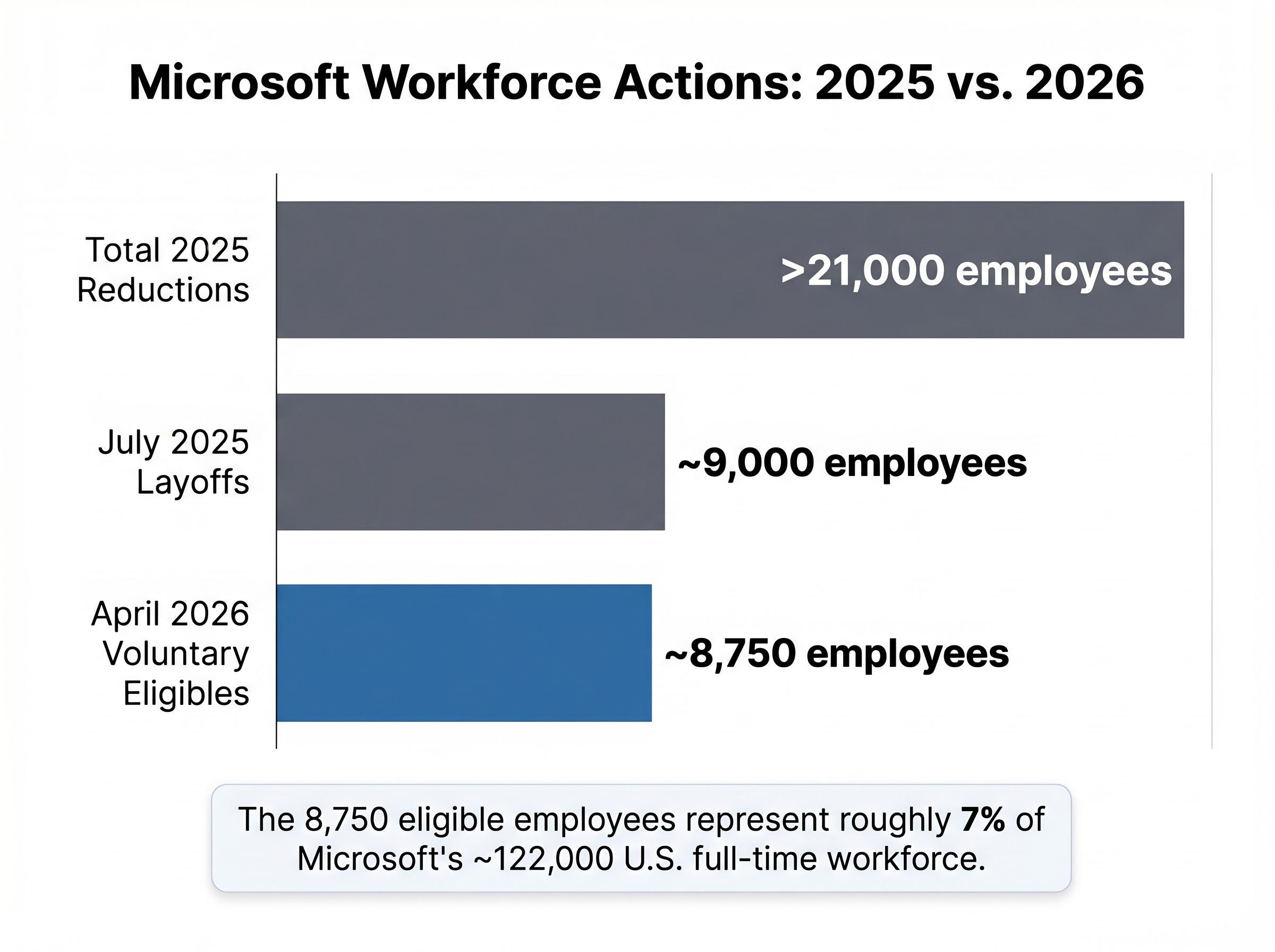
The pattern of workforce reduction is visible in the data.
| Workforce Action | Approximate Scale |
|---|---|
| July 2025 layoffs | ~9,000 employees |
| Total 2025 reductions | More than 21,000 employees |
| April 2026 voluntary retirement eligibles | ~8,750 employees |
For investors monitoring Microsoft’s long-term cost structure, understanding the relationship between AI capex commitments and workforce cost management is central to evaluating the company’s margin trajectory heading into FY2027.
Wall Street’s response has been mixed in degree, not in direction. All three major analyst actions tracked in the wake of the announcement maintained positive ratings, but the spread in price targets reflects genuine uncertainty about Microsoft’s near-term AI monetisation timeline.
| Analyst Firm | Rating | Price Target |
|---|---|---|
| Oppenheimer | Outperform | $515 (down from $630) |
| TD Cowen | Buy | $540 |
| Guggenheim | Buy | $586 |
Oppenheimer’s revised target, down nearly 18% from $630 to $515, cited concerns about AI disruption to Microsoft 365, competitive pressure, and capex growth. The firm retained its Outperform rating nonetheless. TD Cowen and Guggenheim maintained Buy ratings with higher targets, suggesting confidence in the longer-term AI monetisation thesis. Microsoft shares had declined approximately 12% year to date prior to the announcement.
Oppenheimer’s concern about AI disruption to Microsoft 365 is part of a broader investor debate about AI disruption risk to Microsoft 365 subscription revenue, with the per-seat pricing model that underpins Microsoft 365 facing structural pressure as agentic AI tools can orchestrate enterprise workflows without requiring individual seat licences.
Mark Harmsworth, a former Microsoft employee and analyst with the Washington Policy Center, observed that the offer could prove “quite enticing” for employees within three to four years of retirement, given the opportunity to optimise around Washington State’s planned income tax implementation in 2029.
The channel partner ecosystem adds another dimension. Microsoft’s roughly 500,000-member partner network of managed service providers and solution providers faces both pressure and opportunity as the company accelerates toward an AI-first operating model. Service and support gaps left by departing employees could create new revenue channels for partners willing to fill them.
The 29 April earnings call stands as the next major data point for investors attempting to reconcile the divergent analyst views.
A voluntary retirement programme is a company-initiated offer that provides financial incentives for eligible employees to leave the organisation on their own terms. It differs from a layoff (involuntary and immediate) and from a performance improvement plan (targeted at underperformance). The employee chooses whether to accept.
Joe Phillips, an economics commentator, noted: “It’s very interesting because you usually don’t expect technology companies to be using early retirement plans.”
The technology sector has historically relied on a different toolkit for workforce management:
The distinction matters for investors. Voluntary programmes carry a specific risk that layoffs do not: companies cannot control participation rates. If too few employees accept, the cost savings fall short of projections. If too many accept from the same team or function, operational gaps emerge. This uncertainty makes cost-reduction modelling harder than a targeted layoff, where the company controls the headcount reduction precisely.
Microsoft’s decision to accept that uncertainty rather than conduct another round of involuntary cuts suggests the reputational and cultural cost of further layoffs was judged to outweigh the planning risk.
The voluntary retirement programme is one piece of a larger restructuring pattern that has unfolded over the past six months. Viewed in sequence, the individual decisions form a coherent strategic direction:
The pay restructuring deserves particular attention. By decoupling stock awards from bonuses, Microsoft has given managers the ability to reward long-term contributors with equity independently of their most recent performance rating. This is a retention tool for employees the company wants to keep, running in parallel with the retirement programme designed for those it is willing to let go.
Together, these moves paint a picture of a company in deliberate organisational transformation: leadership realigned toward AI infrastructure, physical presence re-established, compensation rebuilt for flexibility, and a pathway created for senior, higher-cost employees to exit voluntarily.
The organisational logic behind targeting long-tenured employees rather than early-career staff becomes clearer in the context of agentic AI compressing junior developer demand across technology organisations, with agentic AI projected to be embedded in 40% of enterprise applications by 2026 and reducing junior developer demand by an estimated 40%, shifting the talent premium toward senior architects and infrastructure engineers rather than execution-level roles.
Microsoft’s voluntary retirement programme is a historically significant move that sits at the intersection of aggressive AI investment, deliberate cost management, and a broader cultural reset of one of the world’s most valuable technology companies. The combination of a first-in-51-years precedent, approximately 8,750 eligible employees, and structural changes to compensation and leadership makes this more than a human resources announcement.
The 29 April 2026 earnings call with CFO Amy Hood will provide the next opportunity for clarity on how the programme fits into Microsoft’s formal financial guidance, while 7 May will reveal the package details that determine whether eligible employees actually accept the offer.
This article is for informational purposes only and should not be considered financial advice. Investors should conduct their own research and consult with financial professionals before making investment decisions. Forward-looking statements regarding Microsoft’s financial guidance, employee participation rates, and programme outcomes are subject to change based on market developments and company performance.
Investors tracking Microsoft’s AI transformation and workforce strategy should monitor the Q3 FY2026 earnings call closely, alongside employee uptake signals after the 7 May notification date.
Microsoft's voluntary retirement programme is a one-time, U.S.-only offer announced on 23 April 2026, providing financial incentives for eligible employees to leave the company on their own terms. It is the first such programme in Microsoft's 51-year history and targets approximately 8,750 employees, roughly 7% of its U.S. full-time workforce.
To qualify, employees must be U.S.-based, at level 67 (senior director equivalent) or below, excluded from sales incentive plans, and meet the 'rule of 70', meaning their age plus years of service must total at least 70.
The programme reflects pressure to manage workforce costs while sustaining massive AI infrastructure investment, with Microsoft spending approximately $37.5 billion in capital expenditures in Q2 FY2026 alone. It also signals a strategic shift away from the involuntary mass layoffs that saw more than 21,000 positions cut in 2025.
Eligible employees will have a 30-day decision window from 7 May 2026, placing the acceptance deadline at approximately 6 June 2026, and full package details including payout amounts and healthcare benefits will be disclosed at that time.
All three major analyst actions maintained positive ratings: Oppenheimer kept an Outperform rating with a revised target of $515 (down from $630), while TD Cowen and Guggenheim both maintained Buy ratings with targets of $540 and $586 respectively.