Record Highs Are Not the Risk Most Investors Think They Are
9 hrs ago


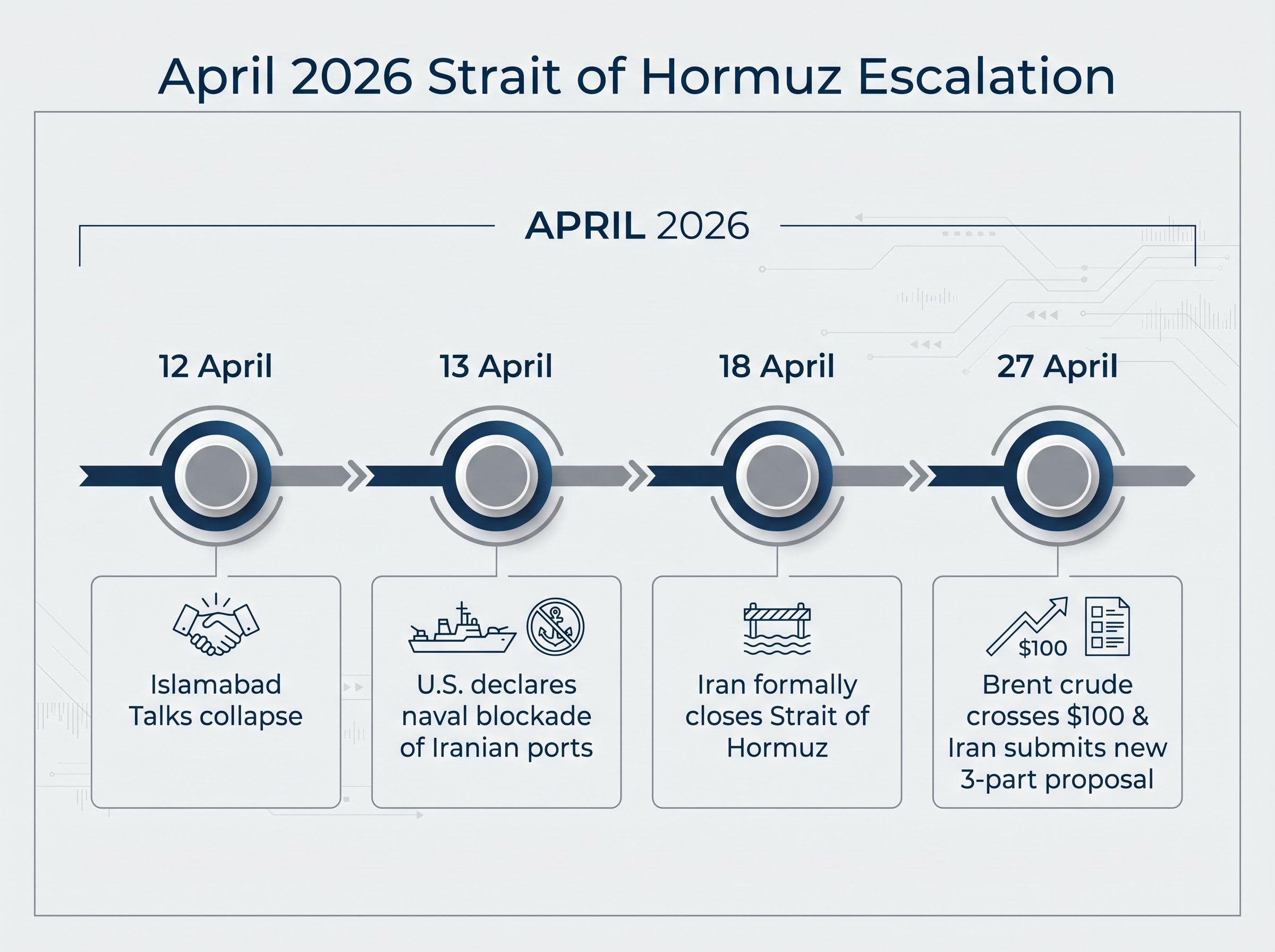
Brent crude crossed $100 per barrel on 27 April 2026, as diplomatic talks between Washington and Tehran collapsed and a dual-layer blockade sealed the Strait of Hormuz for the ninth consecutive day. The failure of the Islamabad Talks on 12 April triggered a U.S. naval blockade of Iranian ports, which in turn prompted Iran’s formal closure of the Strait on 18 April. Two enforcement regimes now operate simultaneously, cutting normal Strait traffic to 2-3 transits per day and stranding more than 700 vessels in the Gulf.
On 27 April, Iran submitted a new proposal to reopen the waterway while deferring nuclear negotiations, but the White House has yet to respond. What follows is a full account of the diplomatic breakdown, the mechanics of the dual blockade, the consequences for oil and shipping markets, and the competing international positions on resolution.
The escalation from diplomatic failure to dual blockade took six days. The sequence matters, because each step was a direct response to the one before it:
U.S. Defense Secretary Pete Hegseth confirmed that at least 34 vessels have been turned around since the U.S. blockade began. Trump’s position remains unchanged.
The blockade continues until a “complete deal” is struck, with no firm deadline given for responding to Iran’s proposal.
Iran’s 27 April offer sits unanswered. Its three components, reopening the Strait, ending hostilities, and deferring the nuclear question, represent a sequencing gambit: resolve the immediate crisis now, negotiate the harder issues later. Whether Washington views this as a genuine off-ramp or a tactical delay will determine the near-term trajectory of the standoff.
Investors tracking resolution probabilities should weight intra-Iranian factional alignment and multilateral diplomatic signals alongside any formal White House response, as the dual-blockade structure has now survived four successive diplomatic attempts including a China-brokered ceasefire in early April and Iran’s latest proposal through Pakistani mediators.
The Strait of Hormuz is a narrow waterway between Iran and Oman, and it is the only maritime exit for oil and liquefied natural gas (LNG) produced by Gulf states including Saudi Arabia, Iraq, Kuwait, Qatar, and the United Arab Emirates. There is no equivalent alternative route capable of handling these volumes at scale.
Approximately 20% of global oil supply transits the Strait. Before the crisis, that figure represented roughly 25% of all seaborne oil. Approximately 20% of global LNG supply passes through the same corridor. When the Strait closes, there is no pipeline network or alternative shipping lane that can absorb the shortfall.
The EIA data on Strait of Hormuz oil transit volumes places the waterway’s throughput at approximately 20 million barrels per day, representing around 20% of global petroleum liquids consumption and roughly one-fifth of all LNG traded internationally, figures that explain why no pipeline network or alternative shipping lane can absorb the shortfall created by its closure.
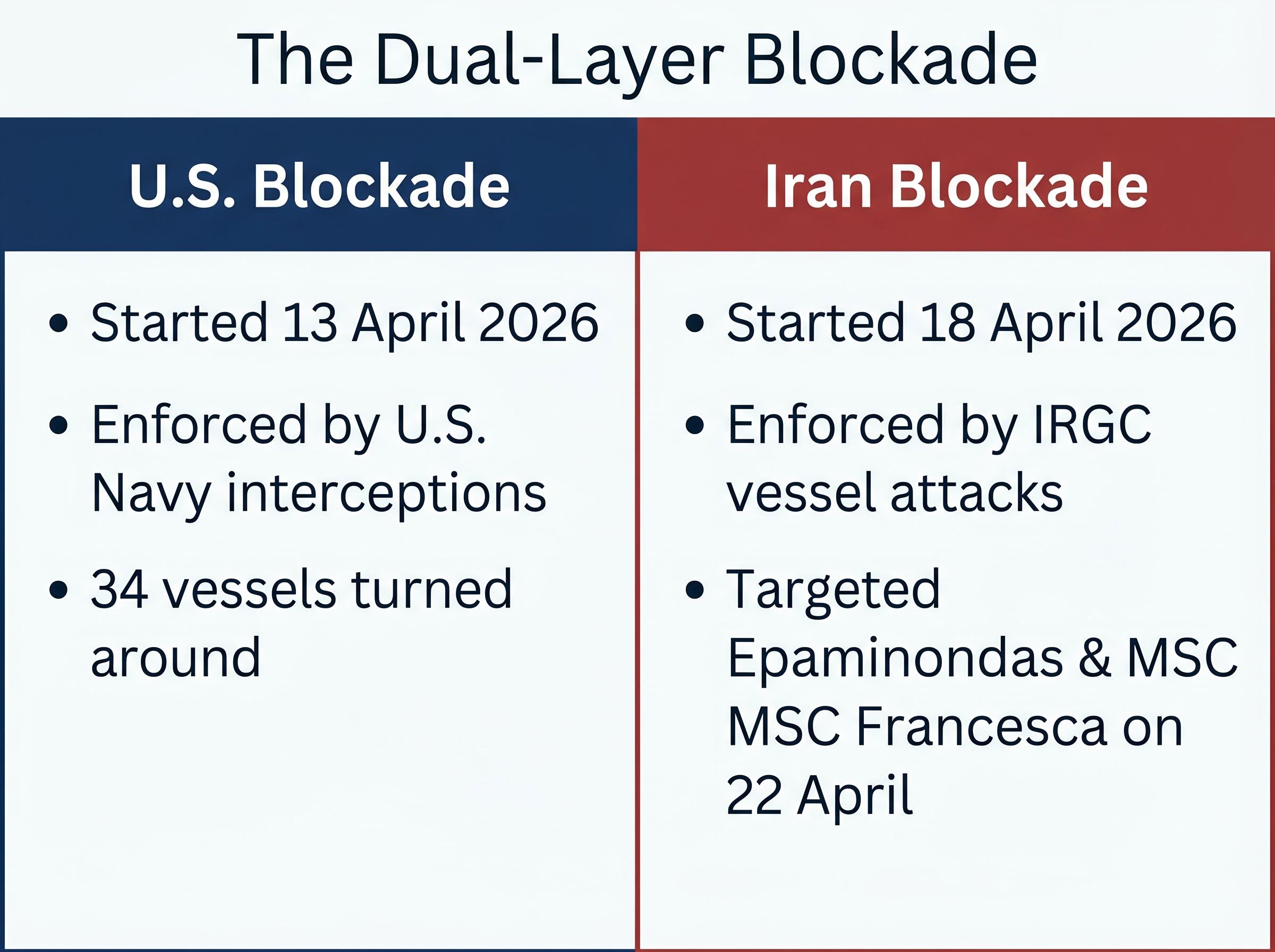
Two separate blockades are now operating simultaneously, and the distinction is important:
| Blockade | Enforcing Party | Start Date | Enforcement Mechanism |
|---|---|---|---|
| Strait of Hormuz closure | Iran | 18 April 2026 | IRGC vessel attacks on non-compliant shipping |
| Iranian port blockade | United States | 13 April 2026 | U.S. Navy vessel interceptions |
Iran’s enforcement has been lethal. On 22 April, the Islamic Revolutionary Guard Corps (IRGC) attacked two merchant vessels:
These incidents demonstrate that Iran is not merely declaring the Strait closed; it is enforcing that closure with direct military action against commercial shipping.
The price data as of 27 April 2026 captures the severity of the disruption:
Brent above $100 is not a sentiment-driven spike. It reflects a physical supply gap that OPEC+ has been unable to close.
The Brent-WTI spread widening to over $9 per barrel on April 24 illustrates how traders are using the Brent-WTI spread as a real-time escalation gauge, with the divergence signalling that geopolitical risk is concentrated at the Middle Eastern chokepoint rather than in North American supply, and that cross-asset transmission into currencies and equity volatility is already underway.
OPEC+ agreed on 5 April to boost output by 206,000 barrels per day. Gulf production fell approximately 27% in March 2026. The gap between the announced response and the actual disruption remains vast.
The 206,000 bpd increase amounts to a fraction of the volume lost to the blockade. Calls for further coordinated action continue within the bloc, but the constraint is geographic: as long as the Strait remains closed, additional output commitments from Gulf producers cannot reach global markets. The chokepoint, not the production decision, is the binding constraint.
Past performance does not guarantee future results. Oil prices remain subject to rapid change based on diplomatic developments and military escalation.
The operational scale of the disruption is visible in the vessel data:
| Metric | Current Figure |
|---|---|
| Vessels stranded in Gulf | 700-plus |
| Daily Strait transits | 2-3 |
| Crude tankers rerouted to U.S. Gulf | 171-plus |
| War risk premium (current) | Approximately 1% of vessel value |
| War risk premium (peak) | 2.5-3% of vessel value |
The rerouting of 171-plus crude tankers to U.S. Gulf ports means longer transit times, higher fuel costs, and growing capacity constraints at receiving terminals. These are not temporary inconveniences; they represent a structural reallocation of global tanker capacity that will take weeks to unwind even after the Strait reopens.
War risk premiums have declined from their peak of 2.5-3% of vessel value to approximately 1%, a directional easing that suggests insurance markets view the probability of further military escalation as having stabilised rather than increased. However, 35-50% no-claim bonuses remain in place, indicating underwriters have not normalised the risk environment.
Lloyd’s List analysis of Gulf war risk premium ranges published in March 2026 documented rates of 2.5% to 5% of hull value for high-risk vessel profiles transiting the Strait, with lower-risk standard tankers securing coverage closer to 0.8% to 1%, a spread that reflects underwriters pricing individual vessel exposure rather than applying a single market-wide rate.
Precise figures from Lloyd’s of London for Hormuz-specific transits remain unverified as of 27 April 2026; Lloyd’s List is the recommended source for exact premium data.
The international response reveals why a quick resolution is structurally unlikely. Three actors hold substantively different objectives:
The military dimension continues to escalate alongside the diplomatic effort. Admiral Brad Cooper of U.S. CENTCOM commented on the assassination of Iran’s naval commander Alireza Tangsiri:
Admiral Cooper stated the killing “makes the region safer,” a framing that underscores the distance between U.S. and Iranian interpretations of the crisis.
The divergence between these positions, U.S. maximum pressure, Chinese bilateral access, Gulf bypass investment, and European multilateralism, means any resolution must navigate four competing frameworks simultaneously.
As of 27 April 2026, the Strait of Hormuz remains closed under dual-layer enforcement, Brent crude sits above $100, and Iran’s proposal to reopen the waterway awaits a White House response. The near-term trajectory depends on whether Washington engages with the 27 April offer, whether OPEC+ output increases can meaningfully offset Gulf supply losses, and whether the Gulf states’ UN resolution bid gains traction at the Security Council. No resolution appears imminent across any of these fronts.
This article is for informational purposes only and should not be considered financial advice. Investors should conduct their own research and consult with financial professionals before making investment decisions.
The Strait of Hormuz blockade refers to the simultaneous closure of the waterway by Iran (from 18 April 2026) and a U.S. naval blockade of Iranian ports (from 13 April 2026), cutting the corridor that carries approximately 20% of global oil supply and 20% of global LNG to near-zero traffic.
The closure followed a chain of escalations: the Islamabad Talks collapsed on 12 April 2026, the U.S. declared a naval blockade of Iranian ports on 13 April, and Iran formally closed the Strait on 18 April in direct retaliation.
Brent crude reached $100.62 per barrel on 27 April 2026, a rise driven by a physical supply gap that OPEC+'s announced output increase of 206,000 barrels per day has been unable to close because Gulf producers cannot export through the sealed Strait.
Investors should track the White House response to Iran's 27 April proposal, the Brent-WTI spread as a real-time escalation gauge, war risk insurance premium movements, and progress on the Gulf states' UN Security Council resolution for a protected shipping corridor.
More than 700 vessels are stranded in the Gulf, daily Strait transits have fallen to just 2-3, and over 171 crude tankers have been rerouted to U.S. Gulf ports, creating structural capacity pressures that analysts expect will take weeks to unwind even after the Strait reopens.