Washington Charges 38 Entities in $10M AI Crypto Fraud Sweep
7 hrs ago


X-energy priced its initial public offering at $23 per share on 23 April 2026, raising approximately $1.02 billion in gross proceeds before fees and expenses. The Maryland-based small modular reactor developer sold 44.3 million Class A common shares in what ranks among the largest public listings in the nuclear energy sector’s history. Underwriters hold a 30-day option to purchase up to 6.6 million additional shares, which could push the total offering above $1.17 billion if exercised in full. Trading on the Nasdaq Global Select Market under ticker XE commenced 24 April, with the deal expected to close 27 April pending customary conditions.
The scale of the raise reflects institutional confidence in advanced nuclear technology at a moment when data centre energy demand and industrial decarbonisation goals are converging. X-energy develops both reactor designs and the fuel technologies required to power them, positioning the company to capture value across the SMR supply chain. For investors tracking the energy transition, this listing provides a rare public market entry point into a sector historically dominated by government contracts and private capital.
X-energy sold 44.3 million Class A common shares at $23 each, generating approximately $1.02 billion in gross proceeds. That figure represents the capital raised before deducting underwriting discounts and offering expenses, which will reduce the net proceeds available for operations and development.
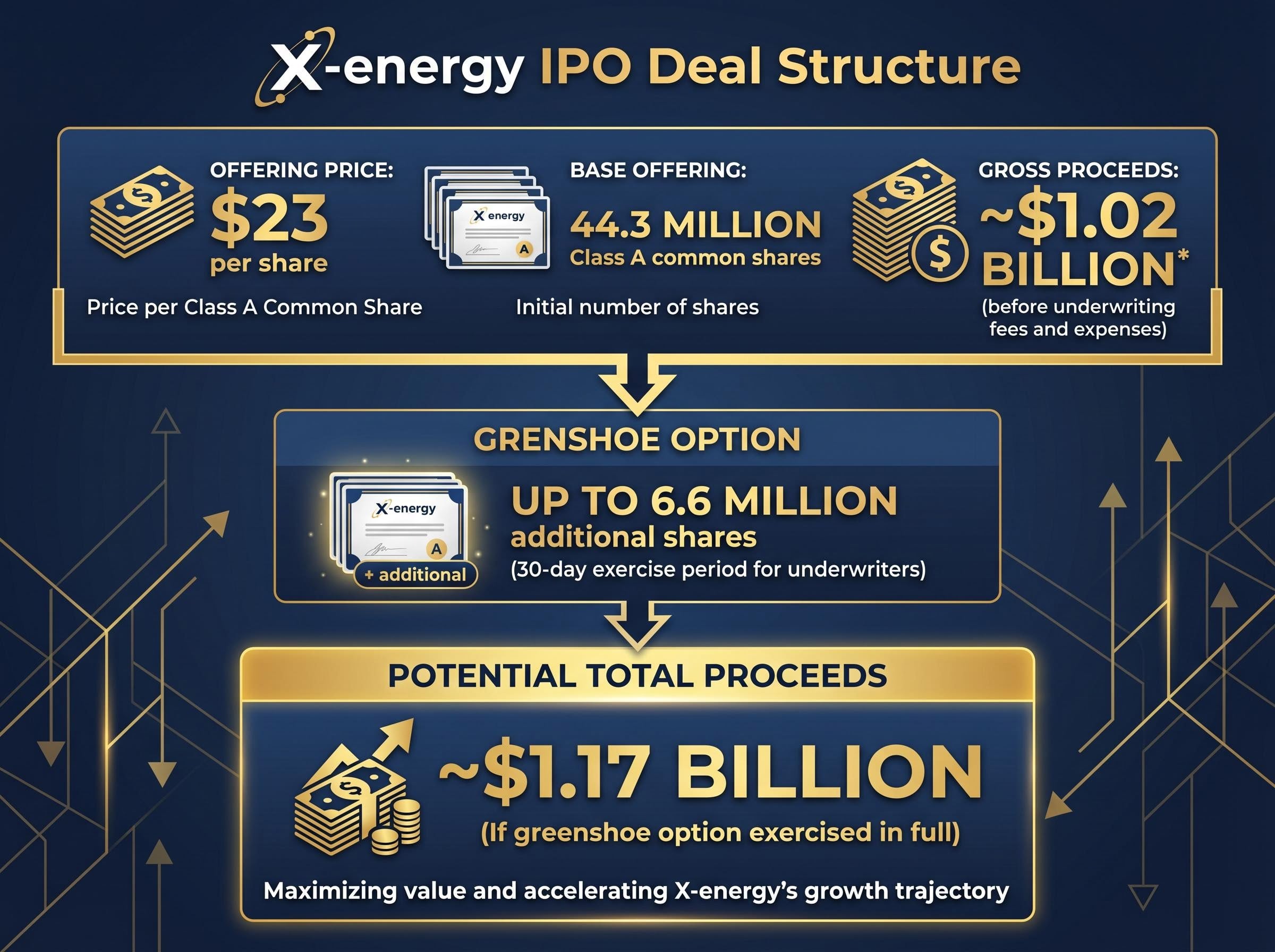
The underwriting syndicate holds a 30-day greenshoe option to purchase up to 6.6 million supplementary shares at the offering price. Full exercise of this over-allotment option would lift total gross proceeds to approximately $1.17 billion, providing additional runway for the company’s reactor development programmes and fuel fabrication plans.
Core Deal Metrics:
Gross Proceeds: X-energy raised approximately $1.02 billion before underwriting fees and offering expenses, positioning the transaction as one of the largest capital raises in the nuclear energy sector.
The pricing lands X-energy’s valuation at a point where institutional buyers judged the risk-reward profile acceptable for a pre-revenue nuclear technology company. The successful completion of the offering signals that public market appetite for advanced nuclear plays extends beyond established utilities into the riskier terrain of reactor development.
Small modular reactors differ from conventional nuclear plants in three ways that matter to investors evaluating the technology thesis.
1. Factory fabrication. SMRs are manufactured in standardised modules at centralised facilities, then transported to site for assembly. This contrasts with traditional nuclear plants, which are constructed on-site with bespoke engineering for each project. Factory production aims to reduce construction timelines and capital cost overruns.
2. Scalability. The modular design allows operators to deploy reactors incrementally, matching capacity additions to demand growth rather than committing to decade-long construction of gigawatt-scale plants. This lowers the upfront capital barrier for utilities and industrial buyers.
3. Safety systems. SMR designs incorporate passive safety features that rely on natural physical processes rather than active mechanical systems or human intervention during emergencies. X-energy characterises its reactors as safer and more efficient than legacy designs, a claim that will face scrutiny as the technology moves through regulatory review and operational deployment.
The investment case rests on SMRs solving a specific problem: delivering clean baseload power at a scale and cost structure that fits industrial decarbonisation timelines. Data centres, chemical plants, and heavy manufacturing facilities require reliable electricity in volumes that solar and wind cannot provide without prohibitive battery storage costs. If SMRs can deliver on their cost and timeline projections, they position themselves as the only dispatchable zero-carbon alternative to natural gas for this segment.
The SMR thesis gains commercial traction from data centre operators committing to multi-gigawatt capacity expansions, with NEXTDC adding 250MW of contracted capacity at its S4 facility in April 2026 and raising FY27 capex guidance to approximately A$5.0 billion to support accelerated deployment.
The IEA’s projection of data centre electricity consumption doubling by 2030, with AI-focused facilities seeing a threefold increase, quantifies the demand drivers underpinning the investment thesis for baseload nuclear capacity. This growth trajectory creates a structural power deficit that intermittent renewables cannot address without prohibitive storage costs, positioning SMR developers to capture demand from industrial buyers facing reliability constraints.
X-energy, headquartered in Rockville, Maryland, develops both the reactor technology and the high-assay low-enriched uranium fuel required to power its designs. This vertical integration differentiates the company from reactor developers reliant on external fuel supply chains, but it also concentrates execution risk across two complex technology streams.
The PLEF project in Kentucky demonstrates how SMR fuel supply chains are attracting multi-layered government and private funding, with high-assay low-enriched uranium fuel production facilities securing performance-based state incentives alongside federal DOE contracts to support next-generation reactor deployment timelines.
The U.S. Securities and Exchange Commission declared X-energy’s registration statement effective on 23 April 2026. Shares began trading on the Nasdaq Global Select Market under ticker XE on 24 April, with the offering expected to close three days later on 27 April, subject to satisfaction of customary closing conditions.
| Date | Event |
|---|---|
| 23 April 2026 | SEC declares registration statement effective |
| 24 April 2026 | Trading commences on Nasdaq Global Select Market (Ticker: XE) |
| 27 April 2026 | Expected closing date (subject to customary conditions) |
The three-day window between first trade and deal closing is standard for U.S. IPOs. During this period, underwriters settle allocations, the company satisfies final regulatory and legal requirements, and the gross proceeds transfer from the underwriting syndicate to the issuer. Until closing occurs, the transaction remains subject to standard conditions, including the absence of material adverse changes and the delivery of required legal opinions.
Investors participating in the offering receive their shares upon closing. Those purchasing shares in the secondary market beginning 24 April are trading based on the expectation that closing will occur as scheduled, though the 27 April date carries the conditional language typical of IPO timelines.
Four banks served as lead joint book-running managers for the offering: J.P. Morgan, Morgan Stanley, Jefferies, and Moelis & Company. The book-runner role places these firms at the centre of the IPO process, responsible for building the order book, advising on pricing, allocating shares to institutional investors, and stabilising the stock in early trading if needed.
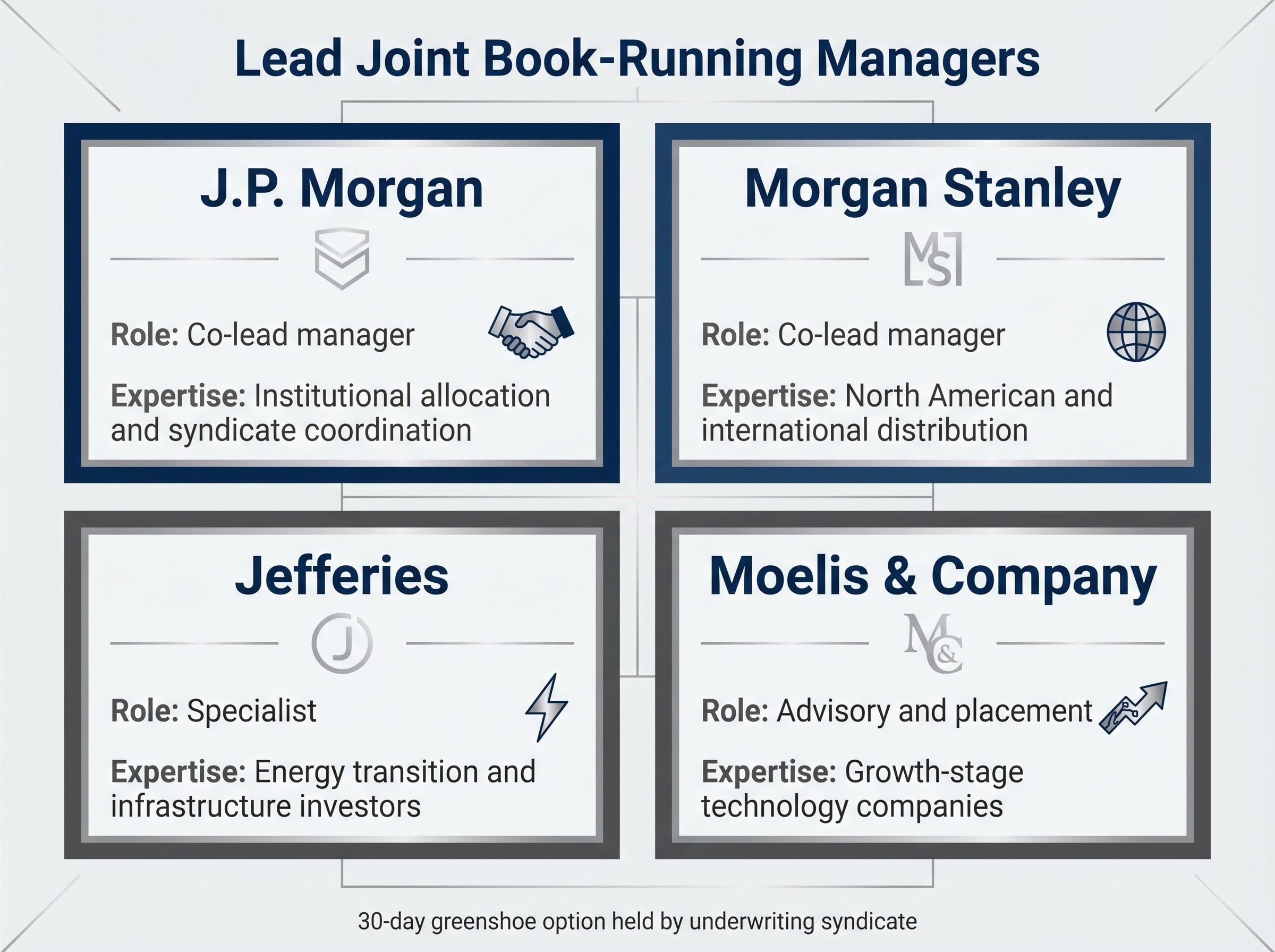
The composition of the syndicate signals that X-energy’s deal met the due diligence thresholds of banks operating at the top tier of equity capital markets. J.P. Morgan and Morgan Stanley anchor the group, bringing global distribution networks and relationships with the largest institutional buyers. Jefferies and Moelis contribute sector-specific expertise and access to specialised investor bases focused on energy transition plays.
Lead Joint Book-Running Managers:
The underwriters also hold the 30-day greenshoe option, giving them the right to purchase up to 6.6 million additional shares at the $23 offering price. This over-allotment option serves two purposes: it allows the syndicate to cover short positions created during the stabilisation period, and it provides the company with the ability to raise additional capital if demand justifies expanding the offering size.
The involvement of this syndicate does not guarantee successful post-IPO performance, but it does confirm that the deal structure, valuation, and company fundamentals passed institutional-grade scrutiny. For retail investors evaluating credibility, the underwriting lineup is a material data point.
X-energy’s IPO ranks among the largest public listings in the nuclear energy industry, a sector where capital formation has historically occurred through government contracts, utility rate base financing, and private equity rather than public equity markets. The successful pricing and execution of a $1 billion-plus raise for a pre-revenue reactor developer marks a shift in how institutional capital is accessing advanced nuclear technology.
Market Positioning: This transaction represents one of the largest nuclear energy IPOs, reflecting institutional appetite for companies positioned at the intersection of decarbonisation policy and baseload power demand.
If X-energy’s stock trades well in the months following the listing, it establishes a template for other SMR developers considering public market fundraising. A handful of advanced nuclear companies remain private, and their investors will be watching this debut closely. Strong performance would validate the thesis that public markets can provide the multi-year capital runway required for reactor commercialisation. Weak performance would reinforce the view that nuclear technology development belongs in the private markets until revenue materialises.
The risks remain substantial. X-energy is deploying capital toward reactor designs that have not yet achieved commercial operation at scale. Regulatory approvals, construction timelines, and cost overruns represent execution risks that pre-revenue nuclear companies face regardless of how much capital they raise. The company’s fuel technology programme adds a second layer of technical and commercial risk.
For investors tracking energy transition capital flows, this listing confirms that nuclear energy is no longer confined to the edges of institutional portfolios. The combination of policy tailwinds, data centre electricity demand, and industrial decarbonisation mandates has moved advanced nuclear from niche to mainstream investment consideration. Whether that translates into successful deployment and shareholder returns remains the question this IPO will answer over the next several years.
Utilities and data centre operators are locking in power equipment capacity years ahead of delivery, with GE Vernova reporting a $13 billion backlog expansion in Q1 2026 alone, signalling that AI infrastructure power demand has moved from forecast to contracted commitment.
X-energy raised approximately $1.02 billion in gross proceeds through its $23 per share IPO, with shares commencing trading on Nasdaq under ticker XE on 24 April 2026. The offering ranks among the largest public listings in the nuclear energy sector and provides the Maryland-based SMR developer with capital to advance both its reactor technology and fuel fabrication programmes. The involvement of J.P. Morgan, Morgan Stanley, Jefferies, and Moelis as lead underwriters signals institutional confidence in the company’s positioning within the advanced nuclear landscape.
The deal closes 27 April, at which point the company will begin deploying the capital raised. Investors should monitor the stock’s initial trading performance and forthcoming disclosures on capital allocation priorities. The success or failure of this listing will shape how public markets evaluate other pre-revenue nuclear technology companies considering similar fundraising paths.
This article is for informational purposes only and should not be considered financial advice. Investors should conduct their own research and consult with financial professionals before making investment decisions.
Investors requiring access to the complete registration statement and subsequent quarterly disclosures will find the SEC’s EDGAR database of public company filings and IPO registration statements provides the definitive source for X-energy’s Form S-1, notices of effectiveness, and ongoing reporting obligations that govern post-IPO disclosure requirements.
X-energy is a Maryland-based small modular reactor developer that raised approximately $1.02 billion through its IPO at $23 per share, listing on the Nasdaq Global Select Market under ticker XE on 24 April 2026. The company develops both reactor technology and the high-assay low-enriched uranium fuel required to power its designs.
X-energy raised approximately $1.02 billion in gross proceeds before underwriting fees and expenses by selling 44.3 million Class A common shares at $23 each. If underwriters exercise their full greenshoe option of up to 6.6 million additional shares, total gross proceeds could rise to approximately $1.17 billion.
J.P. Morgan, Morgan Stanley, Jefferies, and Moelis and Company served as lead joint book-running managers for the X-energy IPO, responsible for building the order book, advising on pricing, and allocating shares to institutional investors.
X-energy trades under the ticker symbol XE on the Nasdaq Global Select Market, with trading commencing on 24 April 2026 following the SEC declaring its registration statement effective on 23 April 2026.
Investors are drawn to SMR developers because rising data centre electricity demand and industrial decarbonisation targets are creating demand for reliable clean baseload power that intermittent renewables cannot efficiently supply. The IEA projects data centre electricity consumption will double by 2030, reinforcing the structural case for dispatchable zero-carbon power sources like SMRs.