
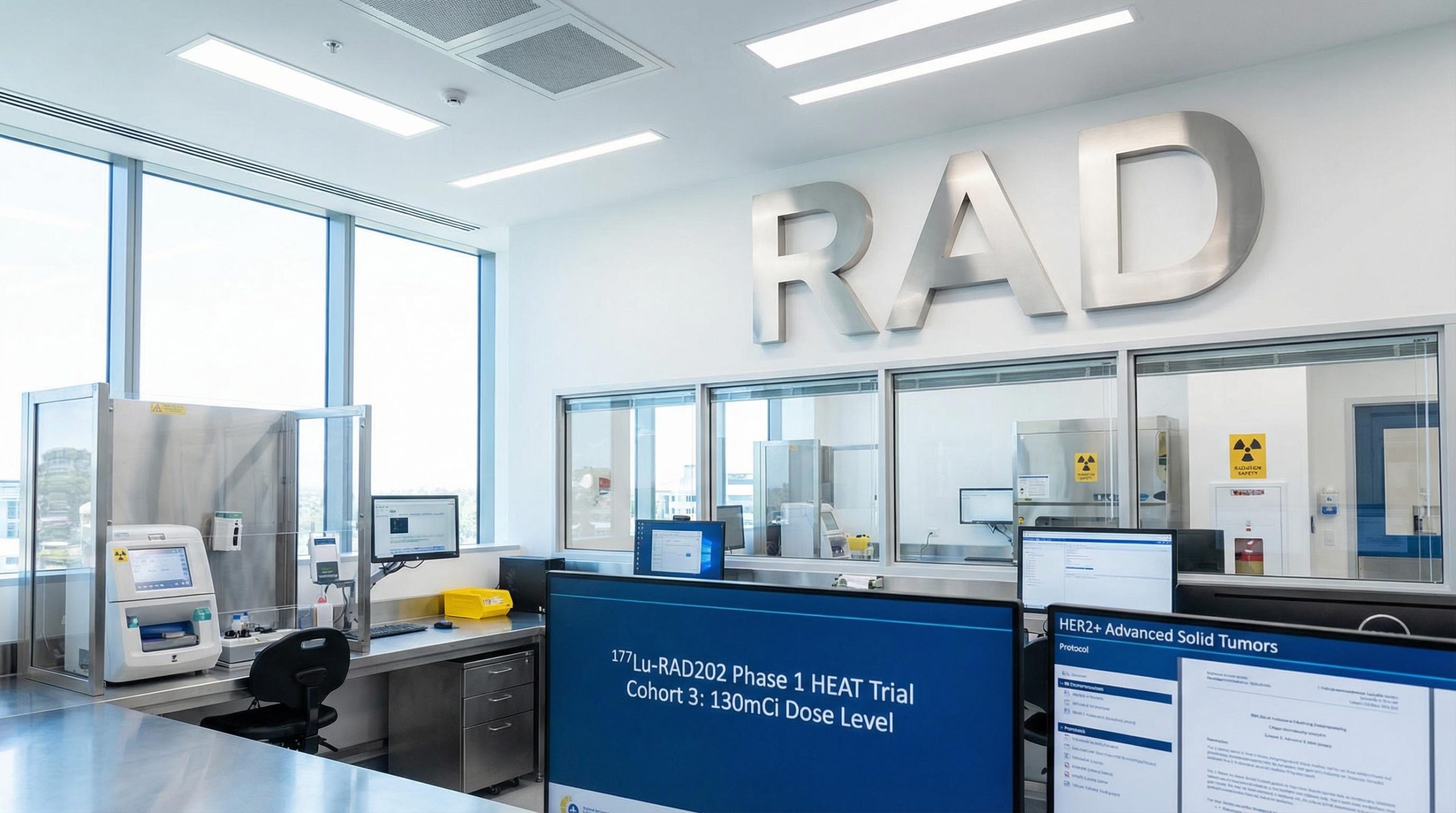
Radiopharm advances RAD202 to higher dose level in HER2 cancer trial
Radiopharm Theranostics (ASX: RAD, Nasdaq: RADX) has received a positive recommendation from its Data Safety and Monitoring Committee (DSMC) to advance its clinical-stage radiotherapeutic asset, 177Lu-RAD202, to the next dose level of 130mCi in the Phase 1 HEAT trial. The Radiopharm RAD202 HEAT Trial Progress marks a key de-risking milestone for the HER2-targeting therapy in patients with advanced solid tumours.
The DSMC’s recommendation follows completion of Cohort 2 at 75mCi, which was announced on 1 October 2025. The rapid progression to Cohort 3 suggests no major safety concerns have emerged during dose escalation, supporting the asset’s favourable tolerability profile to date. The Phase 1 study is being conducted at clinical centres across Australia.
For investors, swift dose escalation without DSMC-imposed delays indicates the therapy is progressing efficiently through early-stage clinical testing, reducing execution risk and maintaining credibility around stated development timelines.
When big ASX news breaks, our subscribers know first
What is a Data Safety Monitoring Committee and why does its recommendation matter?
A DSMC is an independent multidisciplinary committee responsible for reviewing ongoing study data, assessing potential safety events, and making recommendations on whether trials should continue, be modified, or be halted. Committee members typically include clinicians, statisticians, and bioethicists with no financial ties to the sponsor.
In dose escalation studies like HEAT, the DSMC evaluates safety data at each cohort before permitting progression to higher dose levels. A positive recommendation signals that the current dose has not produced unacceptable toxicity or adverse events that would warrant pausing or terminating the trial.
For clinical-stage biotechnology companies, DSMC approvals to escalate represent critical de-risking milestones. Each successful cohort completion narrows the range of uncertainty around optimal therapeutic dosing and confirms the asset can advance toward registrational studies. A DSMC-imposed hold, by contrast, can trigger material delays or programme restructuring.
CEO outlines path to completing dose escalation by end of 2026
Riccardo Canevari, CEO and Managing Director
“We are encouraged by the rapid progress of the Phase 1 ‘HEAT’ trial of RAD202, as it underscores the favourable safety profile, allowing us to accelerate the dose escalation from Cohort 2 to Cohort 3. Considering the current progress and the strong execution, we remain on track to complete the Phase 1 dose escalation by the end of 2026.”
Management has maintained its stated timeline for completing Phase 1 dose escalation by end of 2026. The acceleration from Cohort 2 to Cohort 3 supports this guidance, suggesting patient recruitment and data readout are proceeding without material delays.
Timely completion of dose finding would position RAD202 to enter expansion cohorts or potentially progress toward Phase 2 studies in 2027, depending on the optimal dose identified and efficacy signals observed during escalation.
RAD202 targets HER2-positive cancers with validated approach
RAD202 is a proprietary single-domain monoclonal antibody (sdAb) conjugated with Lutetium-177, designed to target Human Epidermal Growth Factor Receptor 2 (HER2)-positive expression in advanced solid tumours. HER2 overexpression occurs in breast cancer and several other solid tumours, representing a validated oncology target with existing approved therapies demonstrating commercial viability.
In a previous diagnostic study of 10 HER2-positive breast cancer patients, RAD202 demonstrated clinical proof-of-concept with positive safety and biodistribution results, de-risking the mechanism before entry into therapeutic testing.
RAD202 trial parameters:
- Target indication: HER2-positive advanced solid tumours
- Current dose level: 130mCi (Cohort 3)
- Previous dose level: 75mCi (Cohort 2, announced October 2025)
- Prior validation: 10 patients in diagnostic study confirmed proof-of-concept
HER2’s status as a well-characterised target with established clinical precedent reduces target validation risk compared to novel biomarkers. Existing HER2-targeted therapies have generated billions in revenue across multiple indications, demonstrating payer and prescriber acceptance of the target biology.
Radiopharm’s broader clinical pipeline
Radiopharm maintains a diversified clinical portfolio spanning multiple modalities and tumour types, providing investors with exposure to several independent value creation opportunities beyond RAD202.
- Phase 2 trial: One active programme
- Phase 1 trials: Five programmes including RAD202
- Tumour coverage: Lung, breast, prostate, brain
The company’s platform encompasses peptides, small molecules, and monoclonal antibodies, each with distinct targeting mechanisms and potential applications across solid tumour oncology. This breadth provides portfolio diversification within the clinical stage, reducing single-asset dependency.
For investors assessing clinical-stage biotechs, multiple shots on goal across different modalities and cancer types offers risk mitigation relative to single-asset development strategies, while maintaining upside optionality if any individual programme demonstrates compelling clinical activity.
Don’t Miss the Next Biotech Breakthrough
Join 20,000+ investors receiving FREE breaking ASX news in their inbox within minutes of release, complete with in-depth analysis. Big News Blast delivers biotech announcements the moment they hit the market. Click the “Free Alerts” button to stay ahead on emerging clinical-stage opportunities.